

Most people spend over two hours each day just organizing and tracking their tasks. Without a clear system, productivity suffers and stress builds up fast. Building better habits around managing your workload can help you regain control and stay focused on what matters most. This step-by-step guide shows you practical methods to streamline your task lists, prioritize effectively, and make real progress toward your goals.
Table of Contents
- Step 1: Set Up Your Task Management System
- Step 2: Prioritize and Categorize Your Tasks
- Step 3: Schedule and Allocate Time Blocks
- Step 4: Track Progress and Adjust Plans
- Step 5: Review Results and Optimize Workflow
Quick Summary
| Key Point | Explanation |
|---|---|
| 1. Choose a Suitable Task System | Select a digital or physical task management system that aligns with your workflow for better task capture and organization. |
| 2. Utilize the Eisenhower Matrix | Prioritize tasks into quadrants based on urgency and importance to focus on what truly matters. |
| 3. Implement Time Blocking | Schedule specific time blocks for tasks to maintain focus and reduce multitasking, enhancing productivity. |
| 4. Regularly Track Your Progress | Conduct weekly reviews to evaluate task completion and adjust plans based on performance and obstacles encountered. |
| 5. Continuously Optimize Workflow | Analyze your workflow regularly to identify bottlenecks and streamline processes for ongoing improvement. |
Step 1: Set Up Your Task Management System
Creating an effective task management system transforms how you work and study. Drawing inspiration from the Getting Things Done methodology developed by David Allen, you will learn to capture all your tasks systematically and reduce workplace stress.
Start by selecting a digital or physical system that matches your workflow. According to the One-Page Management System approach, your system should help you generate and structure ideas efficiently. Choose a platform or notebook where you can consistently log and track tasks. This might be a dedicated task management software or a simple notebook.
The core of an effective task management system involves three key actions: capturing tasks immediately, categorizing them by priority, and scheduling dedicated time for execution. Break down larger projects into smaller actionable steps. Create separate lists for work tasks, personal goals, and study objectives. Review your task list weekly to ensure you are making consistent progress and adjust priorities as needed.
Warning: Avoid overcomplicating your system. The most successful task management approach is one you will actually use consistently.
Step 2: Prioritize and Categorize Your Tasks
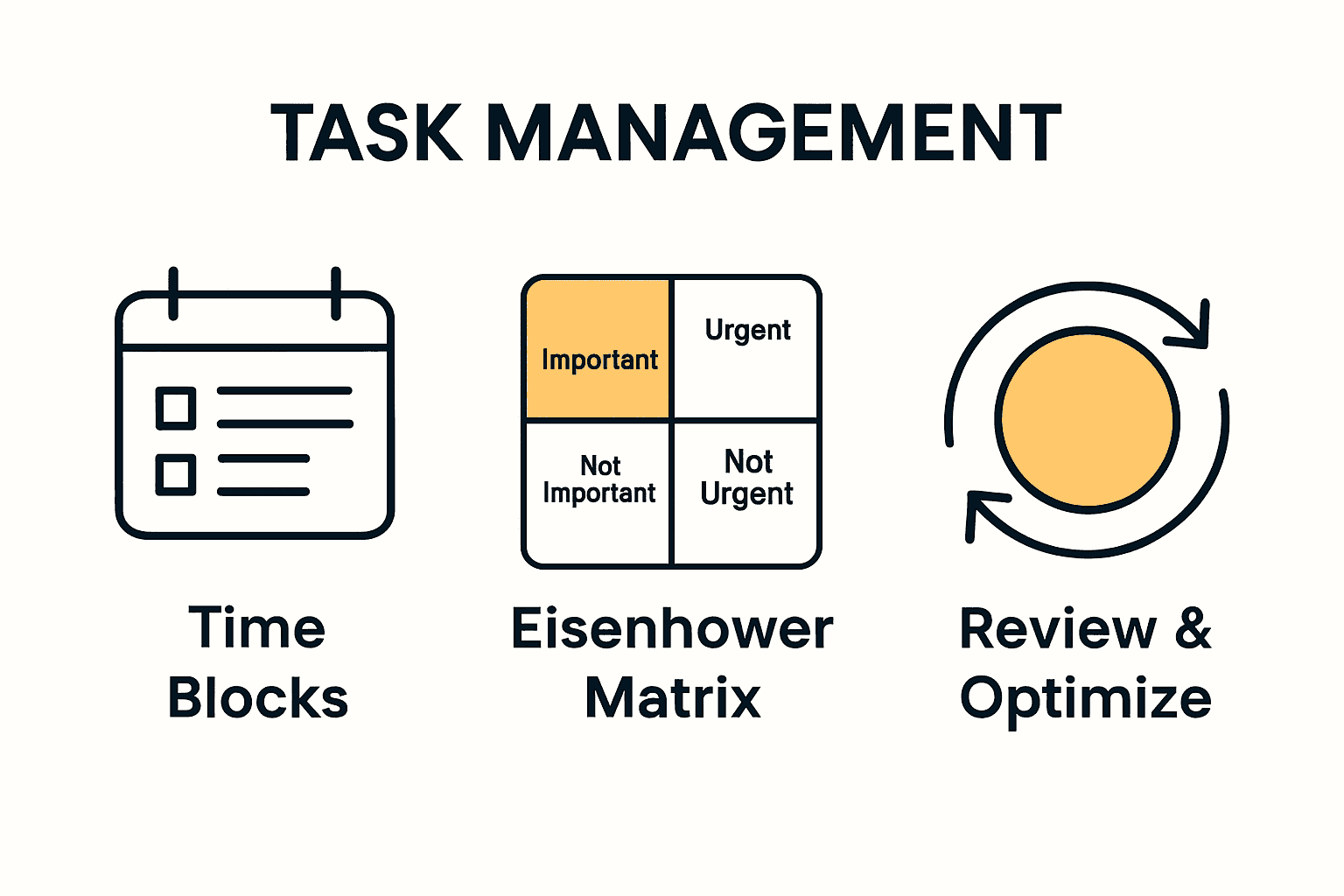
Learning to prioritize and categorize your tasks is crucial for maximizing productivity and reducing overwhelm. According to the Eisenhower Matrix framework, you can transform how you manage your workload by strategically organizing tasks based on their urgency and importance.
Start by dividing your tasks into four distinct quadrants. The first quadrant contains urgent and important tasks that require immediate attention such as critical assignments or time sensitive work projects. The second quadrant focuses on important but not urgent tasks like long term planning and personal development. These are often the activities that create meaningful progress but get overlooked. The third quadrant includes urgent but less important tasks that can be delegated or minimized. The fourth quadrant covers tasks that are neither urgent nor important and should be eliminated whenever possible.
To implement this system effectively, spend time each week reviewing and reassessing your tasks. Understanding prioritization techniques will help you become more strategic about where you invest your energy. Regularly update your task lists and be willing to shift priorities as new information emerges.
 Pro tip: Color code or use visual markers to quickly distinguish between different task categories making your management system more intuitive and easy to navigate.
Remember effective prioritization is not about doing more things but about doing the right things at the right time.
Step 3: Schedule and Allocate Time Blocks
Scheduling and allocating time blocks transforms how you approach productivity and personal management. According to Anoka Tech, effective time management involves creating a daily schedule that includes structured events and allocating specific time slots for prioritized tasks.
Begin by mapping out your most productive hours. Some people work best in early morning hours while others peak in late afternoon. Divide your day into focused blocks typically ranging from 60 to 90 minutes. During these blocks, commit to working exclusively on specific tasks without interruptions. Time management time blocking can help you maintain laser sharp focus and prevent multitasking which often reduces overall productivity.
As recommended by Washington State University, utilize a planner to track and schedule tasks with clear goals. Color code different types of activities academic work personal projects and professional responsibilities. Build in buffer time between blocks to prevent burnout and allow for unexpected interruptions. Pro tip: Schedule your most challenging tasks during your peak energy hours and use less intense time blocks for administrative work or email management.
Remember time blocking is a skill that improves with practice. Be patient with yourself and remain flexible as you develop your personalized scheduling approach.
Step 4: Track Progress and Adjust Plans
Tracking progress and adjusting your plans is critical to maintaining productivity and achieving your goals. According to Wilfrid Laurier University, regularly reviewing your schedule and task lists allows you to assess the realism of your planning and identify time-wasting activities.
Implement a weekly review process where you evaluate your completed tasks and unfinished work. Break down your progress into three categories as suggested by Kings University: ‘must-do,’ ‘should-do,’ and ‘nice-to-do’ tasks. This approach helps you prioritize effectively and understand where you might be spending unnecessary time. Step by step goal tracking can provide additional structure to this process.
During your review, be honest about what worked and what did not. Move unfinished tasks forward thoughtfully do not simply copy them to the next week. Analyze the reasons behind incomplete tasks whether they were unrealistic time estimates or unexpected challenges. Adjust your future planning accordingly and build in more flexible time buffers.
Remember progress tracking is not about perfection but continuous improvement.
Step 5: Review Results and Optimize Workflow
Reviewing and optimizing your workflow transforms how you approach productivity and personal effectiveness. According to Steiner’s Taxonomy of Tasks, understanding group task coordination can help identify process losses and develop strategies for improving overall productivity.
Begin by conducting a comprehensive review of your recent performance. Analyze your completed tasks and assess the efficiency of your current workflow. Understanding workflow for progress tracking can provide deeper insights into your work patterns. As suggested by the Foundations of Computational Management, consider integrating task automation techniques to streamline repetitive processes and reduce time consuming activities.
Identify bottlenecks and areas of potential improvement in your current system. Look for patterns in tasks that consistently take longer than expected or create unnecessary stress. Experiment with different approaches such as batch processing similar tasks or breaking complex projects into smaller more manageable steps. Create a feedback loop where you continuously refine your workflow based on actual performance data.
Remember optimization is an ongoing process not a one time fix.
Master Your Tasks Like a True Centurion
Struggling to keep your tasks organized and your priorities in check can drain your energy and stall your progress. This article highlights the challenges of managing multiple responsibilities and the importance of effective task prioritization and time blocking. If you want a system that helps you capture, categorize, and execute your tasks with clarity and confidence, then embracing a smart, purpose-built approach is key.
Unlock your productivity potential with Optio Station, the mobile app designed for students and young professionals who want to command their day like a seasoned Roman officer. Become the second-in-command to your own success by using proven strategies aligned with themes like the Eisenhower Matrix and time blocking. Explore expert insights on ProductivityThoughts, gather practical tips from the CenturionTips collection, and start leading your tasks with discipline and precision. Take command today at Optio Station and experience the power of managing your work and time like a true Centurion.
Frequently Asked Questions
How can I set up an effective task management system as a student or professional?
Start by choosing a digital or physical system that suits your workflow, such as a planner or task management software. Capture all tasks, categorize them by priority, and review your lists weekly to stay on track.
What is the best way to prioritize my tasks?
Use the Eisenhower Matrix to categorize tasks into four quadrants based on urgency and importance. Focus on urgent and important tasks first, and regularly reassess your priorities each week to adapt to changing needs.
How should I allocate time for my tasks effectively?
Map out your most productive hours and create focused time blocks of 60 to 90 minutes for completing specific tasks. During these blocks, concentrate fully on the task at hand without interruptions to boost productivity.
How can I track my progress and adjust my plans?
Conduct a weekly review to evaluate completed and unfinished tasks, categorizing them into ‘must-do,’ ‘should-do,’ and ‘nice-to-do’. Use this analysis to adjust your future plans and ensure you are spending your time effectively.
What strategies can I use to optimize my workflow?
Review your recent performance to identify bottlenecks and inefficiencies in your workflow. Experiment with techniques like batch processing similar tasks and continuously refine your methods based on what improves your productivity.
How often should I review my task management system?
Review your task management system weekly to ensure it remains effective and to adjust your priorities as needed. This regular check-in helps you stay organized and focused on your most important goals.
Recommended
- 7 Practical Work Goal Examples for Students and Professionals – Optio Station: Best Project Management App for Prioritization
- Task Management Software: Everything You Need to Know – Optio Station: Best Project Management App for Prioritization
- Understanding Why Use Task Lists for Better Productivity – Optio Station: Best Project Management App for Prioritization
- Understanding Why Manage Tasks for Better Productivity – Optio Station: Best Project Management App for Prioritization
- 8 Essential Tips for Time Management for Professionals –
