

Managing your daily tasks can feel like juggling fire—one wrong move and things start slipping. Most people believe they just need a better to-do list or the right app to fix it all. But studies show that simply writing down every task can reveal hidden bottlenecks and reduce stress far more than any fancy tool. This surprising foundation is what actually transforms chaotic schedules into calm, productive days.
Table of Contents
- Step 1: Assess Your Current Task Load
- Step 2: Prioritize Tasks Based On Importance
- Step 3: Create A Structured Daily Schedule
- Step 4: Execute Tasks With Focus And Dedication
- Step 5: Review And Adjust Your Daily Performance
Quick Summary
| Key Point | Explanation |
|---|---|
| 1. Assess your task load thoroughly | Create a complete inventory of all tasks to understand your commitments and avoid overcommitment. |
| 2. Categorize and prioritize tasks | Classify tasks by urgency and importance to focus on what truly matters and manage time effectively. |
| 3. Create a flexible daily schedule | Design a structured schedule aligned with your peak productivity times for optimal task execution. |
| 4. Execute tasks with intense focus | Develop a distraction-free environment and use time-management techniques to enhance concentration and task completion. |
| 5. Regularly review and adjust performance | Periodically assess your progress and refine strategies to continuously improve productivity and work quality. |
Step 1: Assess Your Current Task Load
Successful task management begins with a clear understanding of your current workload. Before diving into complex productivity strategies, you need to take a realistic snapshot of everything on your plate. This initial assessment provides the foundation for smarter, more strategic task allocation and time management.
Start by creating a comprehensive inventory of all your current responsibilities. This means capturing every single task across personal and professional domains. Pull out a notebook or open a digital document and begin documenting everything from work projects and academic assignments to household chores and personal commitments. Be ruthlessly thorough in this process. Include recurring tasks like weekly team meetings, monthly reports, regular study sessions, and even routine activities like grocery shopping or laundry.
Learn more about effective task tracking to streamline this initial assessment. As you compile your task list, categorize each responsibility by its nature and urgency. Create broad categories such as “Professional Commitments,” “Academic Requirements,” “Personal Development,” and “Home Responsibilities.” Within each category, further classify tasks as high priority, medium priority, or low priority.
Once you have your comprehensive list, conduct an honest time audit. Estimate how long each task typically takes and how frequently it recurs. This step reveals critical insights about your actual time commitments versus your perceived availability. Many people discover they’re overcommitted once they quantify their tasks. Pay special attention to tasks that consume significant time but might not appear urgent.
The goal of this assessment is not to overwhelm you but to provide clarity. By mapping out your entire task landscape, you create a realistic foundation for effective time management.
Use this checklist table to ensure your task load assessment is thorough and complete before proceeding to the next step.
| Task Assessment Checklist | Completed (Yes/No) | Notes |
|---|---|---|
| All current tasks documented | ||
| Tasks categorized by priority and type | ||
| Time estimates are realistic and honest | ||
| No significant responsibilities have been overlooked |
Verify your assessment is complete by checking these key indicators:
- All current tasks are documented
- Tasks are categorized by priority and type
- Time estimates are realistic and honest
- No significant responsibilities have been overlooked
Remember, this initial step sets the stage for all subsequent task management strategies. An accurate, comprehensive task load assessment is your first powerful move toward enhanced productivity and reduced stress.
Step 2: Prioritize Tasks Based on Importance
Prioritizing tasks transforms your task list from an overwhelming collection of responsibilities into a strategic roadmap for success. After completing your comprehensive task assessment, the next critical step is determining which tasks deserve your immediate attention and which can be scheduled or potentially delegated.
The most effective prioritization strategy involves evaluating each task through multiple lenses: impact, urgency, and personal goals. Not all tasks are created equal, and recognizing this fundamental truth allows you to allocate your energy more intelligently. Explore advanced prioritization techniques to refine your approach and maximize productivity.
According to research from the University of North Carolina, tasks can be systematically categorized using a simple yet powerful method. Begin by assigning each task a priority level. High-priority tasks are those with significant consequences if not completed, direct alignment with your primary goals, and imminent deadlines. These demand your immediate and focused attention.
Medium-priority tasks represent important responsibilities that contribute to your long-term objectives but do not require immediate action. These might include professional development activities, ongoing project work, or personal improvement initiatives. Low-priority tasks are administrative, routine, or optional activities that can be completed when higher-priority work is finished.
To effectively prioritize, consider creating a visual representation of your tasks. Draw a grid with two axes: one representing urgency and the other representing importance. This helps you quickly identify which tasks require immediate attention and which can be scheduled or potentially eliminated.
Refer to this table as a quick reference to the four quadrants used for prioritizing your tasks and what action to take for each.
| Quadrant | Urgency | Importance | Action |
|---|---|---|---|
| Urgent and Important | High | High | Do immediately |
| Important but Not Urgent | Low | High | Schedule strategically |
| Urgent but Not Important | High | Low | Delegate if possible |
| Neither Urgent nor Important | Low | Low | Eliminate or minimize |
 Place tasks in four quadrants:
- Urgent and Important: Do these tasks immediately
- Important but Not Urgent: Schedule these tasks strategically
- Urgent but Not Important: Delegate if possible
- Neither Urgent nor Important: Eliminate or minimize
Verify your prioritization is effective by checking these indicators: your most critical tasks are clearly identified, you have a structured plan for addressing them, and you feel a sense of control over your workload. Remember, prioritization is not a one-time event but a continuous process of assessment and adjustment. Regularly revisit and refine your priorities to stay aligned with your evolving goals and responsibilities.
Step 3: Create a Structured Daily Schedule
A structured daily schedule transforms your task list from a collection of intentions into a concrete action plan. After assessing and prioritizing your tasks, the next crucial step is designing a schedule that maximizes productivity while maintaining flexibility. This isn’t about creating a rigid timeline but developing a strategic framework that guides your daily activities.
Learn more about effective scheduling techniques to refine your approach. According to research from the University of Sussex, successful scheduling begins with understanding your natural energy rhythms. Most people experience peak productivity during specific times of day. Some are morning powerhouses, while others hit their stride in the afternoon or evening. Identify your most productive hours and strategically place your high-priority tasks during these windows.
Start by blocking out consistent time segments for your most important responsibilities. Allocate specific time ranges for work projects, study sessions, personal development, and essential personal tasks. Be realistic about the time each task requires. Avoid the common pitfall of underestimating task duration, which can lead to constant rescheduling and frustration. Include buffer time between tasks to account for unexpected interruptions or transitions.
Consider employing time-blocking techniques where you dedicate uninterrupted chunks of time to specific types of work. For instance, designate the first two hours of your morning exclusively for deep, focused work that requires maximum concentration. Schedule meetings, email management, and administrative tasks during periods when your energy naturally dips. This approach ensures you’re working with your biological rhythms rather than against them.
Integrate both digital and physical tools to support your scheduling strategy. Use a digital calendar for overall planning, but complement it with a physical planner or notebook for daily tracking. This dual approach provides redundancy and helps reinforce your commitments. Some individuals find color-coding helpful, using different colors to represent various task categories or priority levels.
Verify your schedule’s effectiveness by checking these key indicators:
- Tasks are realistically time-blocked
- High-priority responsibilities are scheduled during peak energy hours
- Buffer time is included between task segments
- The schedule feels balanced and achievable
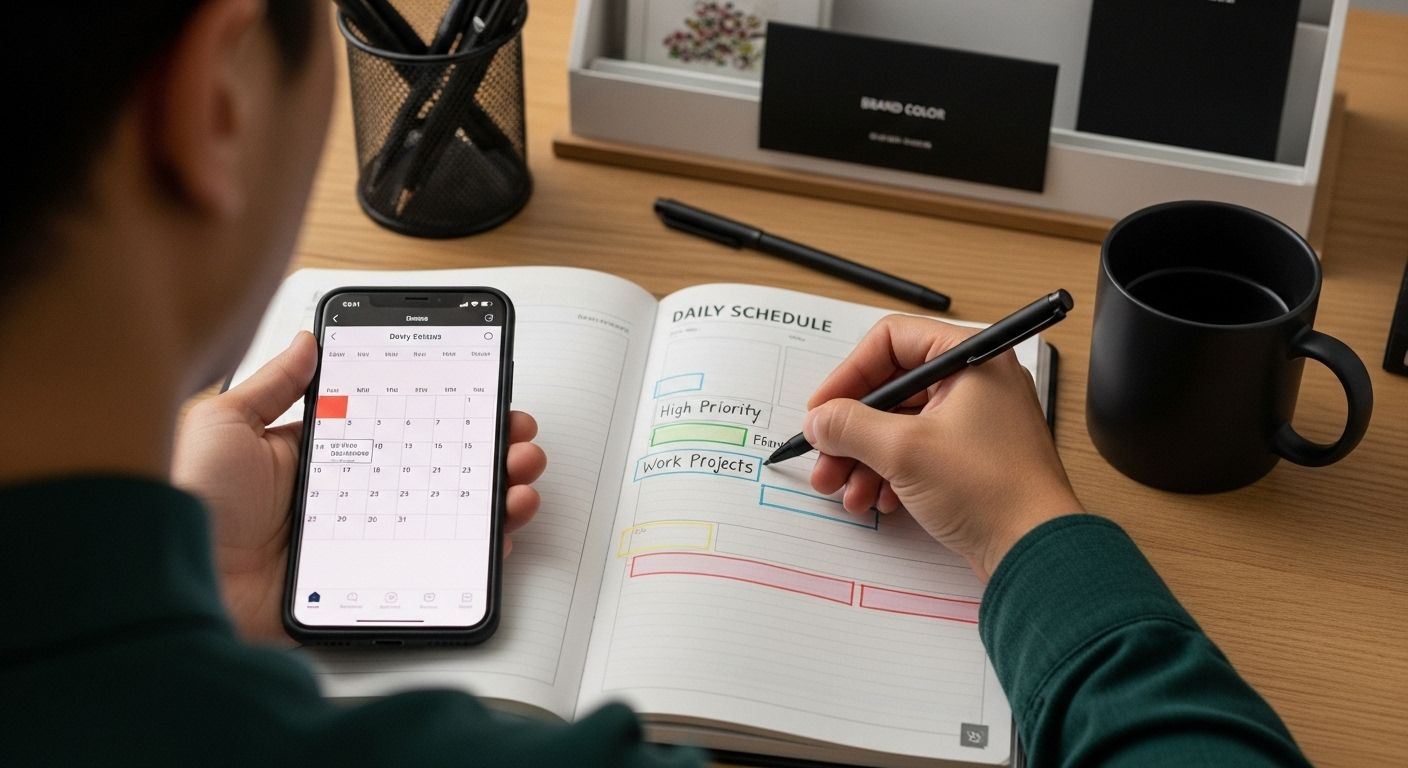
Remember that a schedule is a living document. Be prepared to adjust and refine your approach as you learn more about your productivity patterns and life demands. The goal is not perfection but continuous improvement in how you manage and execute your daily responsibilities.
Step 4: Execute Tasks with Focus and Dedication
Executing tasks with unwavering focus transforms your carefully crafted plans into tangible results. This step is about turning intentions into action, moving beyond planning and diving deep into concentrated work. Sustained concentration becomes your most powerful productivity tool, enabling you to complete tasks efficiently and effectively.
Discover essential habit tracking strategies to support your execution process. According to research from the National Association of Elementary School Principals, successful task execution requires creating an environment that minimizes distractions and supports intense concentration.
Begin by establishing a dedicated workspace that signals to your brain it is time to work. This doesn’t mean you need a perfect home office. Even a specific corner of a room or a consistent spot at a coffee shop can serve as your productivity zone. Remove potential interruption sources: silence mobile notifications, close unnecessary browser tabs, and communicate your focused work periods to people around you.
Implement the Pomodoro Technique or similar time-management strategies that break work into focused intervals. Typically, this involves working intensely for 25 minutes, followed by a 5-minute break. These structured intervals help maintain mental sharpness and prevent burnout. During your focused work periods, commit fully to the task at hand. Multitasking is a productivity myth that fragments your attention and reduces overall effectiveness.
Develop mental resilience by practicing single-tasking. Choose one priority task from your structured schedule and commit to completing it without switching between activities. Use techniques like time-blocking to create uninterrupted work segments. If your mind starts to wander, gently redirect your attention back to the task. This is a skill that improves with consistent practice.
Prepare for potential execution challenges by anticipating and planning for them in advance. Identify potential obstacles that might derail your focus and develop specific strategies to overcome them. This might involve having backup work locations, noise-canceling headphones, or pre-prepared responses to potential interruptions.
Verify your task execution effectiveness by checking these key indicators:
- Tasks are completed within the planned time frame
- Work quality meets or exceeds initial expectations
- You maintain consistent focus during work intervals
- Minimal time is spent on non-essential activities
Remember that focus is a skill that develops with intentional practice. Be patient with yourself, celebrate small victories, and continuously refine your approach to sustained concentration.
Step 5: Review and Adjust Your Daily Performance
Reviewing and adjusting your daily performance transforms your task management from a static process into a dynamic, evolving strategy. This critical step involves honest self-reflection, analytical assessment, and proactive refinement of your productivity approach. Performance review is not about criticism, but continuous improvement.
Discover essential habit tracking techniques to support your ongoing performance evaluation. According to research from the University of Pennsylvania, effective performance management requires specific, timely, and constructive feedback.
Designate a consistent time each day or week for comprehensive performance review. This might be a 15-minute window at the end of your workday or a more extended session on a weekly basis. During this reflection period, examine your completed tasks objectively. Compare your actual performance against the original schedule and priorities you established. Look beyond mere task completion and analyze the quality of your work, the efficiency of your process, and the energy you invested.
Develop a structured self-assessment framework that goes beyond surface-level evaluation. Create a personal performance scorecard that tracks key metrics like task completion rate, time management accuracy, focus maintenance, and overall productivity. Rate yourself on these dimensions using a consistent scale. This quantitative approach provides concrete data points for improvement, transforming subjective reflection into measurable insights.
Pay close attention to patterns and recurring challenges. Are there specific times of day when your productivity consistently dips? Do certain types of tasks consistently take longer than anticipated? Identify these friction points not as failures, but as opportunities for strategic adjustment. Perhaps you need to redesign your schedule, implement different focus techniques, or break complex tasks into more manageable segments.
Maintain a performance improvement journal where you document insights, challenges, and experimental strategies. This living document becomes a personalized roadmap for continuous productivity enhancement. Be kind to yourself during this process.
This checklist table will help you verify if your performance review process is effective and supports continuous improvement each day.
| Performance Review Checklist | Completed (Yes/No) | Notes |
|---|---|---|
| You have a consistent review schedule | ||
| Specific performance metrics are tracked | ||
| Actionable improvements are identified | ||
| Positive changes are implemented and monitored |
Verify the effectiveness of your review process by checking these key indicators:
- You have a consistent review schedule
- Specific performance metrics are tracked
- Actionable improvements are identified
- Positive changes are implemented and monitored
Remember that performance review is a skill itself. Your ability to assess and adjust will improve with practice, turning self-reflection into a powerful tool for personal and professional growth.
Ready to Take Control of Your Daily Tasks?
If you have ever felt lost in a growing list of responsibilities or struggled to stay focused on what matters most, you are not alone. This article showed you how prioritizing tasks, creating structured schedules, and reviewing your performance can transform your productivity. But implementing these smart strategies can be tough without the right tools. Our ProductivityThoughts collection dives even deeper into proven methods for managing your day, offering actionable advice just for goal-driven students and young professionals like you.
Imagine what you could achieve with a mobile app built to simplify task tracking and time management every day. Step up as a Centurion and let Optio Station become your second-in-command. Visit Optio Station right now and get started with tools that make assessment, prioritization, and routine review effortless. Your journey to focus, efficiency, and success can start today. For more practical tips, check out CenturionTips and stay ahead in managing your goals.
Frequently Asked Questions
How can I effectively assess my current task load?
Start by creating a comprehensive inventory of all your current responsibilities across personal and professional domains. Document every single task, categorize them by nature and urgency, and conduct a time audit to understand your actual commitments.
What are effective strategies for prioritizing tasks?
Utilize a method that evaluates tasks based on impact, urgency, and personal goals. Consider categorizing tasks into high, medium, and low priority. You can also create a visual grid to help identify tasks that require immediate attention versus those that can be scheduled later.
How do I create a structured daily schedule?
Design a schedule by blocking out dedicated time for high-priority tasks during your peak productivity hours. Be realistic about the time each task requires, include buffer time for interruptions, and use both digital and physical tools to support your scheduling strategy.
What techniques can I use to execute tasks with focus?
Establish a dedicated workspace, minimize distractions, and consider using techniques like the Pomodoro Technique, which involves working in focused intervals followed by short breaks. Commit to single-tasking and prepare for potential challenges to maintain concentration.
