

Start your 30-day teamwork workout today with three moves: one personal habit, one weekly team ritual, and one measurable check-in. That combination, practiced consistently, is how to develop teamwork skills faster than any workshop or one-off exercise.
This week, do these three things:
- Daily habit (5 minutes): After each meeting or group work session, write one sentence about what you heard from a teammate that you almost missed. This trains active listening faster than any lecture.
- Weekly team ritual (15 minutes): Run a “rose, thorn, bud” check-in at the start of your Monday meeting. One win, one friction point, one idea. Rotate who facilitates.
- Measurable check-in (Friday): Ask yourself: did I follow through on every commitment I made this week? Yes or no. Track it in a notebook or a task app.
Your 30-day roadmap:
- Week 1: Diagnose. Map your team’s current friction points. Write down where communication breaks down and where roles feel unclear.
- Week 2: Co-create a one-page team charter. Agree on goals, roles, and three operating norms together.
- Week 3: Run two structured exercises from the list below. Debrief each one with a single question: “What would we do differently?”
- Week 4: Measure. Count how many commitments your team kept. Run a five-question pulse survey on trust and clarity.
Who this fits: Students working on group projects, early-career professionals joining a new team, and anyone who wants to stop waiting for a manager to fix team dynamics.
What to expect in month one: Clearer roles, fewer dropped handoffs, and at least one honest conversation that would not have happened otherwise.
Pro Tip: Don’t try to fix everything at once. Pick one skill to focus on each week. Depth beats breadth when you’re building new habits.
Key Takeaways
Developing teamwork skills comes down to three consistent actions: practicing personal micro-habits daily, running structured team rituals weekly, and measuring behavioral change at 30-day intervals.
| Point | Details |
|---|---|
| Start with three moves | One daily habit, one weekly team ritual, and one Friday commitment check-in build the foundation. |
| Psychological safety first | Google’s research links high-safety teams to roughly 17% better performance; model fallibility and invite dissent explicitly. |
| Use a team charter early | A 45-minute charter session in week two prevents months of role confusion and misaligned goals. |
| Measure behaviors, not feelings | Track commitments kept, decisions documented, and pulse survey trends rather than workshop satisfaction. |
| Lightweight operating rules win | Channel rules, clear meeting types, and one source of truth reduce friction without requiring organizational approval. |
Table of Contents
- The core teamwork skills worth practicing
- Team exercises you can run in 15 to 90 minutes
- How to build psychological safety and trust on your team
- How to grow your personal teamwork skills without a leadership role
- Tools, meeting formats, and routines that actually support teamwork
- How to measure whether your teamwork is actually improving
- How I’d start improving teamwork on a new team
- Optiostation helps you put these habits into practice
- Sources
The core teamwork skills worth practicing
Teamwork skills like active listening, conflict resolution, and accountability are not fixed personality traits. They are learnable behaviors, and short, deliberate practice moves build them faster than most people expect.
Here are the eight skills that matter most, with a mini-exercise for each:
1. Active listening. Most people listen to respond, not to understand. Practice: in your next meeting, take notes on what others say before you speak. After the meeting, summarize one teammate’s point back to them in a message.
2. Clear communication. Vague language creates rework. Practice: before sending any message or kicking off a task, write the expected outcome in one sentence. If you can’t, the task isn’t clear enough yet.
3. Accountability and dependability. Teams break down when people don’t follow through. Practice: at the end of every meeting, state one specific commitment out loud, with a deadline. Write it somewhere visible.
4. Role clarity. Overlapping or undefined roles cause conflict and dropped work. Practice: draw a simple RACI chart (Responsible, Accountable, Consulted, Informed) for your next project. Even a rough version surfaces assumptions.
5. Conflict resolution. Avoiding conflict doesn’t make it disappear. Practice: the next time you disagree with a teammate, try the “yes, and” technique before stating your counter-position. It keeps the conversation open.
6. Empathy. Understanding a teammate’s constraints changes how you collaborate. Practice: once a week, ask a teammate one question about their workload or priorities before making a request of them.
7. Shared mental models. Teams work faster when everyone pictures the same goal. Practice: at the start of a project, have each person write their version of the goal in one sentence, then compare. The gaps are usually revealing.
8. Adaptability. Plans change. Practice: after any unexpected change, spend two minutes writing what you’ll adjust and why. This builds the habit of responding rather than reacting.
The research on team science is consistent: team processes like shared goals, cohesion, and conflict management are the primary leverage point for effectiveness. Personality matters far less than the habits a team builds together.
Pro Tip: Focus on process, not personality. When a team struggles, the fix is almost never “get better people.” It’s almost always “build clearer processes.”
Team exercises you can run in 15 to 90 minutes
Ready-to-run activities build team collaboration faster than passive training. The CIPD evidence summary confirms that trust and cohesion emerge through interaction, not instruction. These six activities give your team structured interaction with a clear debrief built in.
1. Brainwriting (15 minutes)
Goal: Generate ideas without the loudest voice dominating.
Steps: Each person writes three ideas on sticky notes or a shared doc, silently, for five minutes. Then pass your sheet to the next person, who builds on your ideas for another five minutes. Debrief: “Which idea surprised you most?”
Remote variation: Use a shared Google Doc or a digital whiteboard like Miro. Each person writes in a different color.

2. Speedstorming (30 minutes)
Goal: Rapid cross-pollination of ideas across pairs.
Steps: Set a timer for three minutes. Each pair discusses one challenge. Rotate partners. Run five rounds. Debrief: “What pattern did you hear across conversations?”
Remote variation: Use breakout rooms with a shared timer.
3. Team charter co-creation (45 minutes)
Goal: Build shared ownership of operating norms.
Steps: (1) Five minutes: each person writes their version of the team’s goal. (2) Ten minutes: compare and align on one shared goal statement. (3) Fifteen minutes: define roles. (4) Fifteen minutes: agree on three operating norms. Document everything in one shared page.
Debrief: “What assumption did we surface that we hadn’t talked about before?”
4. Structured debate (60 minutes)
Goal: Practice constructive disagreement and perspective-taking.
Steps: Assign two teams opposing positions on a real team decision. Each side has ten minutes to prepare, ten minutes to present, and five minutes to respond. Then drop the assigned positions and discuss what you actually believe.
Debrief: “What argument from the other side was strongest?”
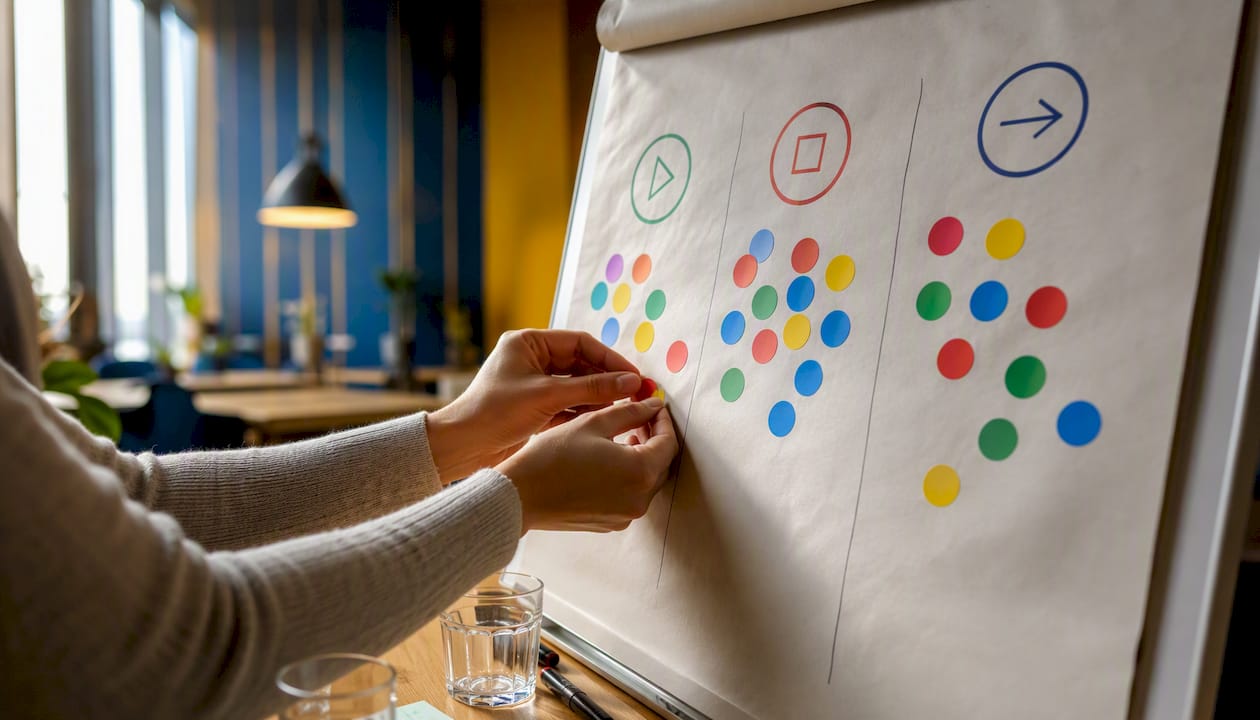
5. Retrospective (45 minutes)
Goal: Build the habit of learning from experience as a team.
Steps: Use the “start, stop, continue” format. Each person writes one item per category. Group similar items. Vote on the top two to act on. Assign an owner and a deadline for each.
Remote variation: Use a virtual board with anonymous sticky notes to reduce social pressure.
6. Campfire storytelling (30 minutes)
Goal: Build empathy and shared context through personal stories.
Steps: Each person shares a two-minute story about a time they worked well on a team and what made it work. No interruptions. After everyone shares, the group identifies common themes.
Debrief: “What condition showed up in every story?”
Facilitator checklist:
- Confirm the goal and time before starting.
- Assign a timekeeper and a note-taker.
- State the debrief question before the activity begins, not after.
- Close every session with one concrete next action and an owner.
Pro Tip: Before any exercise, name psychological safety explicitly. Tell the group: “There are no wrong answers here, and disagreement is welcome.” Saying it out loud changes the room.
How to build psychological safety and trust on your team
Google’s Project Aristotle identified five dynamics that consistently separate effective teams from ineffective ones: psychological safety, dependability, structure and clarity, meaning, and impact. Psychological safety ranked first. Not talent, not experience, not tools.
Psychological safety means teammates believe they won’t be punished for speaking up, asking questions, or admitting mistakes. It’s not about being nice. It’s about whether people feel safe enough to take the interpersonal risks that real collaboration requires.
Statistic: In one Google sales dataset, teams with high psychological safety outperformed their targets by roughly 17%, while low-safety teams underperformed by up to 19%.
That gap doesn’t come from hiring better people. It comes from how the team operates.
Concrete behaviors that raise psychological safety:
- Frame work as learning, not performance. When you open a meeting by saying “we’re here to figure this out together,” you signal that mistakes are data, not failures.
- Model fallibility. Leaders and senior teammates who say “I got that wrong” or “I’m not sure” give everyone else permission to do the same.
- Explicitly invite dissent. Ask “what am I missing?” or “who sees this differently?” at the end of every decision discussion. Make it a routine, not a one-off.
- Respond to bad news with curiosity. When someone raises a problem, the first response should be a question, not a solution or a judgment.
- Acknowledge contributions publicly. Name who said what in meeting notes. It signals that speaking up has visible value.
A 4-step plan to test changes in one month:
- Week 1: Pick one behavior from the list above and practice it in every meeting.
- Week 2: Ask two teammates privately: “Do you feel comfortable raising concerns in our meetings?” Listen without defending.
- Week 3: Add one explicit invitation to dissent to your standard meeting agenda.
- Week 4: Run a five-question pulse survey on safety and dependability. Compare to your Week 2 conversations.
Pro Tip: If you’re new to leading a team, start with modeling fallibility. It costs nothing and signals more than any policy or workshop. Say “I don’t know” once in your first team meeting and watch what it unlocks.
How to grow your personal teamwork skills without a leadership role
You don’t need to be the team lead to shift how a team works. Individual contributors shape team norms constantly, through the habits they model and the micro-behaviors they repeat.
Daily micro-habits to build right now:
- The two-minute listen. Before responding in any conversation, pause for two seconds and repeat back the key point you heard. It sounds small. Over a week, it changes how people feel heard.
- The clarity check. Before starting any task someone assigns you, confirm the expected output in one sentence. “So you need X by Y, right?” This one habit cuts rework dramatically.
- The commitment log. At the end of each day, write every commitment you made and whether you kept it. Review weekly. Most people are surprised by the gap.
- The empathy prompt. Once a day, ask a teammate one question about their work before making a request. “What’s taking most of your time this week?” shifts the dynamic from transactional to collaborative.
Feedback prompts you can use after any meeting:
- “What’s one thing I could have communicated more clearly today?”
- “Did anything I said or did make it harder for you to contribute?”
- “What would have made this meeting more useful for you?”
These prompts work in a one-on-one conversation or in a quick message after a session. They’re specific enough to get real answers, and they signal that you’re invested in improving, not just performing.
Influencing team norms without authority:
The most reliable way to shift a team norm is to model the behavior you want to see, consistently, until others start doing it too. If you want more honest feedback, give honest feedback first. If you want shorter meetings, send a clear agenda before yours. Team accountability spreads through example faster than through requests.
One-month individual development template:
- Week 1: Track your commitments daily. Aim for 100% follow-through by Friday.
- Week 2: Use the clarity check on every task. Count how many times it surfaces a misunderstanding.
- Week 3: Ask for feedback after two meetings using the prompts above.
- Week 4: Identify one team norm you want to shift. Model the behavior you want for five consecutive days.
Tools, meeting formats, and routines that actually support teamwork
More tools don’t mean better collaboration. Collaborative overload is a real productivity drain, and the fix is usually fewer, better-structured touchpoints, not more apps.
The approach that works is a lightweight operating system: a small set of agreed rules that reduce ambiguity without requiring organizational approval.
Channel rules (set these in week one):
- One channel for quick questions (expect a response within four hours).
- One channel for decisions (post the decision, the owner, and the rationale).
- One shared document as the single source of truth for project status.
- No decision buried in a direct message.
Meeting types and when to use each:
- Kickoff (60 minutes): Align on goal, roles, and operating norms. Run once at the start of a project.
- Decision meeting (30 minutes): One agenda item, one owner, one decision. Document the outcome immediately.
- Working session (45–60 minutes): Collaborative work with a defined output. Not a status update.
- Retrospective (45 minutes): What worked, what didn’t, what to change. Run every two to three weeks.
Tool categories and what they’re for:
- Task board: Tracks who owns what and when it’s due. Reduces handoff failures.
- Shared document: Captures decisions, meeting notes, and project context in one place.
- Digital whiteboard: Supports brainstorming and visual mapping in real time.
For collaboration tools that match your workflow, the key question isn’t “which tool is best?” It’s “which tool does the whole team actually use?”
Remote and hybrid checklist:
- Camera on for the first five minutes of any meeting (builds presence).
- Async-first for updates; synchronous only for decisions and creative work.
- Written agenda shared 24 hours before any synchronous meeting.
- Decisions documented in writing within one hour of the meeting.
Pro Tip: Before adding any new tool, ask whether an existing one could do the job. Tool sprawl is one of the fastest ways to fragment a team’s attention and create duplicate work.
How to measure whether your teamwork is actually improving
Measuring teamwork is harder than measuring output, but it’s not impossible. The key is tracking behaviors, not feelings. Diagnosing friction and measuring behavioral change rather than workshop satisfaction is what separates teams that improve from teams that just feel like they’re improving.
Behaviors worth tracking:
- Number of commitments made vs. kept each week.
- Number of decisions documented with a clear owner.
- Frequency of clarifying questions asked before starting tasks.
- Pulse survey scores on psychological safety and role clarity (run every two weeks).
- Number of retrospective action items completed on time.
30/60/90-day milestone table:
| Milestone | Expected outcome | Simple metric |
|---|---|---|
| 30 days | Roles and norms are documented; first rituals are running | Team charter exists; two rituals completed |
| 60 days | Commitments are tracked; communication friction is reduced | commitment follow-through rate |
| 90 days | Psychological safety pulse scores are rising; retrospectives are self-sustaining | Pulse score trend; retros run without a facilitator |
What to do if metrics stagnate:
First, check whether the behavior is actually being practiced or just agreed to in theory. The most common reason metrics don’t move is that the new habit never became a real routine. Second, run a short diagnostic: ask each teammate privately what’s getting in the way. Third, simplify. If the system feels like overhead, cut one element and keep the rest.
For managing team tasks and tracking commitments, a shared task board with clear owners and due dates is the simplest measurement tool available.
How I’d start improving teamwork on a new team
Here’s the sequence that works, in order:
Step 1: Diagnose before you prescribe. Spend the first week observing. Where do handoffs break? Who goes quiet in meetings? What decisions get relitigated? Write it down. You can’t fix what you haven’t named.
Step 2: Run the charter session in week two. Don’t wait until the team is struggling. A 45-minute charter session early in a project prevents three months of confusion. The goal isn’t a perfect document. It’s the conversation.
Step 3: Establish two rituals and hold them. Pick a weekly check-in and a bi-weekly retrospective. Run them at the same time, every time. Consistency matters more than format. Teams that meet irregularly don’t build shared norms.
Step 4: Go for one quick win. Find one friction point from your diagnosis that you can fix in a week. A clearer decision log, a shorter meeting, a single channel rule. Small wins build credibility and buy-in for bigger changes.
Step 5: Measure and adjust at 30 days. Run a five-question pulse survey. Compare to your Week 1 observations. Share the results with the team. Transparency about what’s working and what isn’t is itself a trust-building act.
Common obstacles and how to handle them:
- Dominant voices: Use structured turn-taking in meetings. Brainwriting before discussion gives quieter teammates equal footing.
- Meeting overload: Audit your meeting calendar. Cancel any recurring meeting that doesn’t have a clear owner and outcome. Replace it with async updates.
- Tool sprawl: Pick one tool per function and document the rule. Enforce it by example, not by policy.
The hardest part isn’t knowing what to do. It’s getting small, consistent commitments from teammates who are already busy. Ask for one behavior at a time, not a full system overhaul. “Can we try documenting decisions for two weeks?” is a request people say yes to. “Can we redesign how we collaborate?” is not.
Optiostation helps you put these habits into practice
Developing teamwork skills requires tracking commitments, running structured rituals, and keeping everyone aligned on shared goals. Optiostation, the task and team management app built for students and young professionals, gives you the tools to do all three in one place.
Think of Optio as your second-in-command: it holds your task board, your team commitments, and your operating routines so nothing slips between meetings. Whether you’re running a group project or coordinating a work team, Optiostation keeps the system lightweight and the accountability visible.
Improve your teamwork starting this week with Optiostation, and use the task management guide to set up your first shared board in under ten minutes.
Sources
The research and practitioner guides below informed this article. Use them to go deeper on specific areas.
- Understand team effectiveness
- Enhancing the effectiveness of team science
- High-performing teams: practice summary (CIPD)
- Team dynamics: The five keys to building effective teams
- How to Improve Team Collaboration: A 2026 Guide | AI Dictation
Research sources were used for evidence and frameworks. Optiostation resources provide practitioner templates and implementation guidance for the routines described above.
Recommended
- How to Improve Teamwork and Collaboration at Work – Optio Station: Best Project Management App for Prioritization
- How to Improve Teamwork for Success in College and Work – Optio Station: Best Project Management App for Prioritization
- Benefits of Teamwork – Keys for Global Student Success – Optio Station: Best Project Management App for Prioritization
