

To combat burnout, you recognize the symptom cluster (exhaustion, cynicism, and dropping performance), then act on two fronts at once: emergency steps that protect your recovery time this week, and habit and workplace changes that stop it from coming back. Neither one alone holds. Individual willpower without organizational support just delays the crash.
TL;DR:
- Regularly monitor early burnout signs like unrefreshing sleep, irritability, dread on Sundays, declining work quality, and unexplained physical complaints.
- Protect one evening each week from work entirely and establish a specific boundary, such as no calls after 6 PM, to disrupt burnout momentum.
- Build sustainable habits like daily focus blocks, consistent sleep schedules, and end-of-day routines to maintain long-term resilience.
- Employers should conduct workload audits, train managers to recognize burnout, and foster a culture of support and transparency to reduce organizational risk.
- Address burnout symptoms early with outside help if exhaustion persists beyond a month or daily functioning deteriorates, focusing on recovery over time.
Table of Contents
- What are the early warning signs of burnout at work?
- How do you stop burnout from getting worse this week?
- What daily habits prevent burnout from coming back?
- What can employers and managers do to reduce burnout?
- How long does burnout recovery take, and when should you get help?
- A 7-day action plan to lower your burnout risk
- Why do some jobs cause burnout while others don’t?
- How does workplace culture affect burnout risk?
- Does remote work make burnout better or worse?
- Which stress management techniques actually reduce burnout symptoms?
- Why does peer support matter more than most people think?
- Author perspective: why burnout is rarely only an individual failing
- A practical next step for protecting your recovery time
- Sources
What are the early warning signs of burnout at work?
Burnout shows up in three distinct dimensions, and knowing them separates a rough week from the real thing. The first is exhaustion, the bone-deep tiredness that a weekend doesn’t fix. The second is cynicism or detachment, where you stop caring about outcomes you used to care about. The third is reduced efficacy, meaning your actual output quality slips even though you’re putting in the same hours or more. Six workplace conditions tend to drive this pattern, according to evidence-based burnout research, and spotting them early matters more than diagnosing them perfectly.
Watch for these signs over a two-week stretch, not just a bad Tuesday:
- Sleep that doesn’t restore you, even at 7 to 8 hours
- Irritability with people who normally don’t bother you
- A sense of dread on Sunday night that used to be mild and is now sharp
- Work you’re proud of turning into work you just want off your plate
- Physical complaints (headaches, tight shoulders, stomach issues) with no other cause
Keep a two-line log each evening: one word for mood, one number from 1 to 10 for energy. Patterns hide in daily noise. A week of logs makes them visible.
How do you stop burnout from getting worse this week?
You don’t need a life overhaul to interrupt burnout’s momentum. You need 72 hours of deliberate friction against your own habits, plus a handful of scripts you’re willing to actually use.
- Pick one evening to protect completely. No laptop, no “just checking” email. Tell your team in advance so it isn’t a surprise.
- Set one boundary and hold it for a week. Something specific: “I don’t take calls after 6 PM” or “Wednesdays are meeting-free mornings.”
- Swap one task instead of adding help. Trade a task you’re bad at for one a colleague is bad at. Faster than asking for new headcount, and managers say yes more easily.
- Schedule two or three oasis moments daily. Five minutes of slow breathing, a 10-minute walk, or a phone-free lunch. These work better scheduled and protected than squeezed in when you remember, according to the APA’s guidance on preventing burnout.
- Use a short script when you ask for relief. Try: “I’m at capacity through Friday. Can we push the deadline or move this to someone with room?” Or to a manager: “I want to keep quality up on this project. Can we talk about what’s realistic given the current load?”
A tool like Optiostation’s approach to task overload can help you see which tasks are actually swappable before you ask.
Pro Tip: Write your boundary script down before the conversation happens. People freeze mid sentence when caught off guard, and a pre written line keeps you from over explaining or apologizing your way out of the ask.
What daily habits prevent burnout from coming back?
Prevention lives in rhythm, not in one heroic reset. The habits that hold up long term are boring, repeatable, and specific.
- Protected focus blocks. Two hours a day with no email tab open, calendar marked as busy.
- A consistent sleep window. Same wake time seven days a week beats “catching up” on weekends, which resets nothing.
- Job crafting. Shift 10 to 15% of your role toward tasks that feel meaningful. Volunteer for the client call you enjoy, delegate the report you dread.
- End-of-day rituals. A two-minute shutdown routine, closing tabs, writing tomorrow’s top three tasks, signals to your brain that work is actually over.
- Calendar etiquette. Default meetings to 25 or 45 minutes instead of 30 or 60. It sounds small. It reclaims hours weekly.
A daily routine blueprint helps if you’re rebuilding these habits from scratch rather than tweaking an existing one. The goal isn’t perfection. It’s a rhythm you can sustain when a hard week inevitably hits, without the whole structure collapsing.
What can employers and managers do to reduce burnout?
Individual habits only go so far when the underlying workload or culture is broken. Burnout is largely preventable through structural change, and managers are the single biggest lever an organization has, according to research from UNSW BusinessThink. Gallup’s research narrows this down further, pointing to five root causes leaders should address directly: unfair treatment, unmanageable workload, unclear communication, lack of manager support, and unreasonable time pressure, according to Gallup’s workplace research.
Here’s what that looks like in practice:
- Workload auditing. Regularly review whether role expectations match actual capacity, not the capacity assumed when the job was posted two years ago.
- Manager training. Equip managers to recognize burnout symptoms and hold supportive, non-judgmental conversations about workload rather than just pushing deadlines.
- Autonomy over how work gets done. Prof. Sharon Parker research notes that employees who can negotiate priorities and protect their own focus time show markedly lower burnout rates, per UNSW BusinessThink.
- Predictable rhythms and transparent decisions. Fewer last-minute fire drills, clearer reasoning behind priority shifts.
- Recognition tied to real contribution, not just visibility or hours logged.
If your workplace lacks these, request them specifically rather than vaguely asking for “less stress.” Specificity gets a response; vague requests get sympathy and nothing else.
How long does burnout recovery take, and when should you get help?
Recovery isn’t linear, but it does have a shape. Most people notice energy returning in weeks once they’ve made real changes, with fuller resilience building over a couple of months. Track it against your mood and energy log rather than how you feel on any single day.
Seek professional support if exhaustion persists past a month of genuine effort, if you notice symptoms of depression, or if daily functioning (eating, sleeping, relationships) breaks down. Burnout is linked to increased depression risk, and early intervention improves outcomes according to a systematic review published on NCBI. Employee assistance programs and therapy both help with longer recovery arcs, especially when the underlying job situation can’t change quickly.
A 7-day action plan to lower your burnout risk
Structure beats willpower here. Spread these actions across a week rather than trying to fix everything Monday morning.
- Days 1 to 3: Protect one evening each night. No exceptions, no “just this once.”
- Days 2 and 4: Test a no-meeting focus block in the morning. Notice how much gets done.
- Day 3: Have one direct conversation with your manager about workload, using a specific ask rather than a general complaint.
- Day 5: Do one activity that reconnects you to why the work matters, mentoring someone, finishing something you’re proud of, sitting in on a customer call.
- Every night: Log sleep quality, mood, and one focus rating from 1 to 10.
Review the three indicators on day 7. If sleep and mood improved but focus didn’t, the boundary experiments are working and the workload conversation needs to go further next week. Adjust and repeat.
Why do some jobs cause burnout while others don’t?
Burnout doesn’t come from hours worked alone. Six specific conditions predict it: workload, control, reward, community, fairness, and values, according to the same evidence-based prevention research cited earlier.
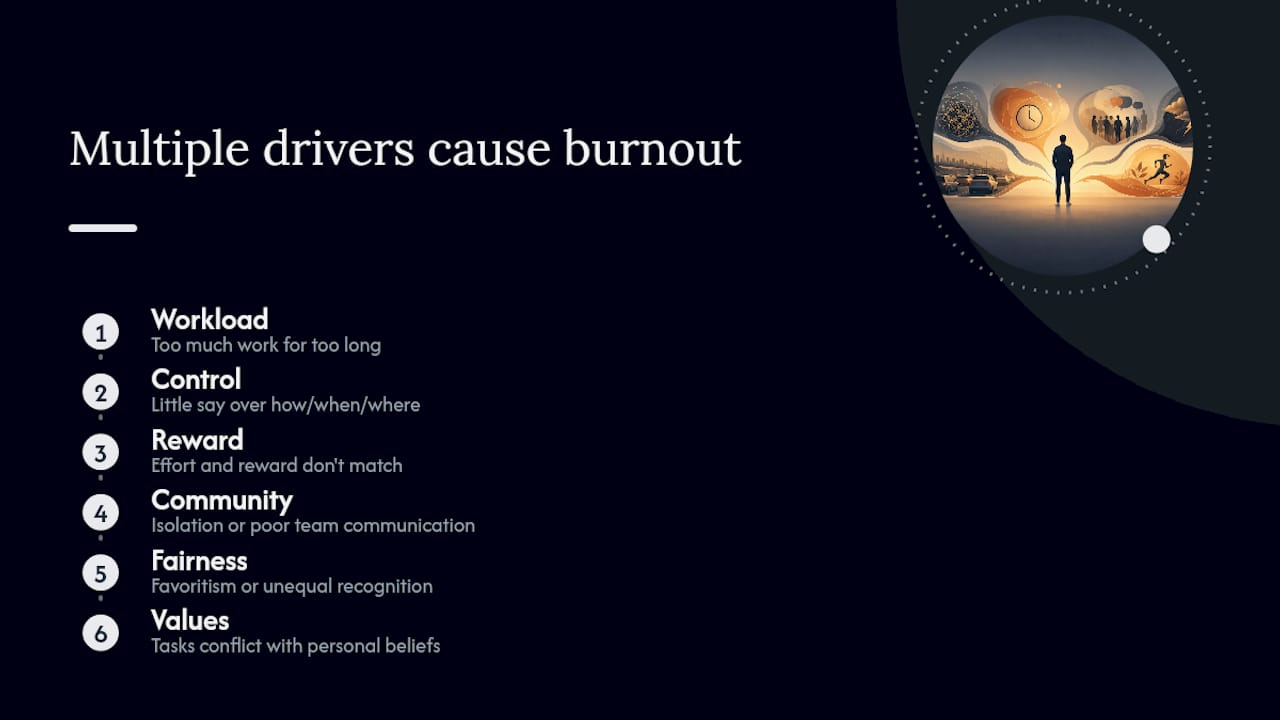
Workload is the obvious one, too much for too long with no recovery window. Control matters just as much: two people doing identical work can have wildly different burnout risk depending on how much say they have over how, when, and where they do it. Fairness shows up when effort and reward don’t match, or when favoritism decides who gets the good projects and who gets the leftovers. Community is the buffer most people underrate, isolated remote workers and people on teams with poor communication burn out faster even at identical workloads. Values misalignment is subtler: when your daily tasks conflict with what you personally believe matters, the friction compounds quietly for months before it surfaces as exhaustion.
Most burnout cases involve two or three of these at once, not just one. A person with reasonable hours but zero autonomy and unfair recognition can burn out just as fast as someone working 60-hour weeks. This is why “just take a vacation” advice fails so often. Vacation addresses exhaustion but leaves control, fairness, and values problems fully intact, waiting for you the Monday you return.
How does workplace culture affect burnout risk?
Culture sets the baseline risk before any individual habit kicks in. A team where asking for help is normal produces far less burnout than one where every request for support reads as weakness, even at identical workloads.
The clearest cultural signal is what happens when someone says they’re struggling. Teams that respond with adjustment (redistributing tasks, extending a deadline, checking in without judgment) build resilience across the whole group. Teams that respond with quiet resentment or a performance review flag teach everyone to hide symptoms until they’re unmanageable. That hiding is expensive. It means the first visible sign of burnout is often a resignation, not a conversation.
Psychological safety, the sense that you won’t be punished for admitting difficulty, correlates strongly with lower burnout rates on a team level. This isn’t about mandatory fun or wellness posters. It’s about whether your manager’s actual behavior, not their stated values, makes honesty safe. Framing burnout as an organizational issue rather than a personal failing changes how teams handle it, according to research on evidence-based prevention, because shame keeps people silent right up until they quit or collapse.
Does remote work make burnout better or worse?
The honest answer is both, depending on what you measure. Remote work removes commute time and gives people more control over their physical environment, both of which help. But it also blurs the boundary between “at work” and “not at work” until that boundary disappears entirely for a lot of people.
The technology piece compounds this. Constant notifications, the expectation of near-instant replies on Slack or email, and video calls stacked back to back with zero buffer time all push people toward the exhaustion dimension of burnout faster than office work typically did. Nobody used to walk from one meeting room straight into another with no thirty-second walk between them. Now it’s the default.
Remote and hybrid workers also lose incidental community, the hallway conversation, the shared lunch, the small talk that used to buffer stress without anyone scheduling it. That loss matters more than most remote work guides admit. The fix isn’t returning to an office. It’s deliberately rebuilding boundaries and community that used to happen automatically: a hard stop time enforced by closing the laptop, notification windows instead of always-on alerts, and scheduled check-ins that replace the hallway conversation you no longer have by accident.
Which stress management techniques actually reduce burnout symptoms?
Mindfulness and meditation get recommended constantly, and they do help, but only as one piece of a larger response, not a substitute for fixing workload or control problems. A ten-minute breathing practice won’t offset a genuinely unmanageable job. It will help you handle the manageable stress that’s left once the bigger problems are addressed.
Breathing exercises work fastest for acute spikes: a tight chest before a hard meeting, racing thoughts at midnight over an unfinished project. Box breathing (four seconds in, four seconds hold, four seconds out, four seconds hold) takes under two minutes and measurably lowers physiological stress response in the moment.
Movement works on a slower timescale. A 10-minute walk, ideally outside and phone-free, breaks the rumination loop that keeps stress circulating hours after the triggering event ended. This matters more than people expect, since burnout often isn’t caused by the stressful event itself but by replaying it for the rest of the day.

Detachment practices, deliberately not thinking about work during off hours, sound simple but take real practice for people who’ve trained themselves to be reachable at all times. Building a consistent shutdown ritual makes this easier than trying to force yourself to “just stop thinking about it” through sheer will.
Why does peer support matter more than most people think?
Short, regular social interactions at work build what researchers call social capital, a buffer that softens the impact of stress spikes before they compound into burnout, according to the evidence-based prevention research cited earlier. This isn’t about forced team bonding events. It’s about whether you have someone at work who’d notice if you were struggling and say something.
Teams with strong communication norms, where people flag being overloaded before it becomes a crisis, catch burnout early enough to redistribute work before anyone hits a wall. Teams without that norm find out someone was drowning only after they’ve already quietly quit or missed a deadline that damages trust. The difference isn’t personality. It’s whether the team has built a habit of checking in.
If you manage people, five minutes at the start of a one-on-one asking “how’s your workload actually feeling” does more for burnout prevention than any wellness initiative. If you don’t manage people, the same question asked of a peer works nearly as well. Boundary-setting guidance can help if you’re not sure how to raise workload concerns without sounding like you’re complaining.
Gallup’s research on manager development backs this up directly: programs that build in regular check-ins and wellbeing coaching measurably reduce burnout risk across entire teams, not just for the specific employees being coached, according to Gallup’s findings. The check-in habit spreads.
Author perspective: why burnout is rarely only an individual failing
The instinct to treat burnout as a personal productivity problem, something you fix with better time blocking or a meditation app, misses what the research actually shows. Workload, fairness, and control are organizational variables, not personal ones. Framing burnout as a character flaw keeps people silent and delays the structural conversations that actually fix it.
That said, individual tools still matter. A schedule that protects focus blocks and logs your energy over time gives you the evidence to have that structural conversation instead of a vague complaint. Tools support behavior change. They don’t replace a manager who won’t adjust workload, and they’re not a substitute for therapy when symptoms cross into depression. Use them as leverage, not as the whole answer.
— Optiostation
A practical next step for protecting your recovery time
There are other ways to build the habits above: a paper planner, a shared team calendar, or sheer discipline. All of them work if you stick with them. What most people actually struggle with isn’t knowing what to do, it’s remembering to do it consistently once the week gets chaotic again.
This is a task and time management app that lets you block off protected focus time, set smart reminders for the boundaries you set this week, and sync with Google Calendar so your “no meetings before 10 AM” rule actually shows up where your team can see it. Color-coded life aspects make it easy to see at a glance whether work is crowding out the recovery time you scheduled. None of this replaces a workload conversation with your manager or professional care if symptoms are serious. It just makes the individual half of the equation easier to hold onto. If you want to see how the priority and scheduling tools fit into a burnout prevention routine, that’s the place to start.
