

Most teams juggle more projects than they realize, yet only about 40 percent finish on time and within budget. Keeping track of every task, deadline, and priority is no small feat. When your project list grows, so do the risks of wasted resources and missed goals. This guide breaks down a proven step-by-step approach that helps you organize, prioritize, and manage projects with greater confidence and clarity.
Table of Contents
- Step 1: List All Current And Upcoming Projects
- Step 2: Assess Project Importance And Deadlines
- Step 3: Estimate Required Time And Resources
- Step 4: Rank Projects Using Priority Criteria
- Step 5: Allocate Focused Time For Top Priorities
- Step 6: Review Progress And Adjust Allocations
Quick Summary
| Key Point | Explanation |
|---|---|
| 1. Compile a comprehensive project list | Gather all existing project details into one master list for effective management and easier tracking. |
| 2. Establish project importance and deadlines | Create a scoring system to prioritize projects based on strategic importance, resource needs, and risks. |
| 3. Accurately estimate necessary resources | Break projects into tasks and use objective methods to gauge the time and resources required for each. |
| 4. Implement a ranking system for projects | Use a numerical scoring matrix to evaluate projects on criteria like strategic value and organizational impact. |
| 5. Set dedicated time for top priorities | Block specific times in your schedule for high-priority projects to maximize productivity and focus. |
Step 1: List all current and upcoming projects
Creating a comprehensive list of your current and upcoming projects is crucial for effective project management. According to research from Wikipedia, an aggregate project plan helps organizations strategically categorize and track all active and potential projects.
Start by gathering all existing project details into a single master list. This means pulling information from your work tracking systems, team communication channels, and personal notes. Break down each project into key components like name, status, priority level, expected timeline, and primary stakeholders. By using a stakeholder analysis approach recommended by Wikipedia, you can evaluate the interests and potential impacts of each project on your team and organization.
Pro tip: Use a digital spreadsheet or project management tool that allows real time updates and collaborative tracking. This ensures your project list stays current and accessible to all team members. As you compile your list, remember to include not just major initiatives but also smaller ongoing tasks and potential future projects that are still in early conceptual stages.
Once your comprehensive project list is complete, you will be ready to prioritize and strategically allocate your time and resources.
Step 2: Assess project importance and deadlines
Now that you have your comprehensive project list, the next critical step is evaluating each project’s strategic importance and establishing realistic deadlines. According to research from arXiv, project prioritization goes beyond simple probability calculations and requires a nuanced approach to understanding project significance.
To effectively assess project importance, create a scoring system that considers multiple dimensions. Research suggests evaluating projects based on factors like potential impact, strategic alignment with organizational goals, required resources, and potential risks. A technique recommended by arXiv involves analyzing how scope changes might affect project cost and schedule, which helps in setting more accurate deadlines and understanding true project complexity.
Pro tip: Develop a simple scoring matrix where you rate each project on key dimensions such as strategic value, resource requirements, potential return on investment, and alignment with current organizational priorities. Assign numerical weights to these factors to create an objective assessment framework.
 This approach transforms subjective decision making into a more systematic process.
As you complete your importance assessment, you will have a clear roadmap for understanding which projects demand immediate attention and which can be strategically scheduled for later implementation.
Step 3: Estimate required time and resources
With your project list prioritized, the next crucial step is accurately estimating the time and resources needed for each project. According to research from arXiv, effective project scheduling requires integrating potential uncertainties to create more reliable time estimates.
Begin by breaking down each project into specific tasks and activities. Research from Medwin Publishers recommends using objective assessment methods to determine activity durations. For each task, consider the skills required, potential roadblocks, and the expertise level of team members. Estimate not just the ideal time frame but also include buffer periods for unexpected challenges or complexity.
Pro tip: Use a three point estimation technique where you calculate best case, worst case, and most likely scenarios for each project task. This approach helps create more realistic timelines and accounts for potential variations in project complexity.
Consider factors like team availability, skill levels, potential external dependencies, and historical performance data from similar past projects.
Once you have detailed time and resource estimates, you will be prepared to create a comprehensive and actionable project management strategy.
Step 4: Rank projects using priority criteria
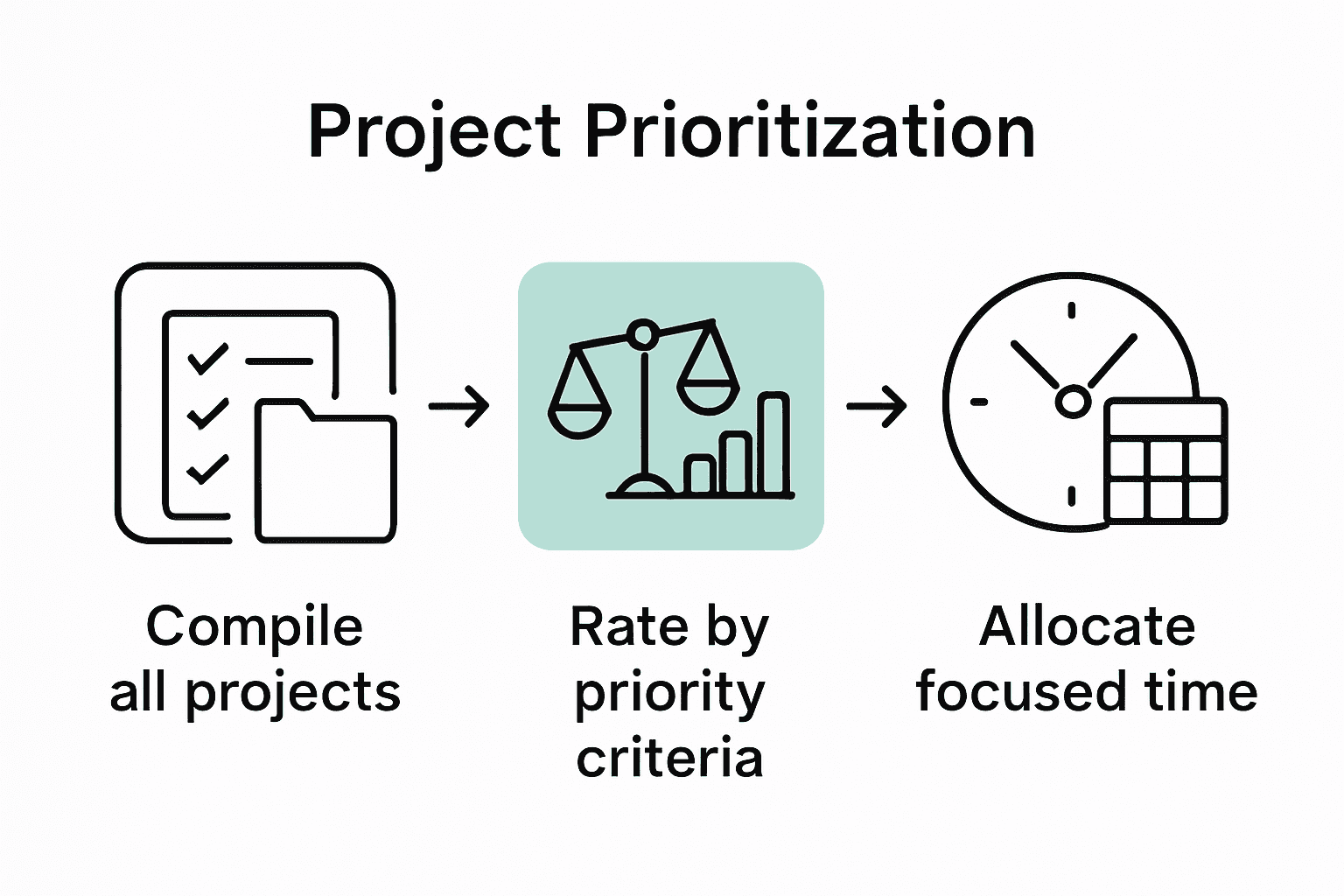
After estimating time and resources, the next critical step is systematically ranking your projects to determine their strategic importance. According to Wikipedia, project prioritization can be effectively achieved by using sophisticated performance metrics that integrate multiple dimensions such as scope, time, and cost into a single value-based index.
Develop a comprehensive ranking system that considers multiple priority criteria. The Wikipedia IpOp model suggests evaluating projects by identifying key decision factors and assessing their potential benefits and feasibility. Create a scoring matrix that assigns weighted points to factors like strategic alignment, potential return on investment, resource requirements, organizational impact, and alignment with long term goals. This approach transforms subjective decision making into an objective prioritization process.
Pro tip: Use a numerical scoring system where each project receives points across different evaluation categories. Assign higher weights to factors most critical to your organization such as revenue potential, strategic importance, or competitive advantage. This method allows you to create a transparent and defensible ranking that goes beyond gut feelings and provides a data driven approach to project selection.
Once you have ranked your projects, you will have a clear roadmap for resource allocation and strategic implementation.
Step 5: Allocate focused time for top priorities
Now that you have ranked your projects, the critical next step is strategically allocating your time and energy to ensure top priority projects receive the attention they deserve. The key is creating a focused work strategy that maximizes your productivity and prevents important initiatives from getting lost in day to day activities.
Start by blocking dedicated time slots specifically for your highest ranked projects. This means creating uninterrupted windows where you can concentrate solely on these critical tasks. Break these priority projects into smaller manageable chunks and assign specific time blocks in your schedule. Consider using a time management time blocking guide to help structure your approach and ensure you are giving adequate attention to your most important work.
Pro tip: Implement a strict no interruption policy during your designated priority project times. Silence notifications, find a quiet workspace, and communicate to colleagues that you are in deep work mode. This laser focused approach allows you to make substantial progress on your most important initiatives without getting derailed by less critical tasks.
By deliberately allocating focused time to your top priorities, you transform your project management from reactive task completion to strategic goal achievement.
Step 6: Review progress and adjust allocations
Regular project monitoring is essential for maintaining productivity and ensuring your strategic priorities remain on track. According to research from the International Journal of Project Management, effective project control requires systematic progress reviews and strategic resource reallocation.
Set up weekly or biweekly review sessions where you comprehensively assess each project’s status. Research by Ofer Zwikael suggests using structured evaluation models to track project performance against initial objectives. During these reviews, analyze key metrics such as completed tasks, remaining workload, potential bottlenecks, and actual time spent versus originally estimated time. Be prepared to make real time adjustments to your resource allocation strategy if certain projects are falling behind or emerging opportunities require immediate attention.
Pro tip: Create a standardized progress tracking template that allows you to quickly compare actual performance against your initial project ranking and time allocation. This visual representation will help you identify trends, recognize potential issues early, and make data driven decisions about redistributing your time and resources.
By consistently reviewing and adjusting your project allocations, you maintain flexibility and responsiveness in your project management approach.
Master Your Project Prioritization with Optio Station
Feeling overwhelmed by multiple projects all demanding your attention at once is a challenge many face. This article highlights the importance of creating an aggregate project list, assessing priorities, and blocking focused time for your top tasks. If you’ve struggled with transforming those concepts into daily action steps, you are not alone. Staying on track means overcoming distractions and finding a system that supports strategic, data-driven decisions and focused execution.
Discover how Optio Station, designed as the trusted second-in-command for Centurions like you, helps tackle exactly these issues. Our mobile app supports time and task management with a unique Roman theme that guides you through prioritization steps. Learn practical tips and app strategies in our CenturionTips collection where every tool aims to keep your projects aligned and your focus sharp.
Take control today by exploring Optio Station at our main site. Begin organizing your projects with confidence, allocate your energy wisely, and conquer your workload like a true Centurion. Get started now and experience project prioritization made simple and actionable. For extra productivity insights, visit ProductivityThoughts to strengthen your time management game.
Frequently Asked Questions
How do I list all my current and upcoming projects?
Start by gathering all existing project details into a single master list, including the project name, status, priority level, expected timeline, and primary stakeholders. Use a digital spreadsheet to enable real-time updates and collaborative tracking.
What criteria should I use to assess project importance?
To evaluate project importance, create a scoring system that takes into account potential impact, alignment with organizational goals, and resource requirements. Assign numerical weights to these factors to help prioritize projects based on their overall significance.
How do I estimate the time and resources needed for each project?
Break each project down into specific tasks and estimate the time required for each, considering potential roadblocks and team skill levels. Use a three-point estimation technique, calculating best case, worst case, and most likely scenarios to create realistic timelines.
What is the best way to rank projects using priority criteria?
Develop a ranking system that assesses projects based on multiple criteria such as strategic alignment, potential return on investment, and resource needs. Utilize a numerical scoring system to assign points across these categories, helping to create a clear ranking of projects.
How can I allocate time effectively to prioritize my top projects?
Block dedicated time slots for your highest-ranked projects, ensuring you create uninterrupted windows to focus solely on these tasks. Consider breaking projects into manageable chunks and scheduling specific time blocks to maximize productivity.
How often should I review project progress and make adjustments?
Conduct weekly or biweekly review sessions to assess each project’s status, including completed tasks and potential bottlenecks. Use a standardized progress tracking template to quickly identify trends and make data-driven decisions about reallocating resources as needed.
Recommended
- Understanding Prioritization Techniques Guide for Success – Optio Station: Best Project Management App for Prioritization
- Project Management Prioritization Matrix: Expert Guide – Optio Station: Best Project Management App for Prioritization
- Understanding Why Set Priorities for Success – Optio Station: Best Project Management App for Prioritization
- Understanding Prioritization Techniques for Success – Optio Station: Best Project Management App for Prioritization
