

Teams work better when three things are locked down: clear roles, shared measurable goals, and communication routines everyone actually follows. That’s the whole formula. Gallup found teams built on strengths-based partnerships see higher retention and more engagement. Below is a prioritized checklist, then focused sections that show you exactly how to build each piece, with Optiostation’s playbook woven in where it helps you move faster.
TL;DR:
- A team charter and daily quick connect are the most impactful starting points, addressing unclear ownership and stale communication habits.
- Clarifying roles through a bring/need statement exposes overlaps and gaps within 15 minutes, promoting shared ownership and accountability.
- Setting explicit communication norms, such as channel rules and response times, significantly reduces misunderstandings and unnecessary meetings.
- Regular routines like weekly retrospectives and recognition rituals build lasting team habits and improve morale with minimal time investment.
- Using a single, visible workflow tool for task management and ownership tracking simplifies progress updates and minimizes the need for status meetings.
Table of Contents
- 12 Ways to Improve Teamwork Starting This Week
- Clarify Goals, Roles, and Build a One-Page Team Charter
- Set Communication Norms That Actually Get Followed
- Why Psychological Safety Determines Whether People Speak Up
- How Should Your Team Make Decisions and Handle Conflict?
- Choosing Workflows and Tools That Keep Work Visible
- Building Routines That Make Teamwork a Habit
- What the Research Actually Says About High-Performing Teams
- Pick a Small Set of Changes and Make Them Stick
- Let Optiostation Handle the Coordination So You Don’t Have To
- Sources
- FAQ
12 Ways to Improve Teamwork Starting This Week
You don’t need a six-month change initiative to fix a dysfunctional team. Most of the friction people describe as “communication problems” or “culture issues” traces back to a handful of missing basics. Pick two or three from this list, implement them this week, and measure what changes before you add more.
- Write a one-page team charter. A charter forces the team to agree, in writing, on mission, goals, roles, and how you’ll handle disagreement. Book one hour, draft it together, and revisit it every quarter.
- Run a daily quick connect, not a status meeting. Ten minutes, three questions: what did you finish, what’s next, what’s blocked. Skip the narrative updates that belong in a doc.
- Clarify roles with a bring/need statement. Each person states what they bring to the team and what they need from others. This surfaces overlap and gaps in about fifteen minutes.
- Set explicit communication norms. Decide which channel is for what (chat for quick questions, email for anything needing a paper trail) and write it down so nobody guesses.
- Map strengths instead of job titles. Ask each teammate what they’re best at and assign stretch work accordingly. This is the practice behind Gallup’s engagement numbers, and it costs nothing to try.
- Make priorities visible to everyone, not just the manager. A shared board with the top three team priorities prevents five people from independently deciding what matters most.
- Require an ownership statement on every task. “This is done when X happens, and I own it” eliminates the ambiguity that turns into finger-pointing later.
- Set a retro cadence and stick to it. Fifteen minutes every two weeks: what worked, what didn’t, one thing to change. Skipping this is how small friction turns into resentment.
- Build a recognition ritual into an existing meeting. One minute at the end of your weekly sync for a shoutout costs nothing and measurably lifts morale over time.
- Give every meeting an agenda and a named decision-maker. If a meeting has no decision to make or agenda item, cancel it.
- Audit your recurring meetings once a quarter. Cut anything that could be an async update. Most teams are shocked by how much time this frees up.
- Pick one lightweight coordination tool and commit to it. A tool like Optiostation can centralize task ownership, check-ins, and deadlines so nothing lives in five different apps at once.
Start with the charter and the daily quick connect. Those two alone fix the majority of the coordination problems that show up in team retros.
Clarify Goals, Roles, and Build a One-Page Team Charter
A charter works because it forces decisions that usually stay implicit and get relitigated every time there’s friction. According to Psyche Guides, a short, co-created charter covering mission, roles, and interaction norms builds ownership in a way that a manager-written policy document never does. The word “co-created” matters. A charter handed down from leadership gets ignored. One the team writes together gets defended.
Your charter needs five things:
- Mission: one sentence describing what the team exists to accomplish, not a mission statement for the whole company.
- Measurable goals: two or three targets with numbers or dates attached, not “improve collaboration.”
- Roles and ownership: who owns what, using a simplified version of RACI (Responsible, Accountable, Consulted, Informed) if your team is more than four people.
- Behavior norms: how you handle disagreement, how fast you respond to messages, what “done” means.
- Decision rules: who decides what, and what happens when the team can’t agree.
Run the session in 30 to 60 minutes. Start by asking everyone to write down, silently, what they think the team’s top three goals are. Compare answers before you discuss. It’s common for a five-person team to produce five different answers, and that gap is exactly what the charter session is meant to close, per SHRM’s research on how managers shape team expectations.
For role clarity specifically, try the bring/need format: each person states what skill or resource they bring and what they need from teammates to do their job well. It surfaces duplicated effort and forgotten ownership faster than an org chart ever will.
Pro Tip: Put the charter in a shared doc everyone can edit, not a PDF. A charter nobody can update becomes a charter nobody follows.
Once roles are assigned, track ownership somewhere visible. A simple tracker, whether it’s a spreadsheet or a dedicated accountability system, keeps “who owns this” from becoming a recurring question in every meeting.
Set Communication Norms That Actually Get Followed
Most team communication breakdowns aren’t personality conflicts. They’re unstated expectations about response time and channel choice colliding in real time. Fix the norms and most of the “why didn’t you tell me” conversations disappear.
Set three rules explicitly:
- Channel rules: chat for anything needing a reply within hours, email for anything formal or external, a project tool for anything that needs a record.
- Response time expectations: define what’s urgent (same day) versus what can wait (24 to 48 hours), so nobody feels ignored and nobody feels obligated to answer at 9 p.m.
- Escalation path: state clearly when someone should loop in a manager instead of waiting on a peer response.
Meetings deserve the same rigor. Every meeting needs an agenda sent in advance, a fixed time limit, and a stated outcome before anyone books the room. A standup needs three questions and nothing more. A decision meeting needs a pre-read so debate happens on the substance, not on catching people up. McKinsey’s research on team health found that teams scoring above average on decision-making were 2.8 times more innovative than teams that weren’t, which is a strong argument for treating meeting structure as more than an afterthought.
Not everything needs a meeting. If a topic can be resolved with a written update and a 24-hour comment window, do that instead. Document the decision in writing wherever it lands, whether that’s a shared doc or a team communication tool, so the reasoning doesn’t live only in someone’s memory.
Why Psychological Safety Determines Whether People Speak Up
Psychological safety is the belief that you can raise a concern, admit a mistake, or challenge an idea without getting punished for it. Teams without it don’t lack good ideas. They lack the confidence to say them out loud, and that silence is expensive because problems surface late instead of early.
A few rituals build this faster than any values poster on the wall:
- Check-in rounds: start meetings with a 30 second answer from everyone, even a simple “how’s your week going,” to normalize speaking before the stakes get high.
- Structured feedback turns: go around the room in a fixed order so the loudest voice doesn’t dominate every discussion.
- A rotating devil’s advocate: assign someone each meeting to argue the opposite position, which gives dissent an official cover story.
- An outside observer: bring in someone from another team occasionally to flag gaps between what your team says it values and what it actually does.
Stanford’s research on workplace collaboration points to cooperative structures, not competitive ones, as the stronger driver of trust. Appointing a formal devil’s advocate role also helps, according to InTheBlack’s analysis, because it catches the gap between a team’s stated norms and its actual behavior before that gap turns into a real mistake.
Healthy conflict has two modes worth naming out loud: the boxing ring, where people debate an idea hard and then let it go, and the campfire, where people process how a decision landed emotionally. Teams that only know the boxing ring burn people out. Teams that only know the campfire never resolve anything.
Pro Tip: Ask “what would make this idea fail?” instead of “does anyone disagree?” The first question gives people permission to critique without singling anyone out.
How Should Your Team Make Decisions and Handle Conflict?
Slow decisions almost always trace back to one missing thing: nobody agreed in advance on who actually decides. Fix that first, before you touch anything else about your decision process.
Split decisions into three types and treat each differently:
- Reversible, low-stakes calls: one person decides, informs the team, moves on. No meeting required.
- Reversible, high-stakes calls: the owner decides after a short round of input, but doesn’t wait for consensus.
- Irreversible calls: the full team weighs in, and a named leader makes the final call if agreement doesn’t happen within a set time.
Write down who has final say on each category before conflict happens, not during it. Escalation should have a clear trigger too. If two people can’t resolve something after one honest conversation, it goes to the manager within 48 hours rather than festering in the background.
Bias creeps into fast decisions more than slow ones, so build in a check. Ask someone to actively search for disconfirming evidence before the team commits. Assign a structured debate where one side argues for the decision and one against, even if everyone privately agrees. McKinsey’s data on decision-making as a top driver of team innovation backs this up directly: teams that debate structurally outperform teams that rubber-stamp the first plausible idea.
Choosing Workflows and Tools That Keep Work Visible
The right tool is boring by design. It’s the one your team will actually open every day, not the one with the most features. Pick a single source of truth for task status, keep the friction to enter and update information low, and make sure the tool fits habits your team already has instead of forcing a new one.
A few workflow principles do more work than any feature list:
- One visual board for the whole team, so status isn’t scattered across five different tools and three group chats.
- Priority tags on every task, so “urgent” isn’t decided by who yells the loudest in chat.
- Named owners on every card, not just an assigned team.
- Simple work-in-progress limits, capping how many tasks one person can have “in progress” at once to stop context switching from quietly wrecking output.
Time tracking earns its place here too, not as surveillance but as diagnosis. When you can see how long handoffs actually take, you find the bottleneck that “it feels slow” conversations never surface. A collaboration workflow that makes ownership and deadlines visible in one place removes the need for status update meetings almost entirely, since anyone can check progress without interrupting anyone else.
Building Routines That Make Teamwork a Habit
Teamwork improves when the good behaviors are scheduled, not left to individual willpower. A team that “means to” check in regularly does it for two weeks and then stops. A team with a fixed cadence does it for a year.
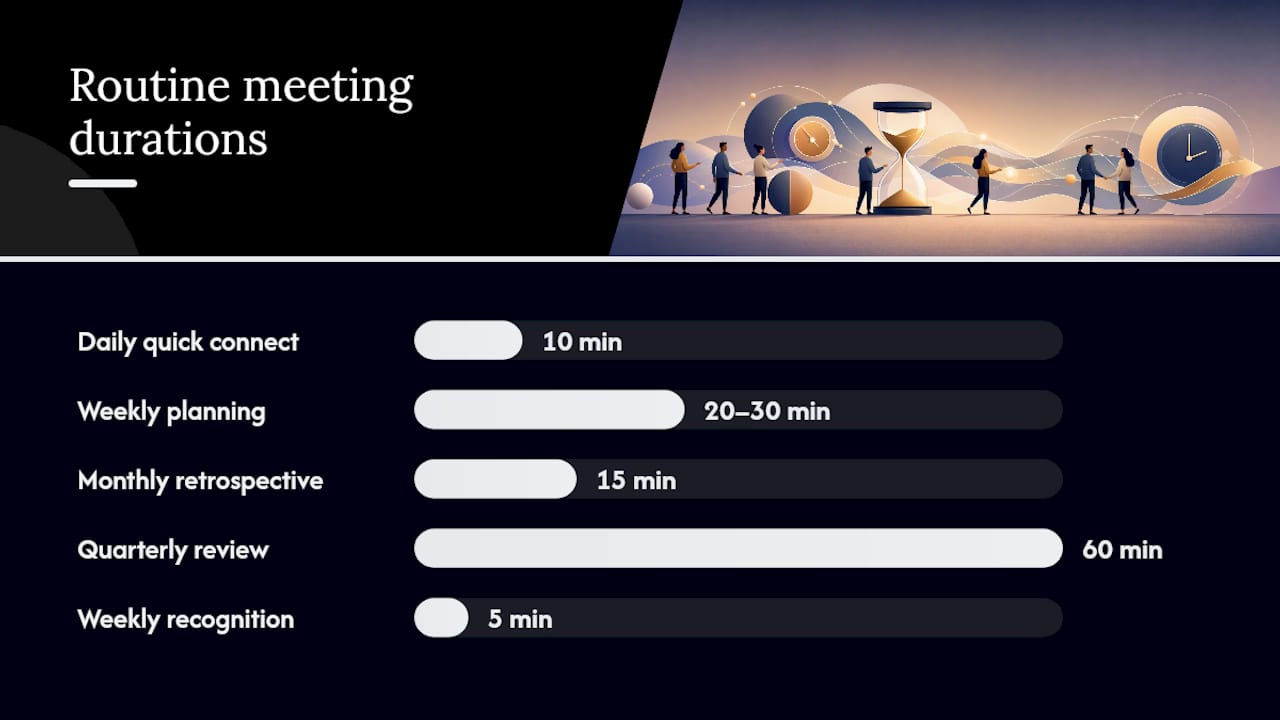
- Daily quick connects (10 minutes): status, blockers, next step. No exceptions, no skipping for “nothing to report.”
- Weekly planning (20 to 30 minutes): confirm priorities for the week and reassign anything that shifted.
- Monthly retrospectives (15 minutes): what worked, what didn’t, and one concrete change to try next month.
- Quarterly reviews (60 minutes): revisit the team charter, update goals, and check whether roles still make sense.
A retro doesn’t need to be complicated. Ask three questions: what should we keep doing, what should we stop, what should we start. Fifteen minutes is enough if you keep the discussion focused on one change, not five.
Pair that with a five-minute recognition ritual at the end of a weekly meeting. One person names a teammate’s specific contribution from that week. It sounds small. It’s one of the cheapest ways to raise morale that a team can adopt without spending a dollar.
Track a few team health signals over time: cycle time on tasks, how often work gets stuck waiting on someone, and a simple sentiment pulse (a 1 to 5 rating on “how did this week feel”) collected weekly. None of these require sophisticated tooling, just consistency.
What the Research Actually Says About High-Performing Teams
Two major bodies of research back nearly everything in this article, and they agree on more than you’d expect from organizations with very different methods.
Gallup’s strengths-based framework centers on four steps: clarity on what each person contributes, shared definitions of success, a clear sense of purpose, and regular check-ins to keep all three aligned. Strengths-based language also gives teams a shared vocabulary for differences that would otherwise read as friction, turning “why does she work that way” into “that’s just how her strengths show up.”
McKinsey’s research groups team health into four categories: configuration, alignment, execution, and renewal. Trust, communication, innovative thinking, and decision-making are the drivers that most strongly predict performance within those categories.
Leaders consistently underestimate what McKinsey calls the “perception gap,” where a team knows the behaviors it should practice but fails to actually practice them day to day. Closing that gap takes structural changes like a written charter and scheduled check-ins, not another values conversation.
The charter and the check-in cadence covered earlier map directly onto these drivers. A charter forces alignment. A daily quick connect builds the communication muscle McKinsey measured. Retros build the renewal function that keeps a team from calcifying around outdated norms.
- Gallup’s four-step model: contribution clarity, shared success, purpose, check-ins.
- McKinsey’s top predictors: trust, communication, innovative thinking, decision-making.
- Both frameworks point to the same fix: write things down, check in often, and revisit regularly.
Optiostation’s own approach to teamwork and collaboration grew out of watching student teams and early-career professionals struggle with exactly this gap: knowing what good teamwork looks like but lacking the structure to practice it consistently.
Pick a Small Set of Changes and Make Them Stick
If you take one thing from everything above, take this: don’t try to fix your team’s collaboration in one sweeping initiative. Pick two changes. The team charter and the daily quick connect are the highest-leverage pair for most managers, because they fix the two problems that cause the most downstream friction: unclear ownership and stale information.
Busy managers fail at team improvement not because they choose the wrong tactics but because they choose too many at once and abandon all of them within a month. A charter takes one hour to draft. A daily quick connect takes ten minutes and no preparation. Both compound because they create the habit of talking about work openly, which makes every other tactic on this list easier to introduce later.
This playbook leans on the same logic: start small, make ownership visible, and build routines around check-ins rather than one-off meetings that everyone forgets about within a week. The goal isn’t a perfect system on day one. It’s a system your team will still be using in six months.
— Optiostation
Let Optiostation Handle the Coordination So You Don’t Have To
Most of what breaks teamwork isn’t a mindset problem, it’s a visibility problem: nobody can see who owns what, deadlines live in five different places, and check-ins get skipped because there’s no easy place to run them. There are tools that give students and young professionals one place to assign task ownership, run quick check-ins, track time, and keep priorities visible without opening a separate tool for each piece.
Color-coded organization and reminder systems can help ensure a team charter and its assigned roles don’t get forgotten shortly after the meeting that created them. If you’re trying to put the ownership tracker or retro cadence from this article into practice, a task management system built for prioritization makes the habit easier to keep than a shared spreadsheet nobody updates. Teams working through the accountability and communication gaps covered here often find that tracking tasks in one visible place removes the need for half their status meetings. Start by adding your team’s charter and this week’s top three priorities into a task management system and see how many status questions disappear on their own.
Sources
- How to improve teamwork and build high-performing teams | Gallup
- Go, teams: When teams get healthier, the whole organization benefits | McKinsey
- How to build team spirit | Psyche Guides
- How to Improve Teamwork | SHRM
FAQ
What should be in a one-page team charter?
A team charter should include a one-sentence mission, two or three measurable goals, clearly assigned roles, agreed-upon behavior norms, and rules for how decisions get made when the team disagrees.
How often should a team run retrospectives?
Monthly retrospectives of about 15 minutes work well for most teams, paired with a lighter weekly planning check-in and a quarterly review of the team charter itself.
What is psychological safety and why does it matter for teamwork?
Psychological safety is the confidence that speaking up, admitting a mistake, or challenging an idea won’t lead to punishment, and teams with it surface problems earlier instead of letting them compound.
How can a tool like Optiostation improve team collaboration?
Optiostation centralizes task ownership, check-ins, and priorities in one visible place, which reduces the status meetings and missed handoffs that fragmented tools tend to create.
How do you measure whether teamwork is actually improving?
Track cycle time on tasks, how often work sits blocked waiting on someone, and a simple weekly sentiment score, since all three shift quickly once charter and communication changes take hold.
