

TL;DR:
- Only 31% of projects are fully successful, often due to leadership clarity issues.
- Effective project leaders set vision, manage portfolios, and improve processes; methodologies vary.
- Clear communication, delegation, and time management are crucial for successful team project management.
Only 31% of projects are fully successful, and that number holds whether you’re a seasoned director or a sophomore managing your first group assignment. The gap between teams that deliver and teams that spiral into missed deadlines and confused roles usually comes down to one thing: leadership clarity at the top. If you’re a college student stepping into a team lead role or a young professional eyeing your first official project management title, understanding how the head of project management actually operates gives you a serious edge. This article walks you through the role, the right methodologies, team tactics, and time strategies that separate good managers from great ones.
Table of Contents
- What is the head of project management?
- Essential methodologies: Waterfall, Agile, and hybrid approaches
- Team management: Delegation, roles, and communication tools
- Time management strategies for leaders
- What most project management advice gets wrong
- Boost your project outcomes with the right tools
- Frequently asked questions
Key Takeaways
| Point | Details |
|---|---|
| Career path clarity | Project management offers a clear progression from coordinator to director with big pay jumps along the way. |
| Methodology matters | Choosing the right framework—Agile, Waterfall, or hybrid—can make group projects and early jobs much smoother. |
| Team clarity prevents failure | Defining roles and using communication tools stops most project breakdowns. |
| Smart time management | Effective heads avoid multitasking and use strategies like time blocking and delegation. |
| Adapting wins over following rules | Project leaders who adapt methods to their teams outperform those who rigidly follow textbook advice. |
What is the head of project management?
The head of project management is the person responsible for setting the direction, aligning team efforts with organizational goals, and making sure projects cross the finish line on time and within scope. This isn’t just someone who tracks tasks on a spreadsheet. It’s the person who decides how the team works, who does what, and what success looks like before a single deadline is set.
Core responsibilities at this level include:
- Vision setting: Defining what a successful project outcome looks like and communicating it clearly
- Portfolio oversight: Managing multiple projects or teams simultaneously
- Stakeholder alignment: Keeping clients, professors, or executives informed and on board
- Risk anticipation: Spotting problems before they derail progress
- Process improvement: Constantly refining how the team works together
For students and young professionals, the path to this role follows a clear ladder. Project management roles progress from coordinator at around $64,600 per year all the way up to director at $156,500 or more. Each step up demands more strategic thinking and less hands-on task execution.
| Level | Focus | Avg. Salary |
|---|---|---|
| Coordinator | Task tracking, admin support | $64,600 |
| Project Manager | Delivery, team management | $95,000 |
| Lead PM | Multi-project oversight | $115,000 |
| Director | Strategy, org-wide leadership | $156,500 |
The smart move early in your career is building the habits of a director while you’re still a coordinator. That means practicing delegation, improving how you communicate goals, and using project management software for students to keep everything visible and organized. Building a strong portfolio at the student stage also signals seriousness to future employers before you ever apply for a senior role.
Essential methodologies: Waterfall, Agile, and hybrid approaches
Choosing the wrong methodology for your team is like using a hammer to tighten a screw. It might work technically, but you’ll make a mess and waste time. Here’s how the three main approaches break down for student and early-career environments.
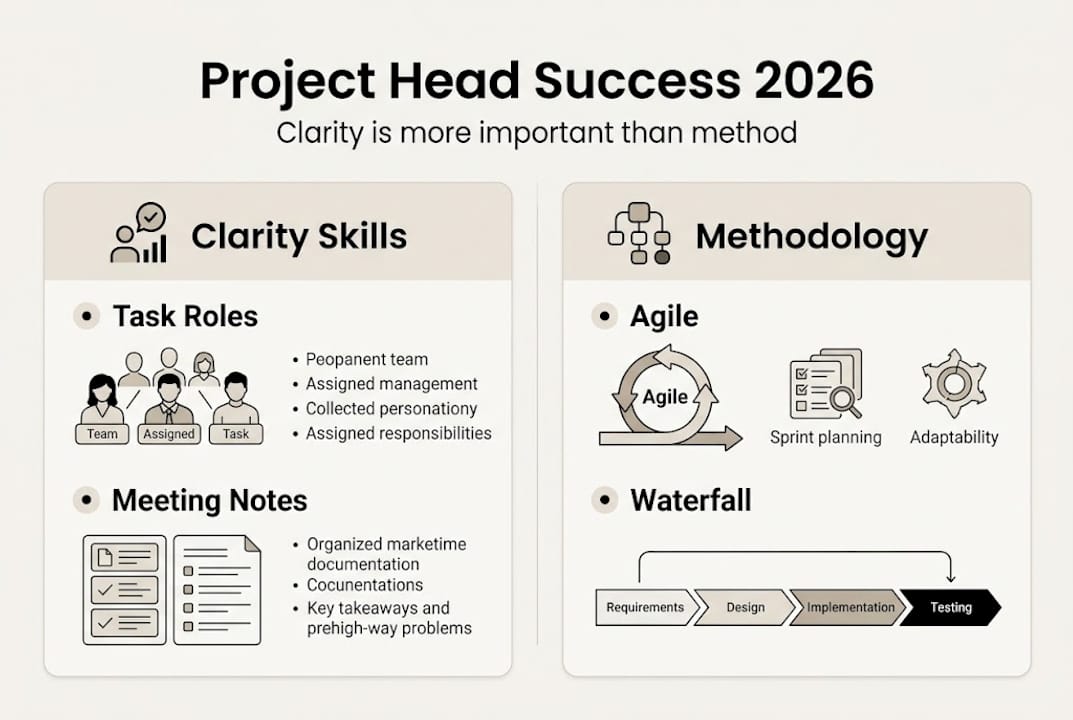
Waterfall is linear. You plan everything upfront, complete each phase before moving to the next, and deliver the final product at the end. It works well for fixed-scope assignments like a research paper with clear deliverables and no room for pivoting mid-project.
Agile is iterative. Your team works in short cycles called sprints, constantly reviewing and adjusting based on feedback. Agile suits evolving teams, while Waterfall fits fixed scopes, and hybrid adoption has climbed to 57% among modern organizations.

Hybrid blends both. You might plan your project structure using Waterfall but execute weekly check-ins and adjustments using Agile principles. This is increasingly popular because it handles the unpredictability of real-world and student group projects without sacrificing structure.
Here’s a side-by-side breakdown:
| Methodology | Best For | Weakness |
|---|---|---|
| Waterfall | Fixed deliverables, rigid deadlines | Poor at handling mid-project changes |
| Agile | Evolving group projects, creative work | Can lack structure without discipline |
| Hybrid | Most real-world and student scenarios | Requires clear planning upfront |
Common mistakes new project leaders make with methodology:
- Locking into Waterfall when the project scope isn’t fully defined yet
- Using Agile without setting clear sprint goals, leading to endless cycles
- Adopting hybrid without deciding who owns the planning versus execution phases
- Switching methodologies mid-project without telling the whole team
Pro Tip: Before your next group project kicks off, spend 15 minutes answering this question as a team: “How likely is our scope to change?” High likelihood means lean Agile. Low likelihood means Waterfall works fine. Either way, document the decision. Explore a detailed breakdown of which tools support each approach.
Team management: Delegation, roles, and communication tools
Here’s an uncomfortable truth about student group projects: 44% of projects fail due to poor communication, and RACI charts are one of the clearest ways to fix that before it starts.
A RACI chart assigns every task to four categories: Responsible (does the work), Accountable (owns the outcome), Consulted (gives input), and Informed (kept in the loop). When everyone knows exactly where they stand on each task, the “I thought you were doing that” conversations disappear.
Key delegation principles that strong project heads follow:
- Assign tasks based on strengths, not availability alone
- Set clear deadlines at the task level, not just the project level
- Give people ownership over outcomes, not just instructions to follow
- Build in checkpoints so problems surface early, not at the deadline
“Clarity is the most underrated project management skill. A team that knows exactly who owns what will consistently outperform a smarter team working in confusion.”
Communication pitfalls are especially common among student teams and new professionals. Assuming everyone checks the same app, over-relying on group chats, or skipping documentation after verbal decisions are all habits that create chaos fast. Pair your team with task management tools that centralize updates so nothing falls through the cracks.
For running productive check-ins, use time blocking techniques to protect meeting time without letting it expand. A 20-minute weekly sync with a shared agenda beats a 90-minute freeform discussion every single time.
Pro Tip: End every meeting with three written outputs: decisions made, tasks assigned with owners and due dates, and the next meeting date. Three sentences. That’s all it takes to cut follow-up confusion by half.
Time management strategies for leaders
The biggest time trap for project heads isn’t slacking. It’s drowning in the wrong kind of work. Admin tasks consume up to 50% of a project manager’s time, and multitasking actively reduces productivity rather than increasing it. If you’re constantly switching between tasks, you’re not managing time. You’re reacting to it.
Here are the top strategies strong project heads use to reclaim their time:
- Eisenhower matrix: Sort every task by urgency and importance. Do urgent and important tasks now. Schedule important but not urgent tasks. Delegate urgent but unimportant tasks. Drop everything else.
- Time blocking: Assign specific blocks of your calendar to specific categories of work. No meetings during deep work blocks. No deep work during admin blocks.
- Weekly reviews: Spend 20 minutes every Friday reviewing what moved forward and what got stuck. This prevents small problems from compounding.
- Automation and AI tools: Use tools that handle status updates, reminders, and progress tracking automatically so you can focus on decisions, not data entry.
- Certification investment: Certifications improve project estimation accuracy and strengthen risk control, both of which save enormous amounts of time on real projects.
For students juggling classes, part-time jobs, and group projects, time management isn’t a nice-to-have. It’s survival. The Eisenhower matrix works especially well because it forces you to stop treating every task as equally urgent. Most tasks that feel urgent actually aren’t. A task management software guide can help you find the right digital tool to make these systems stick without adding more friction to your workflow.
The project heads who consistently deliver results aren’t the ones who work the longest hours. They’re the ones who protect their highest-value time fiercely and delegate everything else with confidence.
What most project management advice gets wrong
Most project management advice treats methodology like a religion. Pick Agile or Waterfall, learn the rituals, and follow them perfectly. In practice, that approach fails most teams because it ignores the actual humans doing the work.
We’ve seen student teams burn out trying to run textbook Agile sprints when their schedules make weekly syncs nearly impossible. We’ve also seen young professionals waste weeks building Waterfall timelines for projects where the client changes direction every other day. The framework isn’t the problem. The rigid application of it is.
The real insight most guides skip is this: your job as a project head is to influence clarity, not control every variable. You can’t force a teammate to communicate better by adding another tool. You can create an environment where communication feels safe, simple, and expected. That’s a leadership skill, not a software feature.
Communication failures are almost always more expensive than choosing the wrong methodology. A team using the “wrong” method but talking openly will outperform a team using the “right” method that avoids hard conversations. Start there before you optimize anything else.
Boost your project outcomes with the right tools
Knowing the strategies is step one. Putting them into action with the right support is where real results happen. Optio, your second-in-command, is built specifically for Centurions like you who need to manage tasks, coordinate teams, and protect their time without the complexity of enterprise tools.
Beyond the app, Optio Station offers curated guides to help you move fast. Explore the top time management apps to find the tools that fit your workflow, dive into a practical team collaboration guide for structuring your group projects, or use the best task management software breakdown to match your team’s needs with the right platform. Your command structure starts here.
Frequently asked questions
What skills are most important for the head of project management?
Strong communication, time management, and methodology flexibility are the foundation. 44% of project failures trace back to poor communication, making it the single most critical skill to develop first.
How does project management career progression work?
You typically start as a coordinator, move to project manager, then lead PM, and eventually director. Salary ranges jump significantly at each level, from $64,600 at the coordinator stage to $156,500 at the director level.
Which project management methodology is best for college projects?
Agile works best when your group’s goals or requirements shift often. Waterfall is a better fit for assignments with clear, fixed deliverables. Agile suits evolving teams while Waterfall serves structured, predictable scopes.
Why do so many projects fail?
Miscommunication, unclear roles, and poor time management are the leading causes. Only 31% of projects hit full success, and 44% fail specifically because of communication breakdowns across teams.
Recommended
- 7 Key Examples of Project Management You Can Learn From – Optio Station: Best Project Management App for Prioritization
- Understanding the Role of Project Management in Success – Optio Station: Best Project Management App for Prioritization
- Command Log – Optio Station: Best Project Management App for Prioritization
- Project time management: proven strategies for students and pros – Optio Station: Best Project Management App for Prioritization
