

Professional development goals are future-focused capability targets, not performance scores. The method that actually works is simple: pick a skill gap, write it as a SMART outcome with a deadline, then convert that outcome into a specific behavior you can schedule this week. Choose one to three goals, not ten, and put a review on your calendar for 30 to 90 days out.
TL;DR:
- Focus on friction points that directly block your progress, especially recurring tasks you avoid or perform poorly at, instead of trendy skills.
- Write goals as specific, measurable, achievable, relevant, and time-bound outcomes that can be broken into immediate, scheduled behaviors.
- Convert goals into concrete actions tied to triggers, such as scheduling a reminder or recurring task, to ensure consistent habit formation.
- Limit yourself to one to three goals at a time and schedule reviews every 30 to 90 days to track progress and adjust as needed.
- Use digital tools to attach reminders and tracking to your behaviors, making it easier to maintain consistency and avoid losing momentum.
Table of Contents
- What Are Goals for Professional Development, Exactly?
- Why Do Professional Development Goals Matter for Career Advancement?
- How Do You Set Professional Development Goals That Actually Work?
- What Are Some Good Examples of Professional Development Goals?
- How Do You Make Development Goals Actually Stick?
- How Optiostation Thinks About Turning Goals Into Habits
- Why Behavior-First Beats Every Other Goal-Setting Approach
- Track Your Development Goals Without Losing the Thread
- Sources
- FAQ
What Are Goals for Professional Development, Exactly?
Professional development goals target the skills, behaviors, and credentials you need for a role you don’t have yet. Performance goals, by contrast, measure how well you’re doing the job you already have, things like quota, ticket volume, or project deadlines.
The distinction matters more than it sounds. A performance goal might be “close 15 deals this quarter.” A development goal is “get comfortable negotiating enterprise contracts so I can handle accounts twice this size next year.” One measures output. The other builds capacity.
According to UW-Madison’s guidance on career goals, framing objectives around future capabilities rather than current output improves readiness for promotion, because you’re building the exact muscle a hiring manager will look for before you need it, not after.
Capability-focused goals tend to fall into a few buckets: communication skills (public speaking, written persuasion), leadership behaviors (delegation, giving feedback), technical skills (a certification, a new software platform), and strategic habits (networking, personal branding). Each one answers a different question: what does the next version of my job actually require that I don’t have yet?
That framing changes how you evaluate progress, too. You’re not asking “did I hit the number.” You’re asking “can I now do the thing I couldn’t do three months ago.” That’s a harder question to fudge, and a much better one for career mobility.
Why Do Professional Development Goals Matter for Career Advancement?
Promotion decisions rarely hinge on someone doing their current job well enough. They hinge on evidence you can already do the next one. That’s the entire logic behind development goals: they’re a rehearsal for a role you don’t hold yet, built while you’re still in the one you do.
Organizations benefit from this too, in ways that go beyond individual careers. Employees who are visibly building new capabilities tend to stick around longer, because they can see a path that doesn’t require quitting to get somewhere new. Teams with a mix of developing skill sets adapt faster when priorities shift, since someone’s already halfway competent in the thing the team suddenly needs.
The evidence on how these goals should be structured is fairly blunt. MIT Sloan Management Review’s research found that fast, specific goals frequently outperform slower, broadly stated ones, particularly when the goal prioritizes clear, time-bound action over an impressive-sounding long-term ambition. A goal to “improve leadership” loses to a goal to “run one team retro per week using a specific feedback format, starting Monday.”
That’s a useful gut check before you write a single goal down. If it can’t be turned into a scheduled action within the next few days, it’s still an aspiration, not a goal.
How Do You Set Professional Development Goals That Actually Work?
The method has four steps, and skipping any one of them is why most development goals quietly die by March. Here’s the sequence.
1. Find the actual friction point, not the trendy skill.
Skip the generic “improve communication” instinct and look backward from the role you want. What does that job require that you can’t yet do well? Better still: what task do you currently avoid, delay, or consistently get mediocre feedback on? That recurring friction point is usually the highest-leverage place to put your energy, because removing it doesn’t just check a box, it removes something that’s been quietly capping your performance for months.
2. Write it as a SMART outcome.
Specific, Measurable, Achievable, Relevant, Time-bound. This isn’t a checklist to satisfy, it’s a filter that kills vague goals before they waste your quarter. “Get better at presenting” isn’t SMART. “Deliver three internal presentations by the end of Q2, each rated 4/5 or higher on the post-meeting feedback form” is.
3. Convert the outcome into a behavior with a trigger.
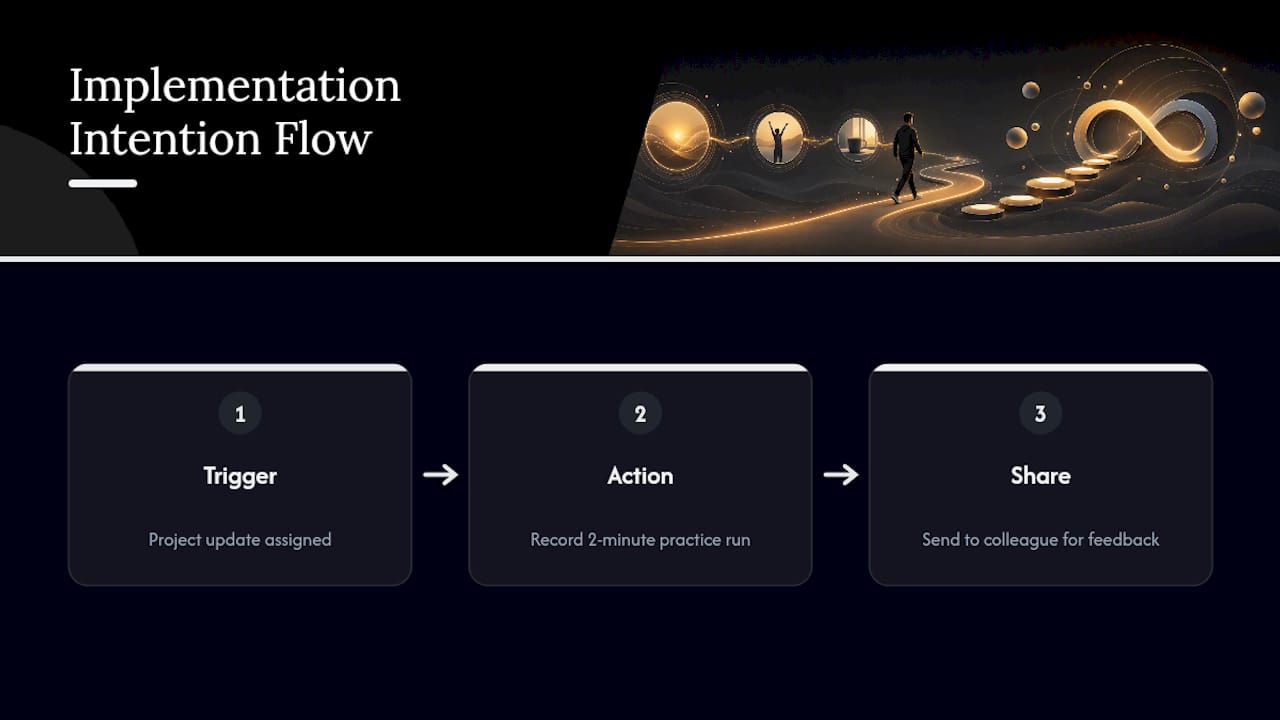
This is the step almost everyone skips, and it’s the one Gwork identifies as the actual differentiator between goals that stick and goals that don’t. An outcome tells you where you’re going. An implementation intention tells you exactly when and how you’ll act on it. The format: “When [trigger] happens, I will [minimum viable action].” For the presentation example: “When I’m assigned a project update, I will record a two-minute practice run the night before and send it to one colleague for feedback.” Small, specific, and impossible to forget because it’s tied to something that already happens on its own.
4. Prioritize ruthlessly and schedule the review.
Pick one to three goals, no more. Trying to build five new capabilities at once splits your attention so thin that none of them get enough repetition to become habit. Put a review on your calendar now, not “eventually,” for 30, 60, or 90 days out, depending on the goal’s complexity.
Pro Tip: Write your implementation intention as a literal calendar event, not a note. “When I open my inbox Monday at 9 AM, I will spend 15 minutes on X” scheduled as a recurring block beats a sticky note every time.
What Are Some Good Examples of Professional Development Goals?
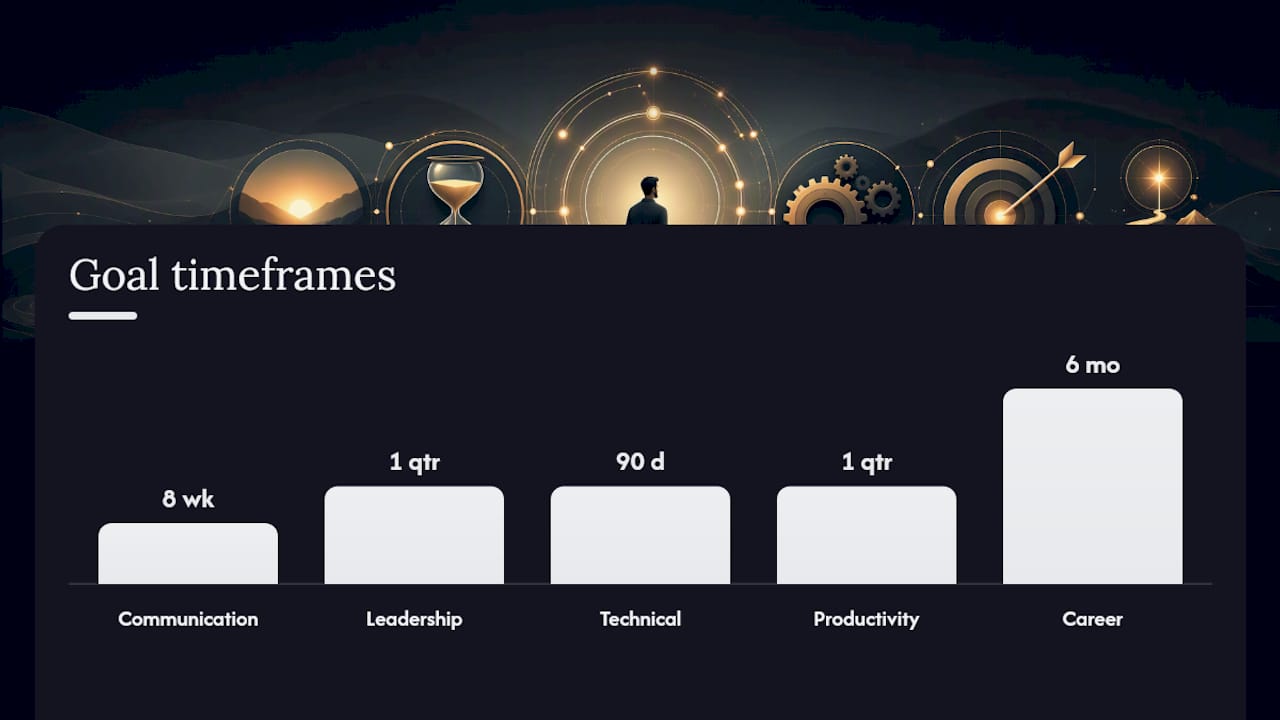
Development goals fall into five broad territories, and grouping them this way makes it easier to spot which gap actually matters for where you’re headed next. Each example below pairs a SMART outcome with the implementation intention that makes it actually happen.
Communication and influence
- Deliver one structured update in every team meeting for eight weeks, using a consistent three-point format, and ask for feedback from your manager at week four. When the meeting agenda goes out, I will draft my three points the night before.
- Write one internal document per month that gets shared beyond your immediate team by quarter’s end. When I finish a project, I will draft a one-page summary before moving to the next task.
- Practice a two-minute “elevator pitch” of your current project until you can deliver it without notes, tested on three colleagues within 30 days. When I take a coffee break, I will run the pitch on whoever’s in the kitchen.
Leadership and management
- Delegate one recurring task per month to a teammate for professional growth, with a check-in after two weeks. When I list my Monday tasks, I will flag one to hand off before I start working.
- Run structured one-on-ones with direct reports using a consistent feedback format for one full quarter. When my calendar shows a one-on-one, I will fill out the prep template the day before.
- Give one piece of specific, unsolicited positive feedback to a colleague each week for two months. When I finish reviewing someone’s work, I will send a two-sentence note before closing the file.
Technical and certification
- Complete a relevant certification within 90 days by studying in fixed blocks rather than cramming. When I sit down after lunch, I will study for 25 minutes before checking email.
- Learn one new software feature or tool per month and apply it to a live project within the same month. When I finish onboarding to a new tool, I will use it on the next task instead of the old method.
Productivity and time management
- Reduce time spent in unstructured meetings by 20% over one quarter by proposing agendas in advance. When I’m invited to a meeting with no agenda, I will ask for one before accepting.
- Complete a weekly priority review every Friday for eight consecutive weeks. When I close my laptop Friday afternoon, I will spend ten minutes planning next week’s top three tasks.
Career strategy and networking
- Have one substantive career conversation with someone outside your immediate team every month for six months. When I schedule my week, I will book one coffee chat before Wednesday.
- Update a professional profile or portfolio with one new accomplishment every quarter. When a project wraps, I will add it to my profile before starting the next one.
Someone early in their career benefits most from communication and technical goals, since those build the visible competence that gets you noticed. Mid-career professionals usually get more mileage from leadership and productivity goals, the skills that separate individual contributors from people trusted to run something. Senior professionals tend to see the biggest return from career strategy and networking goals, because by that point, who knows your work matters as much as the work itself.
Organizing goals this way, by category rather than by job title, also makes it easier to align your personal targets with what your team or manager already cares about, which matters more than most people realize when review season rolls around.
How Do You Make Development Goals Actually Stick?
Writing a good goal is the easy part. Sticking with it past week three is where almost everyone drops off, and the fix isn’t more motivation, it’s better structure.
1. Track it somewhere visible, even if it’s crude.
A simple daily check mark or weekly tally works better than a complex spreadsheet nobody opens. Tracking progress, even informally, meaningfully increases the odds a goal gets finished rather than quietly abandoned, according to gwork.io’s research on professional development goals. The mechanism isn’t complicated: seeing three missed check marks in a row is a nudge most people respond to before they’d otherwise notice they’d stopped.
2. Build in accountability that isn’t a formal review.
The most useful kind of manager involvement isn’t a performance evaluation, it’s a quick, low-stakes check-in. Harvard Business School Online’s guidance on achieving development goals points out that managers are most helpful when they’re asked to simply observe a specific behavior and give short, direct feedback, not deliver a verdict. Ask your manager to watch for one specific thing over the next month rather than requesting a general assessment.
Peer accountability works just as well, sometimes better, since a colleague who knows what you’re working on will notice a missed week faster than a manager checking in once a quarter.
3. Set a cadence and stick to it.
- Weekly: A five-minute check on whether the scheduled behavior actually happened.
- Monthly: A slightly longer look at whether the behavior is producing the outcome you expected, and whether the trigger still fires reliably.
- Quarterly (or at 90 days): A formal review where you decide to keep the goal, adjust the metric, or retire it and pick the next friction point.
Pro Tip: If a goal survives three straight weekly check-ins with zero progress, the problem usually isn’t motivation, it’s that the trigger you picked doesn’t happen often enough. Swap it for something that occurs daily.
How Optiostation Thinks About Turning Goals Into Habits
Development goals fail less often from bad intentions than from bad logistics: the trigger gets forgotten, the review never gets scheduled, the tracking lives in a notebook nobody opens twice. A digital workflow doesn’t fix motivation, but it does fix logistics, by attaching your implementation intention to a task list, a reminder, or a recurring calendar block instead of your memory.
Practically, that means mapping each goal to three things: a recurring task entry for the behavior itself, a reminder tied to the trigger you identified, and a dashboard view you glance at during your weekly or monthly check-in. The tool matters less than the consistency of the mapping.
Why Behavior-First Beats Every Other Goal-Setting Approach
Most advice on professional development goals stops at the SMART outcome and calls it done. That’s the part almost everyone gets right and it’s also the part that changes the least behavior on its own. Writing “become a stronger public speaker by Q3” as “deliver three presentations rated 4/5 by Q3” is progress, but it still doesn’t tell you what to do on a random Tuesday.
The gap between goals that get written down and goals that actually change someone’s career is the implementation intention, the trigger and minimum action that turns a quarterly ambition into something you do this week. Conventional advice treats that step as optional polish. It isn’t. It’s the entire mechanism.
If you take one thing from this article, prioritize the friction point over the impressive-sounding skill. The task you avoid, the feedback you keep hearing, the thing that quietly caps your ceiling. That’s where a development goal earns its keep, not in the skill that looks good on a self-review.
— Optiostation
Track Your Development Goals Without Losing the Thread
Turning a SMART outcome into a habit requires something to hold the trigger, the action, and the streak in one place, which is exactly the gap Optiostation was built to close. Development goals can become task anchors with reminders, so the behavior you scheduled, not just the outcome you hoped for, shows up on your list when the trigger fires. Dashboards may track your streak over the 30, 60, or 90 day window you set for review, and color-coded categories can make it easier to see whether a leadership goal is getting attention or slipping.

Start with the free plan and set up one goal this week using SMART career development goal examples as a template, or read the full breakdown of how to keep track of tasks at work if you want the tracking system built out before you commit to the goal itself. Whatever tool you land on, pick the one that matches how you actually work, not the one with the most features.
Sources
- Setting Career Goals | Professional Development | UW–Madison
- How to Set Professional Development Goals That Actually Stick 2026
- 7 Ways You Can Achieve Your Professional Development Goals
- With goals, fast beats smart | MIT Sloan Management Review
FAQ
What Is the Difference Between a Development Goal and a Performance Goal?
A performance goal measures how well you’re doing your current job, like sales numbers or deadlines met. A development goal builds a capability you’ll need for a future role, like a new skill or certification.
How Many Professional Development Goals Should I Set at Once?
Stick to one to three goals at a time. Spreading attention across more than that reduces the odds any single goal survives long enough to become a habit.
How Often Should I Review My Professional Development Goals?
Review progress weekly for a quick check, and hold a formal review every 30 to 90 days to decide whether to keep, adjust, or replace the goal.
What Is an Implementation Intention in Goal Setting?
It’s a specific plan in the format “when X happens, I will do Y,” pairing a trigger with a minimum action so the goal happens automatically instead of relying on willpower.
Can a Task Management App Help With Professional Development Goals?
Yes. An app like Optiostation can turn a goal’s implementation intention into a scheduled reminder and a trackable streak, which keeps the behavior from getting lost between review dates.
