

TL;DR:
- Effective employee goal setting involves using SMART criteria to create clear, measurable targets aligned with business priorities. Regular reviews and collaborative processes increase commitment, while balancing performance and development goals supports both immediate results and long-term growth. Focusing on 3 to 5 goals enhances progress and accountability throughout the year.
Goal setting for employees is the practice of defining clear, measurable targets that align individual effort with company objectives to drive productivity and professional growth. When employees know exactly what they are working toward and why, performance improves across the board. Employees aligned with company goals are 35% more productive, and top performers align their goals 21–26% more than their peers. That gap is not accidental. It reflects a deliberate system of structured goal planning, regular reviews, and shared ownership between managers and their teams. This guide covers the full picture: SMART criteria, balancing performance with development, collaborative goal creation, and the review cycles that keep goals alive.
How to set effective employee goals using SMART criteria
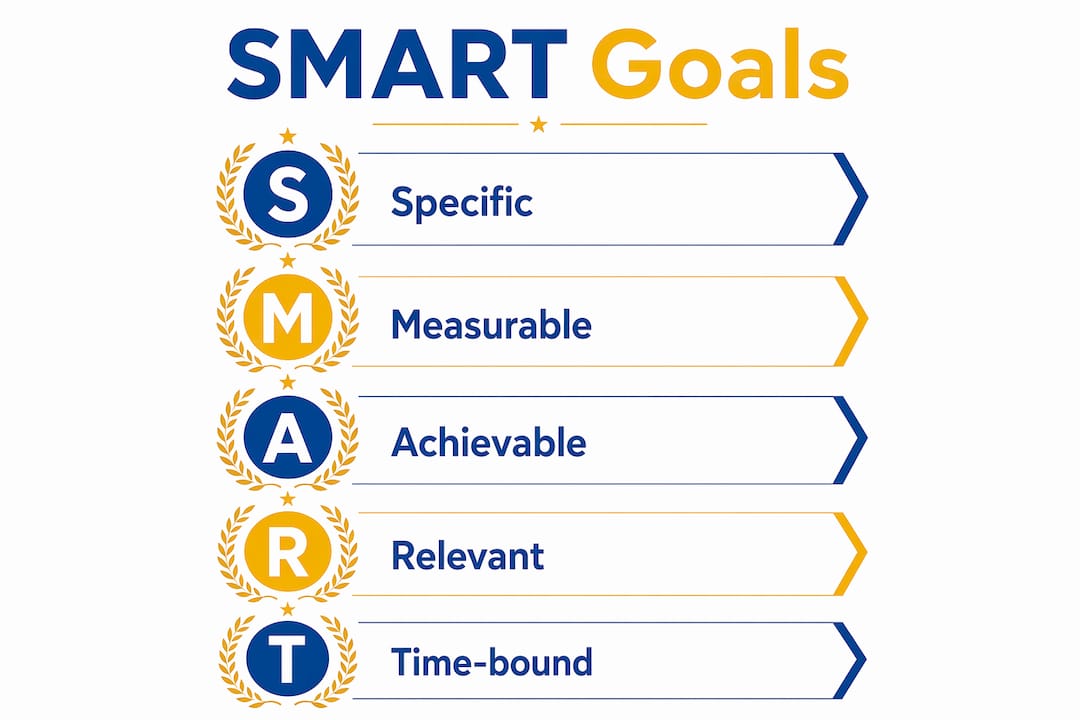
The SMART framework is the most widely used standard for writing employee performance goals that actually work. SMART stands for Specific, Measurable, Achievable, Relevant, and Time-bound. Each element removes a different type of vagueness that causes goals to fail.
Here is what each criterion does in practice:
- Specific: Replaces broad intentions with exact outcomes. “Improve customer satisfaction” becomes “Increase NPS score from 42 to 55.”
- Measurable: Attaches a number or observable result so progress is trackable. Without a metric, you cannot tell if you succeeded.
- Achievable: Sets a target that stretches performance without being unrealistic. Impossible goals kill motivation faster than no goals at all.
- Relevant: Connects the goal to the employee’s role and the team’s priorities. A goal that does not matter to the business will not get attention.
- Time-bound: Assigns a deadline. Open-ended goals drift indefinitely.
Specific, challenging goals improve performance 90% of the time compared to vague “do your best” instructions. That finding alone makes the case for dropping generic targets entirely.
The contrast between a weak goal and a SMART goal is stark. “Get better at presentations” tells an employee nothing. “Deliver three internal training sessions by the end of Q2, rated at least 4 out of 5 by attendees” tells them exactly what to do, when to do it, and how success is measured.

Pro Tip: Write every goal with five elements: outcome, baseline, target, deadline, and owner. Goals built with all five components are clearer and far less likely to stall. Missing even one element creates confusion about who is responsible and what “done” looks like.
For additional frameworks and practical SMART goal tips, Optiostation covers the most effective approaches for both students and working professionals.
Balancing performance and development goals for sustained growth
Performance goals and development goals serve different purposes, and treating them as the same thing is a costly mistake.
Performance goals focus on deliverables: revenue targets, project completion rates, customer response times. They answer the question “What do you need to produce?” Development goals focus on skills and capabilities: learning a new tool, improving public speaking, earning a certification. They answer the question “Who do you need to become?”
Here is why the distinction matters:
- Performance goals drive short-term results and are easy to measure.
- Development goals build the capacity for future performance and are harder to quantify but equally important.
- Neglecting development goals is a major driver of turnover among high-potential managers and senior contributors.
- Behavioral goals, such as improving cross-team communication or giving more consistent feedback, complement both types.
The table below shows how each goal type looks in practice:
| Goal type | Example | Primary benefit |
|---|---|---|
| Performance | Close 12 new accounts by September 30 | Drives measurable output |
| Development | Complete a data analysis course by June 30 | Builds long-term capability |
| Behavioral | Lead one peer feedback session per month | Improves team culture and collaboration |
Setting 3–5 focused goals at a time is more effective than long lists because attention is the scarce resource, not effort. Managers who load employees with ten or more active goals at once see shallower progress across all of them. A focused set of three to five goals, mixing performance and development targets, produces deeper results.
Why does collaboration matter in employee goal setting?
Goals assigned without employee input face resistance. Co-created goals increase commitment and follow-through because employees feel ownership over targets they helped shape. This is not a soft principle. It is the difference between a goal an employee works toward and one they quietly ignore.
The most effective method for building that ownership is the “cascade conversation.” The process works like this:
- The manager shares the team’s OKRs (Objectives and Key Results) and company priorities at the start of the goal-setting cycle.
- The employee proposes their own goals based on those shared priorities.
- Manager and employee refine the goals together, checking for alignment, realism, and clarity.
- Both parties document the agreed goals and set a schedule for reviews.
The cascade conversation transforms employee ownership by making the link between individual work and company direction explicit. Employees who understand why their goal matters are far more motivated to pursue it.
Pro Tip: Start every goal-setting conversation by sharing the team’s top three priorities for the quarter. Ask the employee to propose goals that connect to at least two of them. This single step, recommended by goal alignment research, dramatically increases the relevance of the goals that emerge.
Visibility matters as much as the conversation itself. Documented goals that both parties can see and reference create accountability. Goals that exist only in someone’s memory fade quickly. Written, shared, and regularly reviewed goals stay active.
Organizations in education and professional development, including those working with frameworks from Suraasa, have found that collaborative goal-setting practices transfer directly from classroom settings to workplace performance systems.
How do ongoing reviews improve goal achievement?
Annual goal reviews are the weakest version of a goal-setting system. Monthly or quarterly check-ins create accountability and meaningful progress in ways that once-a-year conversations simply cannot.
The reason is straightforward. Priorities shift. Projects change scope. New opportunities appear. A goal set in january may be irrelevant by april if the business has pivoted. Regular reviews give managers and employees a structured moment to ask: Is this goal still the right one? Are we on track? What is blocking progress?
A practical review cadence looks like this:
- Weekly: Brief status check. Is the employee on track? Any blockers to surface?
- Monthly: Deeper review of progress against each goal. Adjust timelines or targets if circumstances have changed.
- Quarterly: Full goal audit. Retire completed goals, add new ones, and realign with updated team priorities.
- Annually: Comprehensive performance and development review. Use this to set the direction for the next year, not to evaluate the last one in isolation.
Regular goal reviews are not administrative overhead. They are the mechanism that keeps goals connected to reality. Without them, even well-written goals become irrelevant artifacts by mid-year.
Linking reviews to feedback and development planning multiplies their value. A quarterly check-in that includes a conversation about skill gaps, mentoring opportunities, or career direction turns a performance meeting into a growth conversation. That shift in framing is what separates managers who retain high performers from those who lose them.
For a closer look at how regular goal reviews boost productivity, Optiostation’s research on review cycles applies directly to professional settings as well as academic ones.
Common pitfalls in employee goal setting
Most goal-setting failures trace back to a short list of recurring mistakes. Recognizing them is the first step to avoiding them.
- Vague goals: “Improve communication” is not a goal. It is a wish. Every goal needs a metric and a deadline.
- Too many goals at once: Overloading employees with too many goals dilutes focus and leads to superficial progress across all of them. Stick to 3–5 active goals per cycle.
- Goals disconnected from business outcomes: A goal that does not connect to team or company priorities will not get resources, attention, or support when it matters.
- No documentation: Undocumented goals are forgotten goals. Write them down, share them, and make them visible to both parties.
- Unrealistic targets: Stretch goals motivate. Impossible goals demoralize. The line between the two is whether the employee has the resources and time to realistically achieve the target.
- No manager involvement: Goal setting is not a form employees fill out alone. It requires active manager participation, especially during the cascade conversation and review cycles.
Pro Tip: At the start of each quarter, ask every team member to name their top three goals and explain how each one connects to a team priority. If they cannot answer the second part, the goal needs revision before work begins.
What I have learned about goal setting that most guides skip
The most common mistake I see managers make is treating goal setting as a once-a-year paperwork exercise. They sit down in january, write five goals with an employee, and then revisit them in december to score performance. By that point, half the goals are irrelevant and the other half were never tracked. The annual review becomes a reconstruction of memory rather than a reflection of real progress.
What actually works is treating goals as living documents. The cascade conversation is the most underused tool in a manager’s kit. When you start a goal-setting meeting by sharing the team’s OKRs and asking the employee to connect their proposals to those priorities, the quality of the goals that emerge is dramatically better. Employees stop proposing generic targets and start thinking about what genuinely moves the needle.
The other thing most guides underplay is the development goal. Managers focus on performance targets because they are easy to measure and directly tied to business results. But the employees who leave are almost always the ones whose development goals were ignored. A high-potential contributor who hits every performance target but feels like they are not growing will find a place that invests in them. Balancing both goal types is not a nice-to-have. It is a retention strategy.
— Optiostation
Optiostation: built to support your goal-setting system
Optiostation is the task, team, and time management app built for students and young professionals who want a real system behind their goals, not just a list.

With Optiostation, you can document goals, assign owners, set deadlines, and track progress in one place. The app’s task management structure mirrors the cascade conversation model: team objectives flow down to individual assignments, so every Centurion knows how their work connects to the bigger mission. Built-in reminders and check-in prompts keep review cycles on schedule without relying on memory. For managers and employees who want to move from annual goal reviews to a continuous system, Optiostation’s task management tools give you the structure to make that shift practical and permanent.
FAQ
What is goal setting for employees?
Goal setting for employees is the process of defining clear, measurable targets that align individual work with team and company objectives. Effective employee goals follow the SMART framework and are reviewed regularly to stay relevant.
How many goals should an employee have at one time?
Setting 3–5 focused goals at a time produces better results than longer lists. Concentrated effort on a small number of goals leads to deeper progress than spreading attention across many targets.
What is the difference between performance and development goals?
Performance goals focus on measurable deliverables like sales targets or project completion. Development goals focus on building skills and capabilities, such as completing a course or improving a specific competency.
How often should employee goals be reviewed?
Monthly or quarterly check-ins are more effective than annual-only reviews. Regular reviews create accountability, allow goal adjustments when priorities shift, and keep employees on track throughout the year.
What makes a goal SMART?
A SMART goal is Specific, Measurable, Achievable, Relevant, and Time-bound. Goals written with all five elements, including outcome, baseline, target, deadline, and owner, are clearer and more likely to be completed.
Key Takeaways
Effective goal setting for employees requires SMART criteria, a balance of performance and development goals, collaborative creation, and ongoing review cycles to stay relevant and drive real results.
| Point | Details |
|---|---|
| Use the SMART framework | Write every goal with a specific outcome, metric, deadline, and named owner to eliminate ambiguity. |
| Balance both goal types | Mix performance goals with development goals to drive results and retain high-potential employees. |
| Co-create goals with employees | Collaborative goal setting increases commitment and follow-through compared to goals assigned without input. |
| Review goals regularly | Monthly or quarterly check-ins keep goals aligned with shifting priorities and create real accountability. |
| Limit active goals to 3–5 | Focused effort on a small set of goals produces deeper progress than spreading attention across many targets. |
Recommended
- Define your goals: proven strategies for motivation and success – Optio Station: Best Project Management App for Prioritization
- Team Lead Goals: Top 10 for High Performance – Optio Station: Best Project Management App for Prioritization
- Why set study goals? 250% higher performance awaits – Optio Station: Best Project Management App for Prioritization
- Personal Work Goals 2026: 72% Higher Achievement Rates – Optio Station: Best Project Management App for Prioritization
