

Most product teams face tough choices when every feature idea seems important but resources are limited. Studies show that without a clear system, teams often waste time debating priorities and risk missing the mark with customers. Understanding how a feature prioritization matrix works can simplify these decisions, guiding teams to focus on what truly drives business value and user satisfaction. This guide breaks down how these matrices help organizations turn complex decisions into clear, strategic action.
Table of Contents
- Defining Feature Prioritization Matrix and Its Role
- Types of Feature Prioritization Matrices Explained
- Step-by-Step: How the Matrix Process Works
- Real-World Uses for Teams and Projects
- Risks, Mistakes, and How to Avoid Them
Key Takeaways
| Point | Details |
|---|---|
| Feature Prioritization Matrix | This matrix helps product teams align development efforts with business objectives by systematically evaluating and ranking potential features. |
| Structured Evaluation Process | Teams should define evaluation criteria, establish a scoring mechanism, and use systematic comparisons to ensure objective feature assessments. |
| Flexibility in Application | Different matrix types, such as Value vs. Effort and Eisenhower Matrix, should be adapted based on project context and team dynamics. |
| Risks in Prioritization | Common pitfalls include bias, inconsistent scoring, and overlooking implementation complexities; addressing these requires rigorous validation and stakeholder involvement. |
Defining Feature Prioritization Matrix and Its Role
A feature prioritization matrix transforms complex decision-making into a strategic visual tool that helps product teams align their development efforts with critical business objectives. According to savio, this matrix serves as a visual and analytical guide for connecting product features directly with strategic business goals and customer demands.
The core purpose of a feature prioritization matrix is systematic evaluation. Highberg explains that it enables product managers to make informed decisions by providing a structured approach to assessing the relative importance and feasibility of different features. Teams can effectively rank potential developments by considering multiple critical dimensions:
- Value to customers
- Strategic alignment
- Development effort required
- Potential business impact
By mapping features across these dimensions, organizations transform subjective preferences into objective, data-driven prioritization strategies.
 The matrix becomes more than just a ranking tool – it’s a communication framework that helps teams visualize complex trade-offs, ensuring that limited resources are allocated to initiatives with the greatest potential for meaningful progress. Whether you’re leading a startup or managing product development in an established company, a feature prioritization matrix provides clarity and focus in an often chaotic product development landscape.
Types of Feature Prioritization Matrices Explained
Feature prioritization matrices come in various strategic models, each designed to help teams make more informed product development decisions. Highberg highlights several key approaches that product managers can leverage to evaluate and rank potential features effectively:
Key Feature Prioritization Matrix Types
-
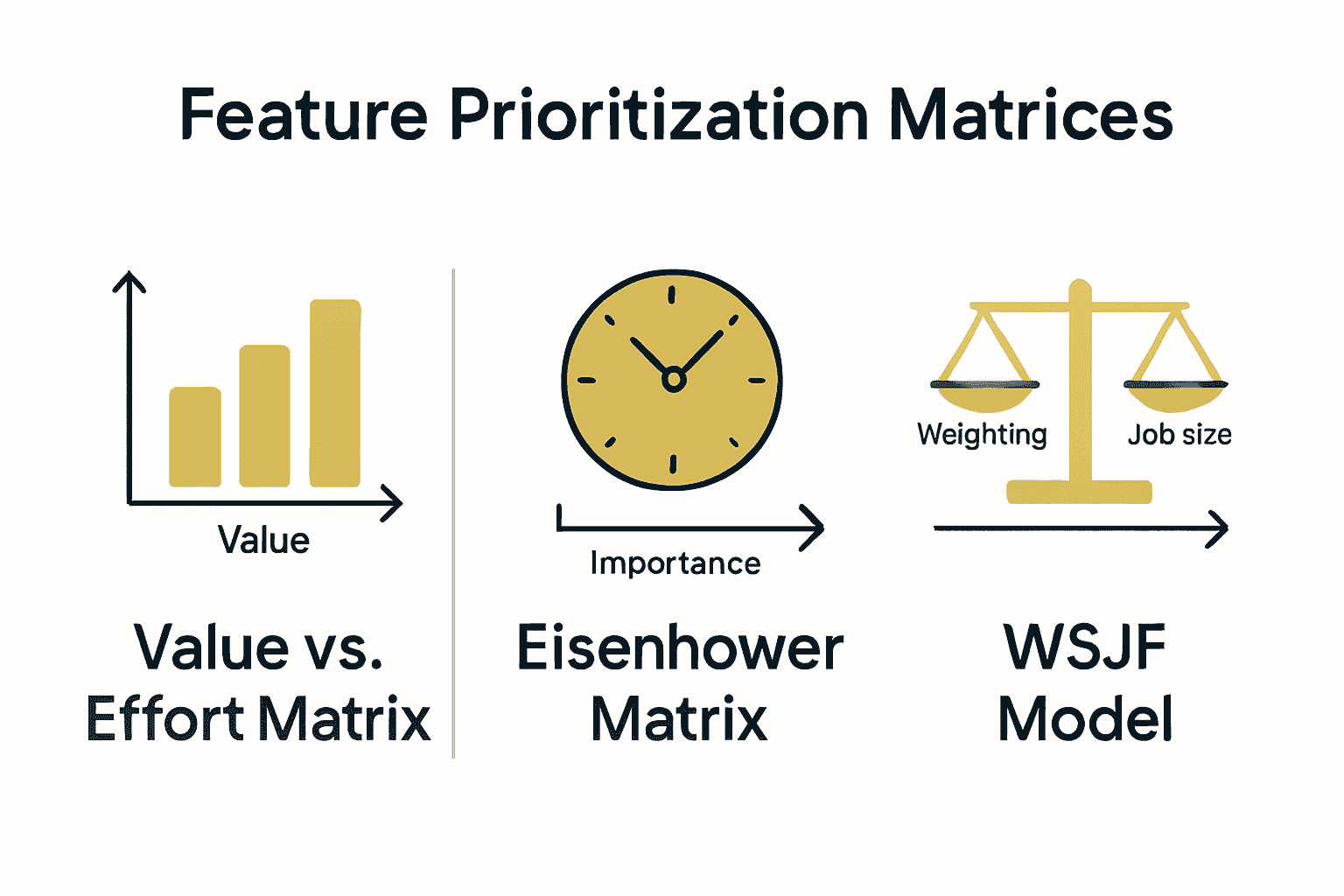
Value vs. Effort Matrix
- Plots features based on their potential value and required implementation effort
- Helps teams quickly identify high-impact, low-effort “quick wins”
-
Eisenhower Matrix
- Categorizes features by urgency and importance
- Enables strategic resource allocation
-
Weighted Shortest Job First (WSJF) Model
- Prioritizes features based on economic value and implementation complexity
- Popular in agile development frameworks
According to Wikipedia, the decision-matrix method (also known as the Pugh method) offers a nuanced approach to feature evaluation. This qualitative technique involves establishing a comprehensive set of criteria and comparing potential features against a reference point, ranking them as better, worse, or equivalent across multiple dimensions.
The beauty of these matrices lies in their flexibility. No single approach works universally – the best matrix depends on your specific project context, team dynamics, and strategic objectives. By understanding and adapting these frameworks, product teams can transform subjective feature discussions into data-driven, objective prioritization processes. Whether you’re working on a small startup project or managing complex product development in a large organization, these matrices provide a structured path to making smarter, more strategic feature selection decisions.
For teams looking to dive deeper into prioritization techniques, our guide on understanding prioritization techniques offers additional insights into making these critical product development choices.
Step-by-Step: How the Matrix Process Works
Navigating the feature prioritization matrix requires a structured, systematic approach that transforms complex decision-making into a clear, actionable strategy. Wikipedia highlights the fundamental principle of the decision-matrix method: establishing a comprehensive set of criteria and comparing potential features against a reference point.
Core Steps in the Matrix Process
-
Define Evaluation Criteria
- Identify key dimensions for assessment
- Examples: Business value, customer impact, implementation complexity
-
Establish Scoring Mechanism
- Create a consistent rating system
- Typically uses numerical scales (1-5 or 1-10)
- Ensure objective and repeatable scoring
-
Gather Feature Candidates
- Collect potential features from various sources
- Include input from:
- Customer feedback
- Sales teams
- Product management
- Development teams
-
Score and Rank Features
- Evaluate each feature against established criteria
- Calculate weighted scores
- Create a prioritized list of features
According to the Analytic Hierarchy Process, complex decisions can be decomposed into a hierarchy of sub-problems, allowing for more nuanced and structured evaluation. This approach transforms subjective feature discussions into data-driven prioritization.
By following these systematic steps, teams can create a transparent, objective framework for feature selection. The matrix becomes more than just a tool – it’s a communication platform that aligns stakeholders, reduces bias, and ensures that limited resources are invested in the most impactful initiatives.
For teams looking to refine their prioritization techniques, our task prioritization matrix guide offers additional strategic insights into making these critical product development decisions.
Real-World Uses for Teams and Projects
Feature prioritization matrices are powerful tools that bridge the gap between strategic vision and practical implementation across diverse project environments. arXiv research reveals a fascinating insight: prioritization strategies that excel in one project type can dramatically underperform in another, highlighting the critical need for context-specific approaches.
Strategic Applications Across Different Project Types
Software Development
- Ranking new feature implementations
- Balancing technical debt with innovation
- Aligning product roadmap with user needs
Product Management
- Evaluating customer feature requests
- Determining minimum viable product (MVP) components
- Allocating limited development resources
Startup Environments
- Quickly pivoting based on market feedback
- Maximizing limited resources
- Maintaining agile development cycles
In user experience research, arXiv highlights a sophisticated approach using the User Experience Research Point of View (UXR PoV) Playbook. This framework employs advanced statistical techniques like multinomial logistic regression to transform subjective feature preferences into data-driven prioritization strategies.
The versatility of feature prioritization matrices extends beyond traditional boundaries. From tech startups to academic research projects, these tools provide a structured method for making complex decisions. They transform potentially endless discussions into clear, actionable plans that align team efforts with strategic objectives.
For teams looking to enhance their collaborative potential, our examples of group projects guide offers additional insights into effective team collaboration and strategic planning.
Risks, Mistakes, and How to Avoid Them
Feature prioritization matrices are powerful tools, but they’re not infallible. Like any strategic approach, they come with potential pitfalls that can derail even the most well-intentioned project planning efforts. Understanding these risks is the first step to creating more robust, effective prioritization strategies.
Common Prioritization Mistakes
-
Bias in Scoring
- Allowing personal preferences to skew objective evaluation
- Failing to include diverse stakeholder perspectives
- Over-weighting certain criteria without justification
-
Inconsistent Preference Evaluation
- Lack of systematic comparison methods
- Subjective rather than objective scoring
- Failing to validate scoring consistency
-
Overlooking Hidden Complexity
- Underestimating implementation challenges
- Ignoring interdependencies between features
- Focusing solely on immediate value
Research from arXiv highlights the critical importance of consistency in decision-making matrices. The study emphasizes the need for rigorous validation of preference comparisons, proving that inconsistent preferences can fatally undermine the entire prioritization process.
arXiv provides additional insights into the nuanced challenges of prioritization, particularly in technical domains. The research reveals that different prioritization techniques can uncover dramatically different types of potential issues, underscoring the importance of a comprehensive, multi-dimensional approach.
To mitigate these risks, teams must embrace a systematic, transparent approach. This means creating clear scoring criteria, involving multiple stakeholders, regularly reviewing and adjusting prioritization methods, and maintaining flexibility in the face of changing project dynamics.
For teams seeking to refine their collaborative skills and avoid common pitfalls, our how to manage team tasks guide offers practical strategies for more effective project management.
Achieve Crystal Clear Feature Prioritization with Optio Station
Struggling to make sense of complex feature prioritization matrices and tired of subjective decision-making? This article reveals how transforming feature ranking into a systematic, data-driven process can eliminate guesswork and align your projects with real business and customer value. When you want to move beyond debate and bias to truly focus your limited resources on what matters most, Optio Station stands ready as your second-in-command.

Discover how our Roman-themed productivity app empowers Centurions like you to master task, team, and time management with precision. Dive into practical strategies inspired by the ProductivityThoughts community and sharpen your prioritization skills with tips from CenturionTips. Visit Optio Station now and take command of your product development journey by organizing, scoring, and executing your feature ideas with confidence. The time to lead smart priorities is now.
Frequently Asked Questions
What is a feature prioritization matrix?
A feature prioritization matrix is a strategic visual tool that helps product teams evaluate and rank potential features based on their value, importance, and feasibility, aligning development efforts with business objectives.
Why is a feature prioritization matrix important for product teams?
It allows product managers to make informed decisions, reduces subjective bias in feature selection, and helps allocate limited resources effectively to initiatives with the greatest potential impact.
What are the different types of feature prioritization matrices?
Key types include the Value vs. Effort Matrix, Eisenhower Matrix, and Weighted Shortest Job First (WSJF) Model, each designed to evaluate and rank features based on various dimensions of importance and effort required.
How do you implement a feature prioritization matrix?
To implement one, define evaluation criteria, establish a scoring mechanism, gather feature candidates, and then score and rank each feature to create a prioritized list based on objective assessments.
Recommended
- Project Management Prioritization Matrix: Expert Guide – Optio Station: Best Project Management App for Prioritization
- Task Prioritization Matrix: Complete Guide for Success – Optio Station: Best Project Management App for Prioritization
- Understanding Prioritization Techniques for Success – Optio Station: Best Project Management App for Prioritization
- Understanding Prioritization Techniques Guide for Success – Optio Station: Best Project Management App for Prioritization
