

What do effective employee goals actually look like?
The best employee goals are specific, tied to a measurable outcome, and written so that both the manager and the employee can tell at a glance whether progress is happening, as explained in the power of a motivation letter for student jobs. Vague targets like “improve communication” sit in performance systems unread. Concrete ones get done. Here are examples across delivery, development, and stretch categories that managers and HR professionals can adapt immediately.
Delivery goals (output-focused):
- Increase customer satisfaction scores by resolving tier-1 support tickets within four business hours
- Reduce project delivery delays this quarter by implementing a weekly status check-in with cross-functional stakeholders
- Complete and launch the updated onboarding workflow by March 31, improving new-hire ramp time
Development goals (growth-focused):
- Complete a data analysis certification through LinkedIn Learning and apply the skills to one live reporting project
- Shadow senior engineers during architecture reviews regularly to build system design knowledge
- Attend an industry conference and share key takeaways with the team promptly upon return
Stretch goals (ambitious targets):
- Lead the cross-departmental product launch from planning through go-live, coordinating multiple teams over the quarter
- Propose and pilot a new client retention process aiming to improve 12-month renewal rates
- Mentor junior team members through their first full performance cycle, with documented regular check-ins
Collaboration and soft skills goals:
- Co-facilitate cross-team workshops regularly to strengthen alignment between product and engineering
- Reduce meeting overruns by preparing and sharing agendas in advance for every recurring meeting you own
- Receive positive peer feedback on clear communication in the mid-year review
These examples work because they describe an outcome, name a metric, and set a deadline. Goal setting that follows this pattern gives employees a clear definition of success rather than a vague direction.
What categories of employee goals cover the full picture?
Performance goals for employees fall into five main categories. Each one serves a different purpose, and a well-rounded performance plan draws from at least two or three of them.
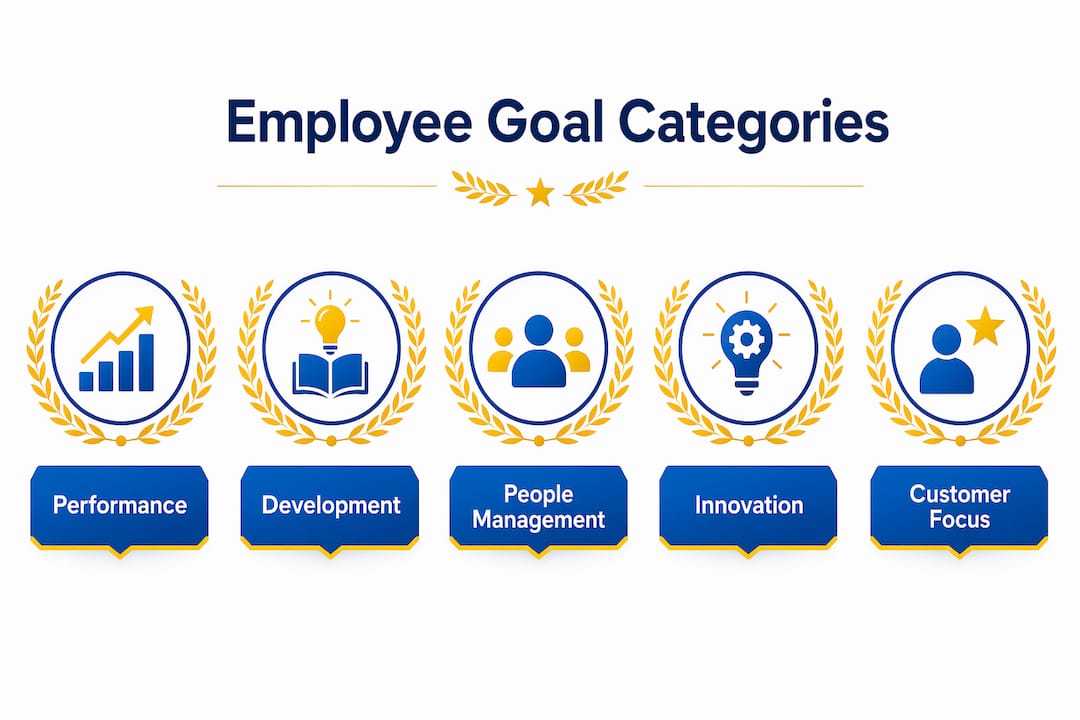
Collaboration
Collaboration goals push employees to work across boundaries, not just within their own lane. They matter most in hybrid and remote environments where informal coordination breaks down.
- Share regular project status updates in the team channel so stakeholders stay informed without extra meetings
- Partner with colleagues from other departments on initiatives
- Contribute regularly to peer code or document reviews, providing timely feedback
Professional growth
Employee development targets keep people engaged and build the skills the organization needs next year, not just this one. Research from the Society for Human Resource Management found that growth opportunities represent the single biggest factor in employees’ overall mental wellbeing at work.
- Earn a project management credential and apply it to an active project
- Read industry-relevant books and present summaries at team meetings
- Take on stretch assignments outside your core role to broaden experience
Self-management
These goals address how employees organize and prioritize their own work, a skill that directly affects team throughput.
- Deliver assigned tasks on or before their deadlines consistently
- Block focused work time daily and reduce context-switching by batching email responses
- Complete a time-tracking exercise and present findings with proposed adjustments
Soft skills
Soft skills goals are often the hardest to write well because they resist easy measurement. The trick is to anchor them to observable behavior.
- Deliver feedback to peers using a structured model such as Situation-Behavior-Impact
- Reduce escalations from direct reports by conducting regular one-on-ones
- Receive positive feedback on active listening in the next 360-degree feedback cycle
People management
For team leads and managers, people management goals address how they develop, support, and retain their teams.
- Conduct regular one-on-one meetings with every direct report and document action items promptly
- Ensure every team member has documented development goals
- Aim to reduce voluntary turnover by completing stay interviews with direct reports
Balancing delivery and development goals prevents burnout and builds the kind of sustained performance that survives a tough quarter.

How do SMART goals and OKRs make goal setting more effective?
Two frameworks dominate goal setting for employees in practice: SMART and OKRs. They solve different problems, and using them together produces the clearest results.
The SMART framework
The SMART framework, created in 1981, remains the industry standard for writing goals that are clear and achievable. Each letter stands for a quality the goal must have.
| Letter | Criterion | What it means in practice |
|---|---|---|
| S | Specific | Names the outcome and who owns it |
| M | Measurable | Defines how success is tracked |
| A | Achievable | Realistic given current resources |
| R | Relevant | Tied to team or company priorities |
| T | Time-bound | Has a clear deadline |
A SMART version of “improve customer service” becomes: “Increase first-contact resolution rate from 62% to 75% by September 30 by completing advanced support training in July.”
OKRs
OKRs (Objectives and Key Results) work at a higher level. The objective is ambitious and qualitative; the key results are specific and measurable. OKRs are designed for stretch targets, with 70% attainment considered a success, not a failure. That framing matters because it gives employees permission to aim high without fear of a missed target counting against them.
Example OKR for a marketing manager:
- Objective: Build the company’s authority in the mid-market segment by Q3
- Key Result 1: Publish eight long-form pieces of content targeting mid-market search terms
- Key Result 2: Generate 150 qualified leads from content channels by September 30
- Key Result 3: Achieve a 25% increase in mid-market demo requests quarter over quarter
Using SMART alongside OKRs creates clarity at both the individual and team levels. OKRs set the direction and ambition; SMART criteria evaluate whether each key result is written well enough to track.
Pro Tip: Never assign goals unilaterally. Goals that employees help shape produce stronger commitment and better follow-through than those handed down from above. Run a 30-minute goal-setting conversation with each direct report before finalizing anything.
One common mistake is setting too many goals at once. Limiting goals to 3–5 per period keeps focus sharp and prevents the dilution of effort that comes from chasing ten targets simultaneously.
How do you align employee goals with business objectives?
Goal alignment is what separates a performance plan that drives results from one that just satisfies an HR requirement. High-performing employees align their personal goals with company objectives far more often than their low-performing peers, and when employees feel that alignment, they are 35% more efficient and productive.
The most practical alignment model cascades goals from the top down. Company-wide priorities (sometimes called BHAGs, or Big Hairy Audacious Goals) break into department OKRs, which then inform individual SMART goals. Cascading goals from company-level objectives to individual targets strengthens organizational focus and accountability at every level.
Best practices for alignment, tracking, and adjustment:
- At the start of each cycle, share the company’s top three to five priorities with every team so individuals can see where their work fits
- Write at least one individual goal that explicitly connects to a team or department objective
- Schedule a mid-cycle review (not just an annual one) to check whether goals still reflect current priorities
- When a project is canceled or a role shifts significantly, revise the goal rather than letting employees work toward something irrelevant
- Use documented goals as the reference point in performance conversations, not just recent memory
Goal setting aligns individual tasks with broader business and customer impact, which is what makes the work feel purposeful rather than transactional. Employees who understand how their output connects to something larger tend to stay engaged longer and push harder when things get difficult.
Tracking matters as much as setting. Goals entered into a shared system and reviewed regularly are far more likely to be acted on than those buried in a document no one opens until review season. Regular review and adjustment of goals based on feedback keeps them relevant throughout the performance cycle.
What does the research say about goal setting for managers?
The evidence for structured goal setting is strong, and a few findings stand out as particularly useful for managers trying to get this right.
Employees who participate in setting their own goals demonstrate higher commitment and better performance than those with goals handed to them. Ownership is not a soft benefit; it is the mechanism that makes the goal work, especially for knowledge workers where the manager often has less visibility into the technical details than the employee does.
Fairness in performance reviews is another area where goal setting pays off in ways managers often underestimate. Documented goals reduce recency bias in performance reviews by providing a long-term reference point, so a strong finish to the year does not erase a slow start, and a rough patch in Q3 does not overshadow months of solid delivery.
Pro Tip: Hold brief monthly check-ins focused specifically on goal progress, separate from your regular one-on-ones. Document what was discussed and any adjustments made. This paper trail protects both the employee and the manager when review season arrives.
Optiostation’s task and team management tools are built to support exactly this kind of ongoing tracking, giving managers a central place to log progress, flag blockers, and keep goals visible throughout the cycle rather than only at review time.
Key Takeaways
Effective employee goals combine clear ownership, measurable outcomes, and alignment with business priorities to drive both performance and engagement.
| Point | Details |
|---|---|
| Use SMART criteria | Write goals that are specific, measurable, achievable, relevant, and time-bound to eliminate guesswork. |
| Limit goals per cycle | Keep each employee to 3–5 goals per period to maintain focus and prevent effort from spreading too thin. |
| OKRs allow 70% attainment | Design stretch goals where reaching 70% is considered a success, not a shortfall. |
| Alignment drives productivity | Employees who align personal goals with company objectives are 35% more efficient and productive. |
| Document everything | Written goals reduce recency bias in reviews and give both managers and employees a fair reference point all year. |
Ready to put these goal-setting principles into practice? Optiostation helps managers and teams track progress, stay aligned, and keep goals visible from day one to review day. 
Explore the best task management tools to find the right system for keeping your team’s goals on track all year.
Recommended
- Goal Setting for Employees: A Manager’s Guide – Optio Station: Best Project Management App for Prioritization
- Personal Work Goals 2026: 72% Higher Achievement Rates – Optio Station: Best Project Management App for Prioritization
- 7 Goal Setting Strategies 2025 for Students and Professionals – Optio Station: Best Project Management App for Prioritization
- SMART goals for work: practical tips to boost productivity – Optio Station: Best Project Management App for Prioritization
