

TL;DR:
- A task handoff involves the structured transfer of responsibility, context, and documentation to ensure uninterrupted work. Proper handoffs include clear ownership, current status, access details, tacit knowledge, and formal confirmation to prevent project failure and confusion. Combining synchronous and asynchronous methods, tracking key metrics, and planning post-handoff support improve overall process reliability.
A task handoff is the structured transfer of responsibility, context, and documentation from one person to another so work continues without interruption. Poor handoffs are one of the most common causes of project failure, and 60% of task transitions experience confusion when no standardized process exists. That number is not abstract. It means missed deadlines, duplicated work, and frustrated teammates. This efficient task handoff guide covers the frameworks, templates, and metrics that students and young professionals need to delegate clearly and keep projects moving.
What are the essential components of an efficient task handoff?
Every reliable handoff shares five core components. Miss one, and the receiver is left guessing.
- Ownership and assignment clarity. Name the new owner explicitly. State the date responsibility transfers. Ambiguity here causes more rework than any other single failure.
- Current status and risks. Document what is done, what is in progress, and what is blocked. Flag any known risks so the receiver is not blindsided on day one.
- Access details. List every file, login, tool, and resource the receiver needs. A handoff without access details forces unnecessary back-and-forth.
- Knowledge transfer. This goes beyond documentation. Tacit knowledge transfer covers the rationale, constraints, and unwritten rules behind a task. A receiver who understands the “why” makes better decisions independently.
- Confirmation and sign-off. Both parties must formally acknowledge the transfer. Without this step, ownership stays legally and practically unclear.
SystemaFlow’s task handoff template organizes these five components into a document that takes roughly 2–3 minutes to fill out per section. That time investment prevents hours of clarification later. The template also includes a “do not reopen” marker for finalized decisions, which stops teams from re-litigating settled issues and wasting everyone’s time.
Pro Tip: Create a repeatable context document that answers four questions at every handoff: What is the task? What matters most right now? What decisions are already final? Who is the new owner? Requiring this artifact at every transfer clears most common misunderstandings before they start.

For students managing group assignments, these five components translate directly. Swap “project manager” for “team lead” and the structure works just as well for a class project as for a workplace deliverable.
How do synchronous and async handoffs compare?
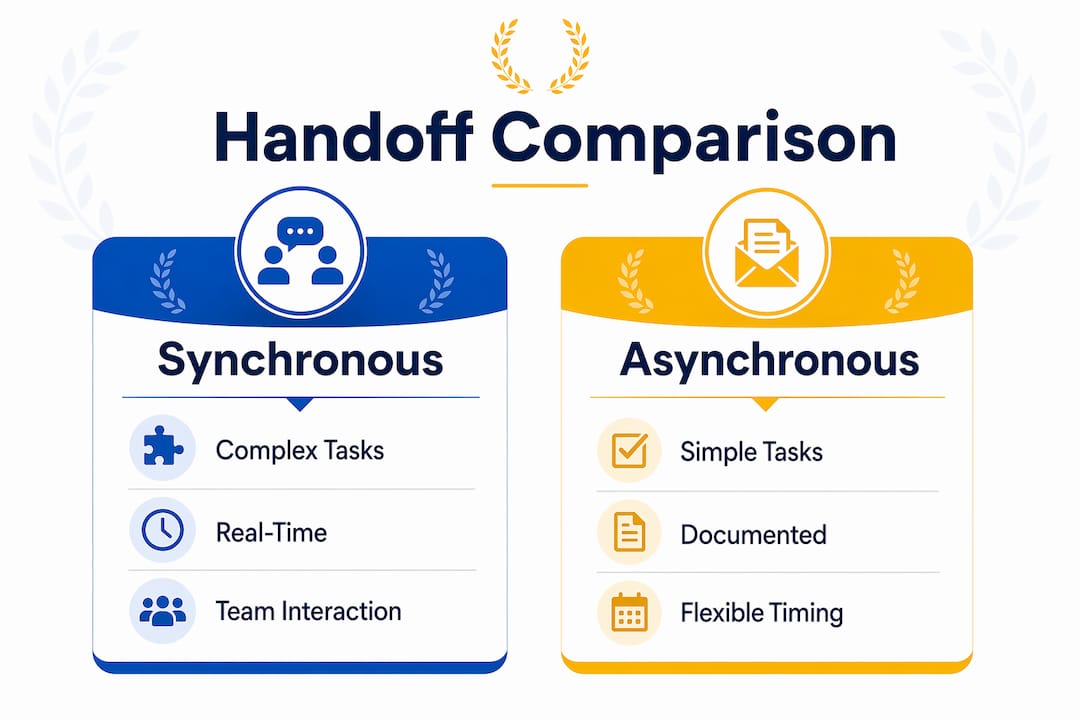
Not every handoff happens in real time. Knowing when to use each approach is a core task management strategy.
| Factor | Synchronous handoff | Async handoff |
|---|---|---|
| Best for | Complex, multi-deliverable tasks | Routine tasks, remote or time-zone-split teams |
| Key step | Live walkthrough with Q&A | Documented package with explicit timing |
| Risk | Scheduling friction | Receiver delays acknowledgment |
| Confirmation method | Verbal plus written summary | Written acknowledgment with timestamp |
| Primary metric | Clarifications post-handoff | Acknowledgment time and rework rate |
Synchronous handoffs work best when a task has many moving parts or when the receiver is new to the work. GitLab advises starting handoff notes at least 30 minutes before the transfer and scheduling a brief overlap session to walk through them together. That overlap often prevents days of follow-up questions. The sender should verify understanding by asking the receiver to summarize the task back, not just confirm they have read the document.
Async handoffs follow a five-step process recommended by StandIn: Prepare, Document, Notify, Confirm, Execute. Each step has a timestamp. Treating the handoff as a measurable state change, with tracked times for notification, confirmation, work start, and completion, turns a vague process into a manageable one. The three metrics that matter most for async health are acknowledgment time, clarification count, and rework rate.
The smartest approach blends both methods. Write the full async documentation package first, then hold a 15-minute synchronous call to walk through it. Synchronous walkthroughs reduce clarifications after the handoff, making them time-efficient even when they feel like an extra step.
Pro Tip: Even for fully remote teams, schedule one short video call after sending the async handoff document. Ask the receiver to name the top three priorities and one risk they spotted. That five-minute check catches gaps that written documents miss.
What are the most common task handoff failures?
Most handoff failures are predictable. They fall into five patterns, and each one has a direct fix.
-
Vague or missing context. The sender assumes the receiver knows the background. The receiver assumes the sender covered everything. Neither assumption is correct. Fix this by requiring the context document described above at every transfer.
-
No confirmation step. Sending a document is not a handoff. A handoff is complete only when the receiver explicitly acknowledges ownership. Without confirmation, the sender still carries the mental load of the task. Build a formal sign-off into every task delegation process.
-
Ignoring timing and response expectations. Async handoffs fail when no deadline is set for acknowledgment. StandIn recommends explicit timing at every step. A 48-hour acknowledgment rule, where the receiver must raise questions within two days or accept full responsibility, creates accountability without micromanagement.
-
Poor documentation format. A wall of text is not documentation. Use headers, bullet points, and numbered steps. The receiver should be able to scan the document in under two minutes and locate any section they need.
-
Skipping tacit knowledge transfer. Written documentation captures what to do. It rarely captures why a decision was made or what constraints shaped it. A receiver who lacks that context will make avoidable mistakes. Spaced knowledge transfer sessions over multiple days improve retention and reduce last-minute confusion, especially for complex tasks.
A defined “definition of done” prevents rework. Before the handoff closes, both parties agree on what a successful completion looks like. That shared standard eliminates the most common source of post-handoff disputes.
What tools and templates make task handoffs measurable?
The right tools turn a handoff from a one-time event into a repeatable, trackable process.
monday.com offers an 8-step handoff framework that covers documentation, tacit knowledge transfer, and explicit ownership assignment. It works well for teams that already use monday.com as their project hub. StandIn is built specifically for async handoffs, with built-in acknowledgment tracking and metric dashboards. Tallyfy provides a handoff checklist template that includes live walkthroughs for multi-deliverable transfers and spot checks to catch failures early.
For students and young professionals who want a lightweight starting point, a simple checklist template covers the essentials without requiring a paid tool subscription.
The four metrics every team should track are:
- Acknowledgment rate. What percentage of handoffs receive a formal confirmation? Anything below 100% signals a process gap.
- Wait time before work start. How long does the receiver take to begin after confirmation? Long wait times indicate unclear priorities or missing access.
- Clarification count. How many questions does the receiver ask after the handoff closes? High counts mean the documentation was incomplete.
- Rework rate. How often does a task come back for correction after handoff? This is the most expensive metric to ignore.
Pro Tip: After each handoff, perform a spot check on one random deliverable end-to-end. Spot checks catch hidden failures before the receiver hits a blocker, and they take less than ten minutes when the documentation is organized correctly.
Tracking these metrics in an assignment tracker gives you a clear picture of where your handoff process breaks down. Fix the metric with the worst score first.
How should you plan post-handoff support?
A handoff is not the end of your responsibility. It is the beginning of a transition period.
The distinction between a handoff and a handover matters here. A handoff transfers a specific task. A handover is a longer operational transition, such as leaving a job or completing a semester project. Complex handovers require a hypercare period of 30–90 days, with defined escalation paths and support structures in place.
For students and young professionals, post-handoff support looks like this:
- Set a check-in schedule. Agree on one or two check-in points during the first week after transfer. This is not micromanagement. It is a safety net.
- Define escalation paths. Who does the receiver contact if they hit a blocker the documentation does not cover? Name that person before the handoff closes.
- Set response-time commitments. The sender should commit to a response window for questions during the transition period. Twenty-four hours is a reasonable standard for most student and early-career contexts.
- Manage stakeholder expectations. If the task involves external parties, notify them of the ownership change. Surprises at this stage damage trust.
Post-handoff support does not mean doing the work for the receiver. It means being available to answer questions that no document could anticipate. The goal is a clean break within a defined window, not indefinite hand-holding.
Key Takeaways
A structured handoff with explicit ownership, documented status, and formal confirmation is the single most reliable way to prevent project transitions from failing.
| Point | Details |
|---|---|
| Use a five-section template | Cover ownership, status, access, knowledge transfer, and sign-off at every handoff. |
| Blend sync and async methods | Write the async document first, then hold a short walkthrough call to verify understanding. |
| Track four core metrics | Measure acknowledgment rate, wait time, clarification count, and rework rate to spot gaps. |
| Plan a post-handoff support window | Set check-ins, escalation paths, and response-time commitments before the handoff closes. |
| Require a context artifact | A short document answering what, what matters, what is final, and who owns it clears most confusion. |
What I have learned from watching handoffs fail
The most expensive handoff mistake is not missing documentation. It is missing confirmation. I have seen teams spend hours on detailed handoff packages only to have the receiver start the wrong task because no one verified understanding. The document existed. The conversation did not.
Students especially underestimate this. A group project handoff that ends with “I’ll send you the files” is not a handoff. It is a file transfer. The difference is whether the receiver can answer three questions without asking: What is my first priority? What decisions are already made? Who do I contact if I am blocked?
My honest recommendation for anyone starting out: use a template for your first five handoffs, even if it feels like overkill. The habit of writing down status, risks, and next steps becomes faster with practice. After five repetitions, it takes less time than the first clarification email you would have sent without it. Start small, iterate on what breaks, and build confirmation into every transfer from day one. The teams that do this consistently are the ones that actually finish projects on time.
— Optiostation
Optiostation’s tools for managing task handoffs
Optiostation is built for exactly the kind of structured, accountable task management this article describes. The Optio app gives Centurions a central place to assign tasks, track status, and document ownership changes without switching between five different tools.
If you are ready to put these frameworks into practice, the best task management software guide on Optiostation breaks down which tools fit different team sizes and workflows. For a broader view of what is available, the time management apps list covers seven apps that support delegation, tracking, and team collaboration. Optiostation’s Optio app sits at the center of that ecosystem, designed to be your second-in-command from the first task assignment to the final sign-off.
FAQ
What is a task handoff in project management?
A task handoff is the formal transfer of responsibility, documentation, and context from one person to another so work continues without interruption. It includes ownership assignment, current status, access details, and a confirmation step.
How do you hand off tasks efficiently in a team?
Use a five-section template covering status, risks, access, knowledge transfer, and sign-off. Follow up with a brief synchronous walkthrough to verify the receiver understands their priorities and escalation path.
What is the difference between a handoff and a handover?
A handoff transfers a specific task or deliverable. A handover is a longer operational transition, such as leaving a role, and typically requires a 30–90 day hypercare period with defined support structures.
What metrics measure a successful task handoff?
Track acknowledgment rate, wait time before work starts, clarification count, and rework rate. StandIn recommends using these four metrics to continuously improve async handoff efficiency.
How do you transfer tacit knowledge during a handoff?
Schedule spaced knowledge transfer sessions over multiple days rather than one final meeting. Cover the rationale and constraints behind decisions, not just the steps, so the receiver can make independent judgments without constant follow-up.
Recommended
- Task Delegation Steps for Effective Team Management – Optio Station: Best Project Management App for Prioritization
- What are task management tools: boost productivity in 2026 – Optio Station: Best Project Management App for Prioritization
- What Is a Task in Project Management: Student Guide – Optio Station: Best Project Management App for Prioritization
- Task Delegation Boosts Team Productivity by 30% – Optio Station: Best Project Management App for Prioritization
