

Setting academic goals often feels overwhelming when you are not sure where to start or how to track your progress. Surprisingly, students who develop comprehensive action plans with clear milestones show significantly higher goal achievement rates. Most people think major progress comes from massive effort or perfect motivation, but the real secret is small steps, self-checks, and being honest about where you are—because that is what actually drives results.
Table of Contents
- Step 1: Assess Your Current Academic And Personal Status
- Step 2: Define Smart Goals Aligned With Your Aspirations
- Step 3: Develop An Action Plan With Milestones
- Step 4: Implement Your Action Plan Consistently
- Step 5: Monitor Progress And Adjust Goals As Needed
Quick Summary
| Key Point | Explanation |
|---|---|
| 1. Assess your current status thoroughly. | Undertake a personal audit of academics and life for precise goal formation. |
| 2. Set SMART goals aligned with aspirations. | Ensure goals are Specific, Measurable, Achievable, Relevant, and Time-bound to enhance clarity and focus. |
| 3. Develop a detailed action plan. | Break down goals into manageable tasks with clear milestones for effective tracking and execution. |
| 4. Implement your plan with consistency. | Establish routines and systems to maintain progress and adapt to challenges along the way. |
| 5. Monitor progress and adjust as needed. | Regularly evaluate achievements and make necessary adjustments to stay aligned with your goals. |
Step 1: Assess Your Current Academic and Personal Status
Successful goal setting starts with honest self-reflection and a comprehensive understanding of your current academic and personal landscape. Knowing exactly where you stand is the foundational blueprint for creating meaningful, achievable goals.
Begin by conducting a thorough personal audit that examines multiple dimensions of your life. Academic performance represents the first critical area. Pull out your recent academic transcripts and carefully review your grades, course performance, and overall academic standing. Look beyond just numerical scores and analyze patterns in your academic journey. Which subjects consistently challenge you? Where do you demonstrate strong capabilities? This introspection helps you understand your academic strengths and potential areas requiring focused improvement.
Parallel to academic assessment, evaluate your personal circumstances and capabilities. Consider factors like time management skills, current extracurricular commitments, part-time work, family responsibilities, and personal well-being. According to research from the American Psychological Association, students who comprehensively assess their personal capacities are significantly more likely to set realistic and attainable goals.
Create a holistic snapshot of your current status by documenting key observations. Your assessment should include:
- Current grade point average (GPA)
- Number of credit hours completed
- Existing time commitments outside academics
- Personal energy levels and stress management capabilities
- Key strengths and potential development areas
During this assessment phase, maintain objectivity and compassion toward yourself. The goal is not self-criticism but understanding. Recognize that everyone’s starting point is different, and your unique circumstances inform your goal-setting strategy.
Once you have compiled your comprehensive personal audit, you will have transformed abstract self-perception into concrete data. This empirical approach eliminates guesswork and provides a solid foundation for developing targeted, achievable goals that align with your current capabilities and aspirations. The more precise and honest your initial assessment, the more effective your subsequent goal-setting process will become.
Step 2: Define SMART Goals Aligned with Your Aspirations
Transforming your academic assessment into actionable objectives requires a strategic approach that turns broad aspirations into precise, achievable targets. SMART goals provide the structural framework that converts abstract dreams into concrete plans. This methodology ensures your goals are Specific, Measurable, Achievable, Relevant, and Time-bound.
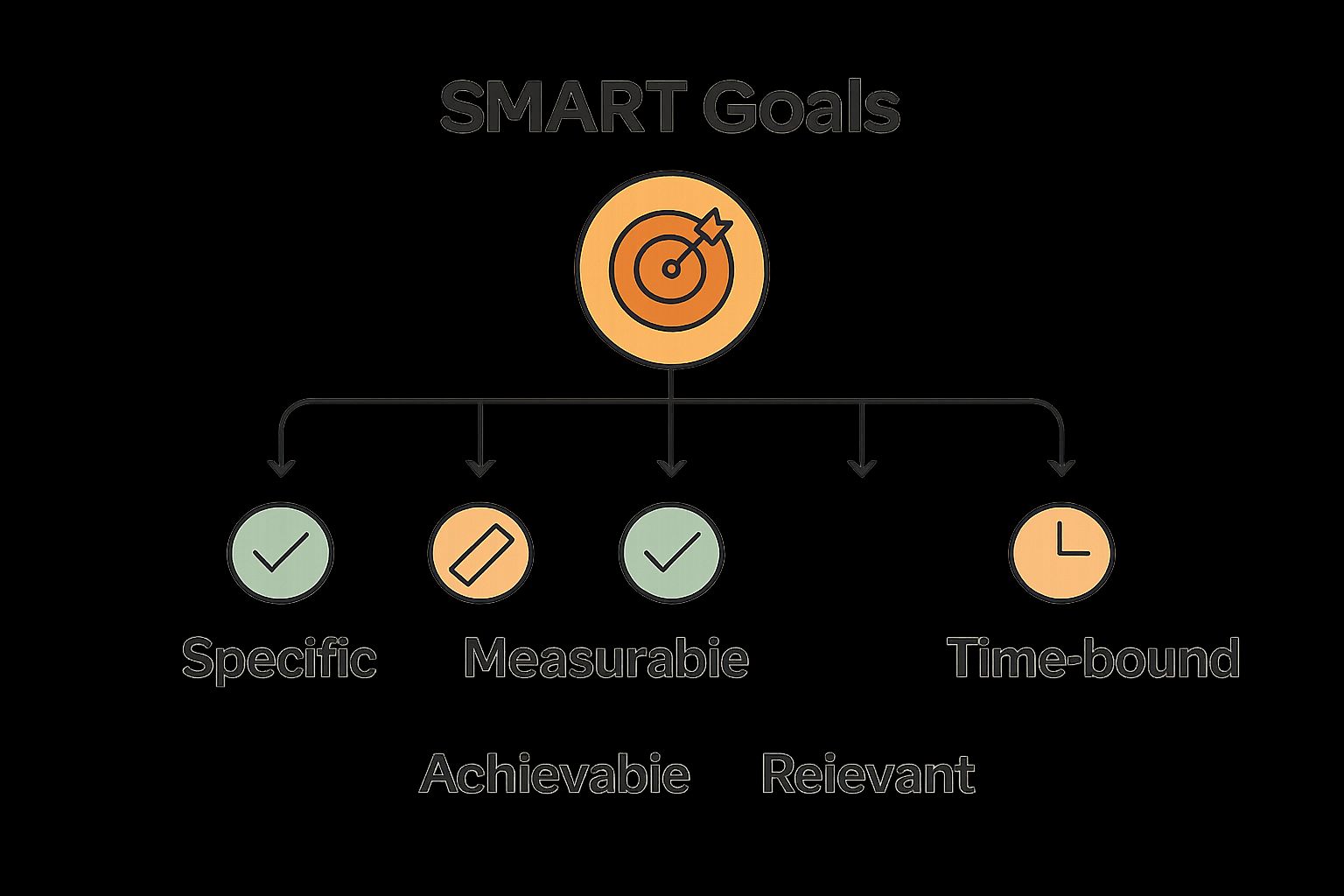
Learn more about our goal tracking strategies that can help you implement these principles effectively. The process begins by translating your initial self-assessment into clear, purposeful objectives that genuinely reflect your academic and personal potential.
Start by crafting goals that are extraordinarily specific. Instead of a vague statement like “improve grades,” articulate a precise target such as “raise my mathematics grade from a B minus to a B plus by the end of the semester by attending weekly study sessions and completing additional practice problems.” Specificity transforms ambiguous intentions into actionable strategies.
Ensure each goal includes quantifiable metrics that allow you to track progress. Measurability transforms subjective intentions into objective benchmarks. For instance, if your goal involves time management, specify exact parameters like “dedicate 10 hours per week to focused study time” rather than simply “study more.” This approach provides clear indicators of advancement and achievement.
Consider your comprehensive personal audit when determining goal achievability. Goals should challenge you without becoming overwhelming. A balanced objective stretches your capabilities while remaining within realistic boundaries. This means understanding your current limitations and designing goals that push your boundaries without causing undue stress.
Verify your goals meet these critical criteria:
- Clear and unambiguous language
- Specific numerical or time-based targets
- Aligned with your current academic capabilities
- Meaningful to your long-term aspirations
- Flexible enough to adapt to unexpected challenges
Your SMART goals are not rigid commandments but dynamic roadmaps. They should evolve as you progress, allowing room for adjustment while maintaining focus on your ultimate objectives. By following this structured approach, you transform wishful thinking into a systematic path toward academic success.
According to research from Carnegie Mellon University, students who implement comprehensive goal-setting strategies demonstrate significantly improved academic performance and personal motivation. Your SMART goals become the bridge between your current reality and your desired future.
Step 3: Develop an Action Plan with Milestones
Transforming your SMART goals into reality requires a meticulously crafted action plan that breaks down complex objectives into manageable, sequential steps. An effective action plan serves as your strategic roadmap, converting theoretical goals into practical, executable tasks.
Explore our weekly agenda setup strategies to complement your milestone planning process. Begin by deconstructing each goal into smaller, interconnected sub-tasks that collectively drive you toward your ultimate objective. This granular approach prevents overwhelm and provides clear directional guidance.
Consider your action plan as a living document that requires regular review and adaptation. Start by establishing chronological milestones that represent significant progress points. These milestones function as checkpoints, allowing you to measure advancement, recalibrate strategies, and maintain motivation. For academic goals, this might mean setting specific markers like completing research proposal drafts, achieving targeted exam scores, or mastering particular skill sets within predetermined timeframes.
Strategic timing is crucial in milestone development. Each milestone should be realistic, challenging, and aligned with your broader academic and personal constraints.
Space your milestones strategically to provide consistent momentum without creating undue pressure. This balanced approach ensures steady progression while maintaining psychological resilience.
Document your action plan with precision, including explicit details about each milestone:
- Specific task description
- Estimated completion date
- Required resources
- Potential obstacles and mitigation strategies
- Success criteria for each milestone
Integrate flexibility into your planning process. Recognize that unexpected challenges will inevitably emerge, and your action plan should accommodate potential adjustments. Rigid plans break; adaptable strategies prevail. This means creating contingency options and maintaining a growth mindset that views obstacles as opportunities for recalibration rather than insurmountable barriers.
According to research from Carnegie Mellon University, students who develop comprehensive action plans with clear milestones demonstrate significantly higher goal achievement rates. Your action plan transforms abstract aspirations into a structured, actionable journey of academic and personal development.
Verify your action plan’s effectiveness by ensuring it answers three critical questions: What exactly will you do? When will you do it? How will you know you’ve succeeded? A well-constructed plan provides clear, unambiguous answers to these fundamental inquiries, setting the stage for purposeful and systematic goal pursuit.
Below is a checklist to help you ensure your action plan for achieving academic goals is comprehensive and effective.
| Action Plan Component | What to Include | Why It Matters |
|---|---|---|
| Specific Task Description | Clear explanation of each sub-task | Provides direction and avoids ambiguity |
| Estimated Completion Date | Target finish date for each task | Supports time management and steady progress |
| Required Resources | Materials, support, or tools needed | Ensures preparedness and reduces unexpected delays |
| Potential Obstacles | Possible challenges, with solutions | Helps you plan ahead and reduce disruptions |
| Success Criteria | Measurable indicators of completion | Shows when a milestone is fully achieved |
Step 4: Implement Your Action Plan Consistently
Consistent implementation transforms thoughtful plans into tangible achievements. Execution is where most goal-setting strategies either flourish or falter, making this step the critical pivot point between intention and actual progress. Your ability to systematically translate your carefully crafted action plan into daily practice determines your ultimate success.
Learn about managing daily tasks effectively to support your implementation strategy. Begin by establishing a consistent routine that integrates your milestone activities seamlessly into your existing schedule. This means identifying optimal time blocks where you can focus exclusively on your targeted tasks without constant interruption.
Develop a reliable tracking mechanism that allows you to monitor progress and maintain accountability. This could involve using a dedicated digital planner, creating a visual dashboard, or maintaining a detailed journal that records your daily achievements and challenges. The key is selecting a tracking method that feels natural and motivating rather than restrictive.
Recognize that implementation is not about perfect execution but about persistent effort. Some days will be more productive than others, and that is perfectly acceptable. Build resilience by treating setbacks as learning opportunities rather than failures. When you encounter obstacles, pause and reassess your approach, making incremental adjustments that keep you moving forward.
Establish supportive environmental conditions that enhance your ability to execute consistently:
- Create a dedicated workspace free from distractions
- Communicate your goals with supportive friends or family
- Develop pre-task rituals that signal mental preparation
- Remove potential obstacles before they interrupt your workflow
Motivation fluctuates, but discipline endures. Develop systems that do not rely solely on momentary inspiration but instead create structured pathways for consistent action. This might mean implementing techniques like time blocking, using productivity apps, or establishing accountability partnerships that keep you engaged with your goals.
According to the American Psychological Association, students who maintain consistent implementation strategies demonstrate significantly higher goal achievement rates. Your daily commitment transforms theoretical plans into concrete progress, bridging the gap between where you are and where you aspire to be.

Ultimately, successful implementation is about creating a sustainable rhythm that aligns with your personal energy levels and academic demands. Be patient with yourself, celebrate small victories, and maintain an unwavering commitment to your long-term vision. Your consistent effort, even in small increments, compounds into remarkable achievements.
Step 5: Monitor Progress and Adjust Goals as Needed
Progress monitoring transforms goal setting from a static plan into a dynamic, responsive journey. Your ability to track, evaluate, and recalibrate determines the ultimate success of your academic and personal objectives. This step is not about perfection but about maintaining strategic flexibility and continuous improvement.
Discover why tracking progress matters and enhance your goal achievement strategy. Establish a consistent review mechanism that allows you to objectively assess your advancement. This means scheduling regular checkpoints where you thoroughly examine your progress, comparing actual achievements against your original milestones.
Develop a comprehensive tracking system that goes beyond surface-level measurements. Quantitative metrics like completed tasks and grade improvements are important, but equally crucial are qualitative assessments of your learning, personal growth, and skill development. Holistic progress tracking captures both numerical achievements and intangible improvements.
Approach your progress reviews with radical honesty and compassionate self-assessment. When you identify gaps between your planned objectives and current performance, view these not as failures but as opportunities for strategic refinement. This might mean adjusting timelines, modifying task approaches, or even reimagining certain goals to better align with your evolving capabilities and circumstances.
Establish clear criteria for goal evaluation:
- Percentage of milestone completion
- Quality of work produced
- Personal energy and motivation levels
- Alignment with broader academic and personal objectives
- Identification of unexpected challenges or opportunities
Flexibility is your greatest asset in goal achievement. Recognize that the most successful students are not those who rigidly adhere to an initial plan, but those who can intelligently adapt their strategies in response to changing circumstances. This might mean accelerating certain goals, extending timelines, or completely restructuring your approach based on new insights.
According to the American Psychological Association, students who engage in regular self-reflection and goal adjustment demonstrate significantly higher long-term success rates. Your progress monitoring is not a bureaucratic exercise but a powerful tool for continuous personal and academic development.
Ultimately, effective goal monitoring is about maintaining a growth mindset. Embrace each review as an opportunity to learn, recalibrate, and move closer to your aspirations. Your willingness to honestly assess your journey, celebrate victories, and learn from challenges will be the most critical factor in transforming your academic goals from potential to reality.
Use this table to review and track key elements during your goal monitoring sessions, ensuring all critical progress factors are evaluated regularly.
| Review Element | Evaluation Criteria | Example Assessment |
|---|---|---|
| Milestone Completion (%) | Percentage of tasks/goals accomplished | 60% of weekly assignments done |
| Quality of Work | Level of accuracy and completeness | Essays meet rubric standards |
| Personal Motivation | Energy, drive, and engagement levels | Consistent study sessions |
| Alignment with Objectives | Relevance to overall academic/personal goals | Activities support major goals |
| Unexpected Challenges | Barriers or opportunities identified | Family event impacted schedule |
Turn Your Study Goals Into Achievements with Optio Station
If you have ever felt stuck turning your academic goals into real progress, you are not alone. Many students struggle to plan, track, and adjust their journey from broad dreams to daily action. The article highlighted how key steps like honest self-assessment, clear SMART goal-setting, and consistent action can make the difference between falling behind and moving forward. Our app at Optio Station is designed to help you master each step by giving you the tools to audit, organize, and track every milestone on your academic path. Take control of your study schedule and see your growth in real time. For deeper insights on how to set priorities and manage your work, check out the Best Project Management App for Prioritization page to discover student-focused solutions that fit any workload.

Ready to bridge the gap between your current habits and your academic dreams? Download Optio Station today at Optio Station and see how easy it is to implement what you learned. With every study session you log and each milestone you reach, you will feel empowered to keep going. Get started now and experience productive goal setting built just for students.
Frequently Asked Questions
What are SMART goals and how can they help in goal setting?
SMART goals are Specific, Measurable, Achievable, Relevant, and Time-bound objectives that provide a structured framework for effective goal setting. They help you turn abstract aspirations into concrete plans by making your goals clear and trackable.
How can I assess my current academic performance effectively?
To assess your academic performance, review your recent transcripts, analyze your grades, identify subjects where you excel or struggle, and document your current study habits and time commitments. This comprehensive self-audit lays the groundwork for meaningful goal setting.
What should be included in my action plan for achieving my academic goals?
Your action plan should break down each SMART goal into smaller, manageable tasks with specific descriptions, estimated completion dates, required resources, potential obstacles, and success criteria. This structured roadmap guides you towards your objectives.
How often should I monitor my progress towards my goals?
Regularly monitor your progress at scheduled checkpoints to objectively evaluate your advancement. This includes reviewing both quantitative metrics, like completed tasks, and qualitative assessments, such as personal growth and motivation levels, allowing for timely adjustments to your goals.
Recommended
- Step by Step Goal Tracking for Students and Professionals – Optio Station: Best Project Management App for Prioritization
- Understanding Why Track Achievements Matters for You – Optio Station: Best Project Management App for Prioritization
- Uncategorized – Optio Station: Best Project Management App for Prioritization
- Understanding Why Use Goal Trackers for Success – Optio Station: Best Project Management App for Prioritization
- blog | siift | 7 Innovative Business Ideas for Students to Start Now
