

TL;DR:
- Setting well-defined, challenging goals leads to higher performance and measurable progress.
- Flexibility and regular adjustments are crucial since circumstances and priorities evolve over time.
Plenty of students and young professionals have goals. The real problem is that most of those goals are little more than vague wishes floating around in their heads. “I want to do better this semester” or “I’d like to get promoted soon” sounds like ambition, but without a clear structure behind it, these kinds of statements lead nowhere. Research consistently shows that well-defined, challenging goals produce dramatically better results than fuzzy intentions. This guide breaks down the science, the frameworks, and the daily habits that turn motivation into measurable progress.
Table of Contents
- Why clear goals matter: the science behind achievement
- Goal-setting frameworks: SMART, OKR, and choosing your best fit
- From intention to action: using time management to achieve goals
- Prioritization: tackling multiple goals for greater change
- What most people miss: why adjusting your goals beats aiming for perfection
- Take your next step: tools and support for goal achievement
- Frequently asked questions
Key Takeaways
| Point | Details |
|---|---|
| Define goals clearly | Setting specific and challenging goals leads to better motivation and outcomes. |
| SMART vs. OKR frameworks | Use SMART for personal, short-term objectives and OKR for ambitious, team-oriented targets. |
| Time management matters | Combining goal setting with time management training improves focus and productivity. |
| Prioritize and adapt | Working on two goals at once can be more effective than one, but stay flexible and adjust as you grow. |
| Perfection not required | Progress is built on ongoing adjustment and learning, not flawless goal achievement. |
Why clear goals matter: the science behind achievement
Most people think that wanting something badly enough is the fuel for success. It isn’t. Intensity of desire only matters if it’s pointed at something specific. This is where the research becomes really revealing.
Locke and Latham spent decades studying how people perform when working toward different types of goals. Their conclusion was striking: specific and challenging goals lead to higher performance than vague or easy ones, and this finding held up across more than 400 studies involving everything from corporate teams to individual students. The theory isn’t just academic. It explains why the person who sets out to “study more” rarely outperforms the person who commits to “completing two chapters of organic chemistry every Tuesday and Thursday from 6 to 8 PM.”
“A goal properly set is halfway reached.” This old idea lines up perfectly with what modern behavioral science tells us: the definition of the goal shapes the quality of the effort that follows.
Here’s the trap most driven people fall into on both ends of the spectrum:
- Too easy: If a goal requires no real stretch, your brain interprets it as low stakes and switches into cruise control.
- Too hard: If a goal feels completely out of reach, motivation collapses because effort doesn’t seem worth it.
- Just right: Goals that feel challenging but achievable create what psychologists call the “sweet spot” of engagement, where you focus harder, waste less time, and bounce back faster from setbacks.
Goal clarity also does something practical: it cuts decision fatigue. When your target is specific, you spend less mental energy deciding what to work on each day and more energy actually doing it. Studies on effective goal-setting consistently show that students with clear academic goals report better time use, less procrastination, and a stronger sense of control over their schedules.
Balancing goal difficulty is a skill. A good rule of thumb is to ask: “Does this goal make me slightly uncomfortable but not paralyzed?” If the answer is yes, you’re probably in the right range.
Goal-setting frameworks: SMART, OKR, and choosing your best fit
Understanding why goals matter is just the first step. Next, you need the frameworks to set them correctly.
Two frameworks dominate for students and young professionals: SMART goals and OKRs (Objectives and Key Results). They serve different purposes, and knowing when to use each one is a real advantage.
SMART goals were originated by George Doran in 1981 and stand for Specific, Measurable, Achievable, Relevant, and Time-bound. This framework is built for personal accountability and short-term targets where 100% completion is the benchmark. It works best when you own the outcome entirely and have full control over the inputs.
OKRs, developed at Intel and later popularized by Google, follow a different logic. You set an ambitious Objective (a qualitative direction) and then attach three to five Key Results (quantitative milestones). The OKR framework intentionally aims for about 70% achievement. Why? Because if you’re consistently hitting 100% on OKRs, your targets aren’t ambitious enough. OKRs thrive in team environments and for multi-month strategic goals.
| Framework | Best for | Success target | Time horizon | Ownership |
|---|---|---|---|---|
| SMART | Personal tasks, coursework | 100% | Days to weeks | Individual |
| OKR | Teams, career ambitions | ~70% | Quarterly | Team or individual |
Here’s how to choose in practice:
- Use SMART when writing a paper, preparing for an exam, or hitting a specific career milestone like earning a certification by a set date.
- Use OKR when leading a group project, planning a semester, or setting professional growth targets for the next three to six months.
- Combine both by using an OKR as your big-picture direction and SMART goals as the weekly action steps underneath it.
Looking at SMART goal examples makes it easier to understand the difference between a well-formed goal and a weak one. For instance, “study more for finals” becomes “complete three full practice exams for statistics between November 10 and November 21, reviewing all wrong answers within 24 hours.” Same intention, completely different outcome.
Pro Tip: When building your first OKR, write the Objective as something you’d be proud to say out loud to a mentor. Then write Key Results that would prove to a skeptic that you achieved it. If you can’t measure a Key Result, rewrite it until you can.
For students applying this at work, a student goal-setting guide can help bridge the gap between academic habits and professional expectations. The same frameworks apply, but the stakes and timelines shift.
From intention to action: using time management to achieve goals
With your goal-setting method in hand, let’s explore how to bridge the gap between your intentions and everyday execution.
Goal setting without time management is like having a destination without a map. You might eventually get there, but you’ll waste a huge amount of time wandering. A compelling study of 145 students over 10 weeks found that combined goal-setting and time management training led to measurable improvements across five areas: efficiency, confidence, focus, study hours, and life balance. None of those improved through goal setting alone.

| Area of improvement | Before training | After 10 weeks |
|---|---|---|
| Study efficiency | Low | Significantly higher |
| Academic confidence | Inconsistent | Noticeably improved |
| Focus during study | Fragmented | More sustained |
| Weekly study hours | Variable | Increased and stable |
| Life balance | Neglected | Actively managed |
The lesson is clear. Goals tell you where to go. Time management determines whether you actually move.
Here’s a practical system for connecting the two:
- Break every goal into weekly targets. If your SMART goal is to write a 3,000-word research paper in three weeks, that’s roughly 1,000 words per week, broken further into 200 to 300 words per writing session.
- Schedule tasks before the week starts. Assign each session a specific time slot on Sunday evening. Leaving it to “when I have time” guarantees it won’t happen.
- Build buffer time. Add one extra session per week as a buffer for the unexpected: a last-minute shift, a social obligation, or a low-energy day. Buffers aren’t procrastination insurance; they’re realistic planning.
- Review on Fridays. A five-minute weekly check-in tells you what moved forward and what needs adjustment before the next week begins.
Looking at SMART time management examples shows that the most productive students don’t work more hours. They work smarter by pairing specific goals with structured blocks of time.
Pro Tip: Don’t just schedule what to do. Schedule where to do it. Research shows that consistent environmental cues (same desk, same playlist, same time) train your brain to enter focus mode faster. Within two to three weeks, sitting down at your study spot will feel automatic rather than effortful.
You can also explore time management goal examples designed specifically for Centurions who are balancing coursework, internships, and personal ambitions at the same time.
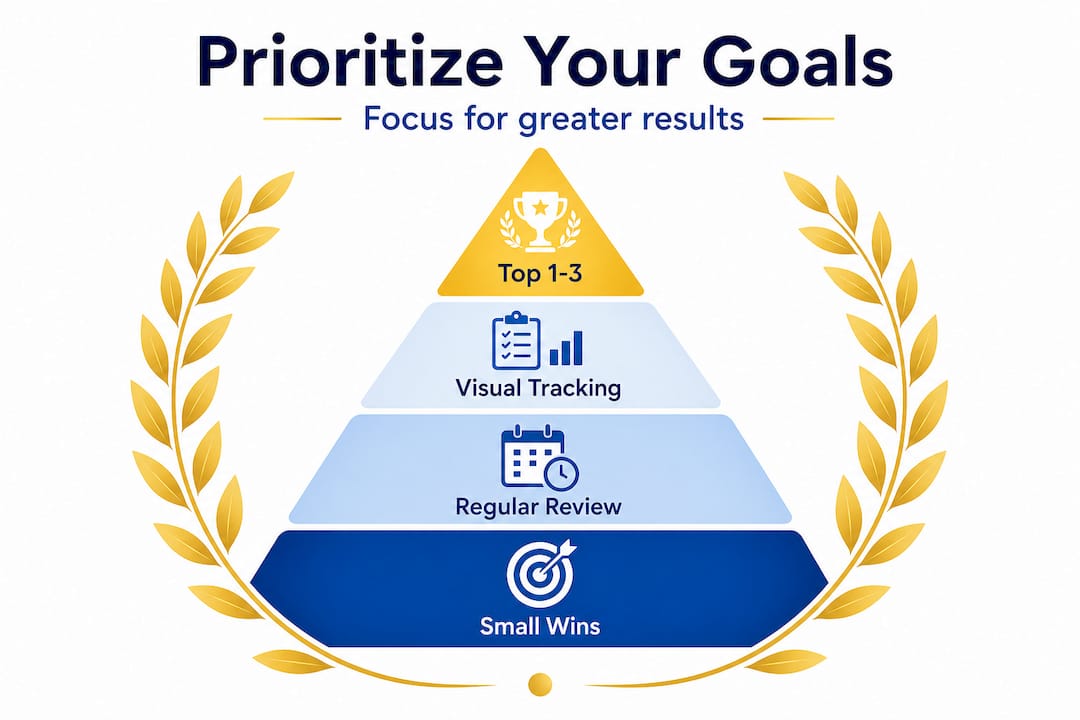
Prioritization: tackling multiple goals for greater change
Taking action means dealing with competing demands. Here’s how prioritization can amplify your results.
Here’s a counterintuitive finding most people overlook. Many coaches and productivity gurus tell you to pick one goal and go all in. But a study of 1,802 participants found that prioritizing two goals actually led to greater behavior change than focusing on a single goal, and it didn’t harm performance in non-prioritized areas. Two goals, when managed well, can create a self-reinforcing cycle.
That said, the operative phrase is “managed well.” Without structure, chasing multiple goals creates noise, not progress.
Here’s how to prioritize effectively without burning out:
- Rank by impact, not urgency. The task that screams loudest isn’t always the one that matters most. Ask yourself: “Which of these goals will move my life forward the most in six months?” That’s your top priority.
- Set weekly focus themes. If you’re working on both fitness and a course project this semester, assign primary energy to one per week while maintaining minimum viable effort on the other.
- Use a simple scoring system. Rate each goal on two dimensions: importance (1 to 5) and deadline pressure (1 to 5). Multiply the scores. The highest number gets first attention.
- Review every two weeks. Priorities shift. What mattered in September might not be the same in November. A quick biweekly review keeps your effort pointed at the right things.
- Drop guilt about the second goal. Maintaining progress on goal two doesn’t require equal time. It requires consistent, intentional minimum effort so momentum doesn’t die.
The practical goal-setting tips that work best for multi-goal scenarios involve visual tracking, where you can see all your active goals at a glance, which reduces the mental load of trying to hold everything in your head at once.
Pro Tip: Never have more than three active goals at the same time. Once you cross that threshold, your brain starts treating all of them as background noise. Two to three well-managed goals will always outperform five half-hearted ones.
For students building out a longer-term plan, reviewing goal strategy examples helps show how to structure quarterly priorities across both academic and career development areas.
What most people miss: why adjusting your goals beats aiming for perfection
Here’s the part of goal-setting advice that almost nobody talks about honestly: you will outgrow your goals. Sometimes faster than you expected.
Most productivity content treats goal-setting as a “set it and forget it” exercise. Write it down, work toward it, achieve it. But real life doesn’t work that way. You take a class and realize your intended major isn’t right. You land an internship and discover a career path you didn’t know existed. A relationship shifts your priorities. A health issue forces a detour.
The students and young professionals who actually build lasting momentum aren’t the ones who stuck rigidly to their original plan. They’re the ones who learned to treat goals like working documents rather than contracts. The real skill isn’t perfect goal-setting. It’s agile adaptation, which means updating your targets as your knowledge, circumstances, and priorities evolve.
This matters because perfectionism around goals is one of the most common reasons people abandon them entirely. You miss one week of workouts and decide the fitness goal is dead. You get a B on the first exam and assume the 4.0 goal is unreachable. But the step-by-step approach to real results shows that progress is almost never linear, and the willingness to adjust your method without abandoning your direction is what separates people who grow from people who stay stuck.
Build a monthly “goal audit” into your routine. Look at each active goal and ask: Is this still relevant? Is the timeline realistic? Does the strategy need updating? Give yourself permission to revise without treating it as failure. A revised goal is still a goal. A discarded goal is lost progress.
Take your next step: tools and support for goal achievement
If you’re ready to put your learning into action, here are the next steps and tools to maximize your momentum.
Reading about goal-setting frameworks is one thing. Having the right tools to execute them is another entirely. Optio is your second-in-command, a mobile app built specifically for Centurions who are juggling tasks, teams, and time across every area of their lives. Whether you’re managing a solo study schedule or coordinating with classmates on a group project, Optio’s Roman-themed system keeps your goals and priorities front and center without the clutter of generic productivity apps.

Explore the best task management tools to find what fits your workflow, or dive into proven methods for managing tasks effectively when your to-do list starts to outpace your calendar. If time feels like the real enemy, building stronger time management skills is the foundational step that makes every other strategy work better. Your goals deserve more than a sticky note. Give them a system.
Frequently asked questions
What is the difference between a goal and a wish?
A goal is a clearly defined, actionable target with measurable steps and a deadline; a wish is a desire without specific criteria, a plan, or any committed action behind it.
How do SMART goals improve time management?
SMART goals make each task specific and trackable, so you can allocate time with precision and measure progress rather than guessing whether you’re moving forward. The SMART framework was built exactly for this kind of structured accountability.
Can I work on more than one goal at once?
Yes, and the research actually supports it: prioritizing two goals produced greater behavior change than one in a study of 1,802 participants, as long as both goals are actively managed and reviewed.
Does goal difficulty level really matter?
Absolutely. Goals that are too easy produce complacency while goals that are too hard cause discouragement. According to Locke and Latham’s research across more than 400 studies, specific and challenging goals consistently outperform both extremes.
Recommended
- How to Increase Motivation: Achieve Your Goals Effectively – Optio Station: Best Project Management App for Prioritization
- Unlock the true role of motivation for peak productivity – Optio Station: Best Project Management App for Prioritization
- Examples of SMART goals to boost academic success – Optio Station: Best Project Management App for Prioritization
- Why set study goals? 250% higher performance awaits – Optio Station: Best Project Management App for Prioritization
