

TL;DR:
- Effective daily tasking involves centralizing tasks, limiting to nine items using the 1-3-5 rule, and categorizing them as Must-Do or Should-Do. It requires a structured workflow of capturing, clarifying, scheduling, and reviewing tasks to build focus and reduce decision fatigue. The system’s success depends on simplicity, consistency, and clear prioritization, rather than motivation alone.
Daily tasking is the disciplined practice of capturing, prioritizing, and executing a focused set of day tasks to maximize output and reduce mental clutter. Most students and young professionals don’t have a discipline problem. They have a list design problem. Structured daily task management, built around proven frameworks like the 1-3-5 rule and the Eisenhower Matrix, produces more completed work than any motivational habit ever will. This guide breaks down exactly how to build that structure, avoid the traps that kill productivity, and make your daily routine work for you.
What are the key components of successful daily tasking?
Effective daily tasking starts with one non-negotiable rule: every task lives in one place. Centralizing task capture in a single point of truth reduces cognitive friction and cuts down on reactive, scattered workdays. When your tasks live across sticky notes, group chats, email drafts, and three different apps, your brain spends energy tracking the system instead of doing the work.

Beyond a single capture point, you need realistic task volume limits. The 1-3-5 rule sets a daily cap of 9 items: 1 large task, 3 medium tasks, and 5 small tasks. That structure forces you to make real decisions about what actually belongs on today’s list versus what belongs on a future list.
Every task also needs a clear, specific description. “Work on essay” is not a task. “Write the introduction paragraph for the sociology paper” is. Vague tasks stall because your brain can’t identify the next physical action.
The final prerequisite is a capture tool you will actually use. That might be a paper notebook, a notes app, or a dedicated task management app like Optiostation. The format matters less than the consistency.
- Single capture point: All tasks go into one system, not scattered across apps and notebooks.
- Task volume cap: Limit your day to 9 items using the 1-3-5 structure.
- Specific descriptions: Write tasks as concrete next actions, not vague categories.
- Consistent tool: Pick one capture method and use it every single day.
Pro Tip: Set up your capture system the night before. A 5-minute prep session before bed means you start the next morning already knowing what you’re doing.
How do you design a daily task list that maximizes focus?
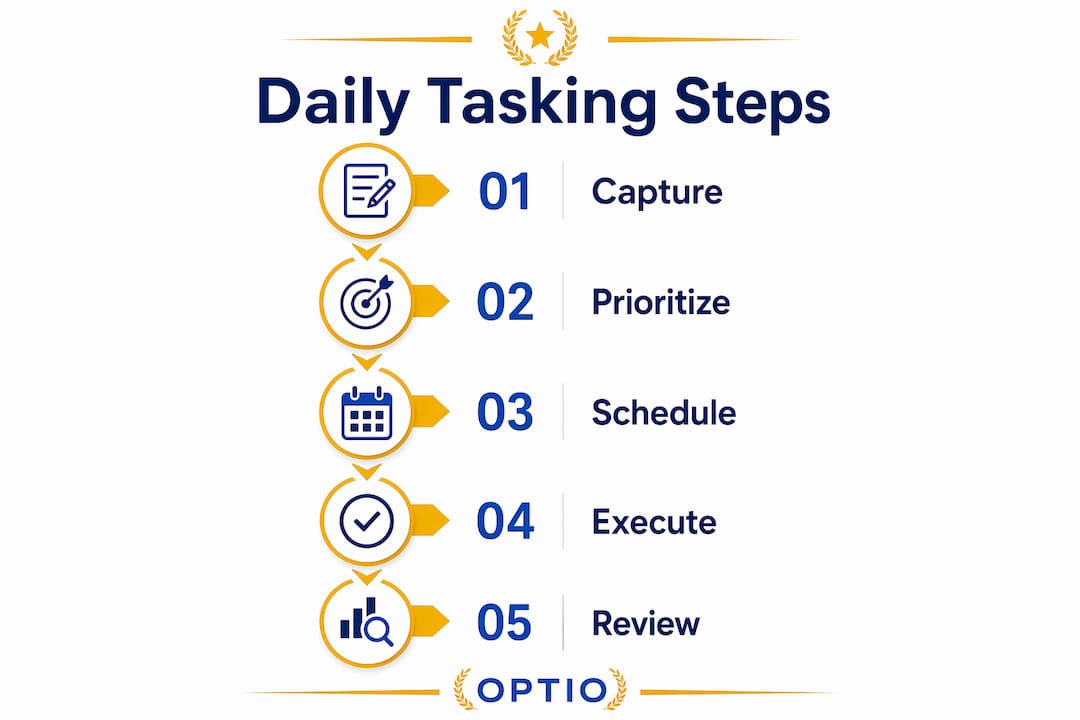
The most effective daily task lists are built around impact, not volume. The Eisenhower Matrix sorts tasks into four quadrants by urgency and importance. Urgent and important tasks go first. Important but not urgent tasks get scheduled. Urgent but not important tasks get delegated. Everything else gets cut. For students and young professionals, this framework alone eliminates the noise that fills most daily lists.
Once you’ve filtered by importance, apply the 1-3-5 rule to set your daily ceiling. An effective daily task list caps at 9 tasks: 1 large, 3 medium, and 5 small. That limit fits the realistic capacity of a workday or class schedule. Going beyond it doesn’t make you more productive. It makes you less accurate about what you can actually finish.
The next design decision is separating “Must-Do” from “Should-Do” tasks. Must-Do items are non-negotiable: the assignment due tonight, the meeting you can’t miss, the client email that needs a reply. Should-Do items are valuable but movable. Splitting tasks visually into these two columns improves completion rates and reduces the burnout that comes from treating everything as equally urgent.
Two frameworks sharpen this further. “Eat the Frog,” a method popularized by Brian Tracy, says to tackle your hardest task first thing in the morning before anything else. The 1-3-5 rule then organizes the rest of the day around that anchor. Together, they prevent the common trap of spending the morning on easy tasks and running out of energy before the hard work gets done.
Scheduling buffer time is not optional. Planning should include buffer blocks to handle interruptions and context switching rather than filling every minute. A schedule with no slack fails the moment a professor runs long, a Slack message demands attention, or a task takes 20 minutes longer than expected.
Here’s a simple comparison of two list design approaches:
| Approach | What it looks like | Result |
|---|---|---|
| Unstructured list | 15+ tasks, no priority order, no time estimates | Low completion, high stress |
| Structured 1-3-5 list | 9 tasks max, sorted by Must-Do and Should-Do | Higher completion, clearer focus |
Pro Tip: Write your Must-Do tasks the night before. When you sit down to work, you already know exactly where to start.
What is an effective daily workflow for managing tasks?
A repeatable daily workflow removes the decision fatigue of figuring out what to do next. The most reliable structure follows four steps: Capture, Clarify, Schedule, and Review. This 4-step daily workflow gives you a complete system from morning to evening.
- Capture. Every task, idea, or commitment goes into your single capture point immediately. Don’t rely on memory. If it’s not written down, it doesn’t exist in your system.
- Clarify. Review each captured item and define the next physical action. “Prepare for Thursday’s presentation” becomes “Find three supporting statistics for slide 4.” Clarification converts vague items into tasks you can actually start.
- Schedule. Assign each task to a realistic time block in your day. Teams that prioritize 3 to 5 critical daily items maintain sharper focus than those who attempt more. Block your Must-Do tasks during your highest-energy hours. Schedule Should-Do tasks for lower-energy windows.
- Review. End every day with a short review. Check what you finished, what you didn’t, and why. An evening shutdown routine improves next-day clarity by reducing decision fatigue. Unfinished tasks need a deliberate decision: roll them to tomorrow, reschedule them, or delete them entirely.
The review step is where most people fall short. They skip it because the day is over and they’re tired. But unfinished tasks provide signals that improve your planning over time. A task that rolls over three days in a row is telling you something: it’s either too vague, too large, or not actually a priority.
A strong daily workflow also includes a morning launch. Before you open email or social media, spend 5 minutes reviewing your task list and confirming your top priority. Morning launch and evening shutdown routines form the core of a productive reset and deserve consistent practice.
- Review your task list before checking messages each morning.
- Assign time blocks to Must-Do tasks during peak energy hours.
- Leave at least one buffer block of 20 to 30 minutes for unexpected demands.
- Run a 5-minute end-of-day review before closing your workspace.
Which common mistakes hinder daily tasking success?
The most widespread mistake is overloading the daily list. Students and young professionals often confuse a long list with a productive day. Busyness is not output. Productivity challenges stem from list design, not individual willpower. A list with 20 items is a wish list, not a work plan.
The second mistake is failing to distinguish Must-Do from Should-Do tasks. When everything feels urgent, nothing gets prioritized. The result is a day spent on low-impact tasks while the high-stakes work waits. This pattern is sometimes called “productivity theater”: you look and feel busy, but the work that actually matters doesn’t move.
- Overloading the list: Cap your day at 9 tasks. If you consistently finish early, add a buffer task, not a tenth item.
- No Must-Do/Should-Do split: Label every task before your day starts. If you can’t decide, it’s a Should-Do.
- Multiple capture tools: Using multiple tools for task capture causes cognitive friction and increases reactive work. Pick one system and commit.
- No buffer time: A fully booked schedule breaks at the first interruption. Build in slack deliberately.
- Ignoring role changes: A student entering an internship needs a different task structure than a full-time student. Revisit your system when your responsibilities shift.
Pro Tip: If a task has rolled over more than twice, break it into smaller pieces or decide it’s not actually a priority. Chronic rollover is a planning signal, not a motivation problem.
What are practical daily productivity tips for students and young professionals?
Good daily task management habits don’t require complex systems. They require consistent, simple practices applied every day. Here are the habits that produce the most reliable results for students and young professionals building their daily planning routine:
- Use one capture tool. Paper, a notes app, or a dedicated task app all work. Switching between them does not.
- Apply a simple prioritization framework. The 1-3-5 rule or the Eisenhower Matrix both work well. Pick one and use it consistently.
- Build end-of-day reviews into your schedule. Treat the 5-minute shutdown as a non-negotiable appointment with yourself.
- Run a weekly review. Once a week, look at what you completed, what rolled over, and what you need to plan for the coming week. This prevents the accumulation of forgotten commitments.
- Use task apps in moderation. A task management app like Optiostation works best as a capture and organization tool, not as a substitute for the thinking required to prioritize. The app holds your list. You decide what matters.
- Protect your peak hours. Identify the 2 to 3 hours when your focus is sharpest and guard them for Must-Do tasks. For most people, this is mid-morning.
For students managing exam periods, time management during high-pressure weeks requires tighter daily lists and shorter review cycles. Reduce your daily task cap during crunch periods rather than expanding it. Fewer, better-executed tasks outperform a long list of half-finished ones every time.
Young professionals entering their first roles benefit from building time management habits early. The task management skills you build in your first year carry forward into every role that follows.
Key Takeaways
Effective daily tasking requires a structured system, not stronger willpower. The 1-3-5 rule, a single capture point, and a consistent four-step workflow produce more completed work than any motivational approach.
| Point | Details |
|---|---|
| Use the 1-3-5 rule | Cap your day at 9 tasks: 1 large, 3 medium, and 5 small to stay realistic. |
| Split Must-Do from Should-Do | Separating task types improves completion rates and prevents burnout from false urgency. |
| Centralize task capture | One system for all tasks reduces cognitive friction and reactive work patterns. |
| Build buffer time in | Reserve at least one 20-to-30-minute block daily to absorb interruptions without derailing your plan. |
| Run an evening shutdown | A short end-of-day review reduces decision fatigue and sharpens next-morning clarity. |
The real reason your daily list keeps failing you
Most people I’ve watched struggle with productivity aren’t lazy. They’re working from a broken list. The list is too long, too vague, or has no real priority order. When the system is flawed, willpower can’t save it. You can be the most disciplined person in the room and still end the day feeling like you got nothing done, because your list set you up to fail before you started.
What actually works is structure that removes decisions. When you know your one big task, your three medium tasks, and your five small tasks before the day begins, you don’t have to think about what to do next. You just do it. That’s not a motivational trick. That’s engineering your environment to make the right behavior the easiest behavior.
The students and young professionals who build this kind of system early have a real advantage. Not because they’re more talented, but because they stop wasting energy on the meta-work of figuring out what to work on. The task management habits you build now compound over years. Start simple, stay consistent, and adjust the system when your role changes.
— Optiostation
Optiostation: your second-in-command for daily task management
Optiostation is built for exactly the kind of structured daily tasking this article describes. The app functions as your Optio, the Roman second-in-command, so you can focus on executing your priorities as a Centurion rather than managing your system.
Optiostation brings task capture, prioritization, and team coordination into one place, purpose-built for students and young professionals. Whether you’re managing coursework, a side project, or your first professional role, the app supports the 1-3-5 structure, daily reviews, and clear task organization without the clutter of enterprise tools. Explore how to manage tasks effectively for students and professionals, or check the full task management software guide to find the right setup for your workflow.
FAQ
What is daily tasking?
Daily tasking is the practice of capturing, prioritizing, and completing a focused set of tasks within a single day. It relies on structured frameworks like the 1-3-5 rule to keep lists realistic and completable.
How many tasks should be on a daily task list?
An effective daily task list should contain no more than 9 items: 1 large, 3 medium, and 5 small tasks. Exceeding this limit dilutes focus and reduces the number of tasks you actually complete.
What is the difference between Must-Do and Should-Do tasks?
Must-Do tasks are non-negotiable commitments due that day. Should-Do tasks are valuable but movable. Splitting your list into these two categories improves completion rates and prevents low-priority work from crowding out high-impact tasks.
Why do most daily task lists stay incomplete?
Most lists fail because of poor design, not poor discipline. Overloaded lists, vague task descriptions, and no priority order make completion structurally impossible. Incomplete tasks signal a planning problem, not a motivation problem.
How does an evening shutdown routine help with productivity?
An evening shutdown review reduces decision fatigue by clearing your mental slate before the next day. It forces deliberate decisions about unfinished tasks and sharpens your morning focus by removing the need to figure out where to start.
Recommended
- Command Log – Optio Station: Best Project Management App for Prioritization
- Task Batching Explained: Boost Focus and Productivity – Optio Station: Best Project Management App for Prioritization
- Master to-do list creation: 40% focus boost for students – Optio Station: Best Project Management App for Prioritization
- 7 Types of To-Do Lists Every Student Should Use – Optio Station: Best Project Management App for Prioritization
