

Balancing coursework, assignments, and personal commitments often feels overwhelming for college students and young professionals. Without a clear plan, you might find yourself cramming before exams, missing deadlines, or sacrificing sleep to catch up. A well-structured study schedule transforms chaos into control by helping you allocate time strategically, reduce stress, and improve academic performance. This guide provides research-backed strategies to design a personalized study schedule that fits your lifestyle and maximizes your productivity throughout 2026.
Table of Contents
- What You Need Before Creating Your Study Schedule
- Step-By-Step Process To Build Your Study Schedule
- Troubleshooting Common Scheduling Challenges And Mistakes
- Expected Results And How To Measure Your Study Schedule Success
- Get Tools To Boost Your Study Schedule And Productivity
- Frequently Asked Questions
Key takeaways
| Point | Details |
|---|---|
| Planning boosts performance | Goal-setting and prioritization significantly enhance productivity and well-being. |
| Schedules reduce stress | Structured study routines improve focus, retention, and lower anxiety levels. |
| Wellness matters | Adequate sleep and breaks maximize learning efficiency and exam performance. |
| Time blocking works | Dedicated study periods with focused sessions increase efficiency dramatically. |
| Personalization is key | Your schedule should reflect your actual availability, not an idealized version. |
What you need before creating your study schedule
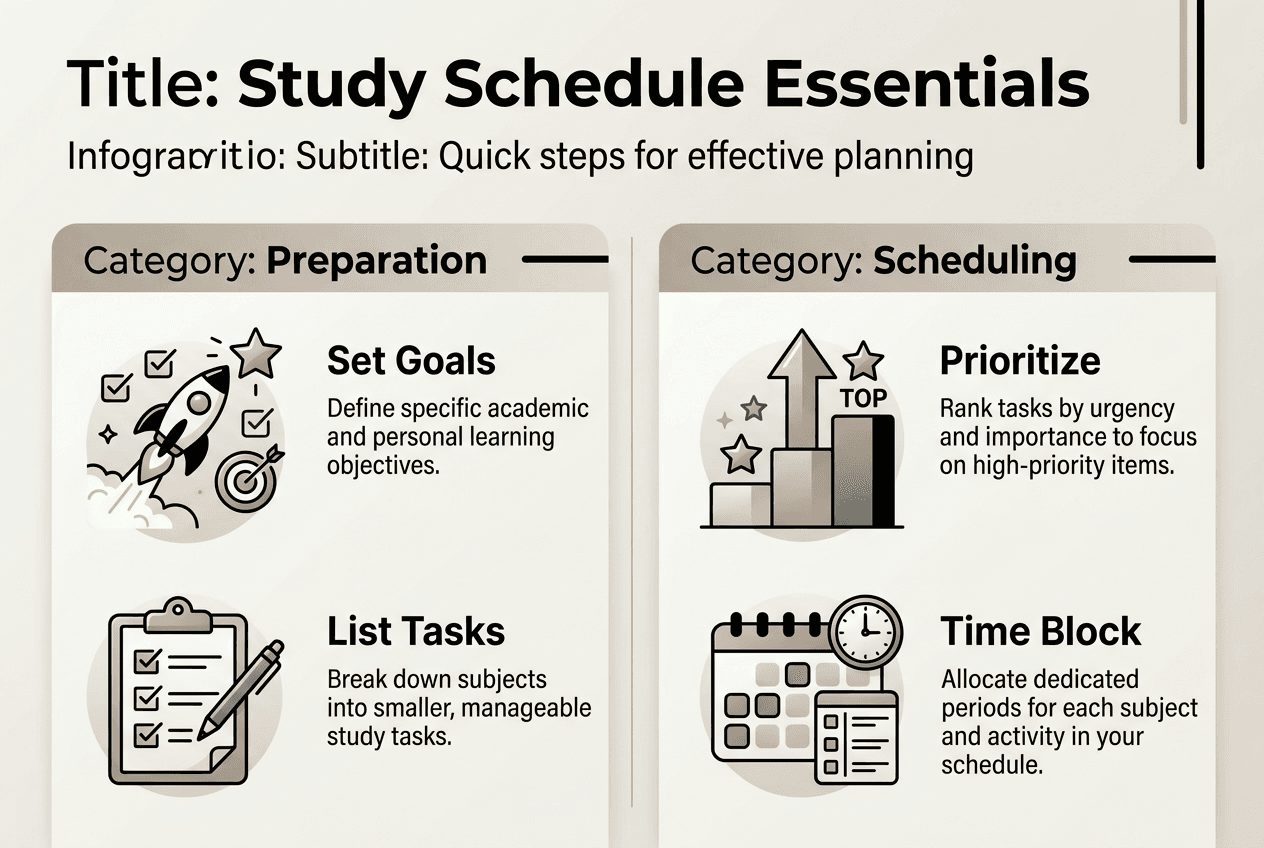
Before you start blocking time on a calendar, you need clarity about what you’re working toward and what demands your attention. Creating an effective study schedule begins with understanding your academic and professional goals. Are you aiming for a specific GPA? Preparing for certification exams? Balancing coursework with internship responsibilities? Clear goals provide direction and help you allocate time where it matters most.
Next, identify all your tasks and commitments. List every assignment, project, exam, work shift, and personal obligation for the coming weeks. This comprehensive inventory reveals how much time you actually have available. Many students underestimate their commitments and create schedules that look good on paper but fail in practice. Be realistic about your capacity.
Prioritization comes next. Not all tasks carry equal weight. External factors like exam weight and syllabus structure influence how you should allocate study time. A midterm worth 30% of your grade deserves more attention than a 5% quiz. Rank your tasks by deadline urgency and importance using frameworks from prioritization techniques to make strategic decisions.
Estimate how long each task will take. Students often underestimate study time requirements, leading to rushed work and poor outcomes. Add buffer time to your estimates. If you think a chapter review takes one hour, schedule 75 minutes. This cushion accommodates interruptions and prevents your entire schedule from collapsing when something takes longer than expected.
Pro Tip: Create a master task list at the start of each week, then break it into daily chunks. This approach, combined with time management goals, keeps you focused on immediate priorities while maintaining awareness of upcoming deadlines.
Finally, assess your energy patterns. Are you sharper in the morning or evening? Schedule demanding tasks during your peak performance hours. Save routine activities like organizing notes or light reading for low-energy periods. Understanding your natural rhythms makes your schedule sustainable. When you prioritize assignments based on both importance and your energy levels, you work smarter instead of just harder.
Step-by-step process to build your study schedule
Now that you’ve laid the groundwork, it’s time to construct your actual schedule. Start by setting specific daily and weekly study goals. Instead of vague intentions like “study biology,” define concrete targets such as “complete chapter 5 review and practice 20 problems.” Specific goals create accountability and make progress measurable. Time management and goal setting improve efficiency, confidence, and academic outcomes when implemented consistently.
Implement time blocking to designate dedicated study periods. This technique involves assigning specific time slots to specific tasks. For example, Monday 2:00 PM to 4:00 PM becomes your calculus study block. Time blocking eliminates decision fatigue because you know exactly what to work on and when. It also creates boundaries that protect your study time from competing demands.
| Approach | Focus Duration | Break Pattern | Best For |
|---|---|---|---|
| Time Blocking | 60-90 minutes | 10-15 minutes | Deep work, complex topics |
| Pomodoro Technique | 25 minutes | 5 minutes | Maintaining focus, fighting procrastination |
| Traditional Blocks | 2-3 hours | 20-30 minutes | Marathon study sessions, review |
Incorporate the Pomodoro technique for sustained focus. Work for 25 minutes, then take a 5-minute break. After four cycles, take a longer 15 to 30-minute break. This rhythm prevents burnout and maintains concentration. Short bursts of focused work often produce better results than marathon sessions where attention drifts.
Here’s how to structure your weekly schedule:
- Block out fixed commitments first (classes, work, meals, sleep).
- Identify available study windows in the remaining time.
- Assign high-priority tasks to your peak energy periods.
- Schedule specific subjects or projects into time blocks.
- Add buffer time between blocks for transitions and unexpected delays.
- Include at least one full rest day per week for recovery.
Review and adjust your schedule weekly. What worked? What didn’t? Maybe you consistently run over time on chemistry problems, or perhaps morning study sessions feel more productive than you expected. Use these insights to refine your approach. Check your weekly planning checklist to ensure you’re covering all bases.

Build in milestones and mini-deadlines. Breaking large projects into smaller checkpoints creates momentum and prevents last-minute panic. If you have a research paper due in four weeks, set milestones for completing research, drafting sections, and revising. These checkpoints provide regular wins that boost motivation.
Pro Tip: Color code your schedule by subject or task type. Visual differentiation helps you quickly assess balance. If your calendar shows all blue (one subject) and no green (another), you know you need to redistribute time. Explore types of schedules to find formats that match your learning style.
Troubleshooting common scheduling challenges and mistakes
Even well-designed schedules encounter obstacles. Recognizing common pitfalls helps you address them before they derail your productivity. One frequent mistake is overcomplicating your approach. Students using three or more study methods scored lower on written exams compared to those using two or fewer. Simplicity often beats complexity. Focus on mastering a few effective techniques rather than juggling many.
Another trap is neglecting wellness in pursuit of academic performance. Sleep deprivation and stress undermine the very outcomes you’re working toward. Research shows higher wellness and seven hours of sleep correlate with better exam performance. Your schedule must protect time for rest, exercise, and social connection. These aren’t luxuries; they’re essential components of effective learning.
Common scheduling mistakes to avoid:
- Filling every available hour with study tasks, leaving no flexibility for life’s unpredictability
- Ignoring your natural energy cycles by scheduling demanding work during low-energy periods
- Failing to account for transition time between activities or locations
- Creating identical schedules for every week without adjusting for exam periods or project deadlines
- Multitasking during study blocks, which fragments attention and reduces retention
- Skipping breaks to “save time,” which actually decreases overall productivity
Flexibility separates sustainable schedules from rigid plans that crumble under pressure. Build buffer time into your week for unexpected events, illness, or days when you simply need extra rest. If your roommate has an emergency or you catch a cold, your entire system shouldn’t collapse. Allow 10 to 20% of your scheduled study time to remain unallocated for these situations.
Recognize diminishing returns. Studying for 12 hours straight doesn’t produce twice the results of studying for 6 hours. Your brain needs processing time. After a certain point, additional study time yields minimal benefit while increasing stress and fatigue. Quality trumps quantity every time.
“The key to academic success isn’t working harder; it’s working smarter by aligning your study habits with how your brain actually learns. Rest and recovery aren’t obstacles to productivity; they’re requirements for it.”
When your schedule isn’t working, diagnose the problem systematically. Are you consistently running over time on certain tasks? Adjust your estimates. Feeling exhausted by midweek? You might be over-scheduling. Struggling to focus during study blocks? Eliminate distractions or try shorter sessions. Your schedule should serve you, not enslave you. Learn to manage tasks effectively by staying responsive to what your experience teaches you.
Expected results and how to measure your study schedule success
A well-executed study schedule produces tangible benefits that extend beyond grades. Students with structured schedules report higher grades and reduced stress levels. You’ll notice improved focus during study sessions because you’ve eliminated the mental burden of constantly deciding what to work on next. This clarity allows you to dive deeper into material and retain information more effectively.
Consistency with your schedule builds momentum. Each completed study block reinforces your commitment and makes the next session easier to start. Over weeks and months, this consistency compounds into significant academic gains. You’ll find yourself better prepared for exams, submitting higher quality assignments, and experiencing less last-minute panic.
| Metric | Before Scheduling | After 4 Weeks | After 8 Weeks |
|---|---|---|---|
| Average exam score | 72% | 78% | 83% |
| Study hours per week | 15 (irregular) | 18 (consistent) | 18 (consistent) |
| Stress level (1 to 10) | 8 | 6 | 4 |
| Sleep hours per night | 5.5 | 6.5 | 7+ |
| Assignments on time | 70% | 90% | 95% |
Incorporating spaced repetition into your schedule significantly enhances retention and engagement. Instead of cramming everything the night before, you review material multiple times over increasing intervals. This approach leverages how memory works, making information stick long-term rather than evaporating after the exam.
To measure your progress effectively:
- Track your grades and compare them to previous terms or semesters.
- Keep a simple journal noting your stress levels, energy, and confidence weekly.
- Monitor how often you complete tasks within estimated time frames.
- Assess your sleep quality and quantity, adjusting your schedule if you’re consistently sleep-deprived.
- Gather feedback from professors or peers about the quality of your work.
- Review your schedule monthly to identify patterns and opportunities for improvement.
You might discover that certain study techniques work better for specific subjects. Maybe active recall serves you well in biology, while practice problems dominate your math preparation. These insights let you refine your approach continuously. A productivity system for students helps you track these patterns and optimize accordingly.
Success isn’t perfection. Some weeks will go smoothly; others will challenge you. The goal is progress, not flawless execution. If you follow your schedule 80% of the time and adjust based on what you learn, you’re succeeding. Celebrate small wins like completing a difficult study block or staying consistent for a full week. These victories build confidence and reinforce positive habits.
Pro Tip: Conduct a monthly schedule audit. Review what worked, what didn’t, and what changed in your life. Update your template to reflect these lessons. Your schedule should evolve with you, becoming more effective as you gain self-knowledge and experience.
Get tools to boost your study schedule and productivity
Creating a study schedule is one thing; maintaining it is another. That’s where the right tools make all the difference. Optio Station offers task and project management features specifically designed for students and young professionals juggling multiple commitments. The app helps you organize assignments, set priorities, and track deadlines in one centralized location.

Time blocking becomes effortless when you can visualize your entire week and drag tasks into specific time slots. Optio Station’s interface lets you build your ideal schedule, then sends notifications to keep you on track throughout the day. Whether you’re balancing coursework with internships or managing team projects alongside individual study, the platform adapts to your workflow.
The Roman-themed app positions itself as your Optio, your second-in-command, supporting you (the Centurion) in conquering your academic and professional goals. You can manage tasks effectively with features that prioritize based on deadlines and importance. Integration with your calendar means your study schedule syncs with everything else in your life, preventing conflicts and double-booking.
Explore Optio Station’s task management capabilities to see how digital tools simplify schedule creation and maintenance. The time blocking features help you implement the strategies discussed in this guide without the hassle of manual planning. Try Optio Station to transform your study schedule from a static document into a dynamic system that grows with your needs.
Frequently asked questions
How do I start creating a study schedule if I have a very busy and unpredictable week?
Begin with flexible time blocks rather than rigid schedules. Identify your non-negotiable commitments first, then look for study windows in between. Prioritize your most critical tasks and tackle those during any available time. Build buffer periods into your schedule to accommodate unexpected events, and review your plan daily to adjust for changes. Flexibility is your friend when life gets chaotic.
What is the best technique to stay focused during study sessions?
The Pomodoro technique works exceptionally well for maintaining concentration. Study for 25 minutes with complete focus, then take a 5-minute break. After four cycles, take a longer 15 to 30-minute break. Minimize distractions by silencing your phone, closing unnecessary browser tabs, and studying in a quiet environment. Set a clear goal for each session so you know exactly what you’re trying to accomplish before you begin.
How can I balance study time with self-care to perform better academically?
Prioritize at least seven hours of sleep nightly and schedule regular breaks within your study routine. Include physical activity, social time, and hobbies in your weekly plan alongside academic work. Balance study intensity with recovery periods to maintain focus and memory consolidation. Remember that rest isn’t wasted time; it’s when your brain processes and solidifies what you’ve learned. Self-care directly enhances academic performance rather than competing with it.
Should I study the same subjects at the same time every day?
Consistency helps build habits, but variety prevents boredom and mental fatigue. Consider rotating subjects throughout the week while maintaining consistent study times. For example, always study from 3:00 PM to 5:00 PM, but alternate between math, history, and science on different days. This approach provides structure while keeping your mind engaged with fresh material.
How do I handle weeks with multiple exams or major deadlines?
Increase your study time gradually in the weeks leading up to heavy periods rather than cramming. Create a countdown plan that maps out what you’ll review each day. Prioritize exams by weight and difficulty, allocating more time to challenging subjects. Consider temporarily reducing non-essential commitments during peak academic periods. Most importantly, maintain your sleep schedule even during exam weeks, as fatigue undermines everything you’ve studied.
Recommended
- 7 Best Time Management Goals Examples for Centurions – Optio Station: Best Project Management App for Prioritization
- 7 Essential Types of Schedules for Students and Professionals – Optio Station: Best Project Management App for Prioritization
- Time Management Time Blocking for Focused Productivity – Optio Station: Best Project Management App for Prioritization
- 7 Time Management Goals for Employees Examples to Boost Productivity – Optio Station: Best Project Management App for Prioritization
