

TL;DR:
- A contractor project manager oversees construction projects from planning to closeout, managing budgets, schedules, and communication. They are essential to maintaining project scope, controlling costs, and ensuring safety, with skills in scheduling, contracts, and leadership. Proper role boundaries and detailed preconstruction planning are key to avoiding delays and cost overruns in construction projects.
A contractor project manager is the professional accountable for planning, coordinating, budgeting, and overseeing construction projects from preconstruction through closeout. This role sits at the center of every major construction decision. The project manager owns the schedule, the budget, the contracts, and the communication chain. Without this person functioning at full capacity, even well-funded projects lose time, money, and scope. Tools like MS Project, CPM scheduling software, and certifications such as PMP and OSHA 30-Hour define the baseline for anyone serious about this career.
What does a contractor project manager actually do?
A contractor project manager oversees the entire project lifecycle, from preconstruction planning through final closeout, managing contracts, site safety, budgets, and weekly milestone meetings. That scope is broader than most people outside construction realize. The role is not just about keeping a schedule. It is about being the single accountable person when anything goes wrong.

Daily tasks include managing RFIs, reviewing submittals, tracking the schedule, running owner and subcontractor meetings, and monitoring the budget line by line. Each of these tasks feeds the others. A delayed RFI response can push a submittal, which delays a material order, which stalls a subcontractor. The project manager’s job is to stop that chain before it starts.
Construction project manager responsibilities also span financial oversight. Financial accountability runs from groundbreaking to closeout, requiring forecasting, pay application review, and strict change order management to prevent cost overruns. Uncontrolled change orders are one of the most common causes of budget failure on commercial projects.
Core construction project manager duties by phase
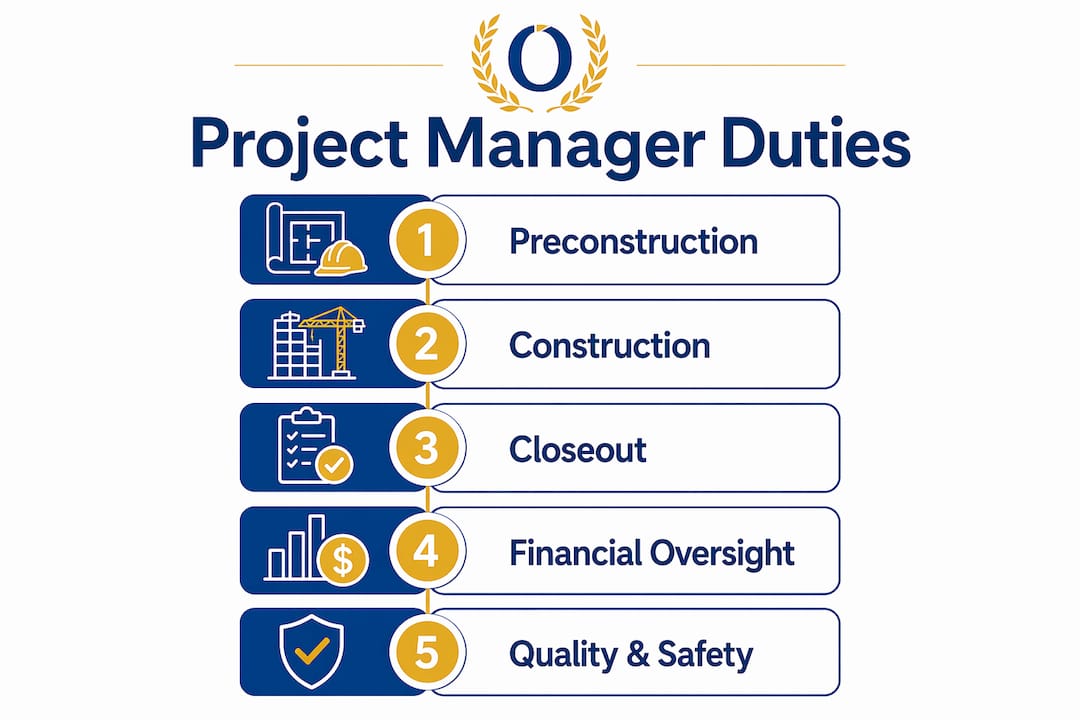
Construction project manager roles and responsibilities shift as a project moves through its phases. Here is what each phase demands:
- Preconstruction: Scope review, contract analysis, subcontractor bidding, schedule development, and risk identification
- Construction: Budget tracking, RFI and submittal management, subcontractor coordination, quality control, and safety compliance
- Closeout: Punch list management, final inspections, lien releases, warranty documentation, and owner turnover
Pro Tip: Build your RFI and submittal log on day one of preconstruction, not after the first site meeting. Catching gaps early is far cheaper than resolving them mid-pour.
Quality control and safety compliance are not optional add-ons. They are core construction project manager duties that protect the contractor’s license, reputation, and profit margin on every job.
What qualifications does a contractor project manager need?
The standard hiring bar for a construction project manager is 4–5 years of experience on projects valued at $10 million or more, combined with a bachelor’s degree or equivalent field experience. That experience threshold exists because the role requires judgment that classroom training alone cannot provide. You need to have seen a project go sideways to know how to prevent it.
Technical proficiency is non-negotiable. Proficiency in MS Project, CPM scheduling tools, and construction management platforms is a standard requirement at most general contractors. Knowing how to build a CPM schedule is not the same as knowing how to read one critically. The best project managers can identify float erosion and critical path shifts before they show up as delays.
Key certifications and skills
- PMP (Project Management Professional): Validates planning, execution, and risk management knowledge across industries, including construction.
- CCM (Certified Construction Manager): Specific to the construction industry, covering cost, schedule, and contract management.
- OSHA 30-Hour: Required on most commercial job sites and signals a baseline commitment to safety compliance.
- Cost estimation proficiency: The ability to read and build a detailed estimate is what separates project managers who control budgets from those who just report on them.
- Negotiation and conflict resolution: Every project involves competing interests. The project manager negotiates daily, with owners, subcontractors, and design teams.
Planning capability is the hallmark of successful construction project managers, directly impacting resource use and cost control. A project manager who cannot build a realistic schedule cannot manage one.
Pro Tip: If you are pursuing the PMP, log your construction hours carefully. PMBOK experience categories map directly to preconstruction, execution, and closeout phases, making construction experience highly transferable.
Soft skills matter as much as technical credentials. Leadership, communication, and the ability to manage conflict without escalating it are what keep a project team functional under pressure.
How does a contractor project manager work with other roles?
The project manager and the superintendent are the two most important roles on any construction project. They are not interchangeable. The project manager handles contracts, cost, and client coordination. The superintendent handles field execution and daily site management. Blurring that line creates confusion, micromanagement, and accountability gaps.
| Role | Primary Focus | Key Responsibilities |
|---|---|---|
| Project Manager | Office and contract side | Budget, schedule, contracts, owner communication, RFIs |
| Superintendent | Field execution | Daily site management, subcontractor direction, safety, quality |
| Subcontractor | Specialty trade work | Scope execution per contract, submittals, RFI responses |
| Owner/Client | Project goals | Approvals, payments, design decisions, change order authorization |
The relationship with subcontractors requires a specific kind of oversight. Effective oversight means setting clear expectations at the pre-construction kickoff meeting, holding weekly look-ahead schedule reviews, and resolving disputes before they become claims. The project manager does not run the subcontractor’s crew. The project manager holds the subcontractor accountable to their contract.
Communication with owners and design teams is where many project managers underperform. Effective project managers move beyond monitoring to actively identifying delays and pushing stakeholders for timely decisions. Waiting for an architect to respond to an RFI is not project management. Following up, escalating when needed, and documenting the delay is.
Key practices for managing team dynamics include:
- Hold a defined weekly owner meeting with a written agenda and action items
- Give the superintendent authority over field decisions without requiring PM approval for every detail
- Document all subcontractor performance issues in writing, even minor ones
- Use a communication plan to define who gets what information and when
What strategies improve project outcomes for construction managers?
Detailed preconstruction planning is the single most effective strategy for protecting project margins. Rushing through preconstruction leads to costly change orders and schedule overruns that compound throughout the build. The time spent refining scope, reviewing contracts, and identifying conflicts before breaking ground pays back many times over.
Change order management is where profit lives or dies. Unmanaged change orders cause uncontrolled cost growth during construction. Every change order should be priced, approved in writing, and logged before the work begins. Project managers who allow verbal change authorizations are setting up disputes at closeout.
Small unresolved issues, like subcontractor disputes or unanswered RFIs, left unaddressed for two weeks can cause six weeks of extra work. That ratio is the clearest argument for proactive issue resolution in construction. The cost of a 30-minute conversation is almost always less than the cost of a three-week delay.
Scheduling and project tracker tools give project managers real-time visibility into where a project stands against its baseline. Without a live schedule, you are managing by memory and assumption.
Effective strategies for construction project managers include:
- Build a detailed CPM schedule during preconstruction and update it weekly
- Track all RFIs and submittals in a shared log accessible to the entire team
- Issue a written change order log at every owner meeting
- Identify the critical path and protect it from scope creep and resource conflicts
- Use look-ahead schedules (3-week rolling) to surface upcoming conflicts before they hit
Pro Tip: Set a hard rule: no verbal change authorizations. Every scope change gets a written change order number before work starts. This one habit prevents most closeout disputes.
The role of a construction project manager spans planner, negotiator, risk assessor, and financial controller. Contractors who treat it as a single-function job miss the full scope of what the role demands.
Key Takeaways
A contractor project manager succeeds by combining detailed preconstruction planning, proactive communication, and strict change order control across every phase of a project.
| Point | Details |
|---|---|
| Preconstruction is profit protection | Refining scope and contracts before breaking ground prevents costly change orders and delays. |
| Role clarity prevents breakdowns | The project manager owns contracts and cost; the superintendent owns the field. Keep these boundaries firm. |
| Proactive issue resolution is non-negotiable | Unresolved RFIs or disputes left two weeks unaddressed can generate six weeks of extra work. |
| Certifications signal readiness | PMP, CCM, and OSHA 30-Hour are the standard credentials for credible construction project managers. |
| Change orders require written control | Every scope change must be priced, documented, and approved before work begins to protect margins. |
What I’ve learned about where construction projects actually break down
The failure point on most troubled construction projects is not the budget or the schedule. It is the moment someone decided a small problem could wait. I have seen subcontractor disputes that started as a two-line email disagreement turn into six-figure claims because no one resolved them in the first week. The math is brutal: two weeks of avoidance equals six weeks of recovery.
Preconstruction is the most undervalued phase in construction project management. Contractors who rush through scope review to get to groundbreaking faster almost always pay for it in change orders and disputes. The project management plan built during preconstruction is not paperwork. It is the document that prevents arguments about who agreed to what.
The other pattern I see consistently is blurred role boundaries between the project manager and the superintendent. When a project manager starts directing subcontractor crews directly, the superintendent loses authority and the field loses accountability. The PM’s job is to give the superintendent the resources and the information to run the site. Not to run it for them.
Construction in 2026 is more complex than it was five years ago. Supply chain volatility, labor shortages, and owner expectations for real-time reporting have all increased the cognitive load on project managers. The contractors who adapt are the ones investing in software proficiency and professional development, not just field experience.
— Optiostation
How Optiostation supports construction project managers
Construction project managers carry more tasks, deadlines, and team dependencies than almost any other professional role. Keeping all of it organized requires more than a spreadsheet.
Optiostation is built for professionals who manage multiple priorities at once. The app helps you track tasks, coordinate team communication, and stay on top of deadlines without losing visibility on what matters most. For project managers who need a reliable system for tracking tasks at work and managing time across complex projects, Optiostation’s tools give you a clear, organized view of your workload. Explore the time management apps list to find the right fit for your workflow and start managing your projects with more control.
FAQ
What is a contractor project manager?
A contractor project manager is the professional responsible for planning, budgeting, scheduling, and overseeing a construction project from preconstruction through closeout. The role covers contracts, subcontractor management, cost control, and owner communication.
How is a project manager different from a superintendent?
The project manager handles contracts, cost, and client coordination. The superintendent manages daily field execution and site operations. On well-run projects, both roles operate with clear boundaries and function as a team.
What certifications does a construction project manager need?
The most recognized certifications are the PMP, CCM, and OSHA 30-Hour. Most commercial contractors also require proficiency in MS Project or CPM scheduling tools as a baseline technical requirement.
Why does preconstruction planning matter so much?
Rushing preconstruction leads to change orders and schedule overruns that compound throughout the build. Refining scope, reviewing contracts, and identifying conflicts before work begins is the most cost-effective investment a project manager can make.
What software do construction project managers use?
MS Project and CPM scheduling tools are standard. Many firms also use construction management platforms for RFI tracking, submittals, budget monitoring, and team communication across the project lifecycle.
Recommended
- Client Project Manager: Skills, Roles, and Best Practices – Optio Station: Best Project Management App for Prioritization
- PMO Manager: Roles, Skills, and Best Practices – Optio Station: Best Project Management App for Prioritization
- Project Management Officer: Roles, Skills, and Responsibilities – Optio Station: Best Project Management App for Prioritization
- Project Management Contract Template: Tools for Success – Optio Station: Best Project Management App for Prioritization
