
TL;DR:
- Construction project managers oversee all phases of a building project, from design review to final closeout, ensuring scope, schedule, budget, safety, and quality compliance. They use scheduling tools to monitor critical paths and continuously track costs, while maintaining clear communication and managing risks throughout the project’s lifecycle. The role demands strong contract literacy, leadership, and software proficiency to successfully deliver projects on time and within budget.
Construction project manager duties are the full set of responsibilities that carry a building project from the first design review to the final punch list, covering scope, schedule, budget, contracts, safety, and closeout. The role is formally defined as full lifecycle project oversight, meaning the PM owns every decision that affects time, cost, and quality from day one. This guide breaks down each duty category so you know exactly what the job demands, whether you are preparing to enter the field or looking to sharpen your understanding of what the role actually requires.
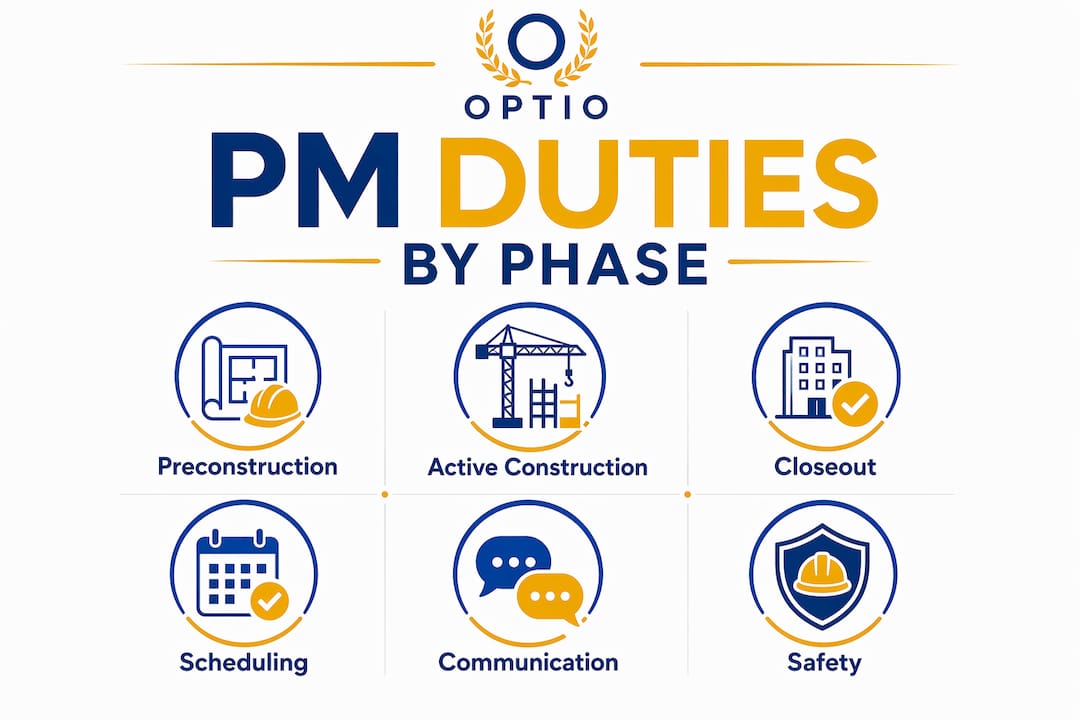
What are the core construction project manager duties by phase?
Construction project manager duties span eight key lifecycle areas: scope definition, contract administration, active oversight, budgeting, safety compliance, stakeholder communication, risk mitigation, and closeout. Each area carries real financial and legal consequences, which is why the role demands both technical knowledge and strong judgment. Skipping or rushing any one area creates problems that compound through every phase that follows.
Preconstruction: scope and planning
The PM’s first job is defining exactly what the project includes and what it does not. This means reviewing design documents, leading scope sign-off meetings with the owner and architect, and identifying gaps before a single shovel breaks ground. A vague scope is the single most common cause of costly change orders later in the project.

Active construction: oversight and control
During construction, the PM tracks schedule, monitors subcontractor performance, reviews pay applications, and enforces quality standards. CPM scheduling software is the standard tool for managing timelines and identifying the critical path. Daily coordination between the PM and the superintendent keeps field work aligned with the contract.
Closeout: documentation and handover
Closeout duties include completing punch lists, obtaining occupancy certificates, supporting commissioning, administering warranties, and processing final billing. This phase can take months and directly affects the owner’s retention payment and the PM’s professional reputation. Rushing closeout is one of the most common mistakes new PMs make.
Pro Tip: Lock down the scope in writing before construction begins. Every undefined item becomes a change order, and change orders erode both the budget and the client relationship.
| Phase | Key PM duties |
|---|---|
| Preconstruction | Scope definition, design review, subcontractor procurement, contract negotiation |
| Active construction | Schedule management, cost tracking, safety enforcement, quality control |
| Closeout | Punch lists, occupancy certification, warranty administration, final billing |
How do construction project managers use scheduling and budgeting tools?
CPM scheduling software identifies the critical path and calculates float, which tells the PM exactly which activities cannot slip without pushing the project completion date. Without this visibility, schedule problems stay hidden until they become crises. Most experienced PMs update the schedule weekly and review it with the superintendent every Monday morning.
Budget management runs parallel to schedule management. The PM tracks actual costs against the original estimate, forecasts the final cost at completion, and flags variances before they exceed contingency. Monthly financial reporting is a standard duty, and the PM typically presents cost reports to the owner or executive team.
Key budgeting and scheduling tasks include:
- Reviewing and approving subcontractor pay applications against completed work
- Pricing and negotiating change orders before authorizing any extra work
- Updating the master schedule after every significant field change
- Forecasting final project cost monthly using earned value or cost-to-complete methods
- Tracking submittals and procurement lead times to prevent material delays
Pro Tip: Flag schedule or budget risks the moment they appear, not after they materialize. A two-week warning gives the team options. A two-day warning gives them none.
Modern construction project managers blend traditional technical knowledge with advanced software proficiency to meet the demands of complex projects. Knowing how to read a CPM schedule is no longer optional. It is a baseline expectation for any PM role in 2026.
What are the communication and leadership responsibilities of a construction PM?
Effective communication is a core PM duty, not a soft skill add-on. The PM runs weekly progress meetings, issues meeting minutes, manages the RFI log, and keeps the owner informed of any condition that affects cost or schedule. Clear, documented communication is the primary defense against disputes.
Leadership in this role means holding subcontractors accountable without damaging the working relationship. The PM sets performance expectations at the start of each subcontract, monitors output against the schedule, and addresses underperformance directly and early. Waiting to address a problem rarely makes it easier to solve.
Delayed resolution of subcontractor disputes can turn a two-week problem into a six-week resolution process. That math makes prompt conflict management one of the highest-value skills a PM can develop. The goal is resolution at the lowest possible level before lawyers or formal claims enter the picture.
Best practices for stakeholder communication:
- Send meeting minutes within 24 hours of every project meeting
- Document all verbal agreements in writing the same day they occur
- Use a single, shared RFI log that all parties can access in real time
- Escalate owner decisions with a clear deadline and consequence statement
- Keep subcontractor correspondence professional, specific, and timestamped
Contract administration requires the PM to understand every subcontract on the project, including delay claim notice requirements and liquidated damage provisions. Knowing the contract terms protects the project financially and gives the PM the authority to act decisively when disputes arise. You can explore contractor project manager strategies for deeper guidance on managing these dynamics.
How do safety compliance and risk management factor into PM duties?
Safety compliance is a non-negotiable PM responsibility. OSHA standards form the baseline, and the PM enforces both OSHA requirements and any project-specific safety plan from day one. Toolbox talks, site inspections, and incident reporting are recurring duties, not occasional ones.
Risk management starts before construction and continues through closeout. The PM identifies potential risks during preconstruction, assigns probability and impact ratings, and builds contingency plans for the most likely threats. Common risks and their management strategies include:
- Weather delays: Build float into weather-sensitive activities and track float consumption weekly
- Supply chain disruptions: Identify long-lead items early and place orders before they hit the critical path
- Subcontractor default: Vet financial stability before award and include performance bond requirements in high-risk contracts
- Safety incidents: Enforce the site safety plan consistently and document every inspection and corrective action
- Scope creep: Require written owner approval before authorizing any work outside the original contract scope
Pro Tip: Proactive safety enforcement does more than prevent injuries. It reduces insurance costs, avoids OSHA citations, and signals to subcontractors that the PM runs a disciplined site.
PMs must adapt dynamically to unforeseen challenges including weather, supply chain issues, and interpersonal conflicts. The ability to pivot quickly without losing sight of the contract requirements separates good PMs from great ones. A solid construction management software setup helps track these risks in real time.
What distinguishes a construction PM from a superintendent?
The project manager operates primarily from the office, managing contracts, budgets, schedules, and client relationships. The superintendent manages the physical work on site, including trade sequencing, daily crew coordination, and quality inspection. Both roles are essential, and neither can succeed without the other.
The PM and superintendent function as a two-person leadership team. The PM sets the contractual framework and financial boundaries. The superintendent executes within those boundaries and reports field conditions back to the PM. Confusion about who owns which decisions is a common source of friction on poorly run projects.
| Responsibility | Project manager | Superintendent |
|---|---|---|
| Budget tracking | Owns | Informs |
| Daily crew coordination | Informs | Owns |
| Contract administration | Owns | Not involved |
| Quality inspections | Reviews | Conducts |
| Client communication | Owns | Rarely involved |
| Trade sequencing | Approves schedule | Executes daily |
Understanding this division helps aspiring PMs focus their development on the business and contractual side of the role. The construction project manager responsibilities guide covers this distinction in more detail for those building toward the role.
Key Takeaways
Construction project manager duties span the full project lifecycle and require equal command of technical, financial, and interpersonal skills to deliver projects on time and within budget.
| Point | Details |
|---|---|
| Full lifecycle ownership | The PM owns scope, schedule, budget, contracts, safety, and closeout from start to finish. |
| CPM scheduling is standard | Use CPM software to track the critical path and update the schedule weekly throughout construction. |
| Budget control is continuous | Track actual costs monthly, forecast final cost, and flag variances before they exceed contingency. |
| Communication prevents disputes | Document all agreements in writing and resolve subcontractor conflicts at the lowest possible level. |
| PM and superintendent are distinct | The PM manages the business side; the superintendent manages daily field operations. |
The part of this role most people underestimate
Construction project management is often described as a coordination job. That framing undersells it significantly. The real weight of the role sits in contract literacy and financial accountability. A PM who cannot read a subcontract, identify a notice requirement, or price a change order accurately will lose money on every project, regardless of how well the field work goes.
New PMs consistently underestimate how much time contract administration takes. Reading every subcontract in detail, tracking RFI response times, and managing the change order log are not administrative tasks. They are the core of the job. The field work happens whether or not the PM is paying attention. The contracts do not manage themselves.
The interpersonal side is equally demanding. Holding a subcontractor accountable while keeping the relationship functional requires a specific kind of directness that most people develop only through experience. The best PMs I have observed are not the most technical. They are the most consistent. They say what they will do, and they do what they say, every time.
Software proficiency is now a baseline requirement, not a differentiator. PMs who cannot navigate CPM scheduling tools or cost management platforms are operating at a disadvantage that compounds over time. The good news is that these skills are learnable, and the construction industry rewards PMs who invest in them early.
— Optiostation
Optiostation: task and time management for construction PMs
Managing a construction project means tracking dozens of moving parts at once. Optiostation is a mobile task, team, and time management app built for professionals who need to stay organized under pressure.
Optiostation’s Optio feature acts as your second-in-command, helping you prioritize tasks, coordinate your team, and keep your schedule visible at a glance. Whether you are managing submittals, tracking punch list items, or setting weekly priorities, the app keeps your workload structured. Check out the time management apps list to see how Optiostation fits into a productive PM workflow. For a broader look at keeping track of tasks at work, Optiostation has you covered there too.
FAQ
What are the main construction project manager duties?
Construction project manager duties cover scope definition, scheduling, budgeting, contract administration, safety compliance, stakeholder communication, risk management, and project closeout. The role spans the full project lifecycle from preconstruction through final billing.
What does a construction project manager do daily?
Daily tasks include reviewing the schedule, approving pay applications, attending coordination meetings, responding to RFIs, and monitoring subcontractor performance. The PM also tracks costs and communicates project status to the owner.
How is a construction PM different from a superintendent?
The PM manages the business side of the project, including contracts, budgets, and client communication, while the superintendent manages daily field operations and trade sequencing. Both roles coordinate closely but operate in separate domains.
What skills does a construction project manager need?
Key skills include CPM scheduling proficiency, contract literacy, cost forecasting, conflict resolution, and clear written communication. Software proficiency in scheduling and cost management platforms is now a standard expectation for the role.
How long does the closeout phase take?
Closeout can take several months depending on project size and complexity. It includes punch lists, occupancy certification, commissioning support, warranty administration, and final billing, all of which directly affect the owner’s retention payment.
Recommended
- Contractor Project Manager: Roles, Skills, and Strategies – Optio Station: Best Project Management App for Prioritization
- Engineering project manager guide: frameworks and strategies – Optio Station: Best Project Management App for Prioritization
- Construction Project Manager Responsibilities: 2026 Guide – Optio Station: Best Project Management App for Prioritization
- Design project manager: master the skills and tools – Optio Station: Best Project Management App for Prioritization
