

TL;DR:
- Breaking large projects into small, clear tasks reduces stress and prevents procrastination.
- Structured breakdown improves focus, track progress, and ensures timely completion.
- Using deadlines and continual review keeps projects manageable and on track.
Big projects have a way of making you freeze. You open your laptop, stare at a blank document or an empty task list, and suddenly feel like the whole thing is impossible. Sound familiar? You’re not alone. Most college students and young professionals hit this wall regularly, and it costs them time, sleep, and grades. The good news: breaking large projects into smaller, clearly defined steps is one of the most research-backed productivity strategies out there. This guide will show you exactly why it works, how to do it, and how to avoid the common traps that trip most people up.
Table of Contents
- The science behind breaking down projects
- Core benefits of breaking down your projects
- Step-by-step framework to break down any project
- Common pitfalls and how to avoid them
- Applying project breakdowns: Practical examples for students and professionals
- Why most people underestimate the power of project breakdowns
- Take your productivity to the next level
- Frequently asked questions
Key Takeaways
| Point | Details |
|---|---|
| Boosts productivity | Breaking projects into smaller parts lets you accomplish more in less time. |
| Reduces overwhelm | Tackling one small task at a time makes big assignments feel manageable. |
| Improves planning | Organizing your work into clear steps creates better time management and tracking. |
| Prevents procrastination | Smaller actions help you start sooner and reduce the urge to delay. |
The science behind breaking down projects
Your brain treats a huge, vague task very differently from a small, specific one. When you look at something like “write my thesis” or “complete the Q3 report,” your brain struggles to find a clear starting point. It registers the task as a threat rather than a challenge. That triggers stress, avoidance, and procrastination. Small, defined tasks, on the other hand, feel approachable. Your brain can picture completing them, which makes it far more willing to start.
One of the most useful psychological concepts here is the Zeigarnik Effect. Named after Soviet psychologist Bluma Zeigarnik, it describes how our minds hold onto unfinished tasks. Incomplete work creates mental tension that keeps nagging at you until it’s resolved. The upside? Once you start a task, your brain becomes motivated to finish it. Breaking a big project into smaller pieces means you get to experience that “finished” feeling more often, which keeps momentum going.
Breaking projects into smaller tasks reduces procrastination and increases completion rates. That’s not just theory. It’s a pattern backed by decades of behavioral research. When a task has a clear end point, you’re far more likely to start it and see it through.
Here’s what happens when you break things down properly:
- Your focus sharpens because each task has one clear goal
- You feel a sense of progress after every completed step
- Decision fatigue drops because you always know what to do next
- Stress decreases because the project feels manageable
- You can spot bottlenecks before they become emergencies
If you want to see what a well-structured breakdown looks like in practice, check out this project management plan example to understand how the pros organize large bodies of work from the start.
Did you know? Studies show that people who set specific sub-goals are significantly more likely to complete their projects on time than those who only set a single end-goal.
Core benefits of breaking down your projects
Now that you know why your brain handles small tasks better, let’s see how breaking down a project delivers real-world results.
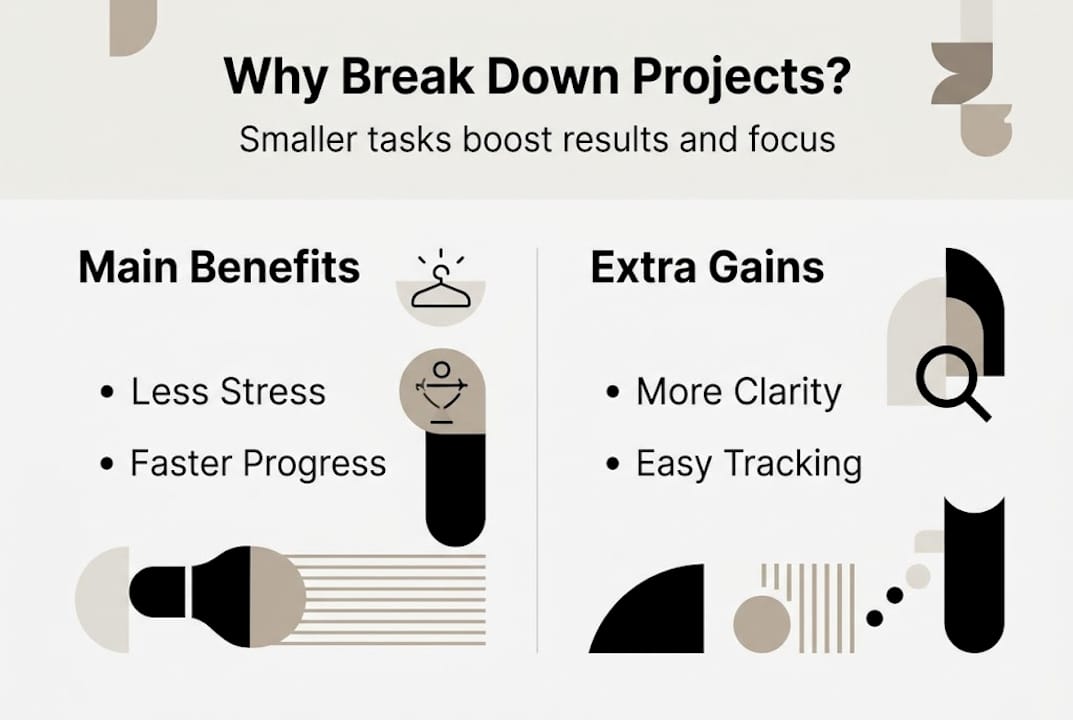
The most immediate benefit is escaping analysis paralysis. That’s the state where you have so many options or so much to do that you end up doing nothing. When you split a project into clear steps, you eliminate the guesswork. You know what’s next, and you just do it.
Dividing projects improves time management and prioritization, which is especially critical for students juggling multiple classes and deadlines. When tasks are small and defined, you can estimate how long each one takes. That makes scheduling realistic instead of wishful.

Look at the difference between tackling a term paper as one task versus breaking it down:
| Approach | Task view | Time estimate | Stress level |
|---|---|---|---|
| Undivided | “Write term paper” | Unknown | High |
| Broken down | Research sources | 2 hours | Low |
| Broken down | Create outline | 45 minutes | Low |
| Broken down | Write first draft | 3 hours | Moderate |
| Broken down | Edit and finalize | 1.5 hours | Low |
The broken-down version turns one scary task into five manageable ones. You can schedule each across your week and track real progress.
Smaller tasks also make prioritizing assignments much easier. When everything is broken down to the same level of detail, you can rank tasks by urgency and importance without second-guessing yourself. Pair this with a solid project timeline template and you have a system that practically runs itself.
Pro Tip: Break tasks down until each one takes no more than 60 minutes to complete. If a task still feels big after you’ve named it, split it again.
Step-by-step framework to break down any project
It’s clear that breaking things down matters. But how do you actually do it? Here’s a step-by-step process anyone can follow.
- Define the final goal. Write one clear sentence describing what “done” looks like for the whole project.
- List the major phases. Think of these as the big chunks: research, planning, execution, review.
- Break each phase into tasks. Each task should be specific and actionable. “Write introduction” beats “work on paper.”
- Break tasks down further if needed. If any task feels like it’ll take more than an hour, split it.
- Assign deadlines to every task. Not just the final due date. Every single sub-task needs its own deadline.
- Review and refine as you go. Projects change. Update your task list when new information comes in.
Using a consistent breakdown method increases completion rates because it removes ambiguity from your workflow. You’re not reinventing the process every time. You follow the same structure and get predictable results.
Here’s a sample breakdown for a group research project:
| Phase | Task | Owner | Deadline |
|---|---|---|---|
| Research | Find 5 academic sources | Alex | Day 3 |
| Research | Summarize each source | Jordan | Day 5 |
| Planning | Create shared outline | All | Day 7 |
| Writing | Draft assigned sections | Each member | Day 12 |
| Review | Peer edit drafts | All | Day 14 |
| Final | Compile and submit | Alex | Day 16 |
Use a project planning checklist to make sure nothing falls through the cracks. An assignment tracker setup can also help you stay on top of every moving piece without relying on memory.
Pro Tip: Schedule a five-minute review at the end of each day to check off completed tasks and adjust tomorrow’s plan. This tiny habit keeps your breakdown accurate and your momentum strong.
Common pitfalls and how to avoid them
Even the best strategies have pitfalls. Let’s look at what can go wrong and how to get back on track.
The most common mistake is making sub-tasks either too vague or too granular. “Do research” is too vague. “Find one sentence on page 47 of Smith 2019” is too granular. The sweet spot is a task that’s specific, actionable, and completable in under an hour.
Over-complicating task breakdown can cause confusion and lower productivity. When your task list becomes its own project, you’ve gone too far. Keep it simple enough that you can glance at it and immediately know what to do.
Other common pitfalls include:
- Skipping deadlines for sub-tasks. Without them, everything drifts to the last day.
- Failing to prioritize. Not all tasks are equal. Some must happen before others can start.
- Losing sight of the big picture. Getting lost in details and forgetting the final goal.
- Never updating the list. A breakdown that doesn’t reflect reality becomes useless fast.
“Simplicity is the ultimate sophistication when it comes to planning. The most effective project managers keep their systems lean so the work stays front and center.”
When a project stalls, go back to basics. Look at your task list and find the one next action that moves things forward. Just one. Do that. Momentum is easier to rebuild than most people think. Using solid project plan templates can also help you reset quickly when things go sideways.
Applying project breakdowns: Practical examples for students and professionals
Understanding theory is one thing. Seeing it in action brings clarity. Here’s how project breakdowns work in both school and work contexts.
Academic example: Semester research project
Practical application of breakdown strategies leads to measurable success in both academic and professional settings. For a semester-long research paper, a smart breakdown might look like this:
- Week 1: Choose topic and draft research questions
- Week 2 to 3: Gather and annotate sources
- Week 4: Build a detailed outline
- Week 5 to 6: Write the first draft section by section
- Week 7: Revise and get peer feedback
- Week 8: Final edits and submission
Each week has a clear deliverable. You’re never wondering what to work on.
Professional example: Team deliverable
For a work project like launching a new product feature, the breakdown might include:
- Define scope and success metrics (Day 1)
- Assign roles to each team member (Day 2)
- Complete individual research tasks (Days 3 to 7)
- Hold a sync meeting to align on findings (Day 8)
- Build the first draft of the deliverable (Days 9 to 12)
- Review, revise, and present (Days 13 to 15)
When everyone has their own named tasks with deadlines, accountability becomes automatic. No one can say they didn’t know what they were supposed to do.
Pro Tip: Use a digital tracker to check off sub-tasks as you finish them. That visual progress is surprisingly motivating and keeps you from losing track when life gets busy.
If you’re juggling several projects at once, learning about organizing multiple projects will help you apply this framework across everything on your plate.
Why most people underestimate the power of project breakdowns
Here’s the uncomfortable truth: most people skip the breakdown step because it feels like extra work before the real work. They think, “I know what I need to do, I’ll just start.” That confidence is almost always misplaced.
We’ve seen it play out the same way every time. Someone powers through a project in a last-minute crunch, barely makes the deadline, and walks away thinking hustle saved them. What they don’t see is the quality they left on the table, the sleep they lost, and the stress that followed them for days.
The student or professional who breaks their project down on day one rarely has a crunch moment. They make steady progress, catch problems early, and submit work they’re actually proud of. Consistent small steps beat occasional bursts every single time.
Breaking things down isn’t a productivity trick for people who can’t handle pressure. It’s what high performers actually do. If you want to outperform your peers, start prioritizing multiple projects with structure instead of willpower.
Take your productivity to the next level
Ready to make project breakdowns a natural part of how you work? The right tools make all the difference.
Optio is built for Centurions like you: students and young professionals who need to manage tasks, teams, and time without losing their minds. Think of it as your second-in-command. It helps you break projects into clear steps, assign deadlines, and track progress all in one place. Explore the best task management software options to find your fit, or learn how to start managing tasks effectively today. When you’re ready to build a system that actually works, Optio Station is where you start.
Frequently asked questions
What does it mean to break down a project?
Breaking down a project means splitting it into smaller, defined tasks that are easier to manage and complete. Dividing projects improves time management and helps you prioritize what matters most.
How do you decide on the smallest tasks when breaking down a project?
Aim to create tasks that can be accomplished in 60 minutes or less and are clearly actionable. A consistent breakdown method ensures each task is specific enough to start immediately without extra planning.
Why do people often avoid breaking down projects?
Many think it takes too much time upfront or believe they can handle everything at once, but this leads to missed deadlines and stress. Over-complicating task breakdown is a real risk, but skipping it entirely is far more costly.
Can breaking down projects help with procrastination?
Yes, smaller tasks make it far less daunting to get started and maintain momentum. Breaking projects into smaller tasks reduces procrastination and increases completion rates by giving your brain a clear, achievable target.
What tools help with breaking down and tracking project tasks?
Task management apps and assignment trackers provide templates and visual layouts for planning and monitoring progress. Task management software helps users break down, organize, and prioritize tasks without losing sight of the bigger picture.
Recommended
- How to Organize Multiple Projects for Maximum Productivity – Optio Station: Best Project Management App for Prioritization
- Essential productivity hacks for students and young pros – Optio Station: Best Project Management App for Prioritization
- Time Management Time Blocking for Focused Productivity – Optio Station: Best Project Management App for Prioritization
- 7 Time Management Goals for Employees Examples to Boost Productivity – Optio Station: Best Project Management App for Prioritization
