

TL;DR:
- Agile project management is an iterative approach that delivers value through short sprints and adaptable scope. It emphasizes collaboration, responsiveness to change, and continuous feedback, making it suitable for various team sizes and project types. This mindset improves early results, reduces risks, and can be applied by students and professionals alike with simple tools and practices.
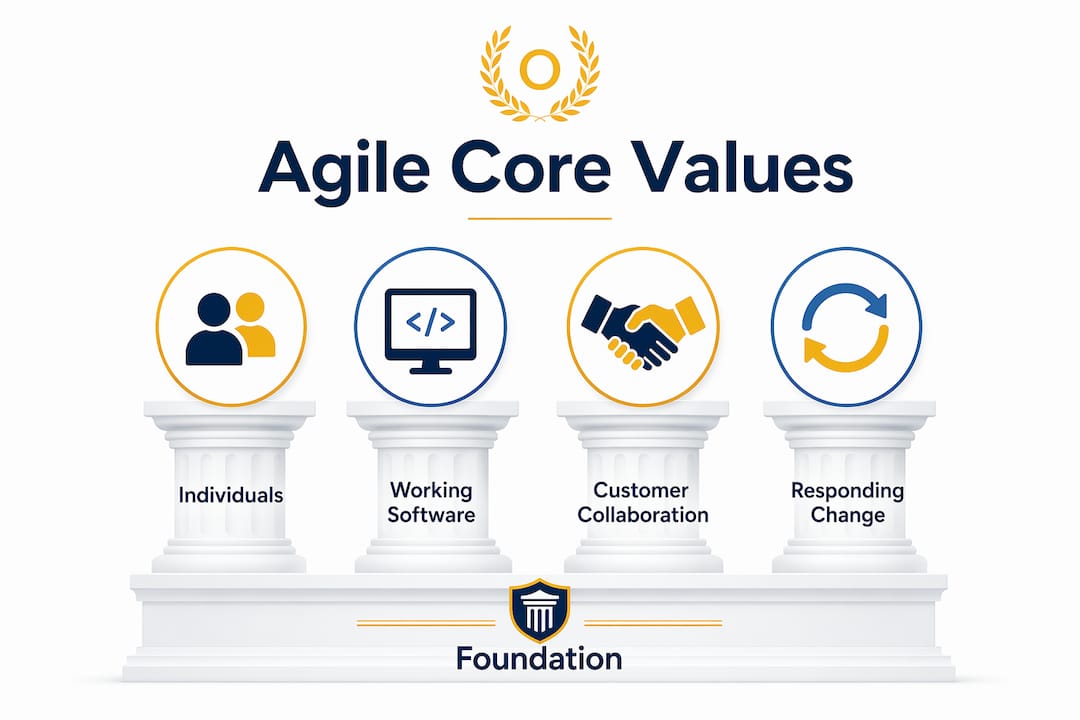
Agile project management is defined as an iterative, flexible approach to delivering projects through short work cycles called sprints or iterations, each lasting 1–4 weeks. Unlike the traditional Waterfall method, which locks in requirements upfront and delivers results only at the end, Agile fixes time and cost while letting scope evolve based on real feedback. The Agile Manifesto, published in 2001, formalized this philosophy around four core values: individuals and interactions, working products, customer collaboration, and responding to change. For students and young professionals, understanding agile project management basics is the difference between managing a group project reactively and running it with real control.
What is agile project management methodology and how does it work?
Agile project management organizes work into short, repeatable cycles. Each sprint produces a working increment of the project, which the team reviews before planning the next cycle. This structure means problems surface early, not after months of wasted effort.

The method uses an empirical control approach: decisions come from direct observation and immediate adjustment, not from a plan written before the work began. That distinction matters. A traditional plan assumes you know everything at the start. Agile assumes you will learn as you go, and it builds that learning into the process.
The four Agile values
The Agile Manifesto prioritizes:
- Individuals and interactions over processes and tools
- Working software over comprehensive documentation
- Customer collaboration over contract negotiation
- Responding to change over following a fixed plan
These are not suggestions. They are the foundation every Agile framework builds on.
Key roles in an Agile team
Three roles appear in most Agile setups. The Product Owner defines priorities and represents the customer’s interests. The Scrum Master removes obstacles and keeps the team focused. The Agile team itself is cross-functional, meaning members collectively hold all the skills needed to deliver the work.
Agile teams are self-directed and rely on committed people with overlapping skills. That autonomy is not accidental. It speeds up decisions and cuts the communication overhead that slows traditional teams down.
Pro Tip: Run a 15-minute daily standup with three questions: What did I finish yesterday? What will I finish today? What is blocking me? This single habit catches problems before they compound.
What are the common Agile methodologies?
Agile methodologies include Scrum, Kanban, DSDM, and Feature Driven Development, each with a different structure and best-fit scenario. Choosing the right one depends on your team size, project type, and how predictable your workload is.
Scrum
Scrum is the most widely used Agile framework. It organizes work into fixed sprints, typically two weeks long, with four recurring ceremonies: sprint planning, daily standups, sprint review, and retrospective. The sprint review shows stakeholders what was built. The retrospective meeting focuses the team on what to improve next cycle. Scrum works best when requirements change frequently and the team needs a clear rhythm.
Kanban
Kanban uses a visual board with columns representing workflow stages, such as “To Do,” “In Progress,” and “Done.” Work items move across the board as they progress. There are no fixed sprints. Kanban suits teams with continuous, unpredictable incoming work, like support queues or content production pipelines.
DSDM and Feature Driven Development
Dynamic Systems Development Method (DSDM) adds governance and structure, making it popular in larger organizations that need Agile principles within formal project controls. Feature Driven Development (FDD) organizes work around building and delivering specific product features, which suits engineering teams with well-defined feature lists.
| Framework | Best for | Key feature |
|---|---|---|
| Scrum | Changing requirements, product teams | Fixed sprints with ceremonies |
| Kanban | Continuous flow, support teams | Visual board, no fixed sprints |
| DSDM | Large organizations, formal governance | Structured Agile with controls |
| FDD | Engineering, feature-based delivery | Feature-by-feature planning |
Pro Tip: Do not pick a framework because it sounds impressive. Pick the one your team will actually follow. A simple Kanban board used consistently beats a complex Scrum setup ignored after week two.
How does Agile project management benefit teams?
The most direct benefit of Agile is that benefits start being realized early, not only at project completion. Each sprint delivers something usable. That means stakeholders see progress, give feedback, and stay engaged throughout.
Agile also reduces the cost of changing direction. In a Waterfall project, discovering a wrong assumption in month five means rewriting months of work. In Agile, that same discovery happens at the end of a two-week sprint, and the next sprint corrects it. The financial and time savings are significant.
Key benefits for teams include:
- Faster value delivery. Working increments ship every sprint, not after a year of development.
- Adaptability. Time and cost stay fixed while scope adjusts to what is actually achievable, preventing feature creep.
- Better collaboration. Daily standups and sprint reviews keep everyone aligned without long status meetings.
- Higher team motivation. Self-directed, cross-functional teams report stronger ownership of their work.
- Reduced risk. Frequent checkpoints catch problems early, before they become expensive.
Agile is particularly effective when project destinations are unclear at the start. That describes most real-world projects, especially in digital product development, research, and academic group work.
How can students and young professionals apply Agile principles?
Agile is not just for software teams. Students managing thesis projects, group assignments, or internship deliverables can apply the same principles with minimal setup. The core idea is the same: break large work into small, testable chunks, review progress frequently, and adjust.
Here is a practical starting point:
- Define your backlog. List every task your project requires. Do not organize it yet. Just get it all out of your head and into one place.
- Prioritize ruthlessly. Rank tasks by impact. Work on the highest-value items first. Optiostation’s prioritization techniques for Agile offer a structured method for this step.
- Set a sprint. Choose a one-week or two-week window. Commit to finishing a specific set of tasks within that window. Do not add new tasks mid-sprint.
- Hold a brief review. At the end of each sprint, check what you finished, what you did not, and why. Five minutes of honest reflection prevents the same mistake next sprint.
- Run a retrospective. Ask one question: what would make the next sprint better? Change one thing and test it.
Agile requires adapting frameworks to team culture, which means you do not need to follow every rule. A student team of three does not need a Scrum Master. But a shared task board and a weekly review will change how that team operates.
For professionals working in consulting or education-adjacent roles, Agile business development applies these same sprint-based principles to client work and freelance projects. The framework scales down as easily as it scales up.
Pro Tip: Use a free digital board tool to visualize your sprint. Seeing tasks move from “In Progress” to “Done” is more motivating than a to-do list. Check out Agile examples for students to see how real teams structure their boards.
Key Takeaways
Agile project management works because it delivers value incrementally, fixes time and cost while adapting scope, and builds continuous feedback directly into the process.
| Point | Details |
|---|---|
| Iterative structure | Sprints of 1–4 weeks produce working increments and enable frequent feedback. |
| Scope flexibility | Time and cost stay fixed; scope adjusts to prevent feature creep and wasted effort. |
| Framework variety | Scrum, Kanban, DSDM, and FDD each suit different team types and project needs. |
| Early value delivery | Benefits arrive throughout the project, not only at the final deadline. |
| Mindset over rules | Agile is a thinking approach, not a rigid checklist. Adapt it to your team’s culture. |
What Agile actually taught me about managing work
Most beginners treat Agile as a set of rules to follow. That is the wrong frame. Agile is a mindset focused on individuals, interactions, and responding to change, and the moment you treat it as a compliance exercise, you lose the benefit.
The most common mistake I see from students and early-career professionals is over-engineering the process before the team is ready. They set up elaborate Scrum boards, assign roles, and schedule every ceremony before anyone has shipped a single deliverable. The result is process theater. The team spends more time managing the Agile system than doing the actual work.
Start smaller than you think you need to. One shared task list, one weekly check-in, and one honest retrospective will outperform a fully loaded Scrum setup that nobody believes in. Once the habit of reviewing and adapting is real, you can add structure. The structure should serve the work, not the other way around.
Agile suits fast-changing environments precisely because it does not pretend certainty exists. That is its strength. The teams that get the most from it are the ones willing to admit what they do not know and adjust accordingly.
— Optiostation
Optiostation: built for the way Agile teams actually work
Agile principles only work when your tasks, time, and team stay organized between sprints. Optiostation is a mobile app built specifically for students and young professionals who need to manage all three without a complex setup.
As your second-in-command, Optiostation helps you build sprint-style task lists, track team progress, and stay on top of deadlines without the overhead of enterprise tools. Whether you are managing a group project or a freelance client, the app keeps your workflow visible and your priorities clear. Check out the best task management software guide to see how Optiostation fits into a real Agile workflow, or go straight to managing tasks effectively for a practical starting point.
FAQ
What is agile project management in simple terms?
Agile project management is a method that breaks work into short cycles called sprints, delivers results incrementally, and adjusts plans based on feedback after each cycle.
How long is an Agile sprint?
Sprints typically last 1–4 weeks, with the team delivering a working increment at the end of each one.
How does Agile differ from Waterfall?
Waterfall fixes scope upfront and delivers at the end; Agile fixes time and cost while allowing scope to evolve based on real-world feedback throughout the project.
Can students use Agile for school projects?
Yes. Students can apply Agile by creating a task backlog, running one-week sprints, and holding brief weekly reviews to adjust priorities before the next cycle.
What is the most popular Agile framework?
Scrum is the most widely used Agile framework. It uses fixed sprints, defined roles like Product Owner and Scrum Master, and four recurring ceremonies to keep teams aligned and continuously improving.
Recommended
- Agile Project Management Examples for Students and Pros – Optio Station: Best Project Management App for Prioritization
- Head of Project Management: Skills to Succeed in 2026 – Optio Station: Best Project Management App for Prioritization
- 7 Key Examples of Project Management You Can Learn From – Optio Station: Best Project Management App for Prioritization
- Prioritization techniques in agile: student productivity – Optio Station: Best Project Management App for Prioritization
