

TL;DR:
- Effective goal setting requires specific plans, such as SMART criteria, to turn intentions into measurable results. Implementing if-then plans and breaking goals into smaller, actionable steps help sustain progress and handle setbacks effectively. Tracking progress with structured systems and pre-planned coping strategies increases follow-through and long-term achievement.
Effective advice on setting goals starts with one rule: a goal without a specific plan is just a wish. Psychologists define goal setting as the process of identifying a desired outcome and creating structured, measurable steps to reach it. The SMART framework, implementation intentions developed by psychologist Peter Gollwitzer, and stepwise progress planning are the three most research-backed methods for turning intentions into results. Intention alone isn’t sufficient; specifying repeatable behaviors, cues, and responses to obstacles is what separates people who achieve their goals from those who abandon them by February.
What are SMART goals and why do they improve goal achievement?
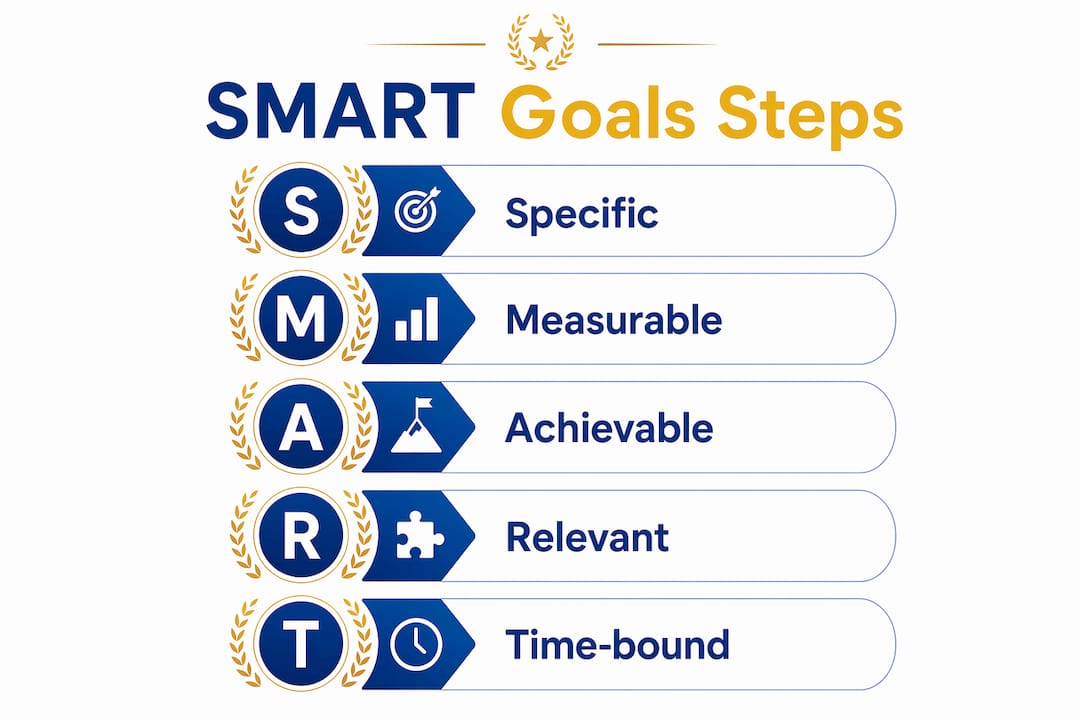
SMART goals are the most widely used framework in goal-setting, and for good reason. Each letter defines a quality your goal must have: Specific, Measurable, Achievable, Relevant, and Time-bound. Without all five, you are working with a vague intention rather than a real plan.
Here is what each element actually means in practice:
- Specific: Name exactly what you want to accomplish, who is involved, and where it happens. “Get fit” fails this test. “Run three miles without stopping” passes it.
- Measurable: Attach a number or observable outcome so you know when you have succeeded. “Read more” becomes “Read two books per month.”
- Achievable: The goal must stretch you without breaking you. Aiming to write a novel in a week when you have never written fiction is not ambitious. It is a setup for failure.
- Relevant: The goal must connect to something you genuinely care about. A goal that conflicts with your actual priorities will lose every time.
- Time-bound: Deadlines create urgency. “Finish my thesis” drifts forever. “Submit my thesis draft by October 31” does not.
The contrast between vague and SMART goals is stark. Compare these two:
| Vague goal | SMART version |
|---|---|
| “Get better grades” | “Raise my GPA from 2.8 to 3.3 by the end of this semester by studying 90 minutes daily” |
| “Exercise more” | “Complete four 30-minute workouts per week for the next eight weeks” |
| “Save money” | “Save $200 per month for six months by cutting dining out to once per week” |
SMART goals prevent vague intentions and create a clear tracking system from day one. When you can measure progress, you stay motivated. When you cannot, you guess, and guessing leads to quitting. For students and young professionals, applying this framework to academic and career goals is one of the fastest ways to close the gap between where you are and where you want to be.
How does if-then planning increase follow-through?
If-then planning, formally called implementation intentions, is the psychological strategy with the strongest evidence base for closing the gap between intention and action. The concept is simple: you pre-decide exactly what you will do when a specific situation arises. The format is “If situation X occurs, then I will perform behavior Y.”
Peter Gollwitzer’s research established this method, and the results are striking. A meta-analysis of 94 independent tests found that if-then plans produce a medium-to-large effect size of d=0.65 on goal achievement. That means people who write if-then plans are substantially more likely to follow through than those who rely on motivation alone.
Here is why it works. When you pre-decide a response, your brain automates action initiation, freeing mental resources and shielding your progress from distractions and temptations. You are not making a decision in the moment. You are executing a script you already wrote.
To build an effective if-then plan, use three components:
- Goal intention: State your overall objective clearly. “My goal is to study for my economics exam.”
- If-then trigger: Link a specific situation to a specific behavior. “If it is 7 p.m. on a weekday, then I will open my notes and study for 45 minutes.”
- Coping plan: Pre-decide your response to likely obstacles. “If I feel too tired to study, then I will do 15 minutes of review instead of skipping entirely.”
The coping plan is the part most people skip, and it is the most important. Planning for obstacles removes the need to improvise during setbacks, which is exactly when willpower is lowest.
Pro Tip: Write at least two or three if-then plans for each goal: one for starting, one for handling your most likely obstacle, and one for resuming after a lapse. This covers the full behavioral cycle and reduces decision fatigue at every critical moment.
Why breaking goals into smaller parts sustains progress
Large goals feel motivating on day one and paralyzing by day ten. The solution is not more discipline. It is better architecture. Breaking goals into smaller, scheduled steps with specific frequency, duration, and timelines improves both tracking and urgency.

Think of it as tiering. A yearly goal like “get promoted” breaks into quarterly milestones like “lead two client presentations.” Those break into weekly behaviors like “spend 30 minutes each Thursday preparing presentation skills.” Each tier makes the next action concrete and immediately doable. Tiering goals by time scale from yearly themes down to weekly baby steps bridges the gap from planning to doing.
Small wins also build momentum. When you complete a short-term step, your brain registers progress. That registration is motivating. It is the opposite of the all-or-nothing thinking that derails most goal attempts, where missing one workout becomes “I’ve ruined everything, so why bother.”
Practical ways to apply this:
- Set a fitness goal as “three 20-minute walks this week” rather than “lose 15 pounds.”
- Set an academic goal as “complete two practice problems per night” rather than “pass the exam.”
- Set a professional goal as “send one networking message per day for two weeks” rather than “expand my network.”
Focusing on a single specific goal and incremental steps within your control enhances self-discipline and reduces the overwhelm that comes from juggling too many competing priorities at once.
What obstacles commonly disrupt goal achievement?
The most common reason goals fail is not lack of ambition. It is lack of preparation for the predictable friction that shows up between intention and execution. Goal failure occurs without concrete action plans, and the obstacles that derail most people are entirely foreseeable.
The most frequent disruptors include:
- Fatigue: You planned to study at 9 p.m., but you are exhausted after a full day. Without a pre-decided response, you skip.
- Distraction: Your phone, social feeds, and background noise compete with your focus at every session.
- Stress: High-pressure periods at work or school create a false sense that goal work must pause until things calm down. They rarely do.
- Self-doubt: A missed day or a poor result triggers the belief that the goal is unreachable, leading to abandonment.
- Context changes: Travel, schedule shifts, or new responsibilities disrupt routines that were working.
Longer-term goals benefit from contextual strategies and a practical mindset for handling lapses. UNC-Chapel Hill psychologist Paschal Sheeran recommends monitoring your attention, anticipating setbacks, and treating lapses as temporary rather than final. A missed day is data, not defeat.
Environmental design is one of the most underused tools here. Put your study materials on your desk the night before. Delete distracting apps from your home screen during work hours. Lay out your gym clothes before bed. These are not tricks. They are pre-decisions that reduce the friction between intention and action.
How to apply these strategies to personal and academic goals
Knowing the frameworks is one thing. Putting them into practice for your actual life is another. Here is how SMART goals, if-then planning, and stepwise progress apply directly to the situations young adults and professionals face most.
For academic goals, accurate and realistic grade targets correlate with better outcomes. A 2026 panel study of online students found that specific, well-calibrated goal setting supports self-regulation and achievement. Setting a goal of “A in every class” when your current GPA is 2.5 is not motivating. It is demoralizing. Set a grade target one realistic step above your current performance, then build a study routine around it using if-then scheduling.
For professional goals, FranklinCovey’s Wildly Important Goal framework recommends choosing one primary goal and tracking lead measures, which are count or time-based daily actions you control. Instead of tracking “get a raise,” track “complete one high-visibility project task per day.” Lead measures tell you whether you are on track before the outcome is decided.
Tools that support both contexts:
- Digital calendars with recurring reminders for scheduled goal behaviors
- Habit-tracking apps that log streaks and flag missed days
- Task management platforms that break projects into dated subtasks
- Accountability partners or study groups for external commitment
The goal-setting guide for students from Optiostation covers how to structure these tools around academic timelines specifically. For time management, SMART time management goals give you a practical starting point for building productive daily routines.
Key takeaways
Effective goal achievement requires SMART criteria, pre-planned if-then responses, stepwise progress, and obstacle anticipation working together, not as isolated techniques.
| Point | Details |
|---|---|
| Use the SMART framework | Make every goal Specific, Measurable, Achievable, Relevant, and Time-bound to enable clear tracking. |
| Write if-then plans | Pre-decide your response to triggers and obstacles to automate follow-through without relying on willpower. |
| Break goals into tiers | Divide yearly goals into quarterly milestones and weekly behaviors to keep next actions concrete. |
| Anticipate obstacles | Identify your top three likely disruptors and write coping plans before they occur. |
| Calibrate academic goals realistically | Set grade targets one step above your current baseline, not aspirational ceilings, to improve self-regulation. |
What actually works, from where we stand
Most goal-setting content tells you to dream bigger. Our experience at Optiostation points in the opposite direction: the people who achieve their goals consistently are the ones who start smaller and plan more specifically than feels necessary.
The biggest mistake we see young professionals and students make is launching three or four major goals at once, each with vague timelines and no obstacle planning. The first week feels productive. By week three, competing priorities have eroded every routine, and the all-or-nothing thinking kicks in.
The behavioral science here is not complicated, but it does require honesty. You have to look at your actual schedule, your actual energy levels, and your actual track record, not the idealized version of yourself you are planning for. A habit-building approach to language learning makes this point well: sustainable progress comes from making the behavior fit your life, not redesigning your life around the behavior.
The frameworks in this article, SMART goals, if-then planning, and tiered steps, are not magic. They are structure. Structure does not replace motivation. It makes motivation less necessary. When your next action is specific, scheduled, and pre-decided, you do not need to feel inspired to start. You just follow the plan.
Start with one goal. Write three if-then plans for it. Break it into this week’s behavior. That is enough.
— Optiostation
Put your goals into a system that tracks them
Goal setting without a tracking system is like writing a to-do list and losing the paper. Optiostation is built specifically for students and young professionals who need to organize tasks, set reminders, and monitor progress without the complexity of enterprise software.

The app lets you break goals into prioritized tasks, assign deadlines, and collaborate with teammates or study partners, all inside a clean interface designed around the way Centurions actually work. Whether you are managing coursework, a side project, or a professional development plan, Optiostation functions as your second-in-command. Explore the best task management tools to find the right setup for your goals, or go straight to managing tasks effectively for a practical starting point.
FAQ
What is goal setting, exactly?
Goal setting is the process of identifying a specific desired outcome and creating a structured plan with measurable steps to achieve it. The SMART framework is the most widely used method for making goals concrete and trackable.
How do SMART goals differ from regular goals?
A regular goal states what you want. A SMART goal specifies what you want, how you will measure it, whether it is realistic, why it matters, and when you will achieve it. That specificity is what makes tracking and follow-through possible.
What are implementation intentions?
Implementation intentions are if-then plans that link a specific situation to a pre-decided behavior. A meta-analysis of 94 tests found they produce a medium-to-large effect on goal achievement by automating responses and reducing reliance on willpower.
How many goals should I work on at once?
Focusing on a single goal with incremental steps produces better results than splitting attention across multiple competing priorities. Once one goal becomes a habit, you can layer in the next.
What should I do when I miss a day or fall behind?
Treat a lapse as temporary, not terminal. Anticipating setbacks and writing a coping plan in advance, such as a shorter fallback behavior for low-energy days, is the most reliable way to resume progress without losing momentum.
Recommended
- Define your goals: proven strategies for motivation and success – Optio Station: Best Project Management App for Prioritization
- What Is a Goal? a Clear Definition for Students – Optio Station: Best Project Management App for Prioritization
- 7 Goal Setting Strategies 2025 for Students and Professionals – Optio Station: Best Project Management App for Prioritization
- SMART goals for work: practical tips to boost productivity – Optio Station: Best Project Management App for Prioritization
