

The biggest advantages of working on a team are better problem solving, more creative output, a lighter individual workload, faster skill building, and higher morale and productivity than most people working alone can match. Each benefit shows up in team research going back decades. The sections below break down why teams produce these results, what the studies actually found, where teamwork falls short, and how to run a team that captures the upside instead of the friction.
TL;DR:
- Teams outperform individuals mainly when tasks have clear, verifiable answers and benefit from error catching, pooled knowledge, and collective learning.
- Clear goal setting, role definition, and short feedback cycles significantly improve team accountability, speed, and error detection in collaborative work.
- Unclear objectives, role confusion, social loafing, unresolved conflicts, and low psychological safety are the most common reasons teams fail.
- Regular progress check-ins, task visibility, and role rotation are essential practices to sustain team performance and learning gains.
- Collaboration tools that make responsibilities and contributions visible are crucial for turning teamwork principles into successful, high-functioning teams.
Table of Contents
- What Are the Main Advantages of Working on a Team?
- What Does the Research Say About Teamwork Benefits?
- When Does a Team Not Outperform an Individual?
- How Do You Actually Capture the Advantages of Teamwork?
- What Do These Advantages Look Like in Practice?
- Why Optiostation Believes Teamwork Is a Skill, Not a Personality Trait
- Turn These Advantages Into a Team That Actually Delivers
- Sources
- FAQ
What Are the Main Advantages of Working on a Team?
Teamwork isn’t just “more hands.” It changes how problems get solved, how mistakes get caught, and how people learn. Here are the advantages that show up most consistently for students and professionals alike.
Collective problem solving. A group brings more angles to a hard problem than any single brain can generate alone. A capstone team splitting research across four members catches gaps one student working solo would miss.
Increased creativity. Bouncing ideas off teammates produces combinations no individual would land on independently. Brainstorming sessions where one idea sparks a better one work because the group, not the individual, holds the full option set.
Shared workload and lower burnout. Splitting tasks across people reduces the load on any one person, and that shared load is directly tied to lower reported stress and better resilience, according to research on teamwork and burnout. A project team dividing research, writing, and editing each carries a fraction of what a solo effort would demand.
Faster learning and cross-training. Working alongside people with different skills speeds up how quickly you pick up new ones. Teams that rotate roles retain procedural knowledge better than people who train solo, based on group learning experiments published in PNAS.
Better decision quality. Groups catch bad assumptions before they become bad decisions, because someone in the room usually asks the question the rest missed. This matters most on decisions with real stakes: budget calls, product launches, grading-weighted group deliverables.
Higher productivity and efficiency. Parallel work beats sequential work. A team that assigns four workstreams simultaneously finishes faster than one person doing the same four tasks in sequence, provided the handoffs are clean.
Better risk taking and innovation. People take smarter risks when they know a teammate has their back on the outcome. Teams with strong trust try the harder approach more often than solo workers who can’t afford to fail alone.
Accountability and motivation. Nobody wants to be the person who didn’t deliver in front of the group. Visible commitments, like a shared task board, create social pressure that keeps people on schedule without a manager checking in daily.
Enhanced communication. Teams force people to explain their thinking out loud, which improves the thinking itself. Explaining your reasoning to a skeptical teammate before a client meeting almost always improves the pitch.
Stronger belonging and morale. Feeling like part of something reduces the isolation that drags down performance. This matters most in long projects, where morale, not raw skill, decides whether people finish strong.
Fewer mistakes through peer review. A second set of eyes catches errors before they ship. A teammate proofreading a report or reviewing code before a deadline routinely finds the mistake the original author was too close to see.
Professional development. Teams expose you to skills and working styles you wouldn’t develop solo, from negotiation to conflict resolution. Early-career professionals build management instincts faster on a team than in an individual role, simply from watching how others handle pressure.
These benefits matter most on tasks with real interdependence: research projects, cross-functional launches, anything where no single person holds every piece of the puzzle.
What Does the Research Say About Teamwork Benefits?
Group performance isn’t a matter of opinion. It has been measured, and the findings explain both why teams work and why they sometimes don’t.
A review of team success factors in Scientific American found that groups of three to five people outperformed the best individual performers in certain experimental tasks. The advantage came from pooled knowledge and collaborative processing, not from any one member being smarter than the rest. The same review points to collective learning cycles, setting a goal, monitoring progress, providing backup, and reflecting afterward, as the mechanism that keeps team performance improving over time rather than plateauing.
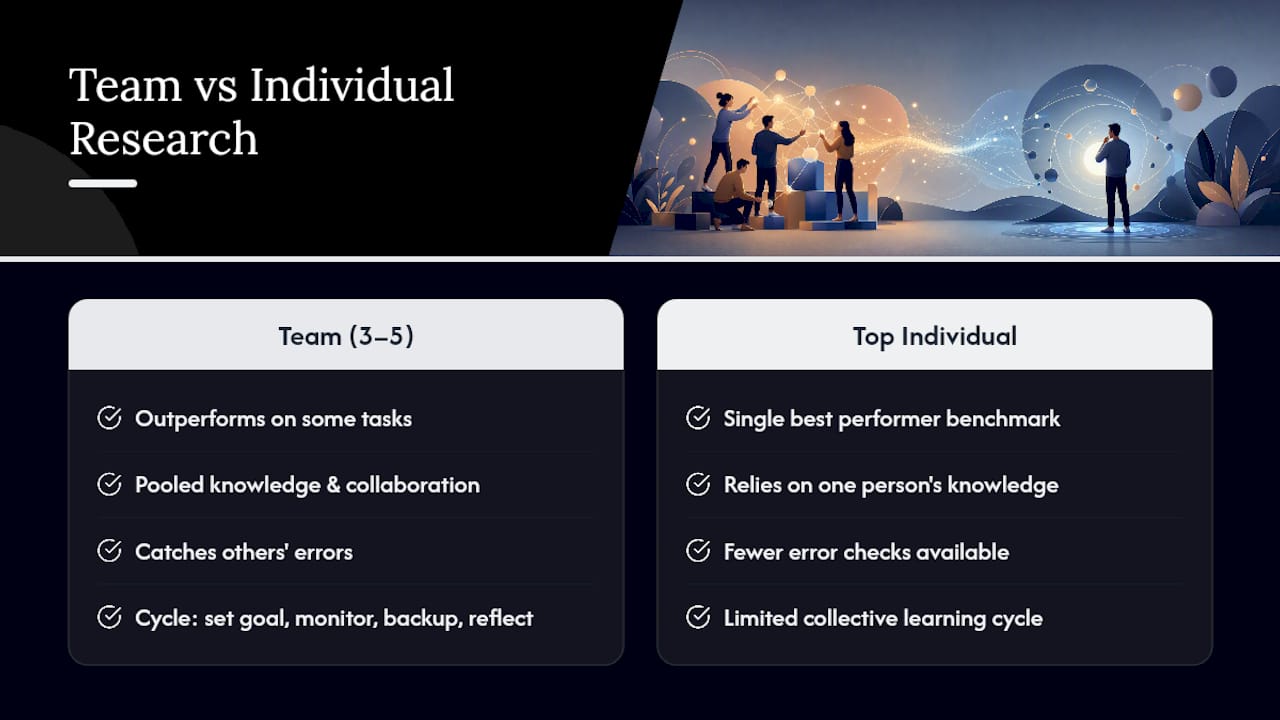
Team climate matters as much as talent. A deliberately stated shared objective, like “customer response time” or “zero rework,” predicts measurable performance gains because it aligns daily decisions and makes trade-offs visible to the whole group.
Wharton’s research on team performance adds an important qualifier: teams reliably beat individuals on tasks with a verifiable correct answer, but the advantage shrinks or disappears on open-ended creative work. That single finding explains a lot of the disagreement about whether teamwork “really works.”
The core insight from decades of team research: groups don’t win because they’re smarter than any one person in them. They win because they catch errors, pool partial knowledge, and keep learning as a unit, something no individual can do alone.
On the well-being side, Atlassian’s review of teamwork research found that teams built on honest feedback and mutual respect report higher emotional well-being and stronger performance indicators than teams without that culture. Shared workload also does something measurable for burnout: peer support directly reduces perceived stress, which explains why teamwork keeps showing up as a factor in retention and performance studies, not just productivity ones.
When Does a Team Not Outperform an Individual?
Teamwork isn’t automatically better. Wharton’s task-space research found the advantage depends heavily on the type of task, and pretending otherwise sets teams up to fail.
Teams reliably beat individuals when a task has a verifiable correct answer, like solving a defined problem, catching an error, or optimizing a known process. Teams are less reliable, and sometimes worse than a strong individual, on open-ended creative work where consensus can dilute a sharp original idea. Writing a novel, designing a bold ad concept, or picking a company’s next big bet often benefits more from one strong point of view than a committee.
Beyond task type, teams fail for predictable reasons:
- Unclear goals that leave members guessing at priorities.
- Poor role clarity, where two people assume someone else owns a task.
- Social loafing, where members coast because contributions aren’t visible.
- Unmanaged conflict that turns disagreement about the work into a disagreement about people, which meta-analytic research on team conflict shows is far more damaging than task disagreement itself.
- Low psychological safety, where people stay quiet instead of flagging problems.
- Weak feedback loops that let small issues go uncorrected for weeks.
Pro Tip: Watch for two early warning signs before a team unravels: repeated missed commitments and silent meetings where nobody pushes back on a bad idea. Both usually show up weeks before the project visibly falls apart.
How Do You Actually Capture the Advantages of Teamwork?
Knowing teamwork helps doesn’t automatically make your team good at it. These practices turn the theory into results.
- Set one shared objective. State it in a sentence everyone can repeat, not a vague mission statement.
- Define roles and deliverables up front. Every task needs one clear owner, even if others help.
- Make tasks visible. A shared board where everyone sees who owns what kills social loafing fast, since visible contributions reduce free-riding.
- Run short feedback loops. A five-minute standup (“what did you finish, what’s blocked”) and a end-of-project retrospective catch problems while they’re still cheap to fix.
- Rotate responsibilities. Cross-training members on each other’s tasks builds the durable learning gains group training research documented, and it protects the project if someone drops out.
- Schedule peer review before deadlines, not after. Catching an error two days before submission beats catching it after the grade or client feedback comes back.
- Use a simple decision rule. A lightweight version of RACI (who’s Responsible, Accountable, Consulted, Informed) prevents the “I thought you were deciding that” problem on professional teams.
A standup template can be as short as: what I finished, what I’m doing next, what’s blocking me. A kickoff template covers the shared goal, roles, and the first deadline. A retro template asks three questions: what worked, what didn’t, what changes next time.
Students negotiating group grading should agree early on how uneven contribution gets handled, and build in a peer-evaluation checkpoint at the midpoint, not just at the end, using helpful AI tools for student productivity that support honest and efficient collaboration. Professionals running cross-functional projects should hold a kickoff that names decision owners before work starts, not after the first disagreement.
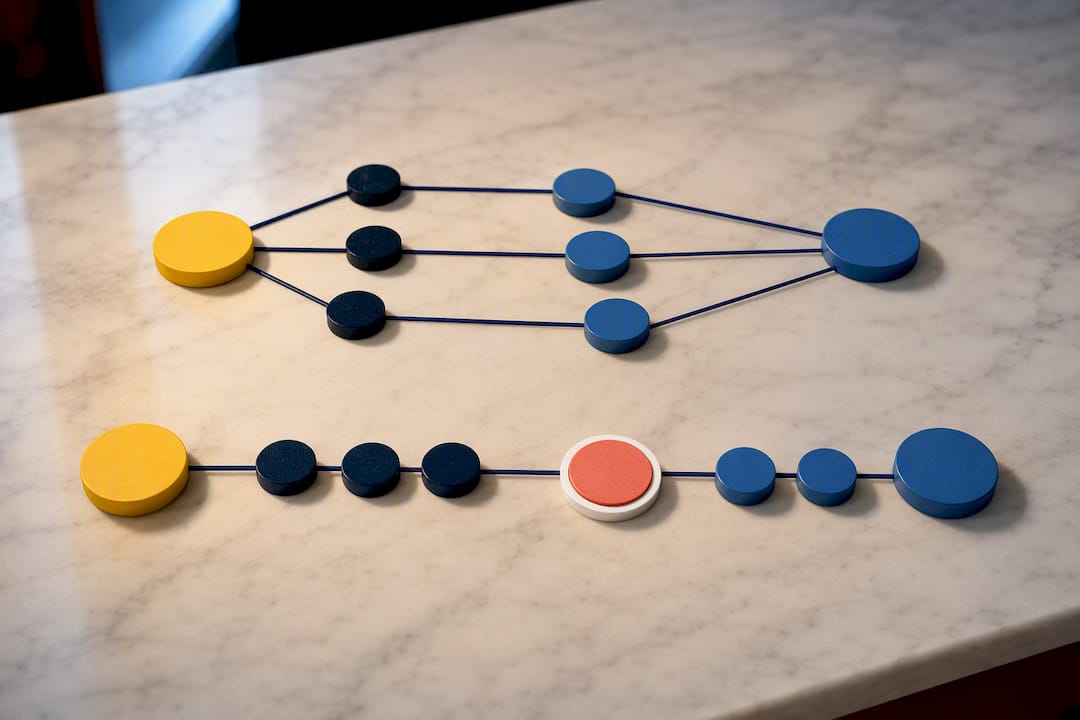
Pro Tip: Shorten your feedback cycle before you do anything else. A team that checks in every three days learns faster than one that waits two weeks, simply because problems get caught while they’re still small.
What Do These Advantages Look Like in Practice?
- Student project: A four-person research team assigns clear roles (research, draft, data, editing) and runs a ten-minute weekly check-in. Stress drops because no one carries the whole deliverable, and the group’s final grade comes in higher than their individual midterm averages, a direct result of catching weak sections before submission.
- Workplace team: A cross-functional sprint team adopts biweekly retrospectives to surface recurring bugs. Within a few sprints, the team traces most issues back to unclear handoffs between design and engineering, fixes the handoff process, and cuts the bug rate significantly.
Readers building their own version of either scenario can find structured templates in examples of successful group projects and tactics for making team contributions visible.
Why Optiostation Believes Teamwork Is a Skill, Not a Personality Trait
Most people treat teamwork as something you’re either good at or not. The research says otherwise: role clarity, visible tasks, and short feedback loops are learnable habits, not fixed traits. Optiostation was built around that idea for students and young professionals still figuring out how to run a team well, not just join one. For deeper tactics on communication and rituals that keep teams aligned, see Optiostation’s guide to improving teamwork and communication.
— Optiostation
Turn These Advantages Into a Team That Actually Delivers
Every benefit covered above depends on one thing: whether your team can see who owns what and whether commitments are actually visible to the group. Task, team, and time management apps for students and young professionals provide shared boards, role assignments, smart reminders, and goal tracking in one place, so the accountability and feedback loops the research points to aren’t something you have to build from scratch with sticky notes and group chats.
If your last group project or sprint fell apart because nobody was sure who owned the next step, that’s a workflow problem, not a people problem. See how collaboration tools boost team communication and tasks and set up your first shared board before your next project kicks off.
Sources
- The Science of Team Success | Scientific American
- When Do Teams Outperform Individuals? – Knowledge at Wharton
- The importance of teamwork (as proven by science) – Atlassian
- PMC article related to teamwork and burnout reduction
FAQ
What are the advantages of working in a team?
The main advantages are better problem solving, more creative output, shared workload that reduces burnout, faster cross-training, and higher morale and productivity than solo work typically produces.
What are the major benefits of using teams in leadership?
Leaders who build strong teams get better decision quality, faster execution through parallel work, stronger accountability from visible contributions, more innovation from trusted risk-taking, and lower turnover from higher team morale.
Do teams always perform better than individuals?
No. Teams reliably outperform individuals on tasks with a verifiable correct answer, but the advantage shrinks on open-ended creative work where one strong individual perspective can outperform group consensus.
How can students capture the benefits of teamwork in group projects?
Assign clear roles early, hold short weekly check-ins, and build in a peer-review step before the deadline instead of after grades come back.
What tools help teams stay accountable and organized?
Shared task boards, role assignments, and reminders make contributions visible and reduce social loafing, which is the core function apps like Optiostation are built around.
