

Keeping track of endless assignments, research projects, and job applications can feel overwhelming for any college senior or recent graduate. When you are juggling so much at once, it is easy for important tasks to slip through the cracks. Action item tracking systems turn scattered to-dos into organized, manageable steps, giving you clarity on who is responsible for what and when it is due. Discover how these systems bring structure and simplicity to your academic and professional journey, so you never miss a beat.
Table of Contents
- Defining Action Item Tracking Systems
- Types of Action Items and Use Cases
- Essential Features For Reliable Tracking
- Collaboration and Accountability Strategies
- Common Pitfalls and How to Avoid Them
- Alternatives To Action Item Tracking Tools
Key Takeaways
| Point | Details |
|---|---|
| Action Item Tracking Systems Enhance Productivity | These systems organize tasks and responsibilities, promoting individual and team efficiency in both academic and professional settings. |
| Key Features Foster Effective Management | Essential features like real-time monitoring and integrated communication improve accountability and collaboration among users. |
| Collaboration is Key for Success | Establishing clear communication protocols and shared goals enhances teamwork and accountability in tracking action items. |
| Explore Alternatives to Traditional Tools | Consider various tracking methods, both digital and analog, to find a system that aligns with your personal productivity style. |
Defining Action Item Tracking Systems
Action item tracking systems represent a strategic methodology for managing tasks, responsibilities, and progress across academic and professional environments. These systems transform scattered, often forgotten assignments into structured, trackable workflows that enhance individual and team productivity. By systematically capturing key tasks, these frameworks ensure nothing falls through the cracks.
At its core, an action item tracking system involves several critical components. These include precise task identification, clear assignment of responsibilities, specific deadlines, progress monitoring, and accountability mechanisms. Operational processes require structured task management to ensure consistent achievement of project objectives. For students juggling multiple assignments, research projects, and extracurricular commitments, such systems become essential navigation tools.
The primary goals of action item tracking systems revolve around transparency, efficiency, and continuous improvement. By creating a centralized repository of tasks, students can visualize their workload, prioritize effectively, and maintain momentum toward academic and personal goals. These systems typically integrate features like status updates, deadline reminders, collaboration tools, and performance analytics to provide comprehensive task management support.
Pro Tip: Start your action item tracking system with a weekly review, categorizing tasks by urgency and importance to maintain strategic focus and prevent overwhelm.
Types of Action Items and Use Cases
Action items can be categorized across multiple dimensions, each serving specific strategic purposes in academic and professional environments. Participatory research approaches reveal that action items fundamentally fall into collaborative and individual task categories, each requiring unique tracking and management strategies. These classifications help students and professionals systematically organize their workflow and maintain clear accountability.
In academic settings, action items typically include research tasks, assignment submissions, project milestones, study preparation, and collaborative group work. Practical action research models demonstrate that these tasks can be further subdivided into immediate, short-term, and long-term objectives. Cyclical research processes suggest that effective action item tracking involves continuous planning, execution, observation, and reflection, allowing individuals to adapt and refine their approach dynamically.
Beyond academic contexts, action items span professional development, personal growth, extracurricular activities, and networking efforts. Different types of action items might include skill development tasks, networking follow-ups, professional certification preparations, internship applications, and career planning initiatives. The versatility of action item tracking systems lies in their ability to accommodate diverse objectives while maintaining a structured, transparent approach to task management.
Pro Tip: Create separate action item categories with color-coded tags to visually distinguish between academic, personal, and professional tasks, enhancing your tracking system’s clarity and effectiveness.
Essential Features for Reliable Tracking
Reliable action item tracking systems require a comprehensive set of features that go beyond simple task listing. Advanced cognitive science-informed tracking tools demonstrate that effective systems must incorporate sophisticated elements that support nuanced task management and collaboration. These features should provide students with dynamic, adaptable frameworks for organizing their academic and professional responsibilities.
Key essential features include real-time progress monitoring, clear task ownership, customizable categorization, and integrated communication channels. Effective systems enable users to track comprehensive action item details including specific deadlines, status updates, priority levels, and collaborative annotations. The most robust tracking platforms allow seamless transitions between individual and group task management, supporting both personal productivity and team-based project workflows.

Technology-enhanced action item tracking systems should include automated notification mechanisms, visual progress dashboards, and flexible reporting tools. These features help users maintain accountability, visualize task completion trajectories, and quickly identify potential bottlenecks or areas requiring immediate attention. Integration capabilities with existing academic platforms, cloud storage solutions, and productivity applications further enhance the system’s utility and user experience.
Here is a summary of essential features for effective action item tracking systems:
| Feature | Benefit | Example Use Case |
|---|---|---|
| Real-time Monitoring | Immediate status awareness | Track project phases |
| Task Ownership | Clear responsibility assignment | Delegate research tasks |
| Custom Categorization | Tailored task organization | Group assignments by topic |
| Integrated Communication | Seamless team collaboration | Group project discussions |
Pro Tip: Choose an action item tracking system with at least three customizable views – list, board, and calendar – to match your personal learning and organization style.
Collaboration and Accountability Strategies
Successful action item tracking hinges on developing robust collaboration and accountability mechanisms that transform individual efforts into collective achievements. Knowledge mobilization strategies emphasize the critical importance of creating structured environments where team members can effectively communicate, share responsibilities, and maintain transparent progress tracking.
Collaboration strategies require establishing clear communication protocols, defining explicit roles and expectations, and creating shared accountability frameworks. Action research partnerships demonstrate that effective teams develop mutual understanding through regular check-ins, transparent task assignments, and consistent performance reviews. These approaches help students and professionals create supportive ecosystems that promote collective achievement and individual growth.
Implementing effective collaboration strategies involves multiple interconnected components. These include setting shared goals, establishing transparent communication channels, developing mutual trust, and creating mechanisms for constructive feedback. Digital tools that allow real-time task tracking, collaborative editing, and performance visualization can significantly enhance team dynamics and individual accountability. By integrating these strategies, students can transform potential individual challenges into collective opportunities for learning and success.
Pro Tip: Schedule weekly 15-minute accountability meetings where each team member shares their progress, challenges, and upcoming priorities to maintain collective momentum.
Common Pitfalls and How to Avoid Them
Action item tracking can quickly become ineffective when students and professionals fall into predictable organizational traps. Time accountability challenges reveal several critical mistakes that consistently undermine task management success, ranging from vague task definitions to inconsistent tracking practices.
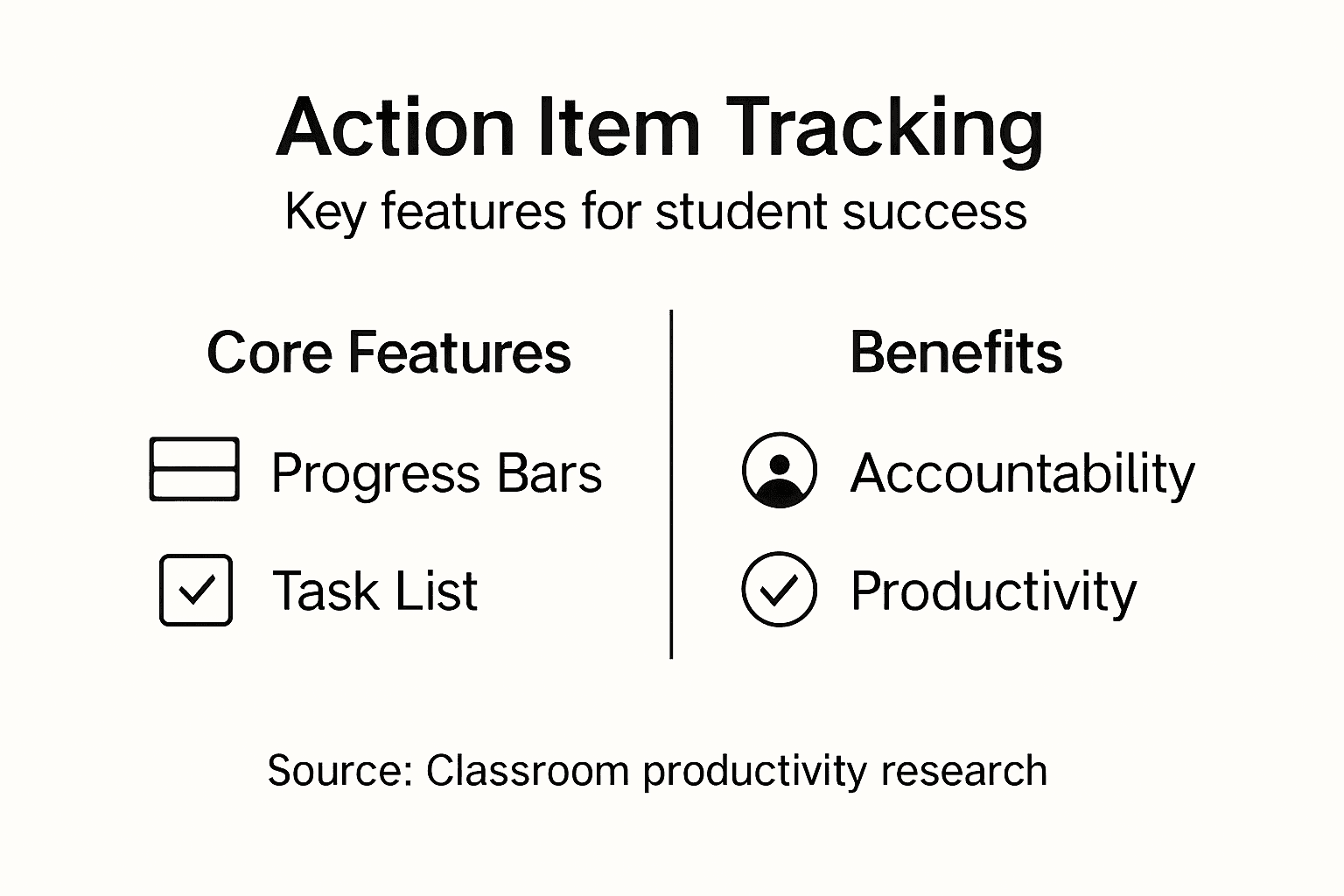
One of the most significant pitfalls involves unclear task ownership and imprecise action item definitions. Fragmented tracking methods often result in tasks becoming lost, misunderstood, or perpetually unfinished. To combat this, successful teams implement strategies like assigning a single point of responsibility for each action item, creating crystal-clear task descriptions, and establishing firm deadlines with specific measurable outcomes.
Technology and human factors intersect in creating robust action item tracking systems. Common mistakes include sporadic status updates, poor time estimation, and inconsistent communication. Students can mitigate these risks by adopting structured review processes, utilizing digital tools with built-in accountability features, and maintaining transparent communication channels that allow real-time progress monitoring. By developing disciplined tracking habits and leveraging collaborative platforms, individuals can transform potential organizational weaknesses into strengths.
Pro Tip: Create a weekly 30-minute review session dedicated to auditing your action items, reassessing priorities, and cleaning up any stagnant or unclear tasks.
Alternatives to Action Item Tracking Tools
Traditional action item tracking tools represent just one approach to managing academic and professional workflows. Research impact tracking platforms offer sophisticated alternatives that extend beyond simple task management, providing specialized solutions for scholarly and professional environments.
Academic researchers and students increasingly turn to AI-powered tools that transform workflow management. Intelligent research assistance tools leverage artificial intelligence to streamline complex processes like literature reviews, citation management, and data analysis. These innovative platforms go beyond basic task tracking, offering comprehensive support for research and academic productivity through advanced technological capabilities.
Alternative approaches to action item tracking include analog methods like physical journals, digital notebooks, mind mapping software, and collaborative spreadsheets. Each alternative offers unique advantages depending on individual learning styles, project complexity, and personal preferences. Some students prefer visual tracking methods like kanban boards, while others might gravitate toward minimalist text-based systems that emphasize simplicity and quick capture of ideas.
Comparing digital and analog tracking alternatives provides insight for different workflows:
| Method | Strength | Limitation |
|---|---|---|
| Digital Tools | Automated reminders | Can be distracting |
| Physical Journals | No tech required | Harder to share updates |
| Mind Mapping Software | Visualizes complex projects | Can be time-consuming |
| Collaborative Sheets | Easy for team editing | Limited advanced features |
Pro Tip: Experiment with three different tracking alternatives before committing to one system, allowing yourself to discover the method that best matches your personal productivity rhythm.
Take Control of Your Tasks Like a True Centurion
Struggling to keep up with your academic and personal action items is a common challenge that can slow your path to success. This article emphasizes the importance of clear task ownership, real-time progress monitoring, and strategic collaboration to unlock productivity and accountability. As a student or young professional, the right tools can transform overwhelming to-do lists into empowering workflows that help you prioritize and conquer your goals.
Optio Station is designed precisely for this mission. Built around a Roman theme where you become the Centurion and Optio stands as your second-in-command, our mobile app offers dynamic task, team, and time management features. With customizable views, integrated communication, and seamless collaboration, you gain the strategic edge to track and complete every action item efficiently.
Elevate your productivity by exploring insightful tips and strategies on our CenturionTips – Optio Station: Best Project Management App for Prioritization page. For broader productivity insights, check out ProductivityThoughts – Optio Station: Best Project Management App for Prioritization.
Ready to step into command and experience action item tracking that fits your unique needs? Visit Optio Station now and unlock the power of becoming your own second-in-command.
Frequently Asked Questions
What are action item tracking systems?
Action item tracking systems are methodologies used to manage tasks and responsibilities, enhancing productivity by structuring and tracking assignments in academic and professional contexts.
How can students benefit from using action item tracking systems?
Students can benefit from these systems by visualizing their workload, prioritizing tasks, and maintaining accountability, which helps them navigate multiple assignments and goals effectively.
What essential features should I look for in an action item tracking tool?
Key features to consider include real-time progress monitoring, clear task ownership, customizable categorization, integrated communication channels, and automated notifications for deadlines.
What are common pitfalls to avoid in action item tracking?
Common pitfalls include unclear task definitions, inconsistent tracking practices, and poor communication. To avoid these issues, maintain clear responsibilities, specific deadlines, and regular status updates.
Recommended
- Understanding Why Track Achievements Matters for You – Optio Station: Best Project Management App for Prioritization
- Effective Goal Setting for Students: Achieve Your Dreams – Optio Station: Best Project Management App for Prioritization
- Understanding the Role of Growth Tracking in Success – Optio Station: Best Project Management App for Prioritization
- Understanding Workflow for Progress Tracking in Detail – Optio Station: Best Project Management App for Prioritization
- Transfer Credit Evaluation Software | DegreeSight
