

Write one SMART academic goal you can complete this month, then schedule the first two study sessions before you close this tab. That single action, backed by research on structured goal-attainment plans, is associated with meaningful gains in academic performance. Everything else in this guide builds on that foundation.
Your ready-to-use SMART goal (copy and adapt):
Your immediate next steps:
- Block two study sessions in your calendar this week (90 minutes each, specific days and times)
- Decide your measurement: quiz score, pages reviewed, or practice problems completed
- Set a 5-minute Sunday check-in to ask: “Did I hit my sessions this week?”
That’s the whole system in miniature. The rest of this guide shows you how to build it for any subject, any semester.
Key Takeaways
Structured academic goal setting, using SMART criteria paired with a tracking cadence and Bloom’s action verbs, turns vague intentions into measurable progress you can act on this week.
| Point | Details |
|---|---|
| Start with one SMART goal | Write one specific, measurable, time-bound goal before setting any others. |
| Match goal type to skill level | Use learning goals early in a course; shift to performance goals once fundamentals are solid. |
| Use Bloom’s verbs | Replace vague verbs like “understand” with observable ones like “compare,” “solve,” or “evaluate.” |
| Track with a weekly cadence | Check session completion and one progress metric every week, same day, same time. |
| Optiostation supports your cadence | Use Optiostation’s goal templates and session scheduler to maintain accountability without manual tracking. |
Table of Contents
- What are academic goals, and when should you use learning vs. performance goals?
- How do you set an academic goal step by step?
- How does the SMART framework apply to academic goals?
- How do Bloom’s Taxonomy action verbs make your objectives measurable?
- What do strong SMART academic goal examples look like?
- How do you track progress and stay accountable?
- When should you adjust or abandon a goal?
- Student-ready SMART templates you can use in 10 minutes
- What students get wrong about academic goal setting
- Optiostation keeps your academic goals on track
- Sources
What are academic goals, and when should you use learning vs. performance goals?
An academic goal is a specific destination you commit to reaching within your studies. It answers: What will I achieve, by when, and how will I know I got there? That last part is what separates a real goal from a wish.
Two types matter most for students.
Learning goals focus on building skill or understanding. “I want to understand how to balance chemical equations” is a learning goal. They work best early in a course or subject, when you’re still building the fundamentals. Rushing to a grade target before you’ve mastered the basics tends to produce cramming, not comprehension.
Performance goals focus on outcomes: a grade, a score, a ranking. “Score 85% on the next lab report” is a performance goal. These make sense once you have enough skill to execute, typically mid-semester or during assessment windows.
The practical rule: start with a learning goal until you can consistently demonstrate the skill, then convert it to a performance goal. A student who sets a performance goal on day one of a new subject often hits a wall and quits. One who builds skill first and then targets a grade tends to hit both.
How do you set an academic goal step by step?
Follow this sequence. It takes about 10 minutes the first time.
- Identify the gap. What’s the distance between where you are now and where you need to be? A C+ in statistics when you need a B to keep your scholarship is a gap. Name it plainly.
- Choose one priority. Pick the single most important gap to close this month. Not three. One. Spreading focus across multiple goals at once is the fastest way to make progress on none of them.
- Write it as a SMART goal. Convert your gap into a specific, measurable, achievable, relevant, time-bound statement. (Full breakdown in the next section.)
- Break it into milestones. A semester goal needs weekly checkpoints. A course goal needs session-level tasks. Example: if your goal is to raise your essay grade from a C to a B by week 10, milestone 1 might be “outline and draft thesis for Essay 2 by Friday of week 3.”
- Schedule your sessions. Put them in your calendar as fixed appointments. Two 90-minute sessions per week beats one 4-hour marathon for retention and follow-through.
- Set your monitoring method. Decide now what you’ll measure and when. A Sunday 5-minute review works for most students. Ask: Did I complete my sessions? What’s my current score or progress indicator?
- Build in an adjustment point. At the midpoint of your timeline, check whether the goal is still realistic. If you’ve missed more than two consecutive milestones, something needs to change, and that’s not failure.
The Oregon State Academic Success Center recommends pairing SMART with a planning system that includes timeline, resources, and tracking, not just the goal statement itself. The goal sentence is the destination; the system is what gets you there.
How does the SMART framework apply to academic goals?
UCOP defines SMART as Specific, Measurable, Achievable, Relevant, and Time-bound. Each element does a specific job.
- Specific: Names the subject, task, and outcome. “Study more” fails this. “Complete chapters 4 and 5 of my economics textbook” passes.
- Measurable: Gives you a number or observable result to check. “Understand the material” is not measurable. “Score 75% or above on the chapter quiz” is.
- Achievable: Calibrated to your current workload and skill level. A goal that requires 6 hours of daily study when you’re carrying 18 credit hours is not achievable. Stanford Student Affairs recommends staging goals in small, realistic steps tied to behavior-change stages.
- Relevant: Connected to something that actually matters to you, a degree requirement, a career path, a personal standard. Relevance is what keeps you going at week 6 when motivation dips.
- Time-bound: Has a deadline. “By the end of week 8” is time-bound. “Soon” is not.
Before → After SMART rewrites:
| Vague goal | SMART version |
|---|---|
| “Get better at writing” | “Earn a B+ or higher on Essay 3 by submitting a revised draft to the writing center by April 2” |
| “Study more for biology” | “Complete 3 practice exams by the Friday before the midterm, scoring at least 70% on each” |
| “Improve my GPA” | “Raise my GPA by the end of the spring semester by targeting A’s in two electives and a B+ in Calculus II” |
Fill-in-the-blanks SMART template:
“I will [specific outcome] in [subject/course] by [deadline] by completing [specific actions] and measuring progress by [metric].”
Example: “I will complete all 8 reading assignments for History 101 by November 30 by reading one assignment per week and summarizing each in 150 words.”
How do Bloom’s Taxonomy action verbs make your objectives measurable?
Vague verbs kill measurability. “Understand photosynthesis” tells you nothing about what you’ll actually do or how you’ll know you’ve succeeded. Bloom’s Taxonomy fixes this by mapping cognitive levels to observable actions.
The Yale Poorvu Center recommends selecting action verbs that make learning objectives observable, because if you can’t see the behavior, you can’t measure it. Johns Hopkins’ Office of the Provost adds that a well-written objective names what the student will do, the conditions, and the criteria for success.
Here’s a practical verb map by cognitive level:
| Bloom’s level | What it means | Student-ready verbs |
|---|---|---|
| Remember | Recall facts | list, define, identify, name |
| Understand | Explain in your own words | summarize, describe, explain, classify |
| Apply | Use knowledge in a new situation | solve, demonstrate, use, calculate |
| Analyze | Break down and examine | compare, differentiate, examine, break down |
| Evaluate | Make a judgment with criteria | assess, critique, justify, defend |
| Create | Produce something new | design, write, construct, develop |
Vague → Measurable using Bloom’s verbs:
- “Understand the Civil War” → “Compare the economic and political causes of the Civil War in a 500-word essay by Thursday”
- “Know statistics” → “Solve 10 regression problems from the practice set with 80% accuracy before the exam”
- “Learn Spanish vocabulary” → “Identify 50 new vocabulary words from chapters 3–5 on a timed quiz by Friday” (for more on setting language learning goals, subject-specific examples can sharpen this further)
A PMC/NCBI review confirms that measurable objectives aligned to instruction and assessment are a necessary skill, not just a nice-to-have, across educational contexts.
What do strong SMART academic goal examples look like?
These are copy-ready. Adapt the subject, score, and deadline to your own situation.
Single study session goals:
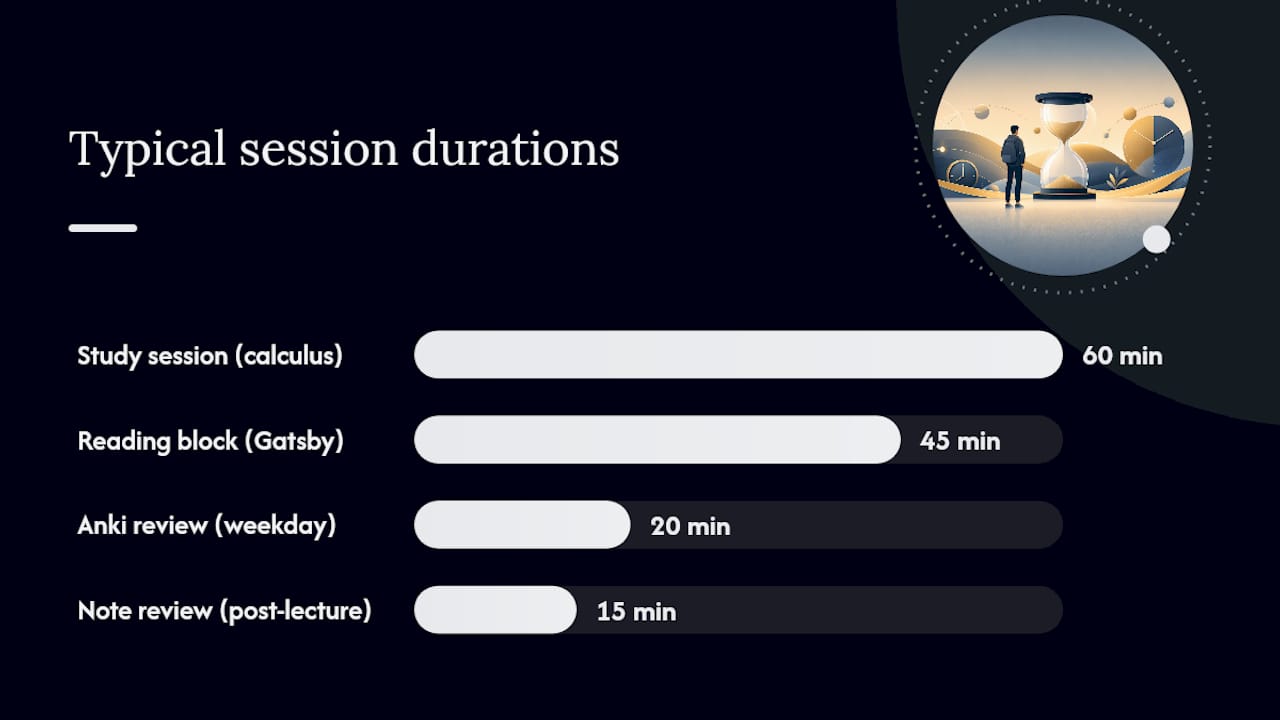
- “Complete problems 1–20 in Chapter 6 of my calculus textbook in tonight’s 60-minute session, checking answers after every 5 problems.”
- “Read and annotate pages 45–80 of The Great Gatsby in one 45-minute block, noting 3 themes per chapter.”
Multi-week course module goals:
- “Score 78% or higher on the Unit 3 chemistry quiz on October 10 by reviewing one sub-topic per study session over the next 3 weeks.”
- “Submit a polished 1,200-word argumentative essay for English Comp by November 5 by completing outline, draft, and revision in three separate sessions.”
Semester-level goals:
- “Finish the spring semester with a 3.5 GPA by earning an A in two courses and a B+ in two others, reviewing progress at each midterm.”
- “Complete all required readings for Political Science 202 by week 14, reading one chapter per week and writing a 100-word summary after each.”
Habit-based goals:
- “Review class notes within 24 hours of every lecture for the entire semester, spending no more than 15 minutes per review.”
- “Complete one Anki flashcard review session of 20 minutes every weekday morning before 9 AM.”
High school variants:
- “Raise my AP Biology grade from a C+ to a B by the end of the grading period by attending tutoring once a week and completing all homework before class.”
For more SMART goal examples across subjects, including discipline-specific templates, Optiostation’s example library covers a wide range of student scenarios.
How do you track progress and stay accountable?
A goal without a tracking system is just a plan you’ll forget by Thursday. The mechanism that keeps goals alive is what FranklinCovey calls a cadence of accountability: regular, visible progress checks that supply frequent feedback and small wins.
Weekly cadence template:
- Daily (2 minutes): Did I complete today’s scheduled session? Mark it done or missed.
- Weekly (5–10 minutes, Sunday): How many sessions did I complete? What’s my current score or progress metric? What’s the plan for next week?
- Monthly: Am I on track for the semester goal? Do I need to adjust scope or pacing?
What to look for in a tracking tool:
- Recurring task or session scheduling (not just a to-do list)
- A visual progress indicator (completion percentage, streak, or scoreboard)
- Simple metric entry (score, pages, problems completed)
- Sharing or accountability features (optional but effective)
| Method | Pros | Cons | Best for | Measurement example |
|---|---|---|---|---|
| Visual board (paper/whiteboard) | Tangible, always visible, zero friction | Not portable, no reminders | Habit goals, daily streaks | Check marks per session completed |
| Digital task tracker | Portable, reminders, recurring tasks | Requires setup, easy to ignore | Multi-goal management | Completion rate per week |
| Accountability partner | Social pressure, real feedback | Dependent on another person’s schedule | High-stakes semester goals | Weekly verbal check-in |
Quick accountability checklist:
- Set a fixed weekly review time (same day, same time every week)
- Track at least one lead measure (sessions completed) alongside one lag measure (score or grade)
- Share your goal with at least one person who will ask about it
- Keep a 2-line log after each session: what you did, what you’ll do next time
For practical organization tools that support tracking, a visual system paired with a digital reminder layer tends to outperform either alone.
When should you adjust or abandon a goal?
Holding onto a goal that no longer fits isn’t discipline. It’s sunk-cost thinking. Disengaging from an impractical goal is a strategic reallocation of limited time, not failure.
Signals that a goal needs adjustment:
- You’ve missed the same milestone three or more times in a row
- A course requirement or exam date has changed
- A new priority (a job offer, a health issue, a harder course) has shifted your available time
- The goal is generating consistent anxiety without any productive output
- You’ve already achieved the underlying skill and the goal is now redundant
Pivot options:
- Reduce scope: Change “score 90%” to “score 80%” if the original target was set before you understood the course difficulty
- Shift goal type: Convert a performance goal back to a learning goal if you’re still building fundamentals
- Reset milestones: Keep the end target but extend the timeline by two weeks
- Full disengage: Drop the goal entirely and reallocate those study hours to a higher-priority course
Goal adjustment log (copy this template):
Original goal: [what you set]
Date of review: [when you’re making the call]
Reason for change: [one honest sentence]
New goal or reallocation: [what replaces it]
What I learned: [one sentence for future goal-setting]
Keeping this log matters. It turns a pivot into a learning event rather than a quiet abandonment, and it gives you data for setting better goals next semester.
Student-ready SMART templates you can use in 10 minutes
Paste any of these into a note, fill in the brackets, and you’re done.
Template 1 — Exam prep:
“I will score [target %] on [exam name] on [date] by completing [number] practice problems per week and reviewing [specific topic] in each session.”
Template 2 — Writing assignment:
“I will submit a [grade target] [assignment type] for [course] by [deadline] by completing the outline by [date 1], the first draft by [date 2], and a revised draft by [date 3].”
Template 3 — Habit goal:
“I will [specific habit] every [day(s)] for [duration] by scheduling it at [time] and tracking completion with [method].”
10-minute use case:
- Pick one template above (2 minutes)
- Fill in every bracket with real numbers and dates (3 minutes)
- Add two study sessions to your calendar right now (3 minutes)
- Write down your accountability check: who, when, how (2 minutes)
Pro Tip: Once you can consistently hit your learning goal (say, scoring 70%+ on practice quizzes), convert it to a performance goal with a higher threshold. That transition signals real skill growth and keeps the challenge calibrated to where you actually are.
For a fully formatted SMART goal worksheet for students, Optiostation’s template page includes printable and digital versions you can complete in a single sitting.
What students get wrong about academic goal setting
Most students treat SMART as a checklist they complete once and then ignore. Write the goal, feel productive, move on. The goal sentence is not the work. The system behind it is.
There’s also a tendency to set performance goals too early. A first-year student who has never written a college-level research paper and sets “earn an A on my thesis” as their first goal is skipping the skill-building phase entirely. The goal isn’t wrong. The timing is. A learning goal first (“I will be able to construct a thesis statement supported by three peer-reviewed sources”) creates the foundation the performance goal needs.
One thing that rarely gets said: mixing easy milestones with harder ones, what researchers call intermittent reinforcement, helps sustain motivation over a long semester. Don’t make every checkpoint a stretch. Schedule some wins. A week where you hit every session and the task was manageable is not wasted time. It’s the fuel that carries you through the harder weeks.
Optiostation keeps your academic goals on track
Manual trackers work until life gets complicated. Three exams in one week, a group project, and a part-time job, and the paper system falls apart. That’s where a dedicated task management app earns its keep.

Optiostation is built for exactly this: students and young professionals who need to manage goals, sessions, and accountability without a complicated setup. As your second-in-command (the Optio to your Centurion), it handles the cadence so you can focus on the work.
When choosing an app to support your study goals plan, look for these features: goal templates you can fill in once, recurring session scheduling, a visual scoreboard that shows weekly completion at a glance, simple metric entry (score, pages, problems), and an accountability-sharing option. Optiostation checks all of them.
Start with the SMART goal template to write your first goal in under 10 minutes, then use the app to schedule sessions and track your weekly cadence. No long learning curve, no complicated onboarding.
Sources
- University of California Office of the President (UCOP)
- Yale Poorvu Center
- Goal Setting 101 | Academic Success Center | Oregon State University
- Writing effective and measurable learning objectives | Office of the Provost (JHU)
- Writing effective learning objectives is a necessary skill in academic medicine (PMC/NCBI)
Recommended
- Examples of SMART goals to boost academic success – Optio Station: Best Project Management App for Prioritization
- Why set study goals? 250% higher performance awaits – Optio Station: Best Project Management App for Prioritization
- Effective Goal Setting for Students: Achieve Your Dreams – Optio Station: Best Project Management App for Prioritization
- Complete Guide to Goal Setting for Students – Optio Station: Best Project Management App for Prioritization
