

Learning feels fun when you care about the topic, can see why it matters, have some say in how you do it, notice yourself getting better and share the work with other people. None of that depends on the subject being easy or on a clever app. It depends on how you set up your study time. That is also where Optio, our app for students and young professionals, comes in: it keeps goals, schedules and team projects in one place, so more of your energy goes to the interesting part.
TL;DR
- Fun in learning is a positive feeling that comes from active engagement, and it makes you want to come back to the activity.
- College students say they enjoy learning that is interesting, relevant to real life or a career, interactive and taught or shared by people they relate to.
- Fun does not replace good study methods. It improves your attitude toward a subject, and a better attitude improves learning.
- You can build fun on purpose: pick your own goals, make progress visible, study with others, add a bit of challenge and space your sessions out.
- A clear plan removes friction, which is often what makes studying feel like a chore.
Table of Contents
- What fun actually is
- What college students say makes learning enjoyable
- Does fun actually help you learn?
- Six ways to build fun into how you study
- Keep the fun and keep what you learn
- A one-week experiment
- Where Optio fits
- Our perspective
- FAQ
- Sources
What fun actually is
Most advice on this topic is a list of classroom games for children. If you are a college student or a young professional, you need a better definition than “add a game.”
A September 2026 scoping review in Perspectives on Medical Education screened 1,073 articles, included 40, and proposed a working definition. Fun is a positive emotional experience that comes from actively engaging in enjoyable activities, often playful ones, and that naturally makes you want to keep going or return. The authors grouped 120 features of fun into seven categories:
| Category | What it looks like when you study |
|---|---|
| Safety | You can get things wrong without feeling judged |
| Novelty | A new method, place or angle on a familiar topic |
| Autonomy | You choose goals, order or format |
| Playfulness | Humor, challenge, light competition |
| Purpose | You can see why the work matters |
| Immersion | You lose track of time because you are absorbed |
| Social connection | You work with people, not alone against a deadline |
The same review found that fun is commonly described as a strong, intrinsic motivating factor. It can even be restorative of self-control. Activities that feel pointless or a waste of time work against it, while a relevant purpose, such as learning, development or reward, supports it.
Take that seriously. Fun is not decoration on top of studying. It is closely tied to purpose, choice and people, and you can influence all three.
What college students say makes learning enjoyable
A 2021 study in the Journal of Pedagogical Research by Seemiller and colleagues analyzed written answers from 1,282 U.S. and 775 Brazilian Gen Z college students. Both groups enjoyed learning that was interesting, inspiring, relevant and engaging. U.S. students also valued gaining knowledge, making a difference in society and having instructors who were competent and relatable. Brazilian students put more weight on learning from peers.
Four themes showed up in both countries:
- Interest in the topic
- Content you can apply to a career or to life
- An effective instructor
- Interactive ways of learning
One U.S. student summed it up as being passionate about the subject, having a charismatic instructor and being able to apply concepts to real-world projects in a hands-on way.
A 2026 study of 350 university students by Wang, Chen, Sun and Chen found something similar from another angle. Engagement, curiosity and classroom experience all predicted enjoyment. Classroom experience had the strongest effect and made curiosity count for more. The links were stronger among science students than humanities students.
You do not control your professor. You do control the other three themes: how you connect the material to your own interests, how hands-on you make your practice, and who you study with.
Does fun actually help you learn?
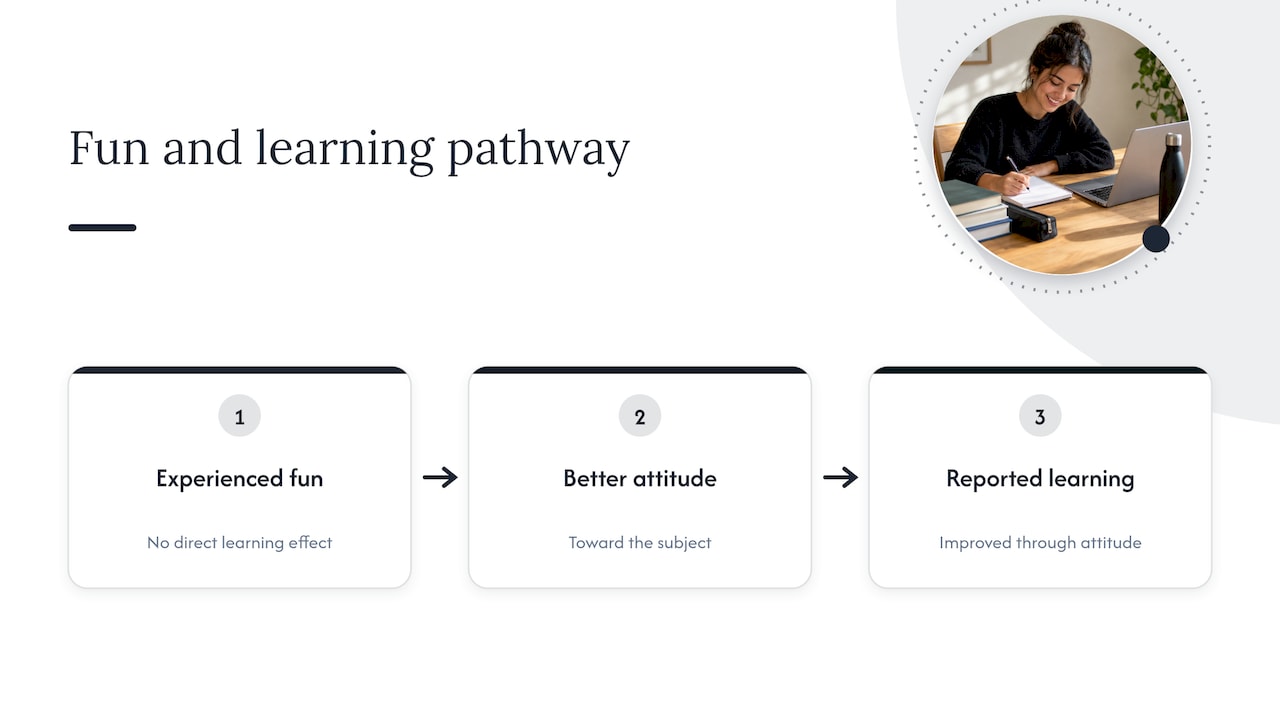
The honest answer is yes, and mostly through your attitude. A 2023 thesis from Eindhoven University of Technology found that experienced fun had no direct effect on reported learning. It did significantly improve students’ attitude toward the subject, and a better attitude in turn improved learning. The indirect path through attitude was significant.
Students seem to sense this. In a 2020 Frontiers in Education study of 551 distance-education students, 88.77% valued fun in online learning and linked it to well-being, motivation and performance.
The practical reading: fun gets you to the desk and keeps you coming back. Good study technique does the remembering. You want both.
Six ways to build fun into how you study
1. Connect the material to something you care about
Purpose is one of the seven categories of fun, and the easiest way to create it is to make the topic personal. Purdue University Global’s Academic Success Center suggests making personal connections, for example studying your hometown’s economic history instead of a generic tax topic. It also suggests asking a classmate a meaningful question each week and applying something you learned to your job.
If you are a young professional, that last one is the shortcut. Pick one idea from this week’s reading and use it in a real task before Friday.
2. Choose your own goals
Autonomy shows up in the fun research and in the study-skills literature. The eCampusOntario open textbook on academic success argues that motivation is personal and dynamic: you do not have to wait for motivation to strike, because it can be activated. It names three ingredients you can build: interest and purpose, belief in yourself, and support and accountability, such as milestones and study groups.
A goal you chose and can finish this week beats a vague plan to “do better this semester.” Our guides on motivational goal setting for students and the role of motivation walk through how to turn a big aim into small targets.
3. Make progress visible
Feeling yourself improve is a quiet kind of fun. Break a course into projects and tasks, then check things off. When each area of life, such as classes, work, health and friends, has its own color, you can see at a glance whether one is crowding out the rest. That is how Optio is set up, with color-coded life aspects, project organization and goal setting built in.
4. Study with other people
Social connection is a category of fun, and Brazilian students in the Seemiller study put peer learning at the center of enjoyable learning. In a 2018 study from New Zealand, 11 of 14 students said the discussion after a Kahoot! quiz was where the most valuable learning happened. The quiz sparked it, and the talking did the work.
If you are planning a group session or a team project, our article on examples of group projects shows formats that give everyone a real role. Optio supports team collaboration, so tasks and ownership stay clear and nobody spends the meeting asking who was supposed to do what.
5. Redesign the task to be more playful or more challenging
A 2025 article in Educational Psychology Review by Costantini, Bakker and Scharp tested what they call playful study design: reshaping study tasks to be more fun, more challenging, or both. Across several studies, it predicted social integration, study engagement and well-being. Designing competition was especially helpful for course grades.
In practice, that can mean:
- Racing a friend to finish practice problems and comparing answers afterward.
- Turning your notes into quiz questions and trading them with a classmate.
- Setting a timer for a short, focused block and trying to beat your last score.
Hands-on, playful approaches are also a theme in writing about how sensory play supports child development, and the same instinct, learning by doing and touching, carries into adult study.
6. Get the challenge right
Fun does not mean easy. A 2016 study by Hamari, Shernoff, Rowe and Edwards of 173 players of two learning games found that perceived challenge was the strongest predictor of learning outcomes, and that the challenge needs to keep pace as your ability grows. If a task is too easy, step it up. If it is overwhelming, cut it into smaller pieces. The sweet spot is where you feel stretched but not buried.
Keep the fun and keep what you learn
Enjoyment is only half the plan. The University of Edinburgh’s Academic Skills hub says that being active and engaged makes studying more interesting, and it recommends methods that also make learning stick:
- Test yourself. Write down what you remember, then check it. Re-reading creates an illusion of familiarity.
- Leave a gap. Wait anywhere from an hour to a day before summarizing from memory.
- Space it out. Several shorter sessions across days beat one long cram.
- Mix problem types. Interleaving feels harder in the moment and pays off later.
- Practice the way you will be assessed. Write mock questions in the style of your exam.
- Use short focused blocks with brief breaks, and keep a dedicated study spot to limit distractions.
These pair naturally with the playful ideas above. A self-quiz with a friend is both retrieval practice and a game.
Spacing is also a scheduling problem. You need to know when your next session is, or it never happens. Our guides on how to organize your study schedule and create an effective study schedule cover the basics. In Optio, smart reminders and Google Calendar integration keep the sessions in front of you.
A one-week experiment
Here is a simple plan you can run this week:
- Monday: Pick one course. Write one personal reason it matters, such as a job you want or a question you are curious about.
- Tuesday: Set one goal you chose yourself, small enough to finish by Friday.
- Wednesday: Do a 25-minute focused block of self-testing, then compare your answers with a classmate.
- Thursday: Add a twist. Make it a race, or write exam-style questions for each other.
- Friday: Check the goal off and note what felt good and what felt flat.
- Weekend: Do a short recall session on Wednesday’s material, with a gap since you last saw it.
Keep what was fun, drop what was not, and repeat.
Where Optio fits
If your studying feels like a chore partly because everything is scattered, Optio gives you one place for it. It is a mobile app built for students and young professionals, with task management, time tracking, goal setting, project organization, team collaboration, smart reminders, motivational content, hashtag-based search and Google Calendar integration. It has a Roman theme: Optio is your second-in-command, and you are a Centurion. The core features are free, with advanced capabilities planned behind a subscription. You can try it at Optiostation.
Our perspective
We built Optio on a simple belief: people enjoy learning more when the logistics get out of the way. Most students we hear about do not lack curiosity. They lack a clear next step, and an unclear next step is quietly joyless.
The research points the same way. Fun grows from purpose, choice, progress and other people. A good plan supports every one of those. Goals you pick yourself give you autonomy. A visible list of finished tasks gives you progress. A shared project board gives you teammates who know their part.
That is why Optio is simple and flexible, and why it is indie-built and shaped by feedback from its community. The Roman theme is there because a little personality makes a to-do list easier to come back to. You are a Centurion with a second-in-command, not a person drowning in tabs.
If you want learning to feel better, start by making your week easier to see. The enjoyment tends to follow.
Optiostation
FAQ
Why make learning fun?
Fun is described in research as an intrinsic motivator that sustains interest and makes you want to return to an activity. In one study of distance-education students, most said fun supported their well-being, motivation and performance. Fun also improves attitude toward a subject, and attitude improves learning.
What makes learning fun for adults?
College students point to interesting topics, real-world relevance, interactive methods and relatable teachers. Adults who study alongside work add choice over goals and a clear link to their job. Study groups and small weekly questions to a peer help too.
Can learning be fun and still be hard?
Yes. In the 2016 game-based learning study, perceived challenge was the strongest predictor of learning outcomes. The aim is a task that stretches you without burying you, and you can adjust it by making steps smaller or harder.
How do I make studying more enjoyable without losing retention?
Pair playful formats with proven methods. Quiz yourself from memory, space sessions over days and mix problem types. Doing these with a friend, with a timer or as a friendly competition adds the fun without losing the effect.
Sources
- What makes learning enjoyable? Perspectives of today’s college students (Journal of Pedagogical Research, 2021)
- Taking Fun Seriously: A Scoping Review of Frameworks (Perspectives on Medical Education, 2026)
- Why do students lose the joy of learning? (2026)
- The Role of Fun in Learning (Eindhoven University of Technology, 2023)
- Factors and Recommendations to Support Students’ Enjoyment of Online Learning With Fun (Frontiers in Education, 2020)
- Playful Study Design (Educational Psychology Review, 2025)
- Effective studying (University of Edinburgh Academic Skills)
- Fall in Love With Learning (Purdue University Global Academic Success Center, 2025)
- Engaging, in International Students: Stories and Strategies for Academic Success (eCampusOntario)
- Challenging games help students learn (2016)
- Students’ perception of Kahoot!’s influence on teaching and learning (2018)
