

The best group project roles are the ones every member can name in one sentence: who runs the meetings, who tracks the deadlines, who records decisions, who edits the final draft. Assign them in the first meeting, match them to strengths, write down who covers for whom, and put the tasks that come with each role where the whole team can see them. In Optio Station, our app for students and young professionals, those tasks, deadlines and reminders live in one shared place, so a role stays attached to real work instead of fading after week one.
TL;DR
- Roles do not divide all the work. They make sure someone owns each coordination job: leading, recording, timekeeping, editing and resolving conflict.
- Four roles cover most student groups: leader/facilitator, arbitrator/monitor, notetaker/timekeeper and devil’s advocate. Small groups simply combine them.
- Assign roles early, based on interests and skills, and agree up front who steps in if someone cannot finish theirs.
- Rotate roles in learning settings. Keep them fixed when consistent results matter more than practice.
- Attach every role to dated tasks in a shared list, so nobody has to ask who is doing what.
Table of Contents
- What group project roles are, and why they help
- The core roles and what each one does
- How to choose and assign roles, step by step
- Fixed roles or rotating roles?
- When a role is unclear or not being carried out
- Roles in practice: a worked example
- Where an app fits
- Try it with your next team
- FAQ
- Sources
What group project roles are, and why they help
A role is a standing responsibility for how the team works, not a slice of the content. Researchers at the University of Geneva’s EduTech Wiki note that in educational settings roles usually do not define all the work, they make sure each member takes on a specific coordination task. One person writes, another researches, but someone also has to schedule the meeting, take notes and chase the deadline. Without roles, those jobs belong to everyone, which in practice means no one.
Education and Training Boards Ireland says assigning roles and their duties can raise productivity and cohesion and stop members from feeling disconnected from the group’s work. The same guide stresses that no role outranks another. The notetaker matters as much as the facilitator.
There is also evidence that balance pays off. A 2024 peer-reviewed study in an MDPI journal found that teams built around a balance of team roles reached consensus on a task more than five minutes faster, on average, than other teams. In that study, 21 of 30 teams also did better after reaching consensus than the average of their members’ individual results. A group that communicates well can beat the sum of its parts.
The core roles and what each one does
Universities publish slightly different lists, but they overlap heavily. Here are the roles you will actually use, with the job each one does.
| Role | What it does in practice |
|---|---|
| Leader / facilitator | Sets the agenda, starts discussion, keeps the team on task, makes sure everyone is heard |
| Organizer / coordinator | Schedules meetings, builds the timeline, tracks who owes what |
| Notetaker / recorder | Writes down decisions and action items, then circulates them after each meeting |
| Timekeeper / progress chaser | Keeps meetings on schedule and watches the external deadlines |
| Editor | Makes the final document consistent in voice, checks for typos, submits the work |
| Arbitrator / mediator | Monitors group climate and helps settle disagreements |
| Devil’s advocate | Questions decisions and checks details so weak ideas get caught early |
| Presenter | Delivers the final result and prepares the team for it |
Leader or facilitator
The University of Waterloo’s Centre for Teaching Excellence lists four fundamental roles: leader/facilitator, arbitrator/monitor, notetaker/timekeeper and devil’s advocate. The Open University describes the team leader as the person who chairs meetings, clarifies aims and the agenda, guides discussion and summarizes decisions. A strong leader may also split tasks and allocate activities, but in a peer group that usually works best as a proposal the team agrees to, not an order.
Notetaker and record keeper
This is the most underrated role. The Open University explains that the record keeper’s minutes become the official record of a meeting, something the team can consult when a decision is revisited or in doubt. Anyone who has argued about what was agreed last Tuesday knows why that matters.
Timekeeper and progress chaser
The same Open University guide gives the progress chaser the job of checking that the team meets its schedule and external deadlines. ETBI adds that the timekeeper sends reminders and keeps meetings on schedule. This is the role that turns a due date into a series of smaller dates.
Editor
In written assignments, the editor makes sure the work is free of typos, reads in a unified voice and gets submitted. The BC Campus textbook on technical writing recommends building in an extra 25% of time for merging each member’s contribution into the shared document, because it usually takes longer than expected. Whoever edits needs that cushion in the schedule.
Mediator and devil’s advocate
These two keep the team honest. The mediator is a neutral, good listener who helps resolve differences of opinion. The devil’s advocate questions decisions on purpose. Both roles protect the team from the quiet failure where everyone nods and no one checks the details.
Roles in a workplace project team
If you are a young professional, the vocabulary shifts. UMass Boston describes the project manager as the person who manages the team’s performance of project tasks, secures approval of deliverables, schedules and tracks resources, and reports status to sponsors and stakeholders. The sponsor, the manager and the team members each have a distinct job. The logic is the same as in a class project: every responsibility has a named owner.
How to choose and assign roles, step by step
1. Assign roles in the first meeting
McGill University’s Teaching and Learning Services advises teams to assign roles early, considering members’ interests and existing skills as well as chances to learn new ones. Waiting until the first crunch means the loudest person takes every role by default.
Where it goes wrong: groups skip this because it feels formal. It takes ten minutes, and it is far cheaper than a mid-project argument.
2. Match roles to strengths, with one stretch role each
UC Berkeley’s student wellbeing guide presents Belbin’s team roles, a framework that includes coordinator, shaper, implementer, resource investigator, plant, monitor evaluator, specialist, teamworker and completer finisher. It adds that each member can take on more than one role depending on natural skills. Belbin’s own view, as cited there, is that letting people choose roles that interest them and come naturally helps the group succeed.
A practical way to run it: each person names the job they would be good at and one they would like to try. Then fill the gaps.
3. Fit the roles to the size of the group
You do not need eight people for eight roles. McGill notes that a group may not need one person in each role, and that a generalist can support whichever role needs help. EduTech Wiki suggests that a group of three works with a leader, a scribe and a third role such as presenter, researcher or specialist. Larger groups can add a critic, a resource collector, a timekeeper and a specialist, while in smaller ones one person combines roles.
| Group size | A workable setup |
|---|---|
| 2 to 3 people | Leader who also organizes, scribe who also keeps time, one researcher or presenter |
| 4 to 5 people | Facilitator, organizer, notetaker/timekeeper, editor, plus a presenter among them |
| 6 or more | Add a devil’s advocate and a mediator, and split research by topic |
4. Write the roles down with dates
A role with no tasks attached is a title. For each role, list the recurring duty (agenda before every meeting, notes within 24 hours) and the one-off deliverables (outline, first draft, slides). Berkeley’s guide recommends individual and team deadlines, publishing tasks in a shared document and naming a coordinator to track progress.
This is where an app earns its place. Optio Station offers task management, team collaboration, time tracking, project organization and Google Calendar integration for students and young professionals. Our group roles guide walks through turning roles into finished work, and the team task list template shows how to lay out who owns what. If you are building the schedule itself, the planning group assignments guide covers it.
5. Agree on a backup before you need one
ETBI recommends that the team’s working agreement name who will take over a role if the original person cannot complete it. One line in your agreement, such as “if the notetaker is out, the timekeeper takes notes”, saves a scramble later.
Fixed roles or rotating roles?
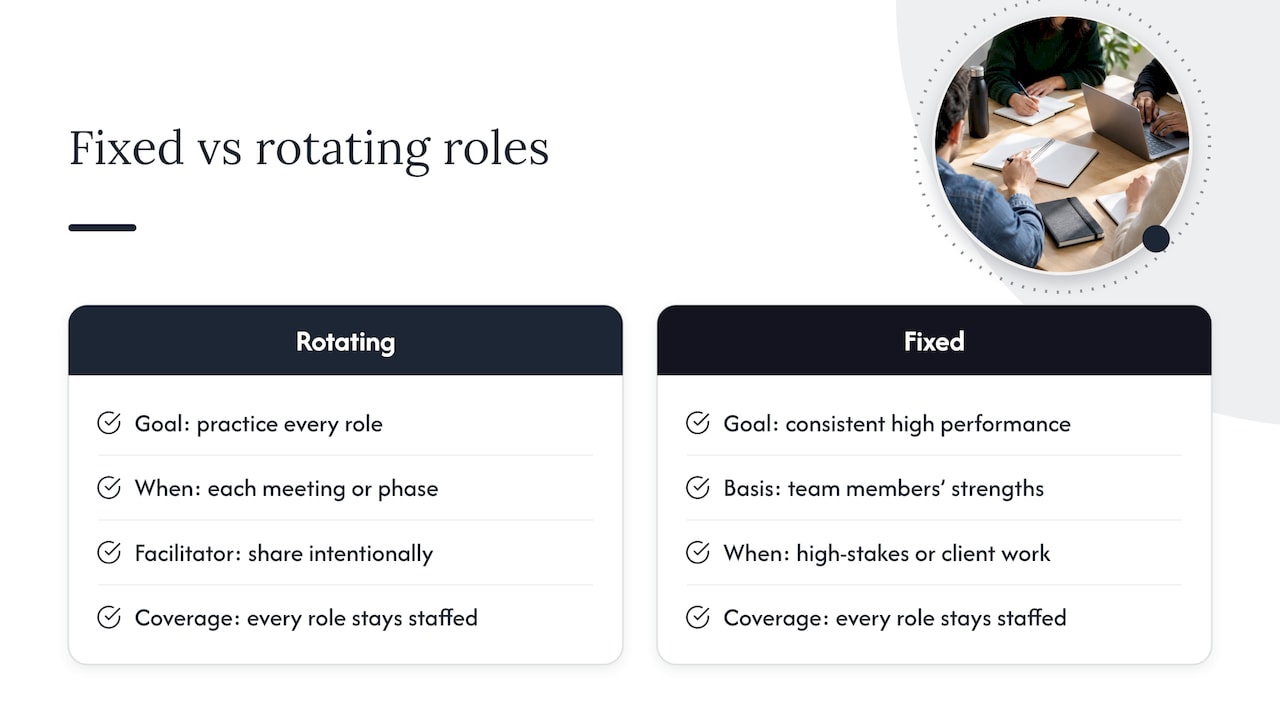
Both work, for different goals. The University of Minnesota’s Effective U guide says roles can be fluid as the group’s needs change, and that many groups benefit from intentionally sharing the facilitator role. The University of Sheffield gives examples of roles changing during a project, such as taking turns to chair meetings or take notes. Waterloo adds that rotation lets each member learn about the roles and about themselves as team members.
The processeducation.org team-design guide draws a useful line. Rotate roles frequently when the aim is for each student to practice every role. For project, problem-solving, committee and grant-writing teams, it recommends permanent roles based on strengths, because consistent high performance matters more than learning growth there. It also notes that responsibilities can shift as the team moves through stages of development.
A simple rule: in a class where learning the roles is part of the point, rotate the facilitator and notetaker each meeting or each phase. On a high-stakes deliverable or a work project with a client, keep roles stable and rotate only if someone is overloaded. The Open University adds one condition for either approach: someone must always perform each role or its tasks.
When a role is unclear or not being carried out
Most role problems are visible within the first two weeks: missed notes, no agenda, a deadline nobody owned. Handle them in this order.
- Check the role is clear. Ask whether the person knew what the role included. Reread the written duties together.
- Talk one-on-one, quickly. Berkeley’s guide advises speaking privately and without delay, because raising it in front of the whole group can put the person on the defensive.
- Revisit the agreed consequences. If the problem persists, return to the consequences for uncompleted tasks that the team set at the start. Amy Baldwin of the University of Central Arkansas, quoted by Berkeley, recommends opening with community standards for communication and troubleshooting issues like missed deadlines. They do not need to be formal, just agreed.
- Activate the backup. Use the cover person you named in step 5 above, and redistribute the dependent tasks.
- Recognize the quieter roles. The processeducation.org guide observes that members with roles other than captain, recorder and reflector often fail to see why their roles matter. The facilitator should point out specific moments where those roles improved the team’s work.
If your group will be working with outside stakeholders, it helps to see how responsibilities are scoped in real settings. Examples of industry-led student projects show how deliverables and ownership are laid out when the stakes are external.
Roles in practice: a worked example
Take a four-person team writing a 15-page marketing report due in six weeks.
- Maya is facilitator and presenter. She sends the agenda the day before each meeting and delivers the final presentation.
- Jordan is organizer and timekeeper. He builds the timeline backward from the due date and sets reminders for each milestone.
- Priya is notetaker and researcher. She posts decisions and action items within a day of each meeting.
- Chris is editor and devil’s advocate. He reviews the draft for consistency and challenges weak claims.
The agreement says Priya covers for Jordan if he is out, and Chris covers for Priya. Following the BC Campus advice, the timeline reserves an extra 25% of the editing window for merging sections, so the draft is due to Chris well ahead of the submission date. Every duty sits on a dated task in the shared list. Nobody has to ask who owns what, because it is written next to the date.
Where an app fits
Roles fail most often at the handoff between meeting and follow-through. The decision was made, the role was named, and then the task lived in someone’s head. A shared task list closes that gap.
Optio Station is built for exactly this kind of work. It combines task management, team collaboration, time tracking, goal setting and project organization, with smart reminders, color-coded life aspects and Google Calendar integration. You can browse tasks with hashtag-based search, and the app wraps the work in a Roman theme: Optio is your second-in-command, and you are a Centurion. For a team, that means the timekeeper’s deadlines, the organizer’s milestones and the editor’s review dates can sit in one place. Our how to manage team tasks guide and team collaboration guide go deeper.
We built Optio as an indie, user-driven app because we think the hard part of teamwork is rarely the idea. It is the follow-through. A role only helps if it turns into a dated task someone can see, and that is the job we designed Optio’s task lists, reminders and calendar integration to do. We keep the app simple and flexible, and we adjust it with feedback from the Centurions who use it. Our advice to any team: name the roles, write the duties, put the dates next to them, and let your second-in-command keep track.
Optiostation
Try it with your next team
Optio Station is a freemium mobile app for college students and young professionals. Set up your group’s roles as tasks, give each a deadline and let smart reminders do the nagging. Start at the Prioritization Station.
If you are still deciding how to rank the work itself, our guide to prioritization techniques is a good companion to your role list.
FAQ
How many roles does a group project need?
As many as there are coordination jobs, not as many as there are people. McGill notes that a group may not need one person in every role. Two or three people can combine facilitator, organizer and notetaker duties, while a group of six can give each job its own owner.
Should the group leader do the most work?
No. The leader’s job is to run meetings, clarify aims and summarize decisions, not to carry the content. ETBI stresses that no role is better than any other, so research, writing and editing carry equal weight.
Can we swap roles halfway through?
Yes. The University of Minnesota says roles can move as the group’s needs evolve, and the Open University says someone just has to cover each role. Agree on the swap together and update the task list so the new owner sees their duties and dates.
What is the most common role nobody wants?
Usually the notetaker, even though the record keeper’s minutes become the official record of what was decided. Rotate it each meeting, or pair it with a role the person likes, such as researcher, so it is shared fairly.
What if someone is not doing their role?
Talk to them privately and soon, as Berkeley’s guide advises. Check that the duties were clear, then return to the consequences the group agreed at the start. If the role still is not covered, activate the backup named in your agreement.
Sources
- Group Roles, Groupwork, ETBI Digital Library
- Group work roles, EduTech Wiki, University of Geneva
- Group Work: Assignment of Roles, University of Waterloo
- How teams work: Allocating team members to roles, Open University
- Project Roles Responsibilities, UMass Boston
- Assigning Roles in Group Work, McGill University
- Project Management Tools and Teamwork Strategies, BC Campus
- 6 steps to surviving your next group project, UC Berkeley
- Group Roles, Effective U, University of Minnesota
- Designing Teams and Assigning Roles, processeducation.org
- Systematic Approach to Academic Teamwork, MDPI
