

A time audit is a short stretch, usually one week, in which you write down what you actually do with your hours instead of what you think you do. You then total the results, compare them with your priorities and rebuild your schedule from real numbers. If you juggle classes, a job, a team project and a social life, it is the fastest way to find out why the day keeps ending with the important thing undone. In Optio, our task, team and time management app for Centurions (our name for students and young professionals), time tracking, color-coded life aspects and goal setting are built to make that record easy to keep.
TL;DR
- A time audit is a log of how you really spend your time over a set period, followed by a review of where it went.
- Most people misjudge their week, so the log replaces guesses with data you can plan from.
- Track in 30 to 60 minute blocks, be honest, and group the entries into a handful of categories.
- Change the top three problem areas first, give the new plan at least two weeks, and keep rest in the schedule.
- A tracking app with color-coded categories and calendar sync makes the log faster and the review clearer.
Table of Contents
- What a time audit actually is
- Why a time audit matters
- How to run a time audit in four steps
- Mistakes that skew your results
- Turning findings into a schedule you can keep
- Our perspective
- Make your next audit easier with Optio
- FAQ
- Sources
What a time audit actually is
Think of it as a bank statement for your hours. Stanford’s Center for Teaching and Learning describes time auditing as a strategy against “time blindness”: you track what you really do, spot the black holes that drain your time, and use the data to build a more realistic schedule.
Columbia University’s veteran transition guide uses a similar comparison, likening it to the IRS auditing your money. The audit reveals how you prioritize time, what you value and where time is wasted. It also says the best audit is granular. Lecture, lab, walking between classes, sleeping, chores, phone calls and social media each get their own line, not one vague bucket called “school.”
A time audit is not:
- A to-do list. A list says what you plan to do. An audit records what happened.
- A productivity contest. The point is information, not a high score.
- Permanent. Most people run one for a week, act on it, and repeat it when a semester, job or routine changes.
Why a time audit matters
Your sense of time is unreliable
Monash University’s Student Academic Success team notes that most people misjudge where their time goes, and that an audit gives you a record you can adjust against. The same page cites research linking good time management more strongly to wellbeing and a sense of control than to performance alone. So the payoff is not only better grades or output. It is also feeling less swamped.
The feeling of having no time is itself part of the problem. In a TED Ideas piece from September 2020, Celeste Headlee reports that believing you are short on time has real effects, and that people with low time perception spend more time on TV or social media and report feeling overwhelmed. Counting hours is a way out of that fog.
Your calendar may not match your values
In an NPR interview published 12 August 2026, psychotherapist Niro Feliciano says she asks clients who feel stuck on a hamster wheel to do a time audit. Often the things that matter most to them have little place in the day-to-day schedule. Her view is that inner peace starts when your schedule lines up with your values.
For a college student, that might mean you say your degree is the priority but the audit shows 14 hours of scrolling and 6 hours of focused study. For a young professional, it might mean you want to learn a new skill but every evening disappears into email. You cannot fix a mismatch you have not seen.
How to run a time audit in four steps
Stanford’s guide gives a four-step frame: pick a time frame, track, reflect, then build a schedule. Here it is with the places where people usually go wrong, and where Optio helps.
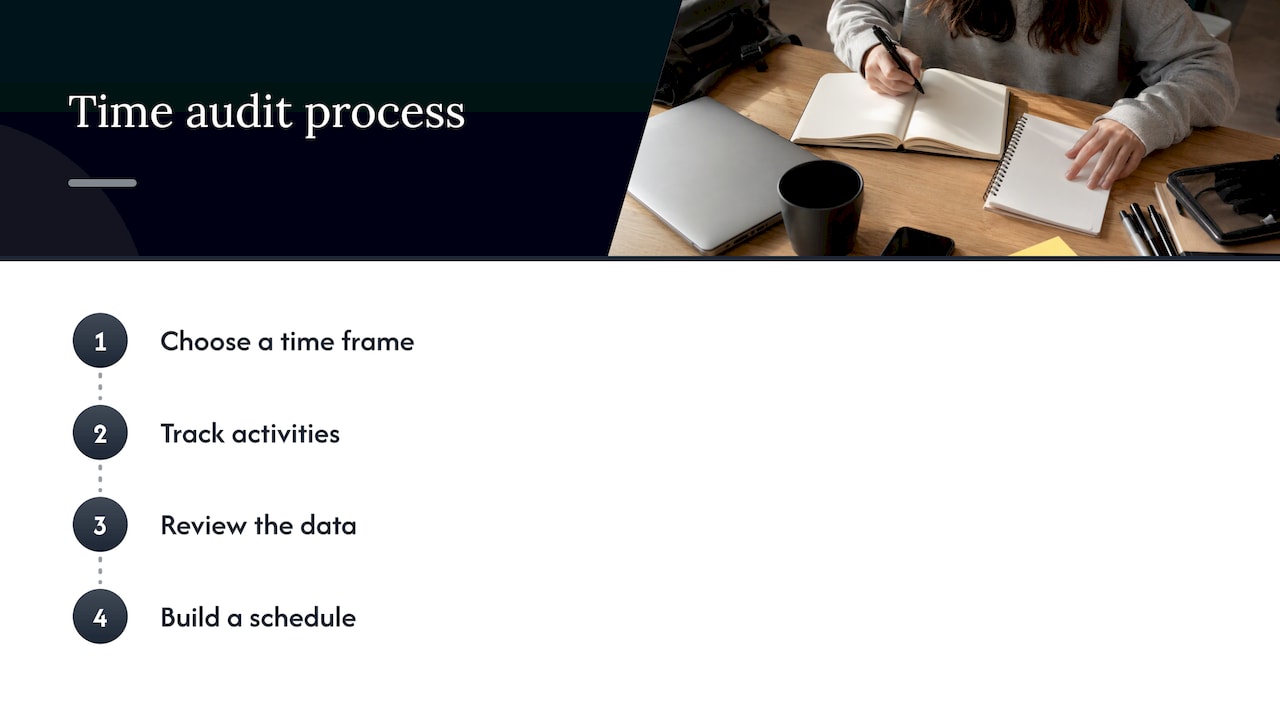
Step 1: Choose a window and start small
Pick a period you can finish. Monash suggests logging a typical week, so avoid a week with a holiday, exams or a trip, unless that is the week you want to understand. If seven days feels like too much, start with three ordinary days and extend.
Where it goes wrong: choosing an atypical week and then planning your whole term from it. Choose the kind of week you live most often.
Step 2: Track in 30 to 60 minute blocks
Stanford advises logging in 30 to 60 minute chunks, honestly and without judgment, noting what you actually did. Its example is a line like “2 to 2:45 pm: scrolled on TikTok and made a cup of coffee.” Monash adds that you should record what you did at the end of each hour or activity block, covering classes, study, paid work, travel, meals, rest and time online.
Two habits make this work:
- Log as you go. Writing Thursday’s log on Sunday means you are guessing again, which is the thing the audit is meant to stop.
- Record the small things. Columbia lists phone calls, moving between classes and social media for a reason. They add up.
Where it goes wrong: forgetting to log, then filling gaps with what you think you did. A tracker on your phone, where you already check messages, removes the friction. In Optio, you can track your time and tag each activity to a color-coded area of your life, so the week sorts itself as you go. Our guide to running a time audit as a Centurion walks through the routine.
Step 3: Sort the entries into categories
Raw logs are hard to read. The University for the Creative Arts’ Time Audit guide says to assign every hour of a 24/7 week to an activity, including sleeping, eating and working, then group them into broader categories such as studying, attending classes, leisure, socializing, exercising and personal care.
Here is a sample week for a student with a part-time job. The numbers are an illustration, not a benchmark.
| Category | What goes in it | Hours logged | Hours you expected |
|---|---|---|---|
| Classes | Lectures, labs, recitations | 15 | 15 |
| Study | Reading, assignments, exam prep | 11 | 18 |
| Paid work | Shifts, commute to work | 16 | 14 |
| Sleep | Nights and naps | 49 | 56 |
| Meals and chores | Cooking, eating, laundry | 14 | 10 |
| Social and leisure | Friends, TV, games | 17 | 12 |
| Phone and social media | Scrolling between other things | 12 | 4 |
| Exercise and self-care | Gym, walks, showers | 6 | 6 |
| Travel and gaps | Transit, waiting, “lost” time | 28 | 33 |
The gap between the last two columns is the finding. In this example, study is seven hours short of the plan and the phone is eight hours over. That is something you can act on.
If you keep life in separate areas, such as school, work, health and friends, assigning each one a color makes the totals visible at a glance. That is the idea behind Optio’s color-coded life aspects.
Step 4: Reflect on the data
Stanford suggests four questions: where did the time go, how long do tasks really take, when do you have the most energy, and are your breaks intentional? Monash adds two more steps: total each category, compare it with your expectations, and name your distractors (social media, videos, messages, housework), noting when they tend to strike.
A useful review pass looks like this:
- Biggest surprise. Which category differs most from your guess?
- Task length. Which tasks took longer than you assumed? Note the real durations.
- Energy map. When were you sharp, and when were you flat?
- Distraction triggers. Does the phone win after lunch, or when a task feels vague?
- Missing items. What matters to you that got almost no time?
Mistakes that skew your results
Editing the truth
Columbia says candor is the most important part: do not leave activities out, and estimate as accurately as you can, because the more accurate the audit, the better your information for acting on it. An audit you tidy up for your own ego is a fiction. Nobody else sees it, so log the two hours of videos.
Trusting your estimates
Monash cites the planning fallacy. In one study, students who usually finished assignments about a day before the deadline predicted they would finish a new one six days early, but only about 30 percent finished by their predicted date (Buehler and Griffin, 2015). Your audit gives you real durations to plan with, so use them instead of your optimism.
Using categories that are too broad
If “school” holds 40 hours, you learn little. Split it into lectures, reading, assignments, group meetings and commuting. The more specific the buckets, the clearer the leaks.
Judging rest as waste
Columbia points out that watching TV or socializing may not matter for work or school, but these activities are restorative and help you perform. Do not aim to delete them. Aim to choose them on purpose.
Stopping after the audit
The record has no value until it changes the schedule. That is the next step.
Turning findings into a schedule you can keep
The UCA guide suggests picking the top three areas where you spend too much or too little time, then writing a plan with specific goals, time blocks, fewer time-wasting activities, space for self-care and some flexibility. It then asks you to put the plan into practice for at least two weeks, tracking and adjusting as you go.
Stanford gives concrete examples of fixes:
- A task you thought took 15 minutes took 45. Overestimate its duration from now on, and use any extra time for a break.
- You are sleepy from 4 to 6 pm. Put low-energy tasks there, such as a walk, the gym, calling family or previewing lecture materials, instead of fighting your energy.
Columbia warns that abrupt changes are not sustainable. Shift an hour or two at a time, not your whole week overnight.
Once you know your real task lengths and energy peaks, time blocking is the natural next move. Our guides on how to time block your day and turning a to-do list into a time-blocked day show how, and the study schedule guide applies it to a semester. Optio connects with Google Calendar, so the blocks you plan sit next to the rest of your commitments.
If your audit shows that rest, family or health got squeezed out entirely, a realistic time management guide offers a useful look at connecting priorities and balance when time is tight.
Finally, feeling resentful is data too. Feliciano suggests asking what you are doing that leaves you resentful, depleted or exhausted, setting boundaries around it, and being purposeful with the time you free up. She also notes that the only people who push back on healthy boundaries are those who benefited from you not having them. Expect some friction with group chats, teammates or a boss, and plan for it.
Our perspective
We built Optio around a simple belief: a plan is only as good as the picture of your week it starts from. Most productivity advice begins with what you should do. A time audit begins with what you did, and that is a far more honest starting point.
That is why we think of the audit as the first mission of any Centurion, not a chore to get through. Once you can see that studying took eleven hours and the phone took twelve, the next move is obvious and it is yours to make. Nobody has to scold you.
Our app is made for students and young professionals who juggle tasks, teams and time at once. Tracking time, sorting it into color-coded areas of life, setting goals and getting smart reminders belong in one place, so the audit, the plan and the follow-through do not live in three different tools. As an indie-built app, we also keep listening to the community that uses it, and your feedback shapes what we build next.
Run the audit for a week. Then pick your top three changes, not ten.
Optiostation
Make your next audit easier with Optio
If you want the log, the categories and the follow-up plan in one place, try Prioritization Station, our app for students and young professionals. It covers task management, time tracking, goal setting, project organization and color-coded life aspects, with smart reminders and Google Calendar integration to keep the new schedule in front of you.
You can explore Prioritization Station and start your first audit week there. For the follow-up, our weekly planning checklist is a good way to turn findings into Monday’s plan.
FAQ
What is a time audit in simple terms?
It is a record of how you actually spend your time over a set period, usually a week, followed by a review. You write down what you did in 30 to 60 minute blocks, group the entries into categories and compare the totals with what you expected. The goal is to plan from facts, not guesses.
How long should a time audit last?
A typical week is the common choice, because it captures classes, work and weekends. Stanford recommends starting small, so a few ordinary days is a fine first run if a full week feels like too much. Pick a stretch that represents how you normally live.
What should I track in a time audit?
Everything, including sleep, meals, commuting, chores, phone time and breaks. Columbia stresses recording time granularly, such as lecture, lab, moving between classes, phone calls and social media, instead of using broad buckets. You can group entries afterward into categories like study, work, leisure, socializing, exercise and personal care.
Why does a time audit matter if I already use a calendar?
A calendar shows what you intend to do, while an audit shows what happened. Monash notes that most people misjudge where their time goes, so the audit supplies the real numbers a calendar plan depends on. Comparing the two is how you spot unrealistic plans.
What do I do once the audit is finished?
Choose the top three areas where you spend too much or too little time and write a plan with specific goals and time blocks. Run it for at least two weeks, tracking and adjusting, as the UCA guide suggests. Change things gradually and keep rest in the schedule.
Sources
- Time Blindness Strategy: Time Auditing, Stanford Center for Teaching and Learning
- How to Perform a Time Audit, Columbia University Veteran Transition and Integration
- Key time management skills, Monash University Student Academic Success
- Feel overwhelmed and stressed? It’s time for you to track your time, TED Ideas
- Why doing a time audit can help you make room for what matters, NPR
- Time Audit guide, University for the Creative Arts
