

A scope management plan is a short document that says how your project’s scope will be defined, documented, checked, and changed. This page gives you a template you can paste into any doc, explains what goes into each section, and shows how to shrink it to fit a class project or a first project at work.
TL;DR
- A scope management plan describes the process for handling scope. The scope statement describes the content of the scope.
- A workable template has eight parts: purpose, roles, scope definition, WBS, baseline, verification and acceptance, change control, and document control.
- For a small team, one page is enough. Keep the headings and cut the paragraphs.
- Decide who can approve a change before anyone asks for one. That single choice prevents most scope creep.
- Review and accept deliverables as you go, not all at the end.
Table of Contents
- What a scope management plan is, and what it is not
- Why bother with a plan on top of the scope statement
- The scope management plan template
- A filled-in example: a semester marketing project
- Adapting the template for a class or first job
- Our perspective on scope plans
- Turn the plan into daily work
- Common mistakes to avoid
- FAQ
- Sources
What a scope management plan is, and what it is not
The plan documents how scope will be defined, controlled, and verified. Project Management Academy describes three phases: planning defines the work and the scope baseline and produces a scope statement, controlling tracks changes and manages scope creep, and closing audits final deliverables against the original plans.
Three documents get mixed up, so here is the difference:
| Document | Answers | Example |
|---|---|---|
| Scope management plan | How will we handle scope? | “Changes need written approval from the sponsor.” |
| Project scope statement | What is in and out? | “A 15-page report and a 10-minute presentation. No survey.” |
| Scope baseline | What exactly did we agree to? | The approved scope statement, WBS, and WBS dictionary |
The baseline definition comes from Stakeholdermap’s template guidance, which also says the baseline should change only through formal change control. A clear written definition of the product and the work needed to build it is what you measure later changes against, a point PMI made in its scope management library decades ago and that still holds.
If you have not written a scope statement yet, start with our project scope example for students and young professionals, then come back here to write the plan around it.
Why bother with a plan on top of the scope statement
Project Management Academy lists four benefits of a strong plan: alignment on shared goals, scope creep prevention, more accurate estimates, and clearer stakeholder communication. In practice, here is what that means for a small team:
- Fewer arguments. When a teammate adds a “quick extra,” you have a rule to point to instead of an opinion.
- Honest estimates. Work you have broken down is work you can size.
- A paper trail. If a professor, manager, or client says “I thought that was included,” you can show what was agreed and when.
The scope management plan template
Copy the headings below. Each one is explained in the sections that follow. The section list draws on the structure that Stakeholdermap and Praxis Framework both use, with the order simplified.
- Introduction and purpose: project background, why this plan exists
- Roles and responsibilities: who writes, reviews, approves, and accepts
- Scope definition: how the scope statement will be prepared
- Work breakdown structure (WBS): how you will decompose the work
- Scope baseline: what gets locked and who can unlock it
- Verification and acceptance: how deliverables are checked and signed off
- Scope change control: how changes are requested, judged, and approved
- Document control: owner, version history, approvals
1. Introduction and purpose
Praxis Framework recommends an introduction that explains the background of the work and how scope governance will be documented. Keep it to three or four sentences: what the project is, who it is for, and what this document covers.
Starter text: “This plan describes how scope for [project name] will be defined, tracked, verified, and changed. It applies to all team members and to the [sponsor/professor/manager].”
2. Roles and responsibilities
Praxis advises documenting roles and adding specialist roles only when requirements, configuration, or technical complexity demands them. For a small team, four roles cover it:
- Sponsor or approver: the person who accepts the final result (a professor, a manager, a client)
- Project lead: owns the plan and the change log
- Team members: build deliverables and flag scope questions
- Reviewer: checks work against the acceptance criteria before it goes to the sponsor
One person can hold more than one role on a three-person team. Just write the names down.
3. Scope definition
This section does not contain the scope itself. It explains how you will produce it. Stakeholdermap’s template asks the author to describe how the detailed scope statement will be prepared from inputs such as workshops, customer briefs, tenders, business cases, or use cases. The PMI Hawaii presentation adds that scope definition should address the scope statement, WBS, WBS dictionary, statement of work, and related artifacts, and that it should tie back to requirements.
For a class project, your inputs are probably the assignment prompt, the rubric, and a kickoff conversation. Name them.
4. Work breakdown structure
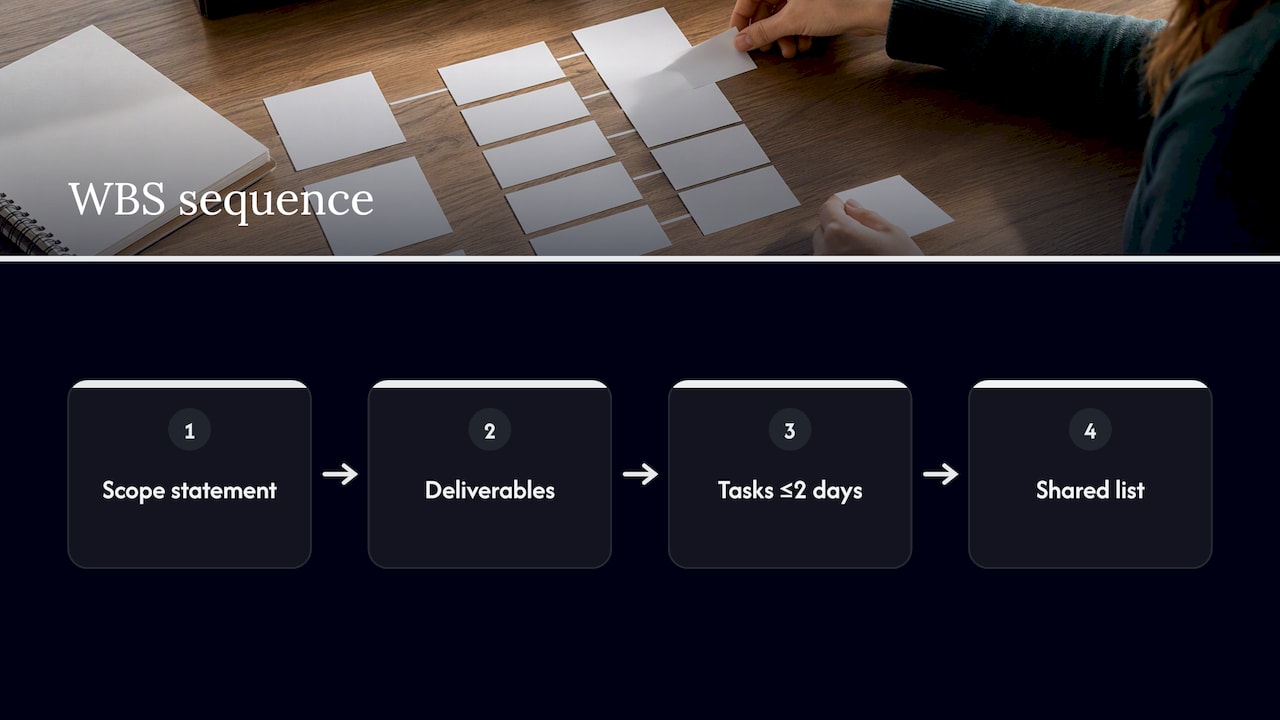
Stakeholdermap’s template asks you to explain how the WBS will be built from the scope statement, including the decomposition technique, applicable standards, and presentation format. That sounds heavy. The student version is: “We will break the project into deliverables, then each deliverable into tasks of two days or less, and keep them in a shared list.” Our guide to a one-page scope and two-level WBS shows how to do this in about ten minutes.
A WBS dictionary is simply a short description for each work package: what it is, who owns it, what “done” looks like.
5. Scope baseline
The baseline is the approved scope statement, WBS, and WBS dictionary. Write one rule: “After approval on [date], the baseline changes only through the change process in section 7.” Store the approved version somewhere nobody edits casually.
6. Verification and acceptance
The PMI Hawaii presentation separates two checks. Verification confirms deliverable quality against project quality standards. Validation confirms deliverables meet requirements and acceptance criteria. It also advises recording acceptance methods, the client name, signature, and date, and reviewing and approving deliverables throughout the lifecycle rather than saving all approval for the end.
In plan form:
- Each deliverable has acceptance criteria written before work starts.
- The reviewer checks quality; the sponsor confirms it meets the need.
- Acceptance is recorded (an email reply counts for a small project).
- Approve milestones as they land, not in one big review.
7. Scope change control
Praxis recommends defining change-control procedures that specify authority levels, change budgets, assessment techniques, and associated communications. Translated for a small team:
| Element | What to write |
|---|---|
| Who can request | Anyone on the team or the sponsor |
| Who decides | Lead for changes under a set size; sponsor above it |
| Size limit | For example, “under four hours of added work and no date impact” |
| Assessment | Effect on time, effort, quality, and other deliverables |
| Communication | Decision logged and shared with the whole team the same day |
The size limit is your “change budget” at small scale. It lets the lead say yes to tiny things without a meeting, and forces a real conversation about large ones.
8. Document control
Stakeholdermap’s template includes project reference, document owner, issue date, version history, and approvals. A four-row table at the top of the page does the job.
A filled-in example: a semester marketing project
Here is the whole plan for a four-person class project, trimmed to the essentials.
Purpose. This plan covers how scope is handled for the Fall go-to-market project for a local coffee roaster.
Roles. Professor: approver. Maya: lead and change-log owner. Devon and Priya: deliverable owners. Sam: reviewer.
Scope definition. The scope statement will be written in week one from the assignment prompt, the rubric, and a call with the roaster.
WBS. Three deliverables (market analysis, campaign plan, final deck), each split into tasks of two days or less, tracked in one shared list.
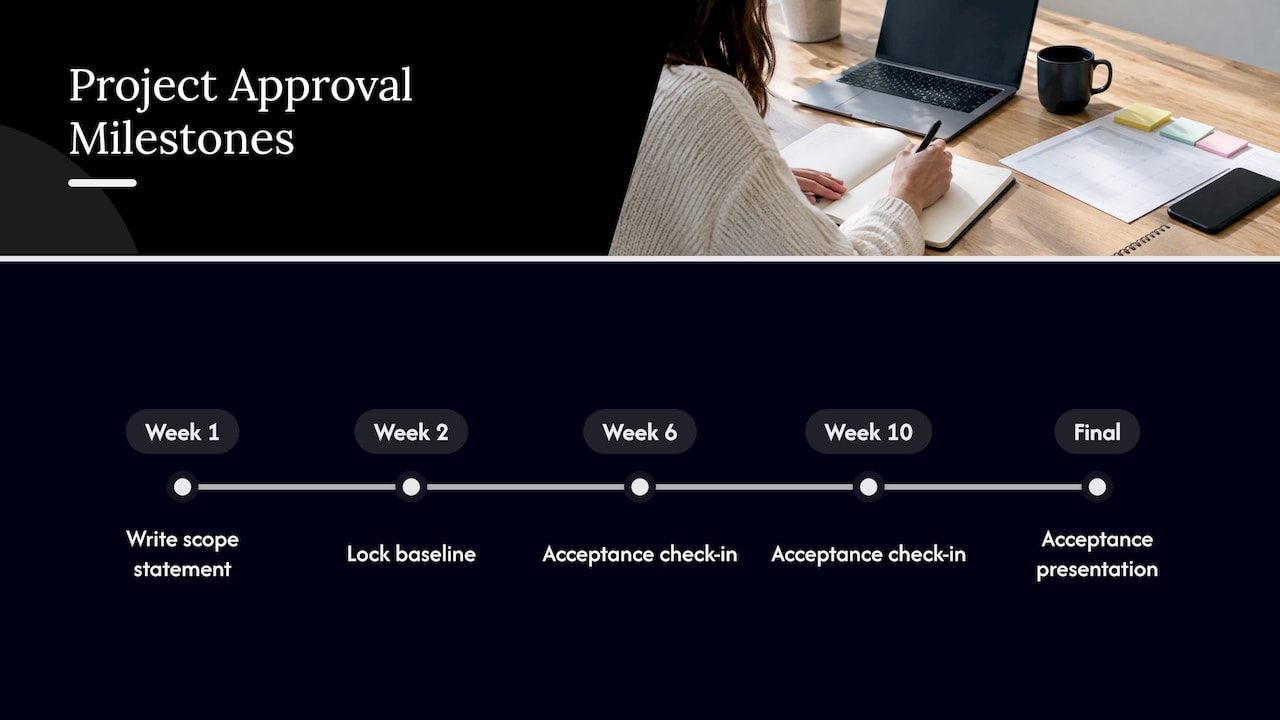
Baseline. Locked after the professor’s approval at the week-two check-in.
Acceptance. Each deliverable has three written criteria. Sam reviews; the professor accepts at the week-six and week-ten check-ins and the final presentation.
Change control. Maya can approve changes under three hours of added work with no date impact. Anything bigger goes to the team, then the professor. Every change goes into the log with date, reason, and decision.
That is under 200 words and answers most of the questions that blow up group projects.
Adapting the template for a class or first job
A corporate template assumes a sponsor, a budget, and a procurement process. You probably have none of those. Here is how to scale it down:
- Merge sections. Combine baseline and change control into one “Locking and changing scope” section.
- Use bullets, not prose. If a section runs past five lines, you are writing for an auditor, not your team.
- Name real people. “The sponsor” becomes “Prof. Alvarez” or “Jordan, our team manager.”
- Replace budgets with hours. Change limits in hours are easier to judge than dollars.
- Review at fixed points. Put a ten-minute scope check on the calendar every other week.
When the project is bigger, for example a multi-phase effort at work, pair the plan with a broader project management plan example or a project implementation plan template.
Our perspective on scope plans
We build Optio for people who do not have a project office: students juggling group work and young professionals handling their first real projects. What we see, and what shaped the app, is that the plan rarely fails because it is missing a section. It fails because nobody looks at it again after week one.
So we favor the shortest version that still names an approver and a change rule. A one-page plan the team reads every Monday beats a twelve-page document that lives in a folder. We also think scope belongs next to the tasks themselves: when the work list and the scope boundary sit in the same place, “is this in scope?” becomes a ten-second check instead of a debate.
You are the Centurion of your own project. The plan is your standing order: simple, written down, and clear about who can change it.
— Optiostation
Turn the plan into daily work
Once your WBS is written, the tasks need a home. Optio is a mobile app for task, team, and time management that lets you organize projects, color-code the parts of your life, set reminders, and sync with Google Calendar, so your work packages show up next to your classes and shifts. You can start from our free five-minute project template and then load your tasks into Optio Station.
If you are managing a team, our guide on how to manage team tasks effectively covers dividing work so owners are clear, and the project timeline template helps you place milestone approvals on the calendar.
Common mistakes to avoid
- Writing the plan after the work starts. By then, scope has already drifted. Write it first, even if it takes thirty minutes.
- Mixing the plan and the statement. Keep process and content separate so you can update one without reopening the other.
- No named approver. Without one, every change becomes a team vote.
- Vague acceptance criteria. “Looks good” is not a criterion. “Includes three competitor comparisons with sources” is.
- Saving approval for the end. Milestone reviews catch misunderstandings while they are cheap to fix.
- No change log. Even a five-column table of date, request, impact, decision, and who decided will protect you.
FAQ
What should a scope management plan template include?
At minimum: an introduction, roles and responsibilities, how scope will be defined, how the WBS will be created, how the baseline is maintained, how deliverables are verified and accepted, and how changes are controlled. Add a document control table with owner, version, and approvals.
What is the difference between a scope management plan and a scope statement?
The plan explains how you will define, control, and verify scope. The scope statement lists what is actually in and out of the project. The approved statement, WBS, and WBS dictionary together form the scope baseline.
How long should a scope management plan be?
It depends on the project. A class project or small team effort works well on one page. Larger, multi-stakeholder projects need more detail on change authority and acceptance, but the same eight headings still apply.
Who writes and approves the plan?
Usually the project lead writes it and the sponsor approves it. On a student team, one member drafts it, everyone reviews it, and the professor or client confirms it before work starts.
Sources
- Scope management plan – Praxis Framework
- Scope Management Plans for Project Management Professionals – Project Management Academy
- Scope Management Plan Template – Stakeholdermap
- 8 Steps to Successfully Planning Scope Management – PMI Hawaii
- Scope management – PMI
