

Work-life balance means managing your work so it does not consistently crowd out the rest of your life, including rest, relationships, and personal goals. It is less about splitting hours evenly and more about protecting your energy and limiting how much job stress spills into everything else. That balance looks different for everyone, which is why chasing a fixed formula usually backfires.
TL;DR:
- Working 55 or more hours weekly significantly increases the risk of stroke and heart disease, with about 488 million people estimated to do so worldwide.
- Many people misunderstand work-life balance by focusing solely on hours, but autonomy, predictability, and job satisfaction influence how manageable long hours feel.
- Effective boundary-setting, like scheduling nonnegotiable commitments and communicating clearly about offline times, can improve personal balance measurably within two weeks.
- Involuntary and unpredictable long hours are linked with higher burnout and health risks, making organizational change more impactful than personal time management alone.
- Monitoring recovery, missed commitments, and energy levels weekly provides reliable signals of whether adjustments are effective or if structural workplace issues persist.
Table of Contents
- Key Takeaways on What Work-Life Balance Really Means
- How Dictionaries and Researchers Define Work-Life Balance
- Why Work-Life Balance Matters for Health and Performance
- What a Healthy Work-Life Balance Actually Looks Like
- Why Imbalance Happens: Hours, Control, and Technology
- Steps That Actually Improve Your Work-Life Balance
- Tracking Whether Your Changes Are Actually Working
- Optiostation’s Guides for Students and Young Professionals
- What to Try First if You’re Short on Time
- Putting the Advice Into Practice With Prioritization Station
- Where This Article’s Claims Come From
- Sources
- FAQ
Key Takeaways on What Work-Life Balance Really Means
Work-life balance is the degree to which your job and your personal life coexist without one consistently draining the other, measured by energy, time, and how often work interferes with things that matter to you. It is not a universal ratio of hours. The benefits are well documented: better focus, fewer burnout symptoms, and steadier relationships at home and at work.
The health stakes are real. Joint estimates from the World Health Organization and International Labour Organization tie working 55 or more hours a week to a higher population-level risk of stroke and ischemic heart disease compared with working 35 to 40 hours.
Two things to try today:
- Write down the three roles or priorities (work, school, relationships, health) you consistently neglect, then pick one to protect this week.
- Block one recurring nonwork commitment on your calendar, like a workout or a call with a friend, and treat it as unmovable.
How Dictionaries and Researchers Define Work-Life Balance
The Cambridge Dictionary defines work-life balance as the amount of time you spend working compared with the time you spend with family and doing things you enjoy. That framing is a useful starting point, but it undersells how subjective the concept actually is.
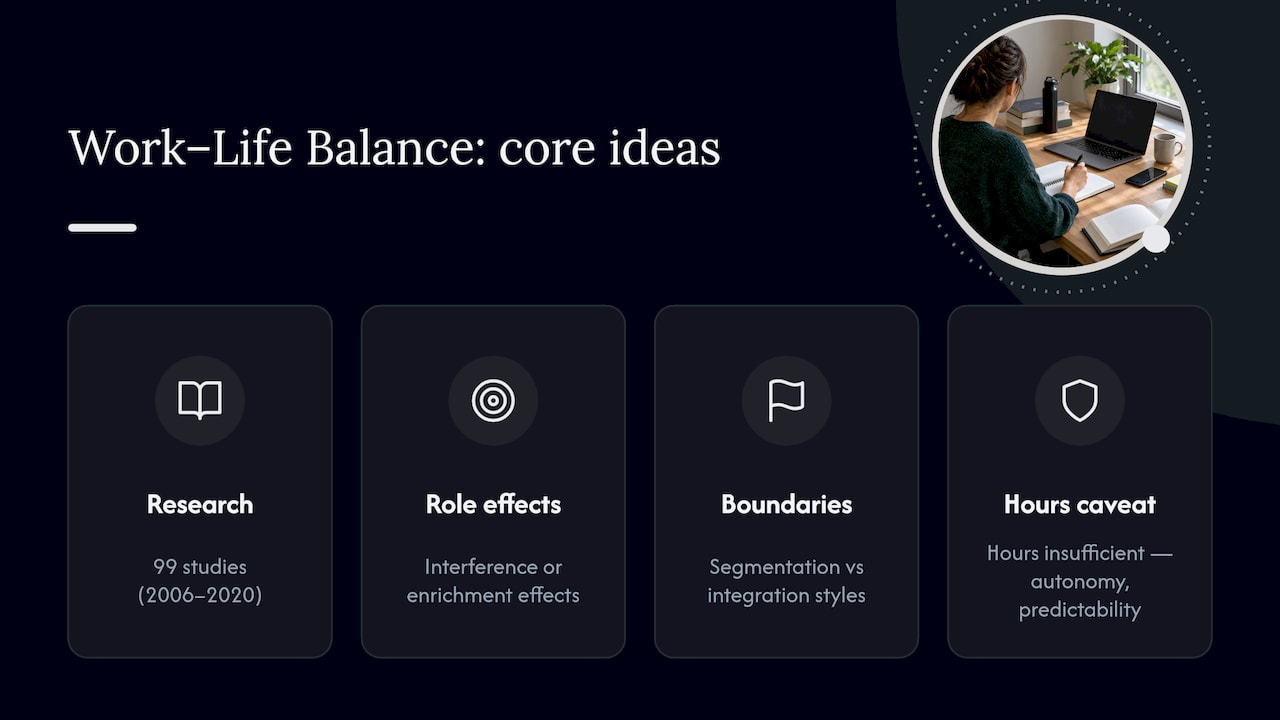
A 2023 scoping review of empirical research examined 99 studies published between 2006 and 2020 and found that researchers measure work-life balance in inconsistent ways: some focus on satisfaction across domains, others on role expectations, and others on the degree of interference between work and nonwork roles. The review recommends treating balance as a subjective, multidimensional construct rather than a single number.
Two academic ideas are worth knowing. The first is role interference versus enrichment: work can either drain your capacity for other roles (interference) or sometimes strengthen them (enrichment), such as when a project teaches a skill you use outside the office. The second is boundary theory, which describes two broad styles of managing the line between work and personal life. Segmentation means keeping work and nonwork strictly separate, with clear start and stop points. Integration means blending them more fluidly, like checking email during a break but leaving early for a family event. Neither style is correct for everyone.
This is also why hours alone are an incomplete metric. Someone working 45 hours a week with full schedule control and high job satisfaction may report better balance than someone working 35 hours with unpredictable shifts and constant interruptions. The number matters less than the context around it, including autonomy, predictability, and whether the hours are voluntary.
Why Work-Life Balance Matters for Health and Performance
Balance affects more than mood. Organizations with employees who report healthy balance tend to see lower burnout, steadier productivity, and better retention, because people who get consistent recovery time make fewer errors and stay in their roles longer.
The health evidence is more specific. The WHO and ILO joint estimates found that in 2016, an estimated 488 million people worked 55 or more hours per week, and that exposure was associated with roughly 745,194 deaths from ischemic heart disease and stroke. That is a population-level association, not a prediction for any one person. Plenty of people work long hours for years without those outcomes, and plenty of people working standard hours still experience high stress. But the pattern is strong enough that public health bodies treat sustained long hours as a structural risk factor rather than a personal quirk.
This matters because individual willpower often cannot offset a job that structurally demands overwork. When long hours are involuntary and ongoing, in other words set by the employer rather than chosen, the research treats them as a workplace hazard, not a motivation problem. That distinction shapes what kind of fix actually works: a to-do list app will not fix a job that requires 60-hour weeks as a baseline, but it can help you document the problem and make better choices about the hours you do control.
What a Healthy Work-Life Balance Actually Looks Like
You can self-assess without a formal test. People with workable balance tend to show a few consistent patterns.
- They recover: energy and mood bounce back after a demanding week instead of staying depleted.
- They meet most of their own priorities, at work and outside it, without constant last-minute scrambling.
- Their stress rises and falls with real demands instead of sitting at a constant high baseline.
Red flags point the other way: chronic fatigue that does not improve with a weekend off, repeatedly missing commitments to friends, family, or yourself, and regular involuntary overtime that you did not plan for and cannot decline. One or two rough weeks during finals or a product launch is not a crisis. A pattern that repeats for months is.
What counts as “good” also shifts with life stage. A student juggling a part-time job and a full course load has different constraints than a young professional two years into a career, and someone supporting a family has different constraints than someone living alone. Our guide on what a good work-life balance looks like for young professionals walks through how those expectations change early in a career.
Why Imbalance Happens: Hours, Control, and Technology
Long hours alone do not predict burnout. What predicts it more reliably is whether those hours are voluntary and whether the schedule is predictable. ILO research on working time found that schedule control and predictability shape how balance is experienced: the same weekly total can feel manageable with autonomy and miserable without it. A freelancer who chooses to work a heavy week to finish a project is in a different position than an employee whose shifts change with no notice.
That same ILO synthesis also links flexible scheduling and predictable hours to better retention and lower absenteeism, which is one reason employers increasingly treat schedule flexibility as a retention tool rather than a perk.
Technology adds a second layer. Phones and laptops erased most of the physical boundary between office and home, so messages, documents, and notifications follow people into evenings and weekends by default. Remote and hybrid work made this sharper: without a commute or a closing time, the workday can quietly stretch until someone actively chooses to end it. Workplace culture compounds the problem when quick replies after hours are treated as normal or even rewarded. None of this means technology or remote work is inherently bad for balance. It means the boundaries that used to be automatic now have to be set on purpose.
Steps That Actually Improve Your Work-Life Balance
Start with what you control personally, then move to what requires a conversation at work.
- Map your priorities. List your top four or five roles (student, employee, partner, friend, your own health) and rate how neglected each one feels right now.
- Time-block the nonnegotiables first. Put sleep, exercise, and one social or personal commitment on the calendar before you schedule work tasks around them.
- Set boundary language and use it. A simple line like “I’m offline after 7 PM, but I’ll respond first thing tomorrow” works better than vague intentions.
- Review weekly. Spend ten minutes each week checking what got crowded out and adjust the following week’s blocks.
Pro Tip: Treat boundary-setting as a skill you practice, not a personality trait you either have or don’t.
Workplace steps take more coordination but matter more when the problem is structural. Request flexible scheduling where your role allows it, especially if predictability, not just total hours, is your real issue. Clarify deliverables with your manager so “urgent” stops meaning everything, and document workload concerns in writing over a few weeks rather than raising them as a one-off complaint. If a full fix is not possible immediately, propose a phased change, like shifting one recurring meeting or reducing after-hours response expectations for a trial month.
A short script for that conversation: “I want to flag that my current workload has meant working past 7 PM most nights for the last three weeks. Can we look at what’s driving that and whether anything can shift, even on a trial basis?” That framing puts the focus on the pattern, not on blame, and gives the manager something concrete to respond to.
Know the limits of self-management too. A systematic review on work-life balance support found that individual time-management habits are necessary but often not enough on their own: sustainable change frequently requires workload renegotiation, clearer boundaries set at the manager level, or broader policy changes. If you have tried personal adjustments for a few weeks and the pressure has not eased, that is a sign to raise it with your employer or, if your health is affected, with a medical professional. Students carrying a heavy course load alongside work can find more scheduling tactics in a guide to managing an overloaded semester.
Tracking Whether Your Changes Are Actually Working
Guessing whether your balance is improving is unreliable. A short weekly check gives you real signal. Track three things: how many hours of genuine recovery you got (sleep, downtime, anything that isn’t a task), how many commitments you missed or had to cancel, and a quick 1 to 10 rating of your energy and satisfaction at week’s end.
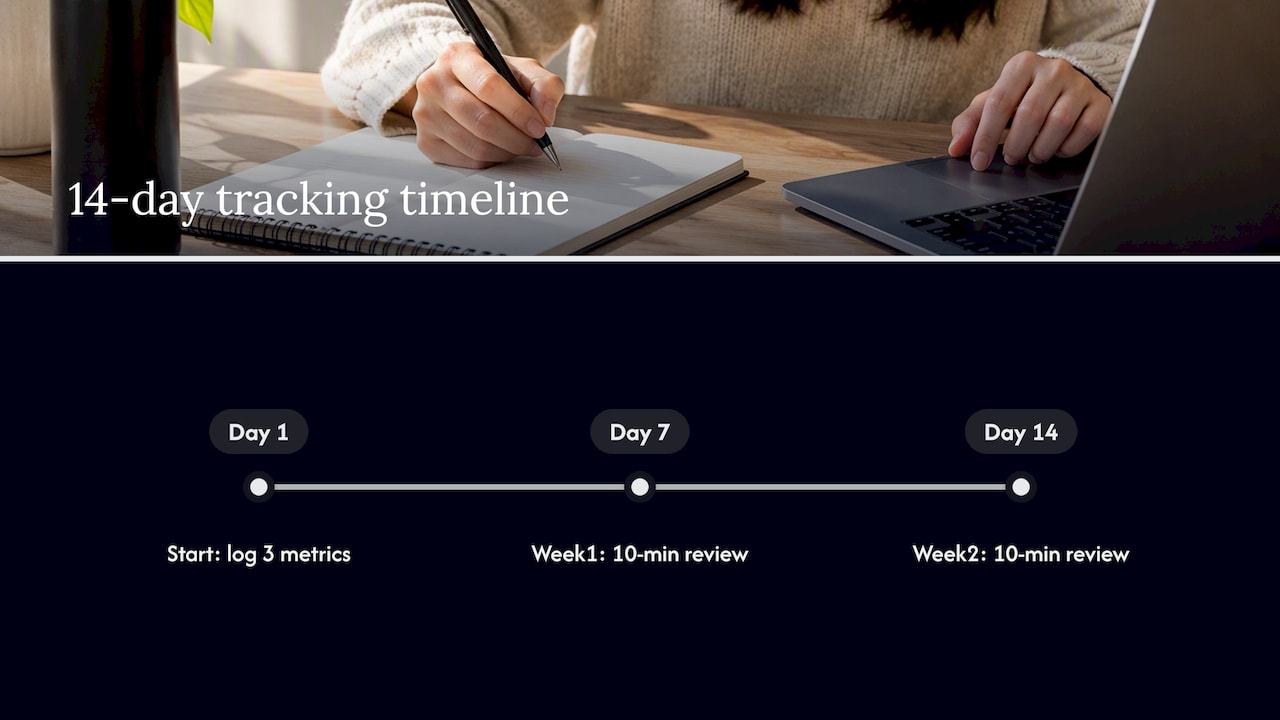
A simple time log for one or two weeks often reveals where hours actually go, which is usually different from where people assume they go. Pair that with a ten-minute weekly review: what worked, what got crowded out, and one adjustment for next week.
Tools help here more than willpower does. Time trackers show you patterns, calendar blockers protect nonwork priorities from getting overwritten by new meetings, and reminders catch boundary slips before they become a habit. This is the gap some productivity apps aim to close for students and young professionals: a single app for tasks, time tracking, and calendar sync instead of juggling three separate habits that are easy to drop when a week gets busy.
Optiostation’s Guides for Students and Young Professionals
Some productivity brands write from direct experience building tools for students and early-career professionals balancing coursework, jobs, and everything else; their guides focus on that audience rather than workplace advice aimed at managers or executives.
For deeper, step-by-step implementation, the step-by-step guide to work-life balance for students covers scheduling tactics suited to academic terms, and the guide to work-life balance in the workplace for young professionals walks through advocacy conversations with managers in more detail than fits here. Readers who want one consolidated resource can also check the complete guide to work-life balance for templates that pair with the weekly review habit described above.
What to Try First if You’re Short on Time
If you only do one thing this month, pick a two-week trial: block three nonwork commitments on your calendar as unmovable, and track missed commitments and energy at the end of each week. Two weeks is long enough to see a pattern and short enough that it doesn’t feel like a permanent overhaul.
Expect the first attempt to be imperfect. Most people underestimate how often work will try to reclaim that blocked time, and the fix is usually smaller boundaries repeated consistently, not one dramatic change. Balance built from personal tactics alone also has a ceiling. If your workload is the actual problem, no amount of time-blocking will fix a job that structurally requires 60-hour weeks, so pair personal changes with an honest conversation at work once you have a few weeks of evidence behind you.
— Optiostation
Putting the Advice Into Practice With Prioritization Station
Most of the steps above (priority mapping, time-blocking, weekly reviews) are easier with one tool instead of three apps that don’t talk to each other. Optiostation’s Prioritization Station was built for students and young professionals juggling coursework, jobs, and a personal life, with color-coded life aspects so work, school, and personal commitments stay visually distinct instead of blending into one overwhelming list.
Inside the app, time-blocking and smart reminders can support boundary habits described earlier, while features like hashtag-based search and calendar integration can help make weekly reviews easier by keeping information in one place. If you’re ready to put a structure around the two-week trial described above, check out Prioritization Station and start mapping your priorities today.
Where This Article’s Claims Come From
The health and workplace claims above come from named research and public health sources, not general impressions.
- WHO/ILO joint estimates on long working hours link 55-plus hour workweeks to higher stroke and heart disease risk at the population level.
- The Cambridge Dictionary provides the baseline definition of work-life balance.
- The 2023 MDPI scoping review surveys how researchers measure work-life balance across 99 empirical studies.
- ILO research on working time explains how schedule control and predictability shape experienced balance.
Sources
- Cambridge Dictionary — work-life balance
- Seeing the forest and the trees: A scoping review of empirical research on work–life balance (2023)
- Global burdens of ischemic heart disease and stroke attributable to long working hours (WHO/ILO joint estimates, PMC)
- Working time and work‑life balance around the world (ILO)
FAQ
What is work-life balance in simple terms?
Work-life balance is how well your job and the rest of your life coexist without one consistently draining the other, measured in energy and attention rather than a strict hour split. The Cambridge Dictionary frames it as the relationship between time spent working and time spent on family, interests, and personal life.
Is there an ideal number of hours for work-life balance?
No single hour count defines good balance, since schedule control, predictability, and whether hours are chosen or forced matter as much as the total. Research instead flags sustained very long hours, specifically 55 or more per week, as a health risk factor rather than a number to avoid for its own sake.
How can I improve my work-life balance as a student?
Start by blocking nonwork priorities like sleep and one social commitment on your calendar before scheduling study or work around them, then review weekly to see what got crowded out. A step-by-step student guide walks through this process in more detail.
Does remote work make work-life balance better or worse?
Remote work can improve balance by removing commute time, but it often blurs boundaries further since there is no fixed start or end to the workday without deliberate limits. Setting explicit offline hours and using boundary reminders helps counter that effect.
What are signs that my work-life balance is unhealthy?
Chronic fatigue that doesn’t improve with rest, regularly missed personal commitments, and frequent involuntary overtime are the clearest warning signs. A rough week during a busy period is normal, but a pattern that persists for months points to a structural problem worth addressing directly.
