

Your goals are the long-term, meaningful targets you choose that guide years of decisions, and they only work when they’re specific enough to act on this week. Start by naming the one value you care most about right now, whether it’s health, craft, or connection, and write a single sentence describing where that value points you in five years. Then pick one micro-action you can finish today. That’s the whole method, everything else in this article just helps you do it well.
TL;DR:
- Most people neglect to define a specific goal, which is necessary to measure progress and stay focused despite multiple appealing options.
- Challenging, well-defined goals directly influence decision-making and help develop skills beyond the immediate target.
- Using a structured process like a Life Areas Map and Three Futures exercise can clarify your highest-gap target and the destination you truly want.
- Breaking down a long-term goal into smaller, measurable weekly actions and planning for obstacles increases the likelihood of consistency and success.
- Regular weekly reviews and adjusting based on progress and setbacks are crucial for maintaining momentum and re-aligning your efforts.
Table of Contents
- What Are My Goals, Really?
- Why Setting Goals Actually Changes Outcomes
- How Do I Find My Goals?
- Turning a Goal Into SMART Terms
- Building an Outcome Map and Friction Map
- Goal Examples Across Life Areas
- What Usually Derails a Goal (and How to Plan Around It)
- Keeping the Goal Alive Week to Week
- Resources That Support This Method
- Why Focus Beats Ambition
- Optiostation: Running Your Goal Cascade Day to Day
- Sources
- FAQ
What Are My Goals, Really?
A goal is a long-term, meaningful target that requires deliberate action and has a definable endpoint. That’s the working definition Positivepsychology when describing what separates a real goal from everything else cluttering your to-do list, and it’s worth sitting with for a second, because most people never actually define the term before chasing it.
A goal is not a wish. “I want to be happier” is a wish. It has no action attached and no way to know when you’ve arrived. A goal is not a task either. “Send the report by Friday” is a task, useful, finite, but it doesn’t point anywhere beyond itself. Goals sit above both: they’re the destination that tasks and habits eventually serve.
Here’s the distinction broken down:
- Wishes describe a feeling you want, with no mechanism for getting there (“I want to feel confident”).
- Tasks are one-time, short-term actions with no larger direction attached (“finish the lab report”).
- Habits are repeated behaviors that may or may not connect to anything bigger (“go to the gym on Mondays”).
- Goals are specific, challenging, and tied to a timeframe, with tasks and habits feeding into them.
That specificity matters more than most people assume. Goal setting theory, developed by researchers Locke and Latham, found that specific, challenging goals consistently produce better performance than vague intentions like “do your best.” Vague framing gives you no target to measure against, so effort tends to drift. A goal like “run a 10K by June” gives your brain something concrete to organize around. That’s the difference between a life goal and a life aspiration: one has an endpoint you can name, the other doesn’t.
Why Setting Goals Actually Changes Outcomes
Goals do two things well: they focus your attention, and they filter your decisions. When you know your Summit Goal is financial independence by 40, a job offer with better pay but worse hours becomes an easier call. Without that target, every decision gets weighed in isolation, which is exhausting and slow.
The Locke and Latham research also found that goal difficulty correlates with performance, up to a point, challenging goals push people to develop new strategies and skills they wouldn’t have needed for an easier target. That’s the part people miss: the value of a goal isn’t only the finish line. It’s the capability you build getting there. Someone training for a marathon gains discipline and injury awareness that outlasts the race itself.
There’s also a prioritization effect. Life throws dozens of “good” options at you weekly. Without a stated goal, you say yes to most of them, and end up busy but directionless. With one, you have a filter. That filter is the whole point of picking a single meaningful target instead of drifting between five.
How Do I Find My Goals?
Most people freeze at this stage. They know they should have goals, but staring at a blank page produces nothing. Three tools fix that: a Life Areas Map, a values-first gap calculation, and an exercise called Three Futures.
- List your life areas. Health, career, relationships, finances, learning, contribution, creativity, and environment cover most of it. Write all eight down.
- Rate each one twice, on a 1 to 10 scale: how satisfied are you right now, and how important is this area to you. Do this fast. Overthinking here defeats the purpose.
- Calculate the gap. Subtract satisfaction from importance for each area. A high importance score paired with a low satisfaction score is your highest-leverage target. An area rated 9 on importance and 3 on satisfaction has a gap of 6, that’s usually your answer.
- Run Three Futures. Picture your life in five years under three scenarios: you kept drifting with no change, you doubled down on your current path, and you made one deliberate pivot toward the highest-gap area. Write two sentences for each. The pivot scenario almost always reveals your real goal, because you can feel which future actually excites you versus which one just sounds responsible.
- Write your Summit Goal. One sentence, five to ten years out, naming a destination. Something like: “By 2033, I run a design studio that only takes projects I’m proud of.”
If you’ve run this exercise more than once and keep landing on the same vague area without a clear target, a formal option exists. The Assessment of Personal Goals, developed at George Mason University, measures 24 universal goal themes and produces a personal goal profile tied to your core motives. It’s not necessary for most people, but if you’re stuck in a loop, it’s a legitimate next step rather than guessing again.
Pro Tip: Do the Life Areas Map with a timer set for five-minute.
Turning a Goal Into SMART Terms
Order matters here, and most advice gets it backward. The SMART framework, Specific, Measurable, Attainable, Relevant, Time-bound, is the standard structure for writing goals, but Psychology Today’s guidance on goal setting is clear that SMART works as a formatting tool, not a discovery tool. Pick the goal based on your values first. SMART it second. Running SMART criteria over a goal you don’t actually care about just produces a well-organized goal you’ll abandon by March.
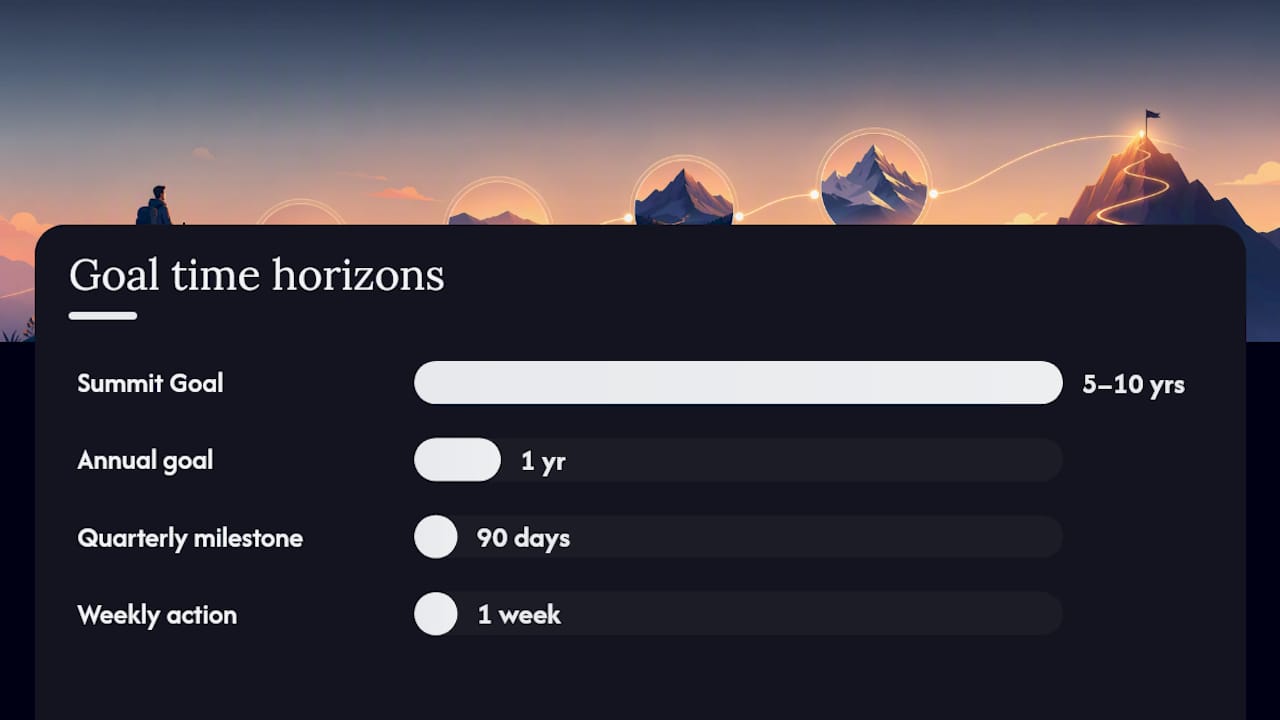
Once you have your Summit Goal, the Goal Cascade breaks it into smaller pieces:
- Summit Goal: the five to ten year destination, one sentence.
- Annual goal: what needs to be true by the end of this year to stay on track.
- Quarterly milestone: a checkpoint you can hit in 90 days.
- Weekly action: the actual behavior you repeat, the only layer that touches your calendar.
The weekly layer is where most goal-setting attempts die, because people set the Summit Goal and skip straight to hoping. Cascade it instead. If the Summit Goal is running that design studio, the weekly action might be “pitch one dream client per week,” something small enough to survive a bad week.
Write two or three success measures for your goal, observable signals that tell you whether you’re actually moving. Not feelings, actual signals: “portfolio has three paid projects,” “monthly recurring revenue over $2,000,” “client list includes two referrals.” Vague goals produce vague measures. Specific goals produce measures you can check off without arguing with yourself about whether they count.
Building an Outcome Map and Friction Map
A Summit Goal without a plan is just a nice sentence. The next step is turning it into something you can execute this week, and the Psychology structures this well: define what you want, define why it matters, name the obstacles, and pick a next step. That four-part structure is the backbone of what follows.
- Build the Outcome Map. Write exactly what success looks like in concrete terms, then list your two or three success measures from the previous section. If you can’t picture the outcome specifically, you’re not ready to plan around it yet, go back and sharpen the Summit Goal first.
- Build the Friction Map. List the three most likely reasons this goal stalls. Be honest: “I lose motivation after week two,” “my schedule gets eaten by group projects,” “I don’t know who to ask for help.” For each one, write an if-then response: “If I miss a Monday session, then I do a 10-minute version Tuesday morning instead of skipping the week.”
- Pick your micro-action. The smallest version of progress you can complete today. Not this week, today. If your goal is fitness-related, the micro-action might be “put running shoes by the door,” not “run five miles.”
- Design a Lazy Day version. A stripped-down version of the habit for days when you have nothing left. A 20-minute study session becomes a five-minute flashcard review. This isn’t giving up, it’s what keeps the habit alive through a bad week instead of resetting to zero.
- Schedule it within 48 hours. Put the micro-action on your calendar now, not “soon.” A goal without a scheduled first action is still a wish.
Pro Tip: Write your if-then plans while you’re calm, not when you’re already stalled. Research on anticipating setbacks shows that planning your response in advance, rather than improvising in the moment, makes you far more likely to actually follow through when things get hard.
This two-part structure, Outcome Map plus Friction Map, is what separates a goal that survives contact with a busy semester from one that quietly disappears by February.
Goal Examples Across Life Areas
Seeing a goal fully worked out, from area to weekly habit, makes the abstract version click. Pick one of these as a starting template and adjust the specifics, don’t try to run all eight at once.
| Life Area | Summit Goal Sentence | Success Signal | Weekly Habit |
|---|---|---|---|
| Career | Land a full-time role in UX design | Portfolio has 4 case studies; 3 interviews completed | Apply to 2 roles, refine 1 case study |
| Health | Run a half marathon by next fall | Complete a 10-mile training run without stopping | 3 runs per week, one long run |
| Financial | Save $5,000 for an emergency fund in 12 months | Balance grows by roughly $420 per month | Automate a transfer, review spending every Sunday |
| Relationships | Rebuild a closer relationship with my sibling | Two real conversations per month, not just texts | One phone call scheduled weekly |
| Learning | Reach conversational fluency in Spanish in 2 years | Hold a 10 minute unscripted conversation | 20 minutes of practice, 5 days a week |
| Contribution | Volunteer consistently with a local mentoring program | Complete 6 months without missing a session | Attend one session, prep materials |
| Creativity | Finish a full short story collection | Draft several stories, revise a few | Write words regularly each week |
| Academic | Graduate with a strong GPA | Maintain a B+ average across core courses | Weekly study block per class |
Use this worksheet structure to build your own: name your top value, write your Summit Goal sentence, list two success measures, sketch a Friction Map with two likely obstacles, and name one action to schedule in the next 48 hours. Optiostation’s academic goal setting guide walks through a similar structure if you want a version built specifically around a school schedule.
What Usually Derails a Goal (and How to Plan Around It)
Most goals don’t fail from lack of ambition. They fail at predictable friction points, and the fix is almost always to name the obstacle before it happens, not after.
- Decision fatigue wears down willpower over the course of a day, so goal-related habits scheduled for 9 PM are far more fragile than ones scheduled in the morning. Research on decision fatigue suggests automating the choice, same time, same trigger, removes the moment where willpower would need to show up at all.
- Motivation dips hit hardest around week three, right after the initial novelty fades and before the habit feels automatic. If-then plan: “If I don’t feel like it on day 15, then I do the Lazy Day version instead of skipping.”
- Overambitious goals collapse under their own weight in the first month. If-then plan: “If I miss three days in a row, then I cut the target in half rather than quitting.”
- Competing priorities from school or work crowd out the goal entirely during busy weeks. If-then plan: “If midterms or a deadline hits, then I protect only the micro-action, not the full habit.”
Planning your response while calm, rather than mid-crisis, is what makes the if-then approach work. You’re not relying on willpower in the moment, you’re just executing a decision you already made.
Keeping the Goal Alive Week to Week
A Goal Cascade without a review rhythm decays fast. The fix doesn’t need to be elaborate: a five minute check-in, fixed at the same time every week, works better than an occasional deep reflection. That consistency is what turns planning into a habit rather than a special event, something Goals & Progress emphasizes in its Goal Cascade guidance.
Three questions cover it:
- What actually moved me forward this week, even a little?
- Where did friction show up, and did my if-then plan work, or does it need adjusting?
- What’s the one next thing for next week?
Your success measures from the Outcome Map tell you when to adjust. If a measure hasn’t moved in three straight weeks, that’s a signal, either the habit is wrong for the goal, or the goal itself needs reframing. Not every stall means quit; sometimes it means the weekly action was too ambitious and needs to shrink.
Beyond the weekly check-in, set two bigger checkpoints: a quarterly review to see if the milestone still makes sense, and an annual review to ask whether the Summit Goal itself still fits who you are. Goals you wrote two years ago don’t automatically deserve your loyalty today.
Resources That Support This Method
Some productivity apps provide guides that align with these steps, so once you’ve done the harder thinking, you don’t have to rebuild the structure from scratch. The SMART goals guide for students and professionals covers formatting once you’ve already picked your values-based target. Examples of SMART goals gives you more worked templates beyond the eight life areas above. For the weekly review habit, why reflect on goals breaks down the five minute rhythm in more depth. Students juggling group work alongside personal goals may also find Babylovegrowth’s blog example templates useful for structuring related coursework or side projects around the same discovery process.
Why Focus Beats Ambition
Most people set three, four, sometimes six goals at once, then abandon all of them by March because none got enough attention to build momentum. One or two focus areas per year is plenty. If a second goal genuinely matters, give it a floor, a minimum weekly action, but let the first one take the real energy.
When goals conflict, sequence them instead of splitting your attention evenly. And if you’re not sure a goal is even right for you yet, treat it as a four to six week experiment rather than a lifetime commitment. That removes the pressure of getting it perfect on the first try, which is usually what stops people from starting at all.
— Optiostation
Optiostation: Running Your Goal Cascade Day to Day
Certain apps are designed to bridge the gap between writing a Summit Goal on paper and actually cascading it into weekly action. They organize tasks by color-coded life areas, so fitness goals and academic goals don’t blur into one undifferentiated list, and use smart reminders to help keep weekly habits visible during busy periods.

This indie-built app uses a Roman theme, positioning the user as the decision-maker, with the app acting as a second-in-command handling the tracking so you can focus on the doing. If the Goal Cascade structure in this article resonated, the academic goal setting guide and the weekly reflection guide both build directly on it. Set up your first color-coded life area and schedule this week’s micro-action on the Prioritization Station landing page, it takes less time than the Life Areas Map exercise did.
Sources
FAQ
What Are Examples of Personal Goals?
Personal goals span health, career, financial, relationship, and learning areas, things like running a half marathon, saving a specific dollar amount, or reaching conversational fluency in a language. The strongest examples pair a specific outcome with a measurable signal, like “save $5,000 in 12 months” rather than “get better with money.”
What’s the Difference Between a Goal and a Wish?
A goal has a definable endpoint and requires deliberate, ongoing action, while a wish describes a feeling with no plan attached. PositivePsychology.com’s framework draws this line clearly: “I want to feel successful” is a wish, “launch my own studio by 2033” is a goal.
How Do I Figure Out What My Goals Should Be?
Start with a Life Areas Map: rate your satisfaction and importance across areas like health, career, and relationships, then find the biggest gap between the two. That gap usually points to your highest-leverage goal, and the Three Futures exercise helps confirm it by showing which future direction actually excites you.
How Many Goals Should I Set at Once?
One or two focus areas per year tends to work better than juggling several, since attention and habit-building time are limited. If a second goal matters, give it a minimal weekly floor rather than splitting your energy evenly across both.
Does Optiostation Help With Tracking Personal Goals?
Optiostation organizes tasks by color-coded life areas and uses smart reminders to keep weekly habits from slipping during busy stretches. Current pricing and feature details are available on the Optiostation site.
