

Teamwork gets built through five concrete levers: a shared purpose everyone can name, roles clear enough that no one guesses, communication norms that survive a bad week, psychological safety that lets people disagree out loud, and routines that turn intentions into habits. Start this week with three moves: draft a one-page team charter, put a monthly check-in on the calendar, and run a 45-minute session to set team norms together. Managers drive a large share of team engagement on their own, according to Gallup. So these levers work best when a manager owns them rather than delegating them to a slide deck. A tool like a team collaboration app can help track the routines once you’ve picked them.
TL;DR:
- Focusing on defining a clear team purpose and measurable goals prevents ambiguity and provides a foundation for all other teamwork routines.
- Regularly scheduled check-ins, including weekly quick connects and monthly reviews, are crucial for sustaining team alignment over six to twelve months.
- Writing a concise, co-created one-page team charter and revisiting it at key moments ensures shared understanding and commitment.
- Clear role statements with specific ownership and “Bring” and “Need” descriptions reduce delays and clarify responsibilities for faster progress.
- A structured communication norms document and tracking behavioral metrics like meeting outcomes and response times enable ongoing coaching and tangible teamwork improvement.
Table of Contents
- How Do You Build Teamwork in the Workplace Starting This Week?
- How Do You Define Roles So Nobody Waits on Someone Else?
- What Communication Norms Actually Prevent Miscommunication?
- How Do You Build Psychological Safety on a Team?
- What Meeting Cadence Actually Sticks?
- How Do You Write a One-Page Team Charter?
- What Should You Actually Measure to Know Teamwork Is Improving?
- Optiostation Resources for Running These Routines
- A Manager’s Honest Take on What Actually Changes
- A Simpler Way to Run the Routines You Just Read About
- Primary Sources and Further Reading
- Sources
- FAQ
How Do You Build Teamwork in the Workplace Starting This Week?
You don’t need a retreat or a new org chart to move the needle on teamwork. You need a short list of things done in order, starting with the one thing every dysfunctional team is missing: a shared answer to “what are we actually here to do?”
Here’s the sequence that works, roughly in the order to tackle it.
Define one purpose and 1 to 3 measurable goals. A team without a stated purpose defaults to whatever’s loudest that week. Write one sentence that says what the team exists to produce, then attach up to three goals you can actually measure, not aspirations like “improve collaboration.” If the goal can’t be checked off or scored, rewrite it.
Co-create a one-page charter in a single sitting. Block 30 to 60 minutes, put the whole team in a room (or a call), and draft the charter together instead of handing down a finished version. This isn’t a nicety. People commit harder to rules they helped write, a pattern researchers call the IKEA effect, and a charter built in isolation by a manager gets ignored within a month.
Clarify roles with “Bring” and “Need” statements. Instead of a vague job description, have each person state what they bring to the team and what they need from others to do it well. Pair that with lightweight ownership tags on shared work (a name next to a task beats a paragraph of process).
Write down communication norms and actually revisit them. Decide which channel is for what, and set a rough response expectation for each. Then when someone gets frustrated waiting three days for a chat reply, you have a norm to point to and adjust instead of an argument about intent.
Redesign your meetings around four things: outcome, timebox, owner, and a follow-up action assigned to a name. A meeting without a stated outcome is a status update pretending to be a discussion. Cut it or fix it.
Set your rhythm and don’t skip it. Monthly working check-ins for priorities and progress, weekly quick connects for relationship and blockers, and a six-month review for the bigger picture. Gallup recommends check-ins at least monthly, paired with informal quick connects to keep people aligned between the big meetings.
Recognize collaborative behavior specifically, not just results. A generic “great job team” lands nowhere. Naming the specific behavior, like someone flagging a risk early or pulling in a teammate on a hard problem, tells the team what to repeat.
Pair complementary strengths on complex work. Gallup’s research on strengths-based teams shows that making individual strengths visible and pairing people around gaps reduces friction on cross-functional tasks. Someone strong on execution paired with someone strong on ideation moves faster than two people with the same instincts.
Expect this to take months, not a week, and plan for it. Teamwork improvement follows a practice curve, not a light switch. Skill transfer research on high-performing teams finds that spaced practice over 6 to 12 months with supervisor involvement produces more durable change than a single workshop, no matter how good the workshop was.
Pro Tip: Run small experiments instead of one big overhaul. Pick one norm, one meeting format, or one recognition ritual, try it for two weeks, and ask the team what to keep or cut. Small PDSA-style cycles (Plan, Do, Study, Act) surface what actually works for your specific team faster than a comprehensive rollout that nobody had a say in.
Notice what’s missing from this list: nothing here requires a budget, an offsite, or executive sign-off. It requires a manager willing to spend a couple of hours setting structure instead of hoping teamwork emerges on its own.
How Do You Define Roles So Nobody Waits on Someone Else?
Ambiguity is the quiet killer of team speed. Not conflict, not personality clashes, just nobody being sure who’s supposed to move first. Fixing that starts with how you write roles down.
A useful role statement answers four questions in one or two sentences: who owns this, what specifically they’re delivering, by when, and what “done” looks like. Compare “Maria handles onboarding” to “Maria owns new-client onboarding, delivers a completed setup checklist within five business days of contract signature, and done means the client has logged into the platform at least once.” The second version can’t be argued about. The first one generates a Slack thread every time something slips.
- Write role statements at the task or workflow level, not just the job-title level. A job title tells you someone’s scope; it doesn’t tell you who owns the Tuesday report.
- Use RACI (Responsible, Accountable, Consulted, Informed) when a task touches four or more people or crosses departments, where the risk of double ownership or silent gaps is real.
- Use lightweight ownership tags, just a name attached to a task in your project tool, when the work is simpler and a full RACI grid would be overkill for a five-person team.
- Revisit ownership whenever a team member leaves, a project scope changes, or the same task gets stuck for a second time.
The “Bring” and “Need” format works particularly well in planning sessions and retrospectives, where roles tend to blur. Each person states what they bring to a given effort (a skill, a relationship, a piece of context) and what they need from the team to execute well (a decision, a resource, a deadline held). Run this at the start of a project and again at each retro; it catches the moment someone’s role has quietly expanded past what they signed up for.
Matching tasks to strengths is the last piece, and it’s where a lot of teams under-invest. Pairing someone strong on structure and process with someone strong on generating options isn’t just a nice balance; it’s often the difference between a plan that sounds great and one that ships. Ask each person to name one thing they do better than most people on the team, and use those answers when you’re assigning the next hard project, not just the easy ones.

What Communication Norms Actually Prevent Miscommunication?
Most communication breakdowns aren’t personality problems. They’re structure problems. Atlassian’s research on team communication finds that the real fix is diagnosing exactly where information stops flowing and documenting the decision, rather than assuming people need a training session on “being clearer.”
The fix is a short, living document your team can point to instead of arguing memory against memory. Call it a rules-of-the-road doc if you want, but keep it to one page with three parts:
- Channel purpose. What goes in chat versus a shared doc versus a call. A rule like “decisions get written down, chat is for quick questions” prevents the classic problem of a real decision getting buried in a scrolling thread.
- Response expectations. Not rigid SLAs, just shared expectations, like same-day for chat, 48 hours for async document comments, and immediate for anything flagged urgent in a specific channel.
- A decision log. One running list of what was decided, when, and by whom. This alone eliminates half the “wait, did we agree to that?” conversations that eat up meeting time.
Statistic Callout: Structural fixes, not personality fixes, close most communication gaps. Atlassian points to missing structure, undefined channels, undocumented decisions, as the root cause behind most recurring miscommunication, and recommends targeted fixes over blanket training.
On tools, keep it simple: your team needs one searchable source of truth for decisions and project status, not five overlapping ones. If your team’s history lives across four different chat threads and nobody’s notes, you don’t have a communication problem so much as a findability problem. A short recorded video update (Loom-style) can also beat a long written status update when the context is visual or hard to summarize in text; use it sparingly, not as your default.
Meeting notes deserve the same discipline as decisions. If a meeting produces an action item, write down who owns it and by when before the meeting ends, and put it somewhere searchable, not in someone’s memory or a private notebook. A shared source of truth for tasks and communication makes this easier to sustain past the first enthusiastic week.
How Do You Build Psychological Safety on a Team?
Psychological safety isn’t a soft add-on. Google’s internal research project on team effectiveness, known as Project Aristotle, found it to be the single strongest predictor of whether a team performs well, ahead of who’s on the team or how skilled any individual member is.
Building it starts with the manager, not a values poster. A leader who admits a mistake out loud, asks for feedback on their own decisions, and debriefs openly after something goes wrong teaches the team that vulnerability doesn’t get punished. Teams copy what leaders model far more than what they announce.
- Ask for feedback on your own decisions in front of the team, not just privately. It signals the norm applies to you too.
- Use a “speak first” rule in tense discussions: have the most junior or quietest person share their view before the most senior person weighs in, so the room’s opinion doesn’t calcify before everyone’s spoken.
- Watch airtime distribution in meetings. If two people are doing 80% of the talking, that’s not a safety problem yet, but it becomes one if it continues for months.
- Debrief openly after a miss, focused on what the process missed, not who to blame.
Conflict deserves its own structure rather than being treated as something to avoid. One useful model pairs a structured “boxing ring,” a scheduled, bounded space for people to argue positions directly, with a “campfire” afterward, a deliberate moment to reconnect and confirm the relationship is intact. Research on team spirit backs this two-part approach: structured debate followed by intentional reconnection prevents disagreement from curdling into lingering resentment, while still letting real disagreement surface instead of getting smoothed over.
Recognition rituals reinforce the whole system. Small, specific acknowledgments, calling out someone who raised a hard question in a meeting, or someone who admitted they were wrong about an estimate, tell the team that risk-taking gets rewarded rather than quietly punished.
Pro Tip: Track who talks in your next three team meetings, roughly. If one or two voices dominate every time, psychological safety isn’t broken, but it’s untested for everyone else in the room. Fix it with a speak-first rule before it becomes a real trust problem.
What Meeting Cadence Actually Sticks?
A charter and a set of norms are worth nothing if the team never revisits them. That’s where cadence comes in, and it’s where most teamwork efforts quietly die: the kickoff was great, the follow-through wasn’t.
Here’s a sequence that holds up over time:
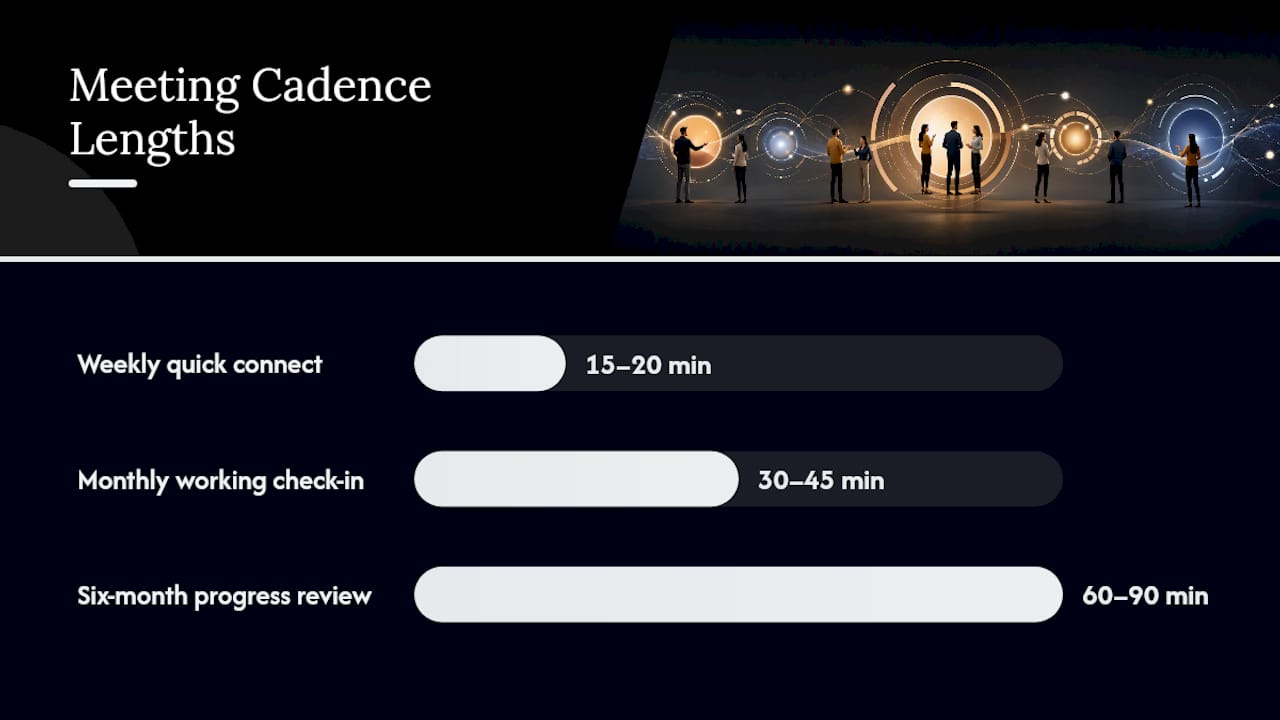
- Weekly quick connects, 15 to 20 minutes, focused on relationship and blockers. Not a status meeting. The question is “what’s in your way” and “how are you doing,” not “what did you finish.”
- Monthly working check-ins, 30 to 45 minutes, focused on priorities and planning. Gallup’s research on high-performing teams treats monthly as the minimum viable cadence for keeping a team’s priorities genuinely aligned rather than assumed aligned.
- Six-month progress reviews, a longer session that steps back from weekly noise to ask whether the team’s actual output matches its stated purpose, and whether the charter still fits.
| Cadence | Length | Purpose | Owner |
|---|---|---|---|
| Weekly quick connect | 15 to 20 minutes | Relationship, blockers, informal alignment | Manager or rotating lead |
| Monthly working check-in | 30 to 45 minutes | Priorities, planning, progress against goals | Manager |
| Six-month progress review | 60 to 90 minutes | Big-picture review, charter refresh, wins and misses | Manager with team input |
Each meeting type needs its own simple agenda template, not a generic “status update” format. For the monthly check-in, structure it around outcomes achieved since last time, decisions that need to be made now, current blockers, and a named follow-up action for each blocker before the meeting ends. Skip the round-robin update; it eats time and rarely surfaces the thing that actually needs discussion.
The reason cadence matters more than any single great meeting is durability. Research on high-performing team development finds that spaced practice over 6 to 12 months, with a manager or coach reinforcing the behavior repeatedly, produces change that survives past the initial enthusiasm. A single training day rarely does. The same research notes that specific if-then plans, like “if a decision stalls for more than three days, escalate it in the next quick connect,” nearly double the rate at which people actually apply a new behavior compared to a vague intention to “communicate better.”
Closing the loop matters as much as the cadence itself. When someone raises feedback in a check-in, they need to see it acted on, or at least explicitly addressed, within a reasonable window. Nothing kills participation in future check-ins faster than the sense that feedback disappears into a void. Track what came up and reference it next time, even briefly: “last month you flagged X, here’s where that stands.”
How Do You Write a One-Page Team Charter?
A team charter earns its keep only if it’s short enough that people actually reread it. One page, five sections, done in a single working session.
The components: a one-sentence mission describing why the team exists, a short list of roles naming who owns what, three to five norms covering communication and decision-making, the team’s meeting cadence, and two or three success metrics the team will track.
- Run the co-creation session in 30 to 60 minutes, with a facilitator (often the manager, sometimes a rotating role) keeping the group moving through each section in order.
- Draft each section as a group rather than pre-writing it and asking for a rubber stamp. This is the step that determines whether the charter gets used or ignored, since people follow rules they helped set far more consistently than rules handed to them.
- Store it somewhere every team member can find in under ten seconds, not buried three folders deep in a shared drive.
New team members need a fast path into all of this. A simple 30/60/90 day onboarding checklist works: by day 30, they’ve read the charter, met each teammate one-on-one, and understand the current sprint or project. By day 60, they own at least one deliverable independently. By day 90, they’ve contributed to a check-in agenda or flagged a process improvement themselves.
Revisit the charter at clear trigger points rather than waiting for it to feel stale: when a new member joins, when the team’s mission or scope shifts, or roughly every six months regardless. A charter that never gets updated becomes a historical artifact instead of a working document.
What Should You Actually Measure to Know Teamwork Is Improving?
Opinions about whether a team is “working well” are unreliable. Behavior is not. The shift from asking “does this feel like a good team” to tracking specific, observable indicators is what separates teams that improve from teams that just feel better for a month after an offsite.
Track a handful of behavioral metrics instead of relying on vibes:
- Meeting outcome rate. What percentage of your meetings end with a documented decision or assigned action, versus just discussion that evaporates.
- Task rework frequency. How often work gets redone because requirements or ownership weren’t clear the first time.
- Response SLA compliance. Whether your team is actually hitting the response norms it set for itself, not just whether it wrote them down once.
- Cross-functional handoff errors. How many handoffs between teams or roles require a correction or clarification after the fact.
None of these need a fancy dashboard. A simple monthly tally, even in a spreadsheet, run on a biweekly or monthly improvement cycle, tells you more than a quarterly engagement survey. The point of tracking is coaching, not scorekeeping: when rework frequency ticks up, that’s a signal to ask what changed in ownership or communication, not a reason to call someone out. Share the numbers with the team, celebrate the improvements publicly, and treat the dips as information.
Statistic Callout: Managers aren’t a minor factor in team engagement, they’re close to the whole story. Gallup’s research attributes a large share of the variance in team engagement directly to the manager, which is why leader coaching and consistency matter more than almost any single team-building exercise you could run. If you’re going to invest in one thing, invest in how consistently the manager shows up for check-ins, feedback, and recognition.
Optiostation Resources for Running These Routines
Everything above works whether you run it on paper, in a shared doc, or in an app built for it. Some task management apps are designed around this kind of structure: task ownership, shared visibility, and recurring routines, suitable for students and young professionals learning to manage teams.
Inside the app, a project or goal functions like a lightweight charter: you can assign ownership tags to tasks the same way you’d assign a “Bring/Need” role in a planning session, and color-code different areas of work so priorities stay visible at a glance instead of buried in a list. Smart reminders can anchor your check-in cadence, a monthly working session, a weekly quick connect, so the rhythm doesn’t quietly slip once the first month’s enthusiasm fades. The collaboration features support the shared-source-of-truth approach Atlassian’s research recommends: one place for decisions and status, rather than five scattered chat threads.
For managers building out a fuller playbook, Optiostation’s guide on improving teamwork and communication walks through templates you can adapt directly from this article’s charter and check-in structure. None of this replaces the actual work of running the sessions and modeling the behavior; the app just makes the routines easier to sustain once you’ve decided to commit to them.
A Manager’s Honest Take on What Actually Changes
The charter and the check-in cadence sound almost too simple when you first write them down, and that’s usually why teams skip them for something more elaborate. In practice, the boring stuff is what moves the needle. A team that commits to a monthly check-in and actually holds it, even when the agenda feels thin some months, ends up more aligned after three to six months than a team that ran one great offsite and never followed up.
The honest caveat: none of this works on the first try exactly as planned. The first charter session runs long, the first quick connect feels awkward, and someone will ignore a communication norm within the first two weeks. That’s expected, not a sign it’s failing. Treat the early stumbles as the first PDSA cycle, not proof the framework doesn’t fit your team.
— Optiostation
A Simpler Way to Run the Routines You Just Read About
Everything in this article, the charter, the check-in cadence, the ownership tags, works with a notebook and a shared calendar if that’s what your team prefers. But most managers lose momentum not because the framework fails, but because tracking it across five different tools becomes its own job.
Optiostation was built around that exact gap: one place to hold your team’s tasks, deadlines, and shared documents instead of stitching together a chat app, a calendar, and a separate notes doc. Color-coded life aspects let you separate team priorities from personal ones without losing track of either, and smart reminders handle the part every manager forgets, nudging the team before the monthly check-in slips another week. If you’re weighing how collaboration tools actually support team communication and task ownership, that’s worth a look before you build your next check-in from scratch. Download Optiostation and set up your first team charter and check-in reminder today.
Primary Sources and Further Reading
The recommendations in this article draw on a small set of sources worth reading directly if you want the fuller research behind any specific tactic:
- Gallup CliftonStrengths: How to Improve Teamwork and Build High-Performing Teams, on manager impact and check-in cadence.
- GetLeda: How to Build a High Performing Team, on spaced learning, if-then plans, and leader development.
- Atlassian: How to Overcome Poor Communication in the Workplace, on diagnosing structural communication breakdowns.
- Stanford IRISS: Competition or Cooperation, Fostering Collaborative Workplace, on Google’s Project Aristotle findings on psychological safety.
- Cambridge Network: The IKEA Effect, on why co-created rules get better buy-in.
- Psyche Guides: How to Build Team Spirit, on structured conflict rituals.
Sources
- How to Improve Teamwork and Build High-Performing Teams – Gallup CliftonStrengths
- How to Build a High Performing Team | 7 Evidence-Based Steps
- How to Overcome Poor Communication in the Workplace: A Guide – Atlassian
- Competition or cooperation: fostering collaborative workplace – Stanford IRISS
FAQ
How Long Does It Take to Build Real Teamwork?
Expect meaningful change over 6 to 12 months of consistent routines, not a single workshop or offsite. Spaced practice with regular manager involvement produces more durable results than a one-time training session, according to research on high-performing teams.
What’s the Single Most Important Factor in Team Effectiveness?
Psychological safety, the sense that team members can speak up, disagree, or admit a mistake without being punished for it, ranked as the top predictor of team performance in Google’s Project Aristotle research.
How Often Should Teams Have Check-Ins?
At minimum monthly, supplemented by shorter weekly quick connects for relationship-building and blocker resolution, per Gallup’s guidance on high-performing teams. A six-month review handles the bigger-picture progress check.
Do Team-Building Activities Actually Improve Collaboration?
They help most when they’re specific and recurring, like a structured conflict debrief or a recognition ritual, rather than a one-off exercise disconnected from daily work. A single trust fall or offsite game rarely changes behavior without the routines and structure to reinforce it afterward.
Can an App Really Help With Teamwork, or Is It Just People and Process?
Teamwork is built by people and habits first, but a tool like Optiostation can make those habits easier to sustain by centralizing task ownership, shared documents, and check-in reminders in one place instead of five scattered apps.
