

A strong performance goal names a measurable outcome, a deadline, and a clear link to team priorities, and the employee had a hand in writing it.
TL;DR:
- Setting only three to five clear, measurable goals per employee ensures focused effort and better progress tracking across reviews.
- Regular weekly check-ins, lasting five to ten minutes, significantly boost goal achievement by maintaining visibility and accountability.
- Goals must be specific, attached to a metric, and realistic, with employee input in drafting to ensure commitment and relevance.
- Combining task tracking with frequent feedback increases success rates by up to 72%, as attention remains on progress rather than neglecting goals.
- Avoid common pitfalls like setting too many goals, lacking measurable outcomes, or drafting goals without employee involvement.
Table of Contents
- What makes a strong performance goals for employees example
- Performance goal examples by category (copy-ready)
- Role-specific performance goals for work by function
- How to write a SMART performance goal in one conversation
- Tracking performance goals: cadence, metrics, and when to recalibrate
- Manager’s quick checklist for goal-setting conversations
- Optiostation’s evidence: tracking plus check-ins drives goal completion
- What are employee performance goals, exactly?
- Why performance goals matter beyond the paperwork
- Common pitfalls when setting performance goals
- Getting employee buy-in on their own goals
- Coaching and feedback: the part that makes goals actually happen
- Where managers go wrong, and the quickest fixes
- Turn these goal examples into tracked, weekly habits
- Sources
What makes a strong performance goals for employees example
The SMART framework still does the heaviest lifting in performance management, and for good reason: goals with a specific target and a defined difficulty level outperform vague ones across decades of goal-setting research. Specific, Measurable, Achievable, Relevant, and Time-bound sounds like corporate shorthand until you see it applied badly, then well.
Take “improve customer communication.” It fails on four of five letters. Rewritten: “Respond to 95% of customer emails within four business hours by the end of Q2.” That version tells the employee exactly what to hit, how it gets measured, and by when.
Here’s what each letter actually demands in practice:
- Specific: Name the exact behavior or output, not the general area (“reduce cart abandonment on checkout page 3” beats “improve sales”).
- Measurable: Attach a number or a binary yes/no outcome, like a percentage, a count, or a pass/fail milestone.
- Achievable: Set a target the employee can influence directly, calibrated to their current skill level and resources.
- Relevant: Tie the goal to a team or company priority the employee can name without prompting.
- Time-bound: Give it a real deadline, not “ongoing” or “this year.”
OKRs (Objectives and Key Results) serve a different purpose. Where SMART goals work well for individual, role-based tasks, OKRs shine when you’re aligning a whole team around a shared, ambitious objective with several measurable results underneath it. An objective like “Become the most responsive support team in our market” might carry key results like “cut average response time to under two hours” and “raise CSAT to 90%.” Use SMART for individual accountability; use OKRs when several people need to row in the same direction.
Whichever framework you pick, structured goal setting with a limited count works better than a long wish list. Cap each employee at three to five meaningful goals per cycle. More than that and nothing gets real attention. Cascade each one from a team or department priority so employees can trace their own targets back to something the business actually needs, and draft the first version together rather than handing down a finished list.
Performance goal examples by category (copy-ready)
Pick one or two goals per category that match your team’s current priorities. Padding an employee’s plan with goals from every category just to look thorough defeats the purpose of the three to five goal limit above.
- Productivity: Increase weekly task completion rate to 90% within 60 days, tracked in a shared task list. Junior employees might start at 75%; senior staff should already clear 90% and aim higher.
- Productivity: Reduce average project turnaround from 10 days to 7 days over one quarter, measured against project management timestamps.
- Productivity: Complete 20 outbound client outreach calls per week for eight consecutive weeks, logged in a CRM. Scale this down for new hires still ramping on scripts.
- Productivity: Cut meeting time by 25% over 30 days by converting status updates to async written reports.
- Quality: Reduce error rate on client deliverables to under 2% over the next quarter, tracked through QA review logs.
- Quality: Achieve a 98% first-pass approval rate on submitted work by Q3, measured against manager or client revision requests.
- Quality: Pass 100% of compliance audits with zero major findings for two consecutive review cycles.
- Quality: Reduce customer-reported defects by 30% within six months, tracked through support ticket tags.
- Collaboration: Lead one cross-functional project touchpoint per month for the next quarter, with meeting notes shared to both teams.
- Collaboration: Achieve an 85% peer feedback score on “responsiveness and teamwork” in the next engagement survey cycle.
- Collaboration: Mentor one junior team member through a defined 90-day onboarding plan, with milestones checked off in writing.
- Collaboration: Reduce cross-team handoff delays from 3 days to 1 day over 45 days, tracked through project timestamps.
- Customer-focus: Raise CSAT score from 82% to 90% within one quarter, tracked via post-interaction surveys.
- Customer-focus: Resolve 90% of support tickets within the first response SLA for 90 straight days.
- Customer-focus: Increase customer retention on assigned accounts by 15% year over year. Entry-level reps might own a smaller book of accounts; senior account managers should own the full portfolio target.
- Customer-focus: Reduce escalations to management by 40% over two quarters through improved first-contact resolution.
- Professional development: Complete a recognized certification relevant to the role within six months, with proof of completion filed.
- Professional development: Shadow two senior team members and document three transferable skills within 60 days.
- Professional development: Present one internal training session to the team by the end of the quarter.
- Professional development: Build one new technical or functional skill to an intermediate level within 90 days, verified through a manager skills check.
- Innovation: Submit two process-improvement proposals per quarter, with at least one piloted within 60 days.
- Innovation: Reduce a recurring manual task’s completion time by 50% through a new tool or workflow within 45 days.
- Innovation: Test one new approach to a persistent team bottleneck and report results within 30 days.
- Well-being: Take all allotted paid time off within the calendar year, tracked through HR records. This one belongs on every plan, not just some.
- Well-being: Keep average weekly overtime under 3 hours for two consecutive quarters, tracked through time logs.
- Well-being: Complete a stress-management or resilience training module within 90 days.
- Technology/digital fluency: Achieve proficiency in the team’s primary reporting or automation tool within 45 days, confirmed through a practical test.
- Technology/digital fluency: Migrate one manual reporting process to an automated dashboard within one quarter.
- Technology/digital fluency: Complete a baseline data-literacy course and apply it to one live project within 60 days.
Notice the pattern across every entry: a number, a deadline, and a way to check it. That’s the whole trick. If a goal on your team’s list is missing any of the three, it’s not a performance goal yet, it’s a hope.
Role-specific performance goals for work by function
Category examples work for almost anyone. Role-specific goals get sharper because they plug into KPIs the employee already tracks.
- Sales: Close $150,000 in new business within Q2, tracked against CRM pipeline data. Adaptation: for a lean team of one or two reps, split the target by account size rather than raw dollar volume. Track alongside win rate and average deal size.
- Sales: Increase upsell revenue on existing accounts by 20% over six months. Adaptation: extend the timeline to a full year for accounts with long renewal cycles. Track alongside customer lifetime value.
- Engineering: Reduce production bug count by 35% over one quarter, measured through ticket tracking. Adaptation: for teams shipping a major rewrite, pair this with a temporary tolerance window during migration. Track alongside deployment frequency and mean time to resolution.
- Engineering: Ship three planned feature releases on schedule within the next two quarters. Adaptation: junior engineers might own one feature with senior support; senior engineers own the full set. Track alongside sprint velocity.
- Marketing: Grow qualified lead volume by 25% within 90 days, tracked through campaign attribution data. Adaptation: for a brand-new channel, set the target on a 90-day learning curve rather than immediate volume. Track alongside cost per lead and conversion rate.
- Marketing: Increase organic search traffic to key landing pages by 30% over six months. Adaptation: lengthen the timeline for competitive keyword categories where results build slowly. Track alongside keyword ranking movement.
- Customer success: Improve net revenue retention on assigned accounts to 95% within the fiscal year. Adaptation: newer team members might own a smaller account tier with a proportionally lower retention floor. Track alongside churn rate.
- Customer success: Reduce time-to-value for new customers from 45 days to 30 days over two quarters. Track alongside onboarding completion rate.
- HR: Reduce time-to-fill open roles from 45 days to 30 days within one hiring cycle. Adaptation: extend the target for specialized or executive searches where the candidate pool is smaller. Track alongside offer-acceptance rate. Related SMART goals for HR frameworks can help build out a full plan.
- HR: Increase employee engagement survey participation from 70% to 90% over one quarter. Track alongside eNPS score.
- Operations: Cut supply chain fulfillment delays by 20% within 60 days, measured through order-tracking data. Adaptation: for teams dependent on external vendors, add a joint goal with procurement rather than holding one person accountable alone. Track alongside on-time delivery rate.
- Operations: Reduce operating cost per unit by 10% over two quarters without lowering output quality. Track alongside error and rework rate.
How to write a SMART performance goal in one conversation
You don’t need a workshop to fix a vague goal. You need a template and ten minutes.
Compact SMART template:
- Owner: who is accountable
- Baseline: where performance stands today
- Target: the specific number or outcome
- Metric: how you’ll measure it
- Deadline: the exact date or cycle end
- Resources: what support or tools the employee needs to hit it
Three rewrite examples:
- Vague: “Get better at handling client calls.” SMART: “Score 4.5 or higher out of 5 on client call quality reviews for 8 of the next 10 calls, evaluated by the team lead, by the end of Q2.”
- Vague: “Be more proactive with reporting.” SMART: “Submit weekly status reports every Friday by 3 p.m. for the next 12 weeks, with zero missed deadlines.”
- Vague: “Improve team collaboration.” SMART: “Complete two documented cross-team project check-ins per month for the next quarter, with notes shared in the team channel.”
Approval checklist before you sign off on any goal:
- Does it connect to a team or company priority the employee can name?
- Is it realistically achievable given current workload and resources?
- Is there a clear, agreed-upon way to measure it?
- Does the employee have (or know how to get) the support needed to hit it?
If any answer is no, send it back for another draft rather than approving something you already suspect won’t land. A goal template like the one in Optiostation’s SMART goal guide can speed this up if you’re building goals for a whole team at once.
Tracking performance goals: cadence, metrics, and when to recalibrate
Weekly check-ins are, by a wide margin, the single biggest factor in preventing goal neglect. Goals reviewed once a quarter turn into paperwork. Goals reviewed weekly turn into daily prioritization.
A good weekly check-in takes five to ten minutes and covers three things: current progress against the target number, one blocker if there is one, and whether the deadline still looks realistic. That’s it. You’re not running a performance review every week, you’re keeping the goal alive.
Present progress in whatever unit the goal was written in, and keep it consistent:
- Percent complete for milestone-based goals (“62% of the certification modules done”).
- SLA compliance for service goals (“94% of tickets resolved within four hours this week”).
- CSAT or eNPS movement for satisfaction-based goals.
- MRR or revenue change for sales and growth goals.
- Error or defect rate for quality goals.
Pro Tip: Ask the employee to report their own number before you look it up. If their estimate and the real number don’t match, that gap tells you more about goal clarity than the number itself.
Change the goal itself only when the underlying assumption was wrong, market conditions shifted, or the target turns out to be genuinely unreachable with reasonable effort. If the goal is still sound but the employee is stuck, add a support action instead, more training, a shifted deadline, or a teammate to pair with, and leave the target alone. Document every adjustment with a date and a one-line reason so the goal’s history doesn’t disappear into memory.
Manager’s quick checklist for goal-setting conversations
Before you walk into a goal-setting conversation, run down this list:
- Does the goal tie to a specific team or company priority?
- Is there one clear metric attached to it?
- Do you both know the current baseline?
- Is the target number written down, not just implied?
- Is there a real deadline on the calendar?
- Does the employee have the resources or access needed?
- Is a review cadence (weekly, biweekly) already scheduled?
Conversation prompts that surface the real picture:
- “What would make this goal feel too easy? Too hard?”
- “What’s most likely to get in your way over the next 30 days?”
- “Whose help will you need, and have you asked yet?”
Red flags to fix on the spot: more than five goals on one plan (cut it down together), a goal with no attached number (send it back), or a goal the employee didn’t help write (that’s the fastest route to quiet disengagement).
Optiostation’s evidence: tracking plus check-ins drives goal completion
Internal usage data from Optiostation shows that users combining task tracking with regular check-ins achieve 72% higher rates of success on their personal work goals than those who set goals without a tracking habit attached. The mechanism lines up with everything above: a goal that shows up in a weekly review gets attention; a goal that lives in a document from January doesn’t.
That number came from individual users tracking personal goals, not a controlled workplace study, so treat it as a directional signal rather than a guarantee for your specific team. Pilot the approach with one or two direct reports before rolling it out company-wide, and adjust which metrics you track based on what your team’s work actually looks like. Optiostation’s weekly progress review guide walks through the mechanics in more depth.
What are employee performance goals, exactly?
An employee performance goal is a specific, measurable target tied to a defined timeframe that an employee works toward as part of their role. It differs from a job description, which describes ongoing responsibilities, and from a KPI, which is the metric used to measure performance over time rather than the goal itself.
A performance goal usually falls into one of two buckets. Job-related goals cover deliverables tied directly to the current role, closing a sales number, cutting an error rate, hitting a project deadline. Career-related development goals cover skills or credentials that prepare someone for a future role, a certification, a new technical skill, a leadership stretch assignment. Strong performance plans include both, because a plan built entirely around delivery goals tends to produce burnout without growth, and a plan built entirely around development goals loses sight of what the business needs this quarter.
The best goals share three traits regardless of category: they’re written down, they’re owned by the employee (not just assigned to them), and they get revisited before the review cycle ends, not just during it.
Why performance goals matter beyond the paperwork
Performance goals do three jobs at once, and most managers only think about the first one.
The obvious job is alignment. A goal that traces back to a team priority helps an employee understand why their work matters, not just what to do next. The less obvious job is motivation. Goals with real specificity and appropriately calibrated difficulty consistently outperform vague direction in goal-setting research, because a concrete target gives someone something to actually aim at rather than a general sense of “do good work.”

The most underrated job is bias reduction. Performance reviews without documented goals lean heavily on recency, whatever the manager remembers from the last two weeks before the review. Measurable goals tracked across a full review cycle force the conversation back to the whole period, not just what’s fresh in memory. That’s a fairness issue as much as a management one, and it’s the reason structured goals show up in nearly every serious performance management framework.
Common pitfalls when setting performance goals
Most goal-setting failures trace back to the same handful of mistakes, and they’re all fixable once you know to look for them.
Too many goals. A plan with eight or ten goals guarantees that none of them get real attention. Cap it at three to five and mean it.
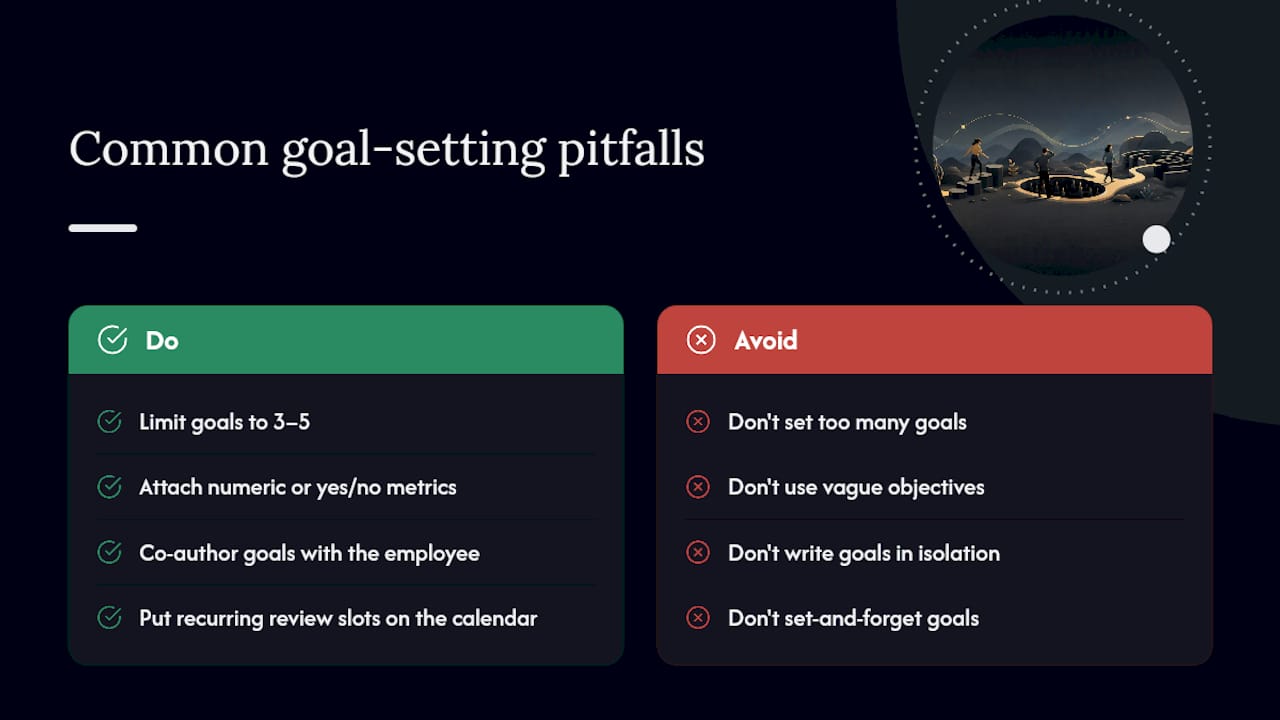
No real metric. “Improve communication” isn’t a goal, it’s a direction. If you can’t attach a number or a clear yes/no outcome, the goal isn’t finished yet.
Goals set in isolation. A goal an employee didn’t help write rarely gets the same commitment as one they co-authored. That’s not a soft HR talking point, it shows up directly in engagement and accountability data.
Set-and-forget goals. A goal written in January and reopened in December has already failed, regardless of the final number. It needed a pulse check in February.
Goals that ignore capacity. Stacking a stretch goal on top of an already full workload without removing anything else sets people up to miss both.
Misaligned targets. A goal that doesn’t trace back to a real team or company priority is busywork with a deadline attached. Ask “why does this matter to the business” before finalizing anything.
Each of these has the same fix: fewer goals, real numbers, employee input at the drafting stage, and a standing review slot on the calendar.
Getting employee buy-in on their own goals
Goals employees help write stick better than goals handed to them fully formed, and the mechanism isn’t mysterious: people commit more fully to targets they had a hand in shaping. Research on co-created goals backs this up directly, and it lines up with what most managers already sense from experience.
The practical version looks like this: come to the goal-setting conversation with a team priority in mind, not a finished goal. Ask the employee how they’d translate that priority into something measurable for their own role. You’ll often get a sharper, more realistic target than you would have written yourself, because they know their daily workflow better than you do.
Give development goals equal weight to delivery goals in that conversation. An employee who only ever gets assigned output targets starts to feel like a number on a dashboard. One who also gets asked “what skill do you want to build this quarter” feels like someone with a future at the company, which tends to reduce turnover risk on top of improving goal quality.
Finally, let employees push back on a target before it’s finalized. If someone says a number feels unrealistic, that’s useful information, not a reason to hold firm. Adjust the number, or ask what would need to change for it to be realistic. Either way, you leave the room with a goal both people actually believe in, not one that only looks good on paper.
Coaching and feedback: the part that makes goals actually happen
A goal without regular feedback is a New Year’s resolution with better formatting. The framework matters, but coaching is what turns the framework into results.
Feedback works best when it’s specific to the goal’s own metric, not general praise or general criticism. “Great job this week” doesn’t help nearly as much as “your response time dropped to three hours, right on pace for the four-hour target.” The second version tells the employee exactly what’s working and lets them repeat it.
Coaching also means catching a stalling goal before the deadline arrives, not after. If a weekly check-in shows someone is 20% behind pace at the halfway point, that’s the moment to ask what’s getting in the way, not the moment to wait and hope it self-corrects. A short conversation now beats a difficult one at review time.
The manager’s role shifts here from evaluator to something closer to a coach: someone who removes obstacles, adjusts support, and occasionally recalibrates the target, rather than someone who simply grades the outcome at the end. That shift alone explains a large share of the gap between teams where goals actually get hit and teams where they quietly fade by March.
Where managers go wrong, and the quickest fixes
Most goal-setting problems Optiostation sees trace back to three habits: too many goals per employee, goals with no attached number, and goals drafted without the employee in the room. Each has a fast fix, cap the list at three to five, force a metric onto every line, and draft the first version together instead of handing down a finished plan.
Try this as a low-risk pilot: pick two direct reports, write SMART goals together using the templates above, and run five-minute weekly check-ins for one full quarter. Compare completion rates against your last cycle. The templates in this article are built to be adapted, not followed word for word, so change the numbers to match your team’s actual baseline before you commit to them.
— Optiostation
Turn these goal examples into tracked, weekly habits
Writing a SMART goal is the easy part. Keeping it visible for twelve straight weeks is where most plans quietly die, and that’s the exact gap Optiostation was built to close. The app maps each goal directly to the daily tasks that move it forward, sends reminders before a weekly check-in slips, and shows progress on a dashboard so you’re not reconstructing status from memory during a 1:1.
If you manage a team of students or early-career professionals, that visibility matters more than the framework itself, since most missed goals fail from neglect, not bad planning. Start by mapping one employee’s current goals into tracked tasks and watch what a single week of visible progress does to their sense of ownership. Optiostation’s task management guide walks through setting this up in under fifteen minutes, and the guide to keeping track of tasks at work covers the weekly review habit in more detail if you want to build it into your own routine before rolling it out to a full team.
Sources
The guidance in this article draws on established HR and performance management sources worth bookmarking:
- A simple guide to setting employee performance goals — Totara
- Employee Goal Setting | Best Practices for Objectives — ADP
