

Start with 1–3 SMART goals tied to one long-term aim, then attach each to a small daily action you can do without thinking. That combination, a clear target plus a built-in habit, is what separates goals that stick from ones that fade by February.
Here is a quick-start checklist you can copy right now:
- Pick 1 performance goal (a result you need to deliver: a grade, a project, a metric)
- Pick 1–2 development goals (a skill or habit you want to build over the next 3–6 months)
- Write each as a SMART goal (Specific, Measurable, Achievable, Relevant, Time-bound)
- Attach one micro-action to each goal that you can do daily or weekly
- Schedule a 15-minute weekly check-in to mark progress
Research from Gail Matthews at Dominican University confirms that writing goals down and committing to them increases the likelihood of achievement. Start there.
Key Takeaways
Writing down 1–3 SMART goals, attaching each to a daily habit, and reviewing progress weekly is the most reliable path from intention to measurable result.
| Point | Details |
|---|---|
| Start small and specific | Pick 1–3 SMART goals; more than five active goals dilutes effort and focus. |
| Mix goal types | Combine one performance goal with one or two development goals for balanced progress. |
| Review on a cadence | Weekly micro-checks, quarterly reviews, and an annual refresh prevent drift and misalignment. |
| Habit-link every goal | Attach each goal to an existing daily routine to reduce friction and improve adherence. |
| Use Optiostation to track | Optiostation connects daily tasks to larger goals in one mobile app built for students and young professionals. |
Table of Contents
- What personal and professional goals are and why they matter
- What goals can you set for yourself, and how do you make them stick?
- 50 concrete goals to set for yourself, grouped by category
- How to set professional goals that actually move your career forward
- How to track progress and when to review or change your goals
- The goal-setting habit most people skip
- Optiostation keeps your goals and daily tasks in one place
- Recommended reading and research
- Sources
What personal and professional goals are and why they matter
Personal goals are self-directed targets for how you live, feel, learn, or grow outside of a job title. Professional goals are targets tied to your performance, career trajectory, or workplace skills. Both types matter, and the best goal plans include both.
Within professional goals, there is a useful split worth knowing:
- Performance (delivery) goals focus on outcomes: finish the project, hit the sales number, pass the exam. They are measurable and time-bound by nature.
- Development goals focus on building capability: learn a new tool, improve your public speaking, earn a certification. The payoff is slower but compounds over time.
FranklinCovey and Culture Amp both recommend mixing these two types rather than loading up on one or the other.
Three concrete benefits of setting goals:
- Focus: a written goal filters out noise and tells you what to work on when everything feels urgent.
- Measurable progress: you can see whether you are moving, which makes it easier to stay motivated or course-correct early.
- Better decisions: when a new opportunity or distraction appears, a clear goal gives you a fast filter. Does this move me toward the target or away from it?
What goals can you set for yourself, and how do you make them stick?
The process is shorter than most people expect. Five steps, repeated on a weekly cadence, cover almost every situation.
- Pick 1–3 priority goals. More than five active goals at once tends to dilute effort. Culture Amp’s research recommends keeping the active list small: typically one or two delivery goals plus one or two development goals.
- Make each goal SMART. Specific, Measurable, Achievable, Relevant, Time-bound. Notejoy’s SMART framework guide also adds Evaluate and Recognize (SMARTER) to build review and reward into the process from the start.
- Break each goal into weekly and daily actions. A goal without a scheduled action is just a wish. Map each goal to at least one recurring task.
- Schedule and track. Block time on your calendar. Use a notebook, a spreadsheet, or a simple task app to log progress weekly.
- Review and adjust. SkillsYouNeed recommends reviewing goals every few months and doing a full refresh annually. Priorities shift; your goals should too.
Three quick SMART conversions:
| Vague goal | SMART version |
|---|---|
| “Get healthier” | Run 3 times per week for 20 minutes |
| “Read more” | Read 1 nonfiction book per month for the next 6 months |
| “Get better at my job” | Complete one online course in data analysis by June 30 and apply one new technique per week |
Harvard Health reinforces this: making goals specific and tracking small wins is what keeps focus across the long haul, not motivation alone.
Pro Tip: Attach each goal to an existing habit. If you already make coffee every morning, use that five minutes to log yesterday’s progress. Behavioral research on PMC shows that habit-linked cues and small, consistent progress checks significantly improve goal adherence over time.
50 concrete goals to set for yourself, grouped by category
The examples below are phrased as editable starting points. Pick what fits, adjust the numbers and dates, and attach a micro-action.
Personal development
- Read 12 books this year (1 per month) — micro-action: read 20 pages each morning
- Complete one online course per quarter in a skill outside your current role — micro-action: watch one lesson per day
- Write in a journal for 10 minutes every evening for 90 days — micro-action: keep the journal on your nightstand
- Learn conversational Spanish by December — micro-action: 15 minutes on a language app daily
- Attend one professional workshop or conference per quarter — micro-action: block the date the week you register
- Reduce screen time to under 2 hours per day by the end of the month — micro-action: set a phone timer at 8 PM
For students, setting academic goals with a tutor is one of the fastest ways to turn vague study intentions into a structured plan with real accountability.
Health and fitness
- Run a 5K by June — micro-action: 20-minute run three times per week
- Sleep 7–8 hours per night for 30 consecutive days — micro-action: set a phone alarm for 10 PM as a wind-down cue
- Cook at home at least 4 nights per week for the next 3 months — micro-action: meal-plan every Sunday for 20 minutes
- Drink 64 oz of water daily — micro-action: fill a large bottle each morning before coffee
- Reduce added sugar intake to under 25g per day for 60 days — micro-action: read nutrition labels before buying
- Do 20 minutes of strength training 3 times per week for 8 weeks — micro-action: lay out workout clothes the night before
Productivity and time management
- Complete your top 3 priority tasks before noon each workday — micro-action: write tomorrow’s top 3 the night before
- Reduce email response time to under 24 hours by batching email twice daily — micro-action: close email tabs outside of 9 AM and 3 PM windows
- Finish all weekly deliverables by Friday at 4 PM for the next quarter — micro-action: block Friday mornings for wrap-up tasks
- Eliminate one recurring time-waster per week for the next month — micro-action: audit your calendar every Monday
- Use a weekly scorecard to track your top goals every Sunday — micro-action: set a 15-minute Sunday evening reminder
Relationships and social
- Call or text one friend or family member you have not spoken to in a month — weekly micro-action: add it to your Sunday list
- Have one intentional, phone-free dinner with family or friends per week — micro-action: put the phone in another room at mealtime
- Express appreciation to one colleague or friend per week in writing — micro-action: send a short message every Friday
- Meet one new person in your field per month for 6 months — micro-action: attend one local or virtual event monthly
- Volunteer for one community event per quarter — micro-action: search for local opportunities the first week of each quarter
Financial
- Save $200 per month for the next 12 months — micro-action: automate a transfer on payday
- Pay off one credit card balance by December — micro-action: add $50 extra to the payment each month
- Track every expense for 30 days using a spreadsheet or budgeting app — micro-action: log purchases each evening
- Build a 3-month emergency fund within 18 months — micro-action: calculate the target amount this week
- Increase your income by taking on one freelance project per quarter — micro-action: update your portfolio or LinkedIn profile this week
Career and professional
- Earn one industry certification by the end of the year — micro-action: study 30 minutes per day, 4 days per week
- Ask for one piece of specific feedback from your manager each month — micro-action: prepare one question before your next 1:1
- Lead one project or initiative per quarter — micro-action: volunteer for the next available opportunity
- Expand your professional network by 10 meaningful connections in 6 months — micro-action: send two personalized connection requests per week
- Present your work to a broader audience once per quarter — micro-action: offer to present at the next team meeting
Balancing short-term and long-term goals: Keep no more than 3–5 goals active at once. Short-term goals (daily to quarterly) build momentum. Long-term goals (1–5 years) give direction. A practical hierarchy, from lifetime aims down to daily actions, prevents your daily work from drifting away from what actually matters to you. SkillsYouNeed’s goal-setting guide describes this long-term to short-term structure in detail.
How to set professional goals that actually move your career forward
The first decision is choosing the right goal type. Performance goals and development goals serve different purposes, and mixing them is what makes a career plan durable.
Performance (delivery) goals are outcome-focused. They answer: what result do I need to produce? Examples: close 10 new accounts this quarter, reduce project delivery time by 15%, achieve a 90% score on the final exam. These are easy to measure and easy to report.
Development goals are skill-focused. They answer: what capability do I need to build? Examples: improve data visualization skills, become proficient in Python, develop stronger negotiation techniques. The payoff shows up over months or years, not weeks.
FranklinCovey recommends a focused format called Wildly Important Goals (WIGs), phrased as “From X to Y by When.” For example: “From closing 4 deals per month to closing 7 deals per month by September 30.” That single sentence forces clarity on the baseline, the target, and the deadline.
Given that the Bureau of Labor Statistics reported median job tenure at 4.1 years, setting multi-year career checkpoints makes practical sense. Most people will change roles or employers within a four-year window, so a 3-year development goal needs to be portable.
Three practical frameworks and when to use each:
- SMART: best for individual goals with a clear deadline. Use it for any goal you can measure in numbers or observable outcomes.
- OKRs (Objectives and Key Results): best for team or organizational goals where you need to align multiple people to one direction. The Objective is qualitative; the Key Results are measurable.
- WIGs (From X to Y by When): best for high-stakes performance goals where the gap between current state and target state needs to be visible at a glance.
Goal stacking is worth adding to any of these frameworks. Link your performance goal to a development goal so that improving a skill directly feeds a deliverable. Example: “I will improve my public speaking skills (development) so I can present the Q3 results to the leadership team (performance).”
Purdue Global’s professional goal-setting guide offers step-oriented templates that work well alongside any of these frameworks.
| Goal type | Focus | Timeframe | Best use case |
|---|---|---|---|
| Performance / delivery | Outcome or result | Days to quarters | KPIs, project milestones, grades |
| Development / skill | Capability building | Months to years | Certifications, new tools, leadership |
| WIG (From X to Y by When) | Single measurable gap | Weeks to quarters | High-priority performance targets |
| OKR | Direction + measurable results | Quarterly | Team alignment, strategic priorities |
Keep active work goals to 3–5. More than that and none of them get the attention they need.
How to track progress and when to review or change your goals
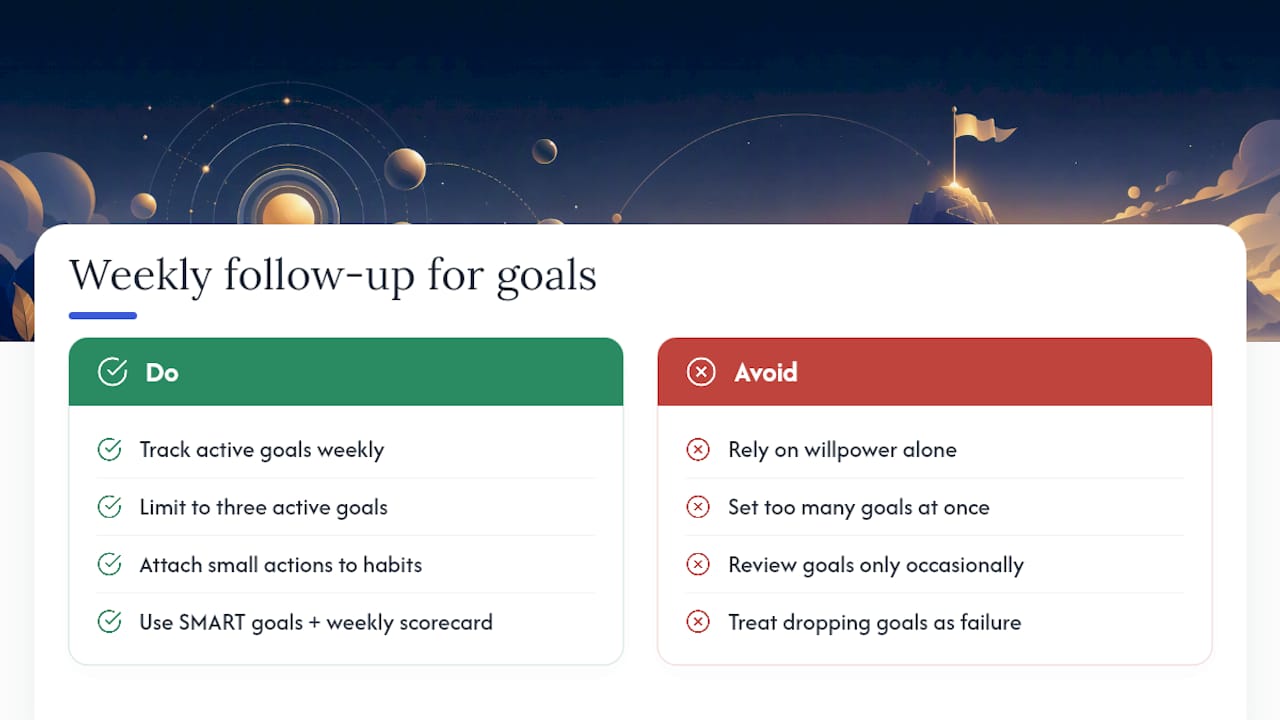
The recommended cadence: weekly micro-checks, quarterly reviews, and an annual refresh. That rhythm catches drift early without turning goal-tracking into a second job.
Simple tracking routines:
- Daily habit check: a two-minute scan of your micro-actions. Did you do them? Yes or no.
- Weekly scorecard: rate each active goal on a 1–5 scale. Note one win and one obstacle.
- Monthly metric review: pull the numbers. Are you on pace? If not, what needs to change?
- Quarterly reflection: review whether the goal still fits your priorities. Adjust the target, the timeline, or drop it entirely if circumstances have shifted.
SkillsYouNeed notes that failing to review and adjust goals is one of the most common causes of misalignment between daily activity and actual priorities. A goal you set in January may be irrelevant by April.
Research published by the American Psychological Association found that progress-focused goals, tracking movement rather than just outcomes, are linked to higher motivation and sustained effort over time.
Weekly scorecard template (copy and use):
Quarterly reflection prompts:
- Which goal made the most progress? What drove it?
- Which goal stalled? What was the real reason?
- Do my current goals still match my top priorities?
- What do I need to start, stop, or adjust next quarter?
For students tracking academic progress alongside personal goals, Optiostation’s guide to effective goal setting covers monitoring and revising in detail.
The goal-setting habit most people skip
Most goal-setting advice focuses on writing the goal. The part that actually determines whether you follow through is what happens the week after you write it.
The conventional wisdom says: set ambitious goals, stay motivated, push through. That framing puts the burden on willpower, which is unreliable. A more durable approach is to make the goal almost boring to execute. Small, scheduled actions attached to existing habits remove the decision-making friction that kills most goals before the first month is out.
There is also a real cost to setting too many goals at once. Three active goals, tracked weekly, will outperform ten goals reviewed occasionally. The research on this is consistent: specificity and frequency of review matter more than the size of the ambition. A SMART goal template gives you the structure; the weekly scorecard gives you the feedback loop. Neither works without the other.
One more thing worth saying plainly: not every goal deserves to survive a quarterly review. Dropping a goal that no longer fits your life is not failure. It is good judgment. The goal was a hypothesis about what mattered. New information changes the hypothesis.
Optiostation keeps your goals and daily tasks in one place
Students and young professionals managing three or more active goals tend to lose track not because they lack motivation, but because their goals live in one place and their tasks live somewhere else entirely.

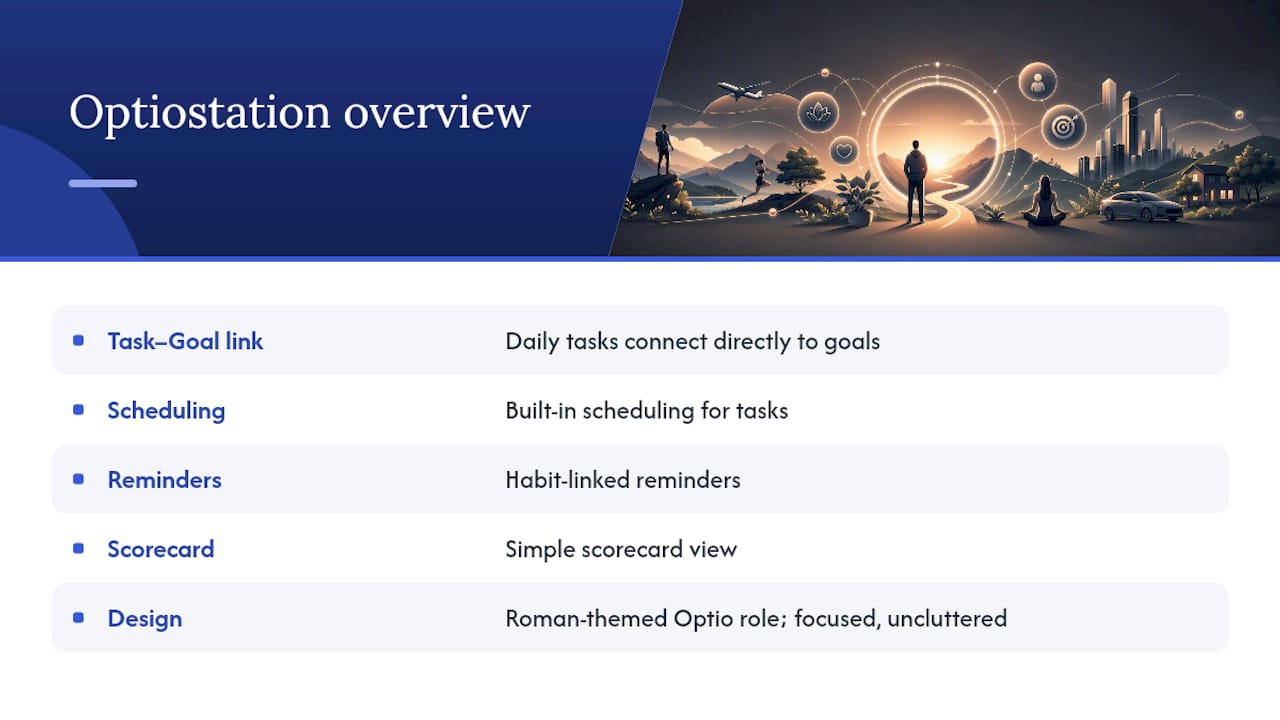
Optiostation is a mobile task, team, and time management app built specifically for that gap. As your second-in-command, it connects your daily task list directly to the goals behind it, so every action you complete moves a visible needle. You get scheduling, habit-linked reminders, and a simple scorecard view, all inside one app designed for the pace of student and early-career life.
The Roman-themed interface, built around the Optio role, keeps the experience focused and purposeful rather than cluttered. No feature overload. Just the tools a Centurion needs to stay on mission.
If you are ready to move from a written goal to a tracked one, explore Optiostation’s time management approach and see how it fits your current goal set.
Recommended reading and research
- Gail Matthews — Dominican University goals research summary: the foundational study showing that writing and committing to goals measurably increases follow-through.
- Harvard Health Blog — get smart about your goals: practical advice on making goals specific and tracking small wins to maintain focus.
- SkillsYouNeed — setting personal goals: covers the long-term to short-term hierarchy and the importance of regular review cadence.
- FranklinCovey — work goal examples: explains performance vs. development goals and introduces the WIG format (“From X to Y by When”).
- Culture Amp — 30 examples of goals for work: guidance on mixing delivery and development goals and keeping the active list to 3–5.
- Notejoy — SMART goals examples for work: clear SMART and SMARTER framework examples with workplace templates.
- Purdue Global — setting professional goals with examples: step-by-step templates for writing professional goals across career stages.
- PMC — behavioral interventions for habit formation: behavioral science evidence for habit-linked cues and progress checks that improve goal adherence.
- BLS — median tenure with current employer: context for why multi-year career checkpoints matter in professional goal planning.
- Optiostation — what are personal goals and why they matter: a clear primer on personal goal categories for readers who want a deeper foundation.
- Optiostation — define what is a goal: your complete guide: comprehensive framework explanations for readers who want to go deeper on goal structure and theory.
Sources
- FranklinCovey blog — work goal examples
- SkillsYouNeed — setting personal goals
- Culture Amp — 30 examples of goals for work
- Dominican University — Gail Matthews Harvard goals research summary
- Harvard Health Blog — get smart about your goals
- PMC — behavioral interventions for habit formation
- Purdue Global — how to set professional goals
- BLS — median tenure with current employer was 4.1 years in January 2020
Recommended
- 7 Key Goal Setting Techniques for Centurions – Optio Station: Best Project Management App for Prioritization
- 7 Effective Goal-Setting Tips for Students and Professionals – Optio Station: Best Project Management App for Prioritization
- 7 Goal Setting Strategies 2025 for Students and Professionals – Optio Station: Best Project Management App for Prioritization
- Examples of SMART goals to boost academic success – Optio Station: Best Project Management App for Prioritization
