

A project scope statement is a short, written agreement that defines what a project will and won’t deliver. Think of it as a shared contract between everyone involved: it prevents scope creep, sets clear expectations, and gives you a document to point to when someone asks for “just one more thing.”
Copy-ready one-liner: “This project will deliver [specific output] by [date], within [budget/resource limit], and does not include [explicit exclusion].”
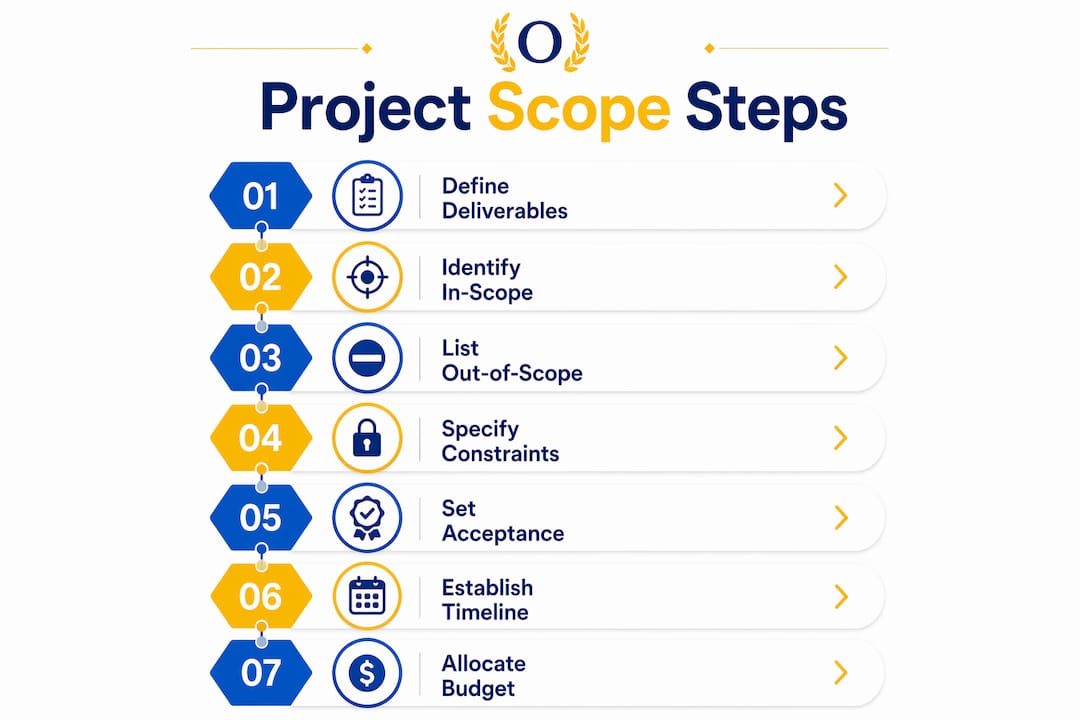
A complete scope statement covers seven elements: deliverables, in-scope work, out-of-scope exclusions, constraints, assumptions, stakeholders, and acceptance criteria. Get all seven right and you have a document that actually protects your project.
Table of Contents
- Use this copy-and-paste project scope template
- Three real-world project scope examples you can adapt
- How to write measurable acceptance criteria
- When and how to update the scope: a simple change-control workflow
- Common mistakes that cause scope creep and how to stop them
- Optiostation’s 7-step project planning checklist for students and young professionals
- Key Takeaways
- Why scope clarity matters more than most students realize
- Useful sources for further reading
Use this copy-and-paste project scope template
The table below gives you every field, what to write, and a one-line example. Copy it into a Google Doc, fill in the brackets, and you have a working scope statement in under 20 minutes.
| Field | What to write | Example content |
|---|---|---|
| Project name | Short, descriptive title | Campus Sustainability Report |
| Project owner | Name and role | Jordan Lee, Team Lead |
| Start / end dates | Specific calendar dates | March 3 – April 28, 2026 |
| Objectives | SMART: specific, measurable, time-bound | Publish a 15-page report by April 28 showing 3 campus energy-use trends |
| Deliverables | Tangible outputs, stated as nouns | Written report, data visualization deck, executive summary |
| In-scope | Work the team will do | Data collection, analysis, writing, peer review |
| Out-of-scope | Work explicitly excluded | Printing, distribution, follow-up presentations |
| Constraints | Real limits: time, budget, people | No budget; 4 team members; 8-week window |
| Assumptions | What you’re treating as true | Campus energy data is publicly available |
| Stakeholders | Who has a say or is affected | Faculty advisor, sustainability office, student senate |
| Acceptance criteria | Measurable pass/fail conditions | Report approved by faculty advisor by April 28; all citations verified |
| Milestones | Key dates with deliverable names | Draft complete March 28; final review April 21 |
| Version / approver | Version number, date, initials | v1.0 — March 3, 2026 — JL |
A few field-by-field notes worth keeping in mind:
- Objectives must be SMART. “Do a good report” is not an objective. “Publish a 15-page report identifying three energy-use trends by April 28” is. Pair every objective with a SMART goal framework so acceptance is evidence-based, not a gut feeling.
- Out-of-scope is the field most beginners skip. Writing exclusions explicitly prevents stakeholders from assuming adjacent work is included, and it’s one of the strongest protections against scope creep.
- Acceptance criteria belong in the template, not in a separate email thread. Put them here so everyone signs off on the same standard before work starts.
Three real-world project scope examples you can adapt
Each example below follows the same structure: deliverables, in-scope, out-of-scope, one measurable acceptance criterion, a timeline note, and a resource note.
Example 1: Student group research project
Deliverables: 12-page research paper and a 10-slide presentation deck.
In-scope: Literature review, primary survey (n=30), data analysis, writing, slide design.
Out-of-scope: Publication submission, printing, post-submission revisions.
Acceptance criterion: Paper scores 80% or higher on the instructor rubric; presentation delivered within 15 minutes.
Timeline: 6 weeks; draft due at week 4.
Resources: No budget; shared Google Drive for collaboration.

Example 2: Freelance website for a small client
Deliverables: Five-page WordPress site with contact form and mobile-responsive layout.
In-scope: Design, development, copy editing of client-supplied text, one round of revisions.
Out-of-scope: Logo design, ongoing hosting, SEO campaigns, social media setup.
Acceptance criterion: All pages load in under 2.5 seconds; contact form submits successfully on mobile and desktop.
Timeline: 3 weeks from content receipt; launch by agreed date.
Resources: Client provides copy and images; developer provides hosting for 30-day handoff period.
Example 3: Campus event
Deliverables: One 3-hour networking event for 80–100 attendees, including venue setup, speaker coordination, and a printed program.
In-scope: Venue booking, speaker outreach, registration page, day-of logistics.
Out-of-scope: Post-event video editing, social media recap posts, catering beyond light refreshments.
Acceptance criterion: At least 75 registered attendees; post-event survey scores 4.0/5.0 or higher on overall satisfaction.
Timeline: 8 weeks of planning; event held in week 9.
Resources: $400 student-org budget; 3-person committee.
Quick comparison
| Example | Main deliverable | Primary in-scope | Primary out-of-scope | Acceptance metric |
|---|---|---|---|---|
| Student research project | 12-page paper + deck | Literature review and survey | Publication submission | 80% rubric score |
| Freelance website | 5-page WordPress site | Design and development | Logo design and SEO | Page load < 2.5 seconds |
| Campus event | 3-hour networking event | Venue and speaker coordination | Post-event video editing | 75+ attendees; 4.0/5.0 survey |
For the website example, tracking web performance KPIs like load time and form submission rates gives you objective evidence at handoff. No debate, no “I thought it felt slow.”
How to write measurable acceptance criteria
The most common mistake in any scope statement is leaving acceptance criteria vague. “The website should feel fast” opens a debate at delivery. “All pages load in under 2.5 seconds on a standard 4G connection” closes it.
Write every criterion as a numeric target, a pass/fail test, or a compliance checklist item. Here are quick bad-vs-good examples:
- Time-based: ✗ “Delivered on time” → ✓ “Final report submitted by April 28, 2026, by 11:59 PM”
- Percentage-based: ✗ “Mostly accurate data” → ✓ “Survey data entry verified at 95% accuracy by second reviewer”
- Count-based: ✗ “Enough attendees” → ✓ “Minimum 75 registered attendees confirmed 48 hours before event”
- Pass/fail test: ✗ “The form works” → ✓ “Contact form submits successfully on Chrome, Safari, and Firefox without errors”
- Sign-off checklist: ✗ “Stakeholders are happy” → ✓ “Faculty advisor, project sponsor, and client each sign the acceptance form”
Useful metric types to keep in your toolkit: elapsed time, percentage thresholds, raw counts, binary pass/fail tests, and named-reviewer sign-offs. Pick the type that matches what you’re actually delivering.
Pro Tip: Run a lightweight user acceptance test (UAT) before final delivery. Recruit two or three people outside your team, give them a task list, and watch them complete it without help. If they get stuck, that’s a failed criterion — fix it before the client or professor sees it.
When and how to update the scope: a simple change-control workflow
Treat the scope statement as a living document that gets reviewed at every milestone and whenever a change request lands. The baseline you set at kickoff is your reference point; every approved change updates that baseline and gets logged.
For student and small-team projects, keep change control light. Require a one-paragraph impact note, a rough time and cost estimate, and one approver’s sign-off before acting on any change.
4-step workflow:
- Request. The requester submits a written note (email or shared doc comment) describing the change and why it’s needed.
- Impact analysis. The project lead estimates the effect on timeline, budget, and other deliverables. One paragraph is enough for small projects.
- Decision. The approver (faculty advisor, client, or sponsor) approves, rejects, or asks for a modified version. No verbal agreements.
- Update and communicate. The project lead updates the scope document, bumps the version number, adds the approver’s initials and the date, and notifies all stakeholders.
Versioning tip: Keep a two-row changelog at the top of your scope document. Format it as: version number | date | what changed | approved by. Version 1.0 is the baseline; every approved change produces v1.1, v1.2, and so on. A scope checklist reviewed at each milestone keeps the document aligned with where the project actually stands.
Common mistakes that cause scope creep and how to stop them
Scope creep rarely arrives as a dramatic demand. It sneaks in through vague language, skipped fields, and verbal agreements nobody wrote down.
- Vague objectives. If your objective can’t be measured, you can’t confirm you’ve met it. Replace “improve the website” with a SMART target tied to a KPI.
- Missing exclusions. Skipping the out-of-scope field is the single biggest invitation for extra work. Name adjacent tasks explicitly — logo design, social media, printing — so you can say no without seeming uncooperative.
- Verbal agreements. A stakeholder says “just add one more page” in a hallway conversation. You say sure. Three weeks later, that’s three pages and a new section. Require written change requests, even a one-line email.
- No acceptance criteria. Without a measurable standard, “done” means whatever the reviewer decides it means that day. Write the criteria before work starts.
- Scope changes with no document update. Approved changes that never make it into the scope document create a gap between what the team thinks they’re building and what the stakeholder expects. Update the doc every time.
For small, low-stakes changes (fixing a typo in a deliverable name, adjusting a milestone date by two days), a quick note in the changelog is enough. Save the full four-step process for anything that touches budget, timeline, or deliverables. A project scope checklist reviewed at each milestone is the simplest habit you can build to stay ahead of creep.
Optiostation’s 7-step project planning checklist for students and young professionals
Optiostation built this checklist specifically for students and early-career professionals who need a repeatable process without the overhead of enterprise project management. Use it alongside your scope statement; the scope review points are marked.
- Clarify goals. Write down what success looks like in one sentence. If you can’t do that, the project isn’t ready to scope. Scope review point: goals must be in the scope before you move to step 2.
- Draft the scope. Use the template above. Fill every field, especially out-of-scope. Get at least one stakeholder to read it before you call it a baseline.
- List deliverables. Break each objective into tangible outputs. A work breakdown structure helps translate objectives into tasks your team can estimate and schedule.
- Assign roles. Name who owns each deliverable. Unowned deliverables slip. Even on a two-person team, one person is accountable for each output.
- Set milestones. Attach a specific date to each major deliverable. Use a milestone timeline template to map them visually so the whole team sees the sequence.
- Run milestone reviews. At each milestone, compare actual progress to the scope baseline. Scope review point: if anything has drifted, run the change-control workflow before continuing. A scope checklist reviewed throughout the project lifecycle keeps objectives and deliverables aligned.
- Close and capture lessons. Confirm all acceptance criteria are met, get formal sign-off, and write a one-page lessons-learned note. Scope review point: confirm the final scope matches what was actually delivered.
The full 7-step planning checklist on Optiostation walks through each step with prompts and checkpoint questions you can use in real time.
Key Takeaways
A clear, measurable scope statement with explicit exclusions and written acceptance criteria is the single most effective way to prevent scope creep on any student or early-career project.
| Point | Details |
|---|---|
| Write exclusions first | Name adjacent work explicitly in the out-of-scope field before anyone assumes it’s included. |
| Make criteria measurable | Replace subjective language with numeric or pass/fail targets (e.g., page load under 2.5 seconds, 80% rubric score). |
| Require written change requests | Never act on a verbal agreement; a one-paragraph impact note and one sign-off is enough for small teams. |
| Version every update | Add version number, date, and approver initials to the scope doc after every approved change. |
| Review scope at milestones | Check the scope baseline at every milestone and at project close, not just at kickoff. |
Start here: Copy the template table from Section 2, fill in your objectives and acceptance criteria first, then work through the remaining fields.
Why scope clarity matters more than most students realize
Most project failures at the student and early-career level don’t come from bad work. They come from unclear agreements. Someone assumed the logo was included. Someone thought “one round of revisions” meant unlimited feedback. Someone said yes to a new feature in a group chat and never updated the document.
The scope statement isn’t bureaucracy. It’s the thing that lets you say no with evidence. When a stakeholder asks for something outside the agreed deliverables, you don’t have to argue — you just point to the document they already signed. That shift, from negotiating on the fly to referencing a shared baseline, is what separates projects that finish cleanly from ones that drag on.
Optiostation built its templates and checklists specifically because students and young professionals rarely get taught this in class. The tools exist; the habit of using them is what takes practice. If you want to go deeper on managing scoped tasks once your scope is set, that’s the natural next step after drafting your statement.
Useful sources for further reading
- Developing a Project Scope Statement in 8 Easy Steps — Northeastern University’s step-by-step guide; strong on SMART objectives and stakeholder sign-off. Conceptual guidance.
- How To Write a Project Scope in 5 Steps (With Example) — Indeed’s practical walkthrough with a real scope statement example for a mobile app project. Template and example.
- Project Scope Checklist — A printable checklist covering objectives, deliverables, in-scope, out-of-scope, constraints, and change control. Checklist format.
- Scope Document Template — A full seven-section scope document template with version history and sign-off fields. Template.
- What Is a Project Scope and Why Does It Matter? — Coursera’s introductory explanation of scope, KPIs, and stakeholder alignment. Conceptual guidance.
- Project Scope: Definition, Steps, Tips & Tools — ProjectManager’s guide covering scope baselines, WBS, and change control. Conceptual and process guidance.
- Optiostation 7-Step Project Planning Checklist — Optiostation’s checklist for students and young professionals; includes scope review prompts at each milestone. Checklist and template.
- Project Management Plan Example — Expands a scope statement into a full project plan; useful once your scope baseline is set. Template and example.
Recommended
- Best free project management software for students 2026 – Optio Station: Best Project Management App for Prioritization
- Engineering project manager guide: frameworks and strategies – Optio Station: Best Project Management App for Prioritization
- Best project management software for students in 2026 – Optio Station: Best Project Management App for Prioritization
- Project management portfolio template guide 2026 – Optio Station: Best Project Management App for Prioritization
