

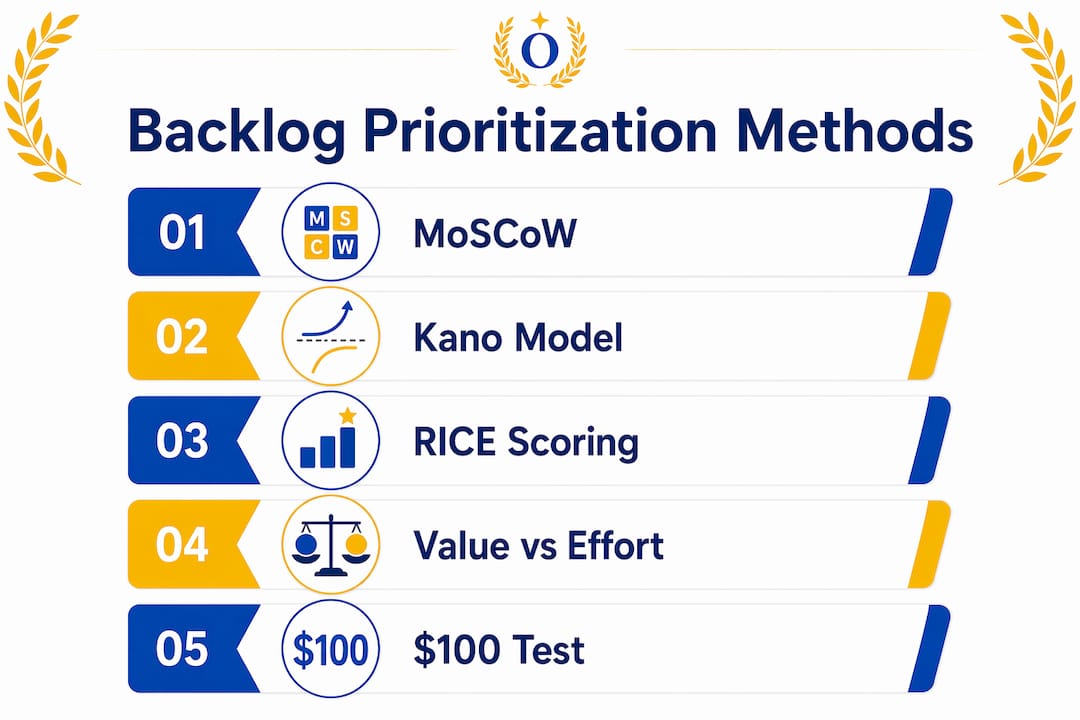
The most effective product backlog prioritization techniques turn subjective debates into evidence-based decisions. The five methods product managers rely on most are MoSCoW, the Kano model, RICE scoring, the Value vs Effort matrix, and the $100 test. Each one approaches the same core problem from a different angle.
Here’s a quick orientation before the deep dives:
- MoSCoW sorts items into four buckets (Must-Have, Should-Have, Could-Have, Won’t-Have) to clarify scope and manage stakeholder expectations.
- Kano model maps features to user satisfaction, separating baseline requirements from delighters that create competitive advantage.
- RICE assigns a numeric score using Reach, Impact, Confidence, and Effort, making trade-offs visible and defensible.
- Value vs Effort matrix plots items on a 2×2 grid so quick wins surface immediately and low-return work gets cut.
- $100 test gives stakeholders a fixed budget to “spend” on backlog items, surfacing collective priorities through participatory voting.
None of these methods replaces product owner judgment. They structure the conversation so that judgment lands on the right questions. Continuous backlog refinement and honest stakeholder input are what keep any of them working over time.
Table of Contents
- Why backlog prioritization makes or breaks Agile delivery
- ## 1. How the MoSCoW method clarifies scope fast
- ## 2. How the Kano model connects features to user satisfaction
- ## 3. How RICE scoring makes prioritization evidence-based
- ## 4. How the Value vs Effort matrix surfaces quick wins
- ## 5. How the $100 test distributes prioritization power
- Choosing the right technique for your backlog
- Key Takeaways
Why backlog prioritization makes or breaks Agile delivery
Every Agile team operates under capacity constraints. You cannot build everything, so the order you choose determines what value actually ships. A systematic literature review on Agile requirement prioritization found that ignoring critical requirements during prioritization leads directly to poor quality and unsatisfied clients. That is not a theoretical risk; it shows up in delayed releases, rework, and features that land with a thud.
The harder challenge is that priorities rarely come from one source. Engineering wants to pay down technical debt. Sales wants the feature a prospect mentioned last Tuesday. Leadership wants the roadmap item tied to a strategic initiative. Without a shared prioritization model, whoever argues loudest wins, and the backlog quietly becomes a political document rather than a value-delivery plan.
Good prioritization techniques in Agile solve this by making reasoning transparent. When a team can point to a score, a category, or a matrix placement, the conversation shifts from “I think this matters” to “here’s why this ranks here.” That shift protects the product owner and builds trust with stakeholders across the board.
Dependencies and technical constraints add another layer. An item might score well in isolation but be worthless until something else ships first. Effective backlog management accounts for these relationships, not just individual item scores.
## 1. How the MoSCoW method clarifies scope fast
MoSCoW is the fastest way to bring order to a chaotic backlog. Clear categorization helps teams manage expectations and balance deliverables within Agile sprints, and the method’s four buckets do exactly that:
- Must-Have: Non-negotiable. The product fails without these. Think authentication, core data persistence, legal compliance.
- Should-Have: High value but not sprint-critical. These get done if capacity allows, and they usually do.
- Could-Have: Nice to have. They improve the experience but cause no real harm if deferred.
- Won’t-Have (this time): Explicitly out of scope for the current cycle. The phrase “this time” matters; it manages expectations without permanently killing an idea.
“Won’t have” is often meant as “won’t have this time” — it manages expectations on what’s feasible right now, instead of dismissing deliverables entirely.
The practical power of MoSCoW is speed. A product owner can run a team through a backlog of 30 items in under an hour. The limitation is the gray zone between Should and Could. Two stakeholders will often disagree on which bucket a feature belongs in, and MoSCoW gives no formula to resolve that. Use it as a first-pass filter, then apply a scoring method like RICE to the Must and Should items when you need finer ordering.
## 2. How the Kano model connects features to user satisfaction
The Kano model, developed by Professor Noriaki Kano, starts from a premise most prioritization frameworks ignore: not all value is equal in the eyes of the user. Kano identifies features by their impact on user satisfaction, distinguishing basics, performance attributes, and delighters.
- Must-Be Basics: Features users expect by default. Their absence causes dissatisfaction; their presence goes unnoticed. A mobile app that crashes on login fails here.
- Performance Features: Satisfaction scales linearly with quality. Faster load times, more accurate search results, cleaner reporting. More is better.
- Delighters: Features users didn’t know they wanted. When they find them, satisfaction spikes. These are your competitive differentiators.
Using Kano, teams prioritize must-be features to meet baseline expectations and identify delighters for competitive advantage.
The practical application involves a paired questionnaire: ask users how they feel if a feature exists, then how they feel if it doesn’t. The gap between those two answers reveals the category. This is more rigorous than gut instinct, and it prevents teams from over-investing in delighters while Must-Be Basics are still broken.
In backlog refinement cycles, Kano works well as a filter before RICE scoring. Classify items first, then score the Performance and Delighter candidates to determine build order.
## 3. How RICE scoring makes prioritization evidence-based
RICE is the method most product teams reach for when they need to defend a backlog order to skeptical stakeholders. RICE transforms subjective prioritization debates into evidence-based discussions by scoring items on four factors: Reach, Impact, Confidence, and Effort.
The formula is straightforward: (Reach × Impact × Confidence) / Effort.

| Factor | Definition | Example Scale |
|---|---|---|
| Reach | Users or events affected per quarter | Actual product data |
| Impact | How much it moves the goal per person | 3 = massive, 2 = high, 1 = medium |
| Confidence | How evidence-backed the estimates are | 100% = data-backed, 50% = largely intuition |
| Effort | Total person-months across product, design, and engineering | Person-months |
Two factors deserve special attention. Confidence is a signal, not a penalty. An item scoring 50% confidence tells you the fastest way to raise its rank is to run a small discovery experiment first. That maps directly onto the Scrum principle of transparency and empiricism.
Effort is the factor teams most often underweight. RICE Effort estimates must include product, design, and engineering contributions, not just developer hours. Excluding non-development work falsely inflates the scores of large initiatives and quietly destroys team throughput.
RICE also helps avoid backlog politicization by making reasoning transparent to stakeholders and Scrum teams. The score doesn’t overrule the product owner; it makes the trade-off visible so the conversation focuses on the right things. For a deeper look at applying this framework, Optiostation’s RICE prioritization guide walks through practical scoring scenarios.
## 4. How the Value vs Effort matrix surfaces quick wins
The Value vs Effort matrix is the fastest visual tool for backlog prioritization. You plot each item on a 2×2 grid: value on one axis, effort on the other. Four quadrants emerge, and each one tells you something different.
- High value, low effort: Do these first. They are your quick wins and deliver the best return on team time.
- High value, high effort: These need justification. Break them into smaller pieces before committing resources, or gather more evidence to confirm the value estimate.
- Low value, low effort: Fill-in work. Fine to pick up when capacity allows, but never at the expense of higher-value items.
- Low value, high effort: Cut or defer. These are the backlog items that quietly drain a team’s capacity without moving the needle.
A value vs effort approach makes trade-offs explicit by placing stories on a simple 2×2. High-value, low-effort items emerge as your quick wins, while low-value, high-effort items become clear targets for de-prioritization.
The matrix shines in collaborative sessions. Put it on a shared board, have the team place items together, and disagreements about placement become productive conversations about what “value” actually means for a given feature. That alignment is often more useful than the final grid itself.
Pro Tip: When scoring value, use a consistent definition before the session starts. “Value” means different things to engineering, sales, and customer success. Agree on whether you’re measuring revenue impact, user adoption, or risk reduction, and write it on the board before anyone places a single item.
The limitation is that both axes rely on qualitative scoring. Without a shared definition of value and a consistent effort scale, two teams can produce very different grids for the same backlog. Pair the matrix with an Agile prioritization matrix approach to add structure to the scoring process.
## 5. How the $100 test distributes prioritization power
The $100 test, also called cumulative voting, is the most democratic of the common backlog prioritization methods. Stakeholders allocate a fixed budget among backlog items, revealing collective priorities through transparent allocation. The more dollars an item receives, the higher it climbs.
Running a $100 test session takes five steps:
- Prepare the backlog. List the items clearly with enough context that every participant understands what each one does.
- Distribute the budget. Give each participant a notional $100 to allocate however they choose.
- Allocate independently. Participants assign their dollars before seeing anyone else’s choices. This prevents anchoring and groupthink.
- Aggregate the results. Total the dollars each item received across all participants.
- Review and discuss. Items with high totals reflect genuine consensus. Items with wide variance in individual allocations signal conflicting priorities worth discussing openly.
The method’s real strength is surfacing disagreement. When one stakeholder puts $40 on a feature and another puts $0, that gap is data. It tells you the team has not aligned on the value of that item, and that conversation needs to happen before the item goes into a sprint.
The $100 test works best when priorities are genuinely contested and you need buy-in from multiple stakeholders. It’s less useful for technical debt or compliance work, where the “value” isn’t something stakeholders can easily compare against feature requests. For those items, constraints-based prioritization or MoSCoW’s Must-Have category handles the ordering more cleanly.
Choosing the right technique for your backlog
No single method covers every situation. The right choice depends on your backlog size, team maturity, and how much stakeholder alignment you need to build.
- MoSCoW works best for rapid scope decisions and sprint planning when time is short.
- Kano fits early-stage product discovery, when you’re still learning what users actually need versus what they say they want.
- RICE earns its place when you need to defend a backlog order to leadership or when the team keeps cycling through the same prioritization arguments.
- Value vs Effort matrix is the go-to for team alignment sessions and when you want a visual output stakeholders can read at a glance.
- $100 test shines when stakeholder conflicts are blocking progress and you need a structured way to surface and resolve them.
Combining methods is often the most practical path. Run MoSCoW first to reduce the backlog to a manageable set, then apply RICE to the top tier for precise ordering. Use the Kano model during discovery to classify new feature requests before they enter the backlog at all.
Measuring whether your prioritization is working matters as much as choosing a method, as explained in the Revue des Progrès Académiques : Évaluer et Ajuster les Stratégies d’Apprentissage. Track delivery velocity, customer satisfaction scores, and how often items get re-prioritized after a sprint starts. Frequent mid-sprint reprioritization usually signals that the upstream ordering process is breaking down, not that priorities are genuinely changing.
Backlog refinement should happen at least once per sprint. Priorities shift with market conditions, user feedback, and technical discoveries. A backlog that was correctly ordered three months ago may be actively misleading today. Treat effective backlog prioritization as a continuous practice, not a one-time exercise.
Finally, no framework replaces product owner judgment. RICE scores, Kano categories, and matrix placements are inputs to a decision, not the decision itself. Dependencies, strategic bets, and compliance mandates don’t fit neatly into any scoring model. Keep the frameworks as tools that make your reasoning transparent, and keep the accountability where it belongs.
Optiostation’s task and team management app helps product managers and students alike stay on top of priorities without losing sight of the bigger picture. Whether you’re managing a sprint backlog or juggling multiple projects, explore the best task management software options to find the right fit for your workflow.

Key Takeaways
The most reliable product backlog prioritization techniques combine a fast categorization method with a scoring framework, then validate results through continuous refinement and stakeholder input.
| Point | Details |
|---|---|
| Start with categorization | MoSCoW quickly reduces a large backlog to a manageable set before applying scoring methods. |
| Score for transparency | RICE uses the formula (Reach × Impact × Confidence) / Effort to make trade-offs visible and defensible. |
| Map user satisfaction | The Kano model separates Must-Be Basics from Delighters, preventing over-investment in the wrong tier. |
| Visualize trade-offs | The Value vs Effort matrix surfaces quick wins and flags low-return items for removal or deferral. |
| Build stakeholder consensus | The $100 test reveals collective priorities and surfaces conflicting views before they stall a sprint. |
Recommended
- Understanding Prioritization Techniques Guide for Success – Optio Station: Best Project Management App for Prioritization
- Understanding Prioritization Techniques for Success – Optio Station: Best Project Management App for Prioritization
- Prioritization techniques in agile: student productivity – Optio Station: Best Project Management App for Prioritization
- How Do You Prioritize Multiple Projects Effectively – Optio Station: Best Project Management App for Prioritization
