

TL;DR:
- A consistent daily routine centered on wake time, hydration, movement, and planning improves focus and wellbeing. Building habits gradually over two months and anchoring them to behaviors rather than clocks ensures longevity and flexibility. Small, repeatable habits sustain energy and productivity, even amid schedule disruptions.
The best daily routine is a consistent sequence of habits built around a stable wake time, hydration, short movement breaks, and deliberate planning. It is not about packing every hour with tasks. Research confirms that consistency over intensity produces better long-term health and productivity than infrequent bursts of effort. For college students and early-career professionals, this distinction matters more than any specific schedule. The habits you repeat daily shape your focus, energy, and output far more than the occasional all-nighter or marathon work session ever will.

What is the best daily routine for productivity and wellbeing?
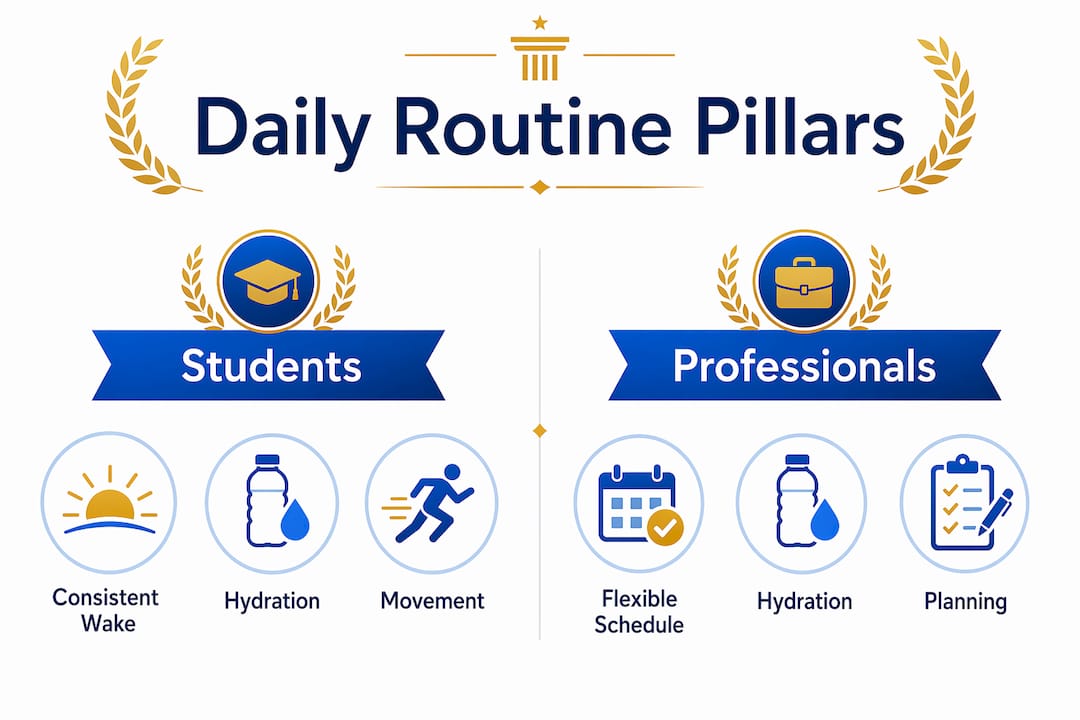
The best daily routine centers on four non-negotiable pillars: a consistent wake time, morning hydration, brief movement throughout the day, and a short planning session. These are not wellness trends. They are the habits with the strongest evidence behind them for sustaining focus and energy across a full day. A simple daily routine combining hydration, movement, and planning produces a meaningful shift in mental state and output quality.
What makes a good daily routine is not its complexity. Students who try to build 10 new habits at once almost always quit within two weeks. The routines that stick are the ones built on a small, repeatable structure that survives a bad day. Think of your routine as a skeleton, not a script. The skeleton stays in place even when the day goes sideways.
The ideal daily schedule for a college student or young professional looks different from a CEO’s morning ritual. You may have 8:00 AM lectures, unpredictable commutes, or back-to-back meetings. Your routine has to work for your real life, not an idealized version of it.
Why is a consistent wake time the foundation of any good routine?
Maintaining a consistent wake time within 30 minutes daily improves sleep quality, morning alertness, and daytime mood. That 30-minute window is the key detail most people miss. You do not need to wake at 5:00 AM. You need to wake at roughly the same time every day, including weekends.
Your body runs on a circadian rhythm, a roughly 24-hour internal clock that regulates sleep pressure, cortisol release, and body temperature. When your wake time shifts by 90 minutes or more between weekdays and weekends, you experience what sleep researchers call social jetlag. The result is grogginess, poor concentration, and lower mood on Monday mornings, even after a full night of sleep.
Here is what a realistic wake time setup looks like:
- Pick a time you can hit 6 out of 7 days. If you have a 9:00 AM class three days a week, waking at 7:30 AM every day is more sustainable than 6:00 AM on class days and 9:30 AM on others.
- Get morning light within 30 minutes of waking. Natural light suppresses melatonin and signals your brain that the day has started.
- Avoid hitting snooze. Fragmented sleep in the final 9 minutes does not restore energy. It increases grogginess.
- Set your wake time based on when you need to be functional, not when you wish you were a morning person.
Pro Tip: Write your wake time into your schedule the same way you write a class or meeting. Treat it as a fixed commitment, not a preference.
How to incorporate hydration and movement breaks into your day
Hydration and movement are the two habits most people agree are important and most consistently skip. The fix is not motivation. It is structure.
Drink water before anything else in the morning. Your body loses fluid overnight through breathing and light sweating. Starting the day dehydrated reduces cognitive performance before you have even opened your laptop. Keep a full glass or bottle on your nightstand so the habit requires zero decision-making.
Movement does not require a gym. Short, frequent movement breaks, such as 10 bodyweight squats every 45 minutes, sustain focus and control blood sugar as effectively as longer single exercise sessions. This approach is sometimes called the 3-3-3 rule: three hours of deep work, three shorter tasks, and three maintenance tasks, with movement woven between blocks. The benefits of morning movement extend beyond physical health, directly improving mood and mental clarity for the hours that follow.
Here is a simple daily movement and hydration sequence:
- Wake up. Drink one full glass of water before checking your phone.
- Step outside or stand near a window for 5 minutes to get natural light.
- Do 10 squats or a 2-minute stretch before sitting down to work or study.
- Set a 45-minute timer. When it goes off, stand up, move for 2 minutes, and drink water.
- Repeat the 45-minute cycle throughout your work or study blocks.
This sequence takes no extra time. It fits inside the gaps you already have. Students who use active movement breaks during study sessions report better focus and less mental fatigue by the end of the day.
What practical strategies help build daily routines that stick?
Average habit formation takes 66 days. That number surprises most people who expect habits to feel automatic within two weeks. The implication is direct: you need a system that keeps you going for two months before the behavior becomes effortless.
Visual trackers and checklists reduce decision fatigue by removing the daily question of “should I do this today?” The answer is already yes. A simple habit tracking approach makes the streak visible, which creates its own motivation. Seeing 14 consecutive checkmarks makes you far less likely to break the chain on day 15.
The most effective strategies for building lasting routines include:
- Start with one habit per week. Adding one new behavior at a time prevents the overwhelm that kills most routine attempts.
- Use habit stacking. Linking new habits to existing behaviors bypasses willpower entirely. “After I pour my coffee, I will drink a glass of water” is more reliable than “I will drink water in the morning.”
- Design for your actual energy levels. Schedule demanding tasks during your peak focus window, not during the hour after lunch when your energy naturally dips.
- Build a minimum viable version. On hard days, a 5-minute version of your routine beats skipping it entirely. Momentum matters more than perfection.
- Replace, do not force. If you skip a task three weeks in a row, it does not belong in your routine. Swap it for something you will actually do.
Pro Tip: Use implementation intentions: write down exactly when, where, and how you will perform each habit. “I will do 10 squats in my kitchen at 10:00 AM” outperforms “I will exercise more” every time.
How do you design an ideal daily schedule around your real life?
Routines built around sequences and anchor habits outperform routines built around strict clock times. Clock-based routines collapse the moment your schedule shifts. Sequence-based routines survive because the trigger is a behavior, not a time.
An anchor habit is a fixed point in your day that does not move: waking up, eating breakfast, finishing your last class, or sitting down at your desk. You attach new habits to these anchors. The sequence “wake up, drink water, get light, plan my top three tasks” works whether you wake at 6:30 AM or 8:00 AM.
Routines designed for your real constraints outperform idealized versions that cause frustration and abandonment. The table below shows how to adapt the same core routine across different daily demands.
| Schedule type | Morning anchor | Midday habit | Evening wind-down |
|---|---|---|---|
| Full-time student | Wake, hydrate, review class notes | 10-minute walk between lectures | Plan next day’s tasks, screen off by 10:30 PM |
| Early-career professional | Wake, hydrate, 15-minute planning block | Movement break every 45 minutes | Reflect on wins, prep tomorrow’s top 3 tasks |
| Part-time worker and student | Wake, hydrate, review schedule | Lunch walk or stretch | Light reading, consistent sleep time |
| Remote worker | Wake, hydrate, get outside light | Stand and move every hour | Shut down ritual, close laptop at set time |
The key is that every version shares the same skeleton: hydration, movement, and planning. The timing and length adjust. The structure does not.
What do effective daily routine examples actually look like?
A practical daily routine example for a college student starts with waking at a consistent time, drinking water, and spending 10 minutes reviewing the day’s priorities using a to-do list system. The morning block covers the hardest academic task first, when focus is sharpest. A midday walk or movement break resets attention for afternoon classes or study sessions.
Evening routines matter as much as morning ones. A short wind-down sequence, 20–30 minutes before sleep, signals the brain to shift out of work mode. This includes dimming screens, reviewing what went well, and writing tomorrow’s top three tasks. The daily planning benefits of this evening review compound over time: you wake up knowing exactly where to start, which eliminates the morning decision tax.
The most effective routines mix and match based on individual energy and schedule:
- Morning-heavy routines front-load the most demanding work before noon and use afternoons for meetings, emails, and lighter tasks.
- Evening-heavy routines suit night owls and those with early morning obligations. Deep work happens after 7:00 PM, with a firm cutoff and wind-down ritual.
- Balanced routines split focus work into two blocks, morning and late afternoon, with a genuine midday break in between.
Flexibility in routine adherence is not a weakness. If part of your day goes off track, return to the next helpful habit rather than abandoning the rest of the day. One missed habit does not erase the structure. Resuming matters more than being perfect.
Key Takeaways
The best daily routine is a consistent, flexible sequence of simple habits built around a stable wake time, hydration, movement, and planning, not a rigid schedule that collapses under real-life pressure.
| Point | Details |
|---|---|
| Consistent wake time | Keep your wake time within 30 minutes daily to protect sleep quality and morning alertness. |
| Hydration and movement | Drink water first thing and take short movement breaks every 45 minutes to sustain focus. |
| 66-day habit timeline | Expect two months before a habit feels automatic; use visual trackers to stay consistent. |
| Anchor habits over clock times | Build your routine around behavioral triggers, not fixed times, so it survives schedule shifts. |
| Start small, stay flexible | Add one habit per week and keep a minimum viable version ready for difficult days. |
What I have learned about routines that most advice gets wrong
Most routine advice assumes you have a blank calendar and unlimited willpower. You do not. Neither do I. The routines that actually changed how I work were not the ones I found in productivity books. They were the ones I built around what I was already doing.
The biggest mistake I see is treating a missed day as a failure. Routines are not streaks. They are structures. A structure that bends does not break. The moment you decide one skipped morning means the whole system is ruined, you have made the routine fragile by design.
Gradual habit building is not a compromise. It is the method. Starting with one anchor habit, getting it solid, then adding the next one, produces a routine that is still running six months later. The person who adds 10 habits at once is usually back to zero by week three.
The other thing nobody says clearly enough: your routine should feel slightly boring. If it is exciting, it is probably too ambitious. The goal is a sequence so familiar that you do it without thinking. That is when it starts working.
— Optiostation
How Optiostation helps you build and track your best routine
Optiostation is built for exactly the kind of Centurion who knows what they want to do but needs a reliable system to make it happen every day. The Optio app functions as your second-in-command, holding your tasks, habits, and schedule in one place so you never start the day wondering where to begin.
Whether you are a student managing lectures and deadlines or an early-career professional balancing projects and personal goals, Optiostation gives you the structure to build routines that last. The time management apps list on Optiostation covers the tools that pair best with a consistent daily routine setup. You can also explore time management goals built specifically for Centurions who want to move from reactive to intentional every single day.
FAQ
What is the best daily routine for a college student?
The best routine for a college student includes a consistent wake time, morning hydration, a short planning session, and movement breaks between study blocks. Keep it simple enough to repeat on your worst day.
How long does it take to build a daily routine?
Habit formation averages 66 days before a behavior becomes automatic. Use a visual tracker to stay consistent through the first two months.
What should a good morning routine include?
A good morning routine includes waking at a consistent time, drinking water immediately, getting natural light, and reviewing your top three priorities for the day. These four steps take under 20 minutes.
Should I follow a strict schedule or a flexible routine?
Anchor habits and sequences outperform rigid clock-based schedules because they survive disruptions. Build your routine around behavioral triggers, not fixed times.
What do I do when I miss part of my routine?
Return to the next habit in your sequence rather than abandoning the rest of the day. Flexibility increases sustainability, and resuming after a disruption is the defining habit of a durable routine.
Recommended
- 7 Best Time Management Goals Examples for Centurions – Optio Station: Best Project Management App for Prioritization
- Organize your study schedule for maximum productivity – Optio Station: Best Project Management App for Prioritization
- Productivity rituals that boost focus: 26% performance gain – Optio Station: Best Project Management App for Prioritization
- Work routine ideas that actually fit your busy life – Optio Station: Best Project Management App for Prioritization
