

TL;DR:
- Goals in life are purposeful targets aligned with personal values that guide long-term decisions. Setting specific, value-driven goals and breaking them into milestones using frameworks like SMART and Goal Cascade increases the likelihood of success. Regular reviews help maintain progress and adapt goals to changing circumstances and priorities.
Goals in life are defined as specific, purposeful targets that give your decisions direction and your efforts meaning across every major area of your life. Without them, thriving is unlikely. The question of what is goals in life goes beyond simple ambition. It touches on values, timing, and the systems you use to translate big visions into daily progress. Whether you are a college student figuring out your next move or a young professional building a career, understanding how personal life goals work is the clearest path from where you are to where you want to be.
What is goals in life, and why does it matter?
Life goals are purposeful, long-term objectives that align with your core values and guide your behavior over months, years, or decades. They are not wishes or vague hopes. A life goal has direction, a reason behind it, and ideally a structure that connects it to your daily actions.

Goal setting has proven over 35 years to be a powerful motivator by sharpening focus, energizing persistence, and guiding behavior. That track record matters because it means the benefits of defining life goals are not theoretical. They are measurable and repeatable.
Personal life goals also span multiple areas. Health, career, finances, and relationships each deserve attention. Focusing on a single area may produce success in one domain but reduce overall life satisfaction. A college student who sets only academic goals while ignoring health or social connection often burns out before graduation.
The term “goal setting” is the recognized framework in psychology and performance research for this practice. You will see it used by researchers like Edwin Locke and Gary Latham, whose work forms the foundation of modern goal theory. Knowing that term helps you find credible resources and apply the research correctly.
What are the key characteristics of life goals?
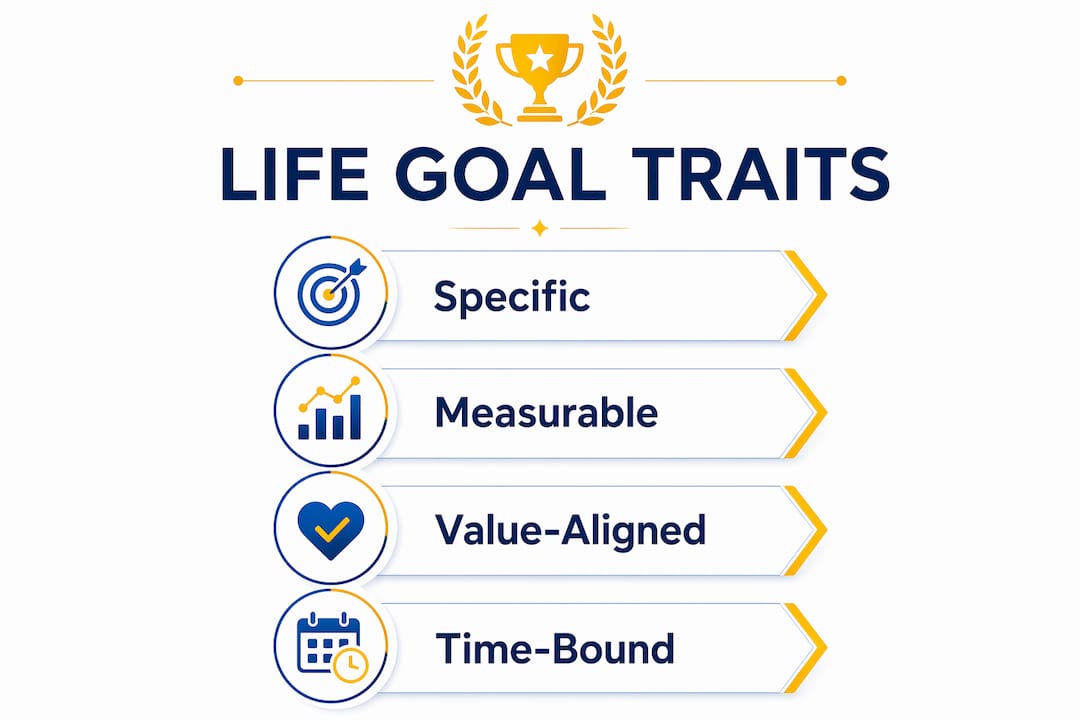
Life goals share four defining characteristics that separate them from casual intentions. Understanding these helps you evaluate whether what you are calling a goal actually functions like one.
- Clarity. A clear goal specifies what you want and when you want it. “Get healthier” is not a goal. “Run a 5K by october” is.
- Personal alignment. The most effective goals reflect your own values and current life circumstances, not external expectations from parents, peers, or social media.
- Energizing quality. Goals focus effort and motivate persistence by directing attention toward relevant behaviors and away from distraction. A goal you genuinely care about pulls you forward even on hard days.
- Commitment. Locke and Latham’s Goal Setting Theory identifies commitment as the variable that determines whether a goal produces results. High commitment comes from goals you chose, not goals assigned to you.
These four characteristics explain why so many people set goals in january and abandon them by march. The goals were vague, externally driven, and carried no real personal commitment.
Pro Tip: Before writing any goal down, ask yourself: “Would I pursue this if no one else knew about it?” If the answer is no, the goal is driven by external pressure, not internal values.
The psychological mechanism behind goal setting is straightforward. Purposeful human behavior depends on conscious goals that serve as benchmarks for growth. When you set a goal, your brain begins filtering information differently. Opportunities and resources that match your goal become more visible. This is not mystical. It is how attention works.
How to set effective life goals using recognized frameworks
The most widely used goal-setting technique is the SMART framework. SMART goals are Specific, Measurable, Achievable, Relevant, and Time-bound, with deadlines that create urgency and measurable progress. The framework remains the industry standard in 2026 because it forces you to answer the questions that vague goals leave open.
Here is how to apply SMART criteria step by step:
- Specific. Replace broad language with exact outcomes. Instead of “improve my finances,” write “save $5,000 by december 31.”
- Measurable. Attach a number, percentage, or clear milestone. “Read more” becomes “read one book per month.”
- Achievable. Stretch yourself, but stay within the range of what is realistic given your current resources and time.
- Relevant. The goal must connect to something you genuinely value. A goal that does not serve your larger purpose will not survive the first obstacle.
- Time-bound. Set a deadline. Without one, a goal becomes an open-ended wish with no urgency.
Pro Tip: Write your SMART goal in one sentence. If you cannot fit it into one sentence, it is not specific enough yet. Try the SMART goal format designed for students and young professionals to practice this.
Beyond SMART, the most effective long-term approach uses a hierarchical structure called a Goal Cascade. Establishing lifetime goals provides major decision-making perspective. The cascade works like this:
| Level | Timeframe | Example |
|---|---|---|
| Summit Goal | 10–25 years | Become a licensed architect |
| 5-Year Plan | 3–5 years | Complete architecture degree and first internship |
| Annual Milestone | 12 months | Pass all core design courses with a B or higher |
| Quarterly Check-in | 3 months | Complete two studio projects and one industry visit |
The cascade solves the most common reason people fail to reach long-term goals. Most people fail because they never break big visions into smaller periodic milestones connected by a hierarchical system. The Summit Goal gives you direction. The quarterly milestones give you traction.
For effective goal setting for students, the cascade is especially useful because it connects the pressure of a semester to a larger life purpose. A student who knows their Summit Goal finds it easier to push through a difficult course because the course has a clear role in the bigger picture.
Why aligning life goals with your values matters
Goal abandonment is rarely about laziness. It is almost always about misalignment. Life goals must align with personal values and current life stage. When they do not, motivation collapses the moment the goal becomes difficult.
Three common misalignment traps affect college students and young professionals most often:
- Borrowed goals. You adopt a goal because someone you respect has it, not because it fits your own values. A pre-med student who pursues medicine to satisfy a parent’s expectation is running on borrowed fuel.
- Wrong season goals. A goal that made sense at 19 may not fit at 24. Life circumstances change. A goal set before a major relationship, job change, or health event may no longer reflect your actual priorities.
- Ambition without foundation. Setting a goal that requires resources, skills, or time you do not yet have creates early failure. Early failure damages confidence and makes future goal-setting feel pointless.
The fix is a short values audit. Write down your top five personal values. Then check each goal against that list. If a goal does not connect to at least one core value, it will not survive adversity.
Balanced life goals span health, career, finances, and relationships. Neglecting any one area creates imbalance that eventually undermines the areas you did invest in. A young professional who hits every career milestone but ignores health and relationships often finds the career wins feel hollow.
Venture University’s career strategy program offers one structured approach to breaking Summit Goals into achievable milestones for students entering competitive fields. It is a useful external reference point when your own goal structure needs outside perspective.
How to maintain progress and adapt your goals over time
Setting a goal is the easy part. Maintaining momentum over months and years is where most people struggle. The solution is a system, not willpower.
- Monthly check-ins. Effective goal tracking involves quantitative monthly check-ins to monitor progress toward deadlines and make course corrections. Set a recurring calendar block on the first of each month. Review your numbers, not your feelings.
- Goal adjustment. Adjusting a target or timeline is critical and not a sign of failure. Successful goal management includes knowing when to pivot based on alignment and progress. A goal that no longer fits your life is not worth defending out of stubbornness.
- Friction mapping. Before committing to a goal, list the three most likely obstacles. Write a specific response to each one. This is called a friction map, and it converts vague intention into prepared action.
- Habit formation. Goals and habits work together. A goal tells you where to go. A habit is the daily action that gets you there. Linking a new behavior to an existing routine increases the chance it sticks.
Pro Tip: Track your goals with numbers, not adjectives. “I made progress” tells you nothing. “I completed 3 of 4 milestones this quarter” tells you exactly where you stand.
The table below shows how a simple monthly review system works in practice:
| Review area | What to measure |
|---|---|
| Milestone completion | Number of planned tasks completed vs. planned |
| Timeline status | On track, ahead, or behind schedule |
| Value alignment | Does this goal still reflect what I care about? |
| Next action | One specific task to complete before next review |
Goal structure, review, and flexibility keep momentum alive and prevent burnout. The review process is not about judgment. It is about information. You cannot adjust what you do not measure.
For young professionals managing multiple responsibilities, tools that combine task tracking and goal visualization reduce the mental load of keeping a goal cascade active. The goal stays visible, and the next action stays clear.
Key Takeaways
Life goals work when they are specific, value-aligned, and connected to a structured cascade that links daily actions to long-term purpose.
| Point | Details |
|---|---|
| Define goals precisely | A life goal must be specific, measurable, and tied to a personal value to function effectively. |
| Use a Goal Cascade | Break Summit Goals into 5-year, annual, and quarterly milestones to stay on track daily. |
| Apply the SMART framework | Specific, Measurable, Achievable, Relevant, and Time-bound criteria turn vague wishes into real plans. |
| Align with your values | Goals that conflict with your values or current life stage get abandoned when difficulty arrives. |
| Review and adjust monthly | Quantitative monthly check-ins prevent stagnation and signal when a goal needs adjustment, not abandonment. |
What I have learned from watching young adults set goals
The most common mistake I see is treating goal-setting as a one-time event. You sit down in january, write five big goals, and then return to the same list in december wondering why nothing moved. That is not goal-setting. That is wishful thinking with a date on it.
What actually works is treating your goals like a living document. The Summit Goal stays stable. Everything below it gets reviewed, adjusted, and sometimes replaced. A student who set a goal to study abroad in 2024 and then faced a family financial crisis did not fail. The goal needed a new timeline, not a eulogy.
The other thing I have noticed is that young adults tend to set goals in only one area of life, usually career or academics. That focus feels productive, but it creates blind spots. Health declines. Relationships thin out. Then the career goal gets harder to pursue because the support system is gone.
Balanced goal-setting across health, relationships, finances, and career is not a soft suggestion. It is a structural requirement for sustained performance. The research from Ramsey Solutions on types of personal goals backs this up clearly.
Start with clarity. Build the cascade. Review the numbers. Adjust without guilt.
— Optiostation
Optiostation: your second-in-command for goal tracking
Knowing what your goals are is step one. Keeping them visible, organized, and moving forward is where most people need support.

Optiostation is built for exactly this. The app gives students and young professionals a structured space to set milestones, assign deadlines, and track progress across every area of life. The Roman-themed interface treats you as the Centurion in command of your own direction, with Optio as your second-in-command handling the details. From task management tools to milestone reminders and goal visualization, Optiostation keeps your Goal Cascade active and your next action clear. If you are ready to move from planning to doing, Optiostation is where that shift happens.
FAQ
What is the definition of goals in life?
Life goals are specific, purposeful objectives that align with your core values and guide your decisions over the long term. They span multiple areas including health, career, finances, and relationships.
What are my goals vs. what should my goals be?
Your goals are the ones that reflect your own values and current life circumstances. Goals based on external expectations or social pressure tend to be abandoned when they become difficult.
How do I figure out what is my goal in life?
Start with a values audit. Write down your top five personal values, then identify the long-term outcomes that would honor those values. Your Summit Goal should emerge from that intersection.
What goal setting techniques actually work?
The SMART framework and the Goal Cascade are the two most research-backed techniques. SMART makes individual goals precise. The cascade connects short-term milestones to a long-term purpose. You can explore SMART goal examples to see both in practice.
How often should I review my life goals?
Monthly check-ins are the standard recommendation. Review your milestone completion rate, timeline status, and whether each goal still aligns with your current values and life stage.
Recommended
- What Is a Goal? a Clear Definition for Students – Optio Station: Best Project Management App for Prioritization
- Define your goals: proven strategies for motivation and success – Optio Station: Best Project Management App for Prioritization
- What Are Personal Goals and Why They Matter – Optio Station: Best Project Management App for Prioritization
- Personal Work Goals 2026: 72% Higher Achievement Rates – Optio Station: Best Project Management App for Prioritization
