

TL;DR:
- Short-term goals are specific, measurable objectives completed within a year that promote immediate progress.
- They build momentum by providing quick feedback, boosting motivation, and reducing overwhelm during personal or professional growth.
A short-term goal is defined as a specific, measurable objective you complete within a few days to one year, designed to create immediate progress toward your broader ambitions. Unlike vague intentions, these goals give you a concrete target and a deadline. The US Chamber of Commerce confirms that short-term goals fall under a 12-month window, typically organized around daily, weekly, or quarterly targets. For college students and young professionals, understanding the definition of short term goal is the first step toward building real momentum in school and at work.
What is a short term goal and why does it matter?
A short-term goal is a tactical objective that bridges where you are now and where you want to be. It is specific enough to act on today and short enough to see results within weeks or months. Think of it as the unit of execution in any personal or professional growth plan.

The reason these goals matter so much comes down to psychology. When you complete a short-term goal, your brain registers a win. That win releases dopamine, which reinforces the behavior and makes you more likely to keep going. For a student trying to finish a research paper or a new analyst trying to hit a quarterly target, that feedback loop is what separates people who follow through from people who don’t.
Short-term goals also reduce the paralysis that comes with big ambitions. Wanting to become a software engineer is motivating in theory but overwhelming in practice. Breaking that ambition into goals like “complete 10 Python lessons in 21 days” gives you something to act on right now. The SMART framework, which stands for Specific, Measurable, Achievable, Relevant, and Time-bound, is the most widely used structure for building goals with that kind of clarity.
What are the key benefits of short term goals?
Short-term goals deliver benefits that long-term planning alone cannot provide. The most important is immediate feedback. You know within days or weeks whether your approach is working, which lets you adjust before you’ve wasted months of effort.
Here are the core benefits worth understanding:
- Motivation through quick wins. Completing a goal, even a small one, builds confidence. Indeed Career Advice notes that short-term goals act as skill-building micro-wins that steadily grow your professional reputation.
- Reduced overwhelm. Breaking a year-long goal into weekly steps removes the psychological weight of the full task. Research shows that breaking marathon training into weekly running increments reduces psychological barriers by up to 70%.
- Sharper focus. A time-bound goal forces you to prioritize. You stop asking “what should I do?” and start asking “what do I do today?”
- Measurable progress. You can track completion rates, which gives you data to improve your planning over time.
- Burnout prevention. Short cycles let you rest and reset. You finish a goal, celebrate, and start fresh rather than grinding toward a finish line that never seems to move.
For students, a concrete example is setting a goal to read 30 pages of a textbook every weekday for two weeks before an exam. For a young professional, it might be completing three LinkedIn outreach messages per week for a month. Both are specific, time-bound, and immediately actionable.
Pro Tip: Set your short-term goals on Sunday evening for the week ahead. Spending 10 minutes planning on Sunday reduces decision fatigue on Monday morning and makes you 40% more likely to follow through.
Short term vs long term goals: how do they work together?
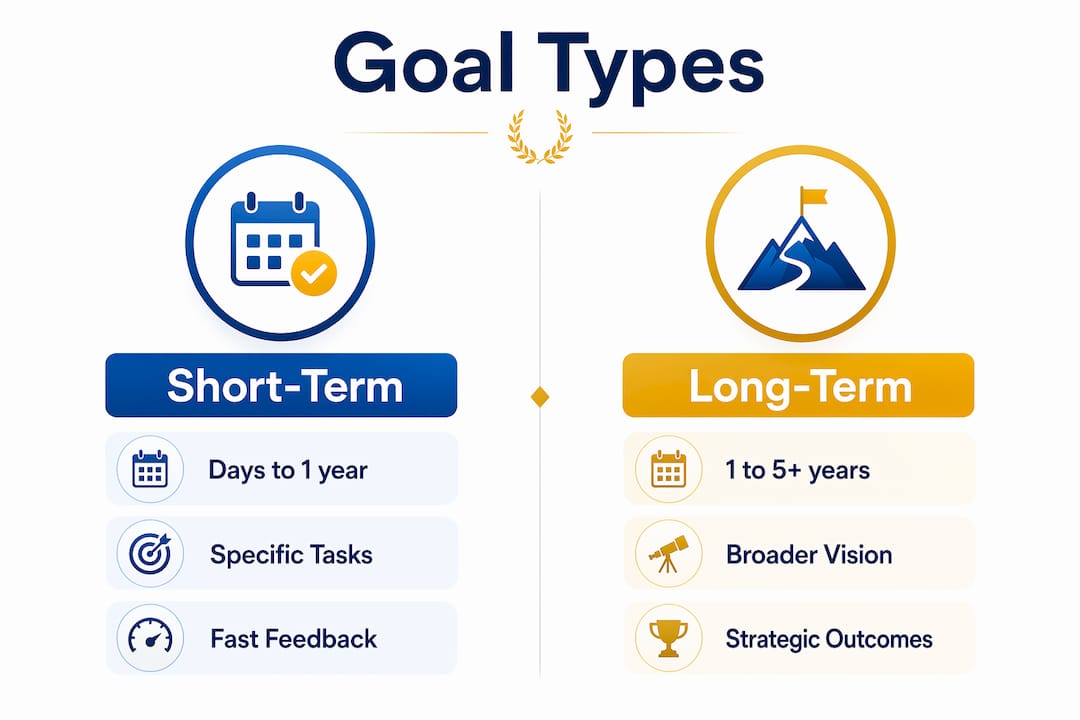
Short-term and long-term goals are not competing priorities. They are different layers of the same plan. The US Chamber of Commerce describes this relationship as a cascading goals pyramid, where each short-term goal feeds directly into a larger vision.
The table below shows the key differences and how each type functions:
| Feature | Short-Term Goals | Long-Term Goals |
|---|---|---|
| Timeframe | Days to 12 months | 1 year to 5+ years |
| Focus | Specific actions and habits | Broad outcomes and vision |
| Feedback speed | Fast, within weeks | Slow, measured in years |
| Primary purpose | Build momentum and skills | Define direction and identity |
| Example | Read one chapter daily for 30 days | Earn a degree or promotion |
The biggest mistake students and early-career professionals make is treating these two types as separate. The US Chamber of Commerce is direct on this point: treating them as isolated objectives instead of interconnected components of a goals hierarchy is the most common failure in goal planning.
A practical example: if your long-term goal is to become a marketing manager within three years, your short-term goals might include completing a Google Analytics certification this quarter, writing two blog posts per month for six months, and scheduling one informational interview per week for the next four weeks. Each short-term goal builds a skill or relationship that the long-term goal requires. Remove any one of them and the path gets longer.
How to set short term goals that you actually achieve
Setting a goal is easy. Setting one you actually complete requires a system. The SMART framework is the most proven starting point. A SMART goal is Specific, Measurable, Achievable, Relevant, and Time-bound. Applied to real life, it turns “I want to get better at public speaking” into “I will deliver a 5-minute presentation at my campus club every other week for 8 weeks.”
Here is a step-by-step process for setting short-term goals that stick:
- Start with your long-term vision. Identify one major outcome you want in the next 1–3 years. Your short-term goals should serve that outcome directly.
- Apply the SMART criteria. Write your goal in one sentence that includes what you will do, how you will measure it, and when you will finish. The SMART framework improves goal clarity and follow-through significantly.
- Break it into atomic tasks. The first action for any goal should take 5 minutes or less. If your goal is to write a research paper, your first task is “open a blank document and type the title.” The US Chamber of Commerce confirms that atomic first steps prevent the start-stop procrastination cycle.
- Set a tracking mechanism. Use a calendar, a checklist, or a digital tool. Indeed Career Advice notes that visual task completion increases motivation and helps maintain focus over time.
- Start smaller than you think you need to. Primer Magazine’s 2026 research shows that starting with 2 minutes of meditation instead of 30 increases adherence past 14 days. The same principle applies to any new habit.
- Review and adjust weekly. Goals that don’t get reviewed get abandoned. A 10-minute weekly check-in is enough to catch problems early and recalibrate.
For academics, strong examples of short-term goals include completing 10 course lessons in 21 days, submitting one scholarship application per week for a month, or improving a GPA by 0.3 points in one semester. For young professionals, examples include reaching out to five new contacts per week, completing a certification in 30 days, or setting SMART goals for work that align with your team’s quarterly targets.
Pro Tip: Focus your short-term goals on inputs you control, not outcomes you can’t. Goal Posters research confirms that input-focused goals like “schedule a networking coffee” outperform outcome goals like “get a promotion” because you can execute them regardless of external conditions.
What mistakes kill short term goals before they start?
Most short-term goals fail for predictable reasons. Recognizing these patterns early saves you weeks of wasted effort.
- Goals that are too vague. “Study more” is not a goal. “Study organic chemistry for 45 minutes every weekday at 7 p.m.” is. Vague goals give your brain no clear signal to act on.
- Goals that are too large for your current habits. Primer Magazine’s 2026 findings are clear: starting too big is the primary cause of early abandonment. If you haven’t exercised in months, committing to 90-minute daily workouts will fail by week two.
- No tracking system. A goal without a record is just a wish. Without tracking, you lose visibility into your progress and miss the psychological reward of checking something off.
- Treating short-term and long-term goals as separate. When your daily actions don’t connect to a bigger purpose, motivation drops fast. Every short-term goal should answer the question: “What long-term outcome does this serve?”
- Setting too many goals at once. Three focused goals will outperform ten scattered ones every time. Overloading creates decision fatigue and splits your attention across too many fronts.
- Ignoring the need for adjustment. Life changes. A goal that made sense in September may not fit in November. Build in a monthly review where you give yourself permission to modify goals without treating it as failure.
The goal-setting guide for students from Optiostation covers how to apply these principles within academic schedules, which tend to shift dramatically between semesters.
Key takeaways
Short-term goals work because they convert abstract ambition into specific, trackable actions that deliver fast feedback and build the habits long-term success requires.
| Point | Details |
|---|---|
| Definition is precise | A short-term goal is specific, measurable, and completed within 12 months. |
| SMART framework is the standard | Apply Specific, Measurable, Achievable, Relevant, and Time-bound criteria to every goal. |
| Atomic first steps prevent procrastination | Make your first action take 5 minutes or less to break the start-stop cycle. |
| Short and long-term goals must connect | Treat every short-term goal as a direct building block toward your larger vision. |
| Tracking is non-negotiable | Visual progress records increase motivation and keep you accountable week to week. |
The part most goal-setting advice gets wrong
Here is what Optiostation has observed working with students and young professionals: most goal-setting content focuses on the goal itself and ignores the system around it. You can write the most perfectly worded SMART goal and still fail if you have no consistent time to work on it, no way to track it, and no connection between that goal and something you genuinely care about.
The advice to “start small” sounds obvious until you actually do it. Starting with 2 minutes of a new habit instead of 30 feels almost embarrassing. But that embarrassment is the point. It removes every excuse your brain can generate for not starting. Once you start, momentum takes over. Optiostation has seen this pattern repeatedly: the students who set the smallest, most specific goals in September are the ones who show the most measurable progress by December.
The other thing worth saying plainly: celebrate your completions. Not with a party, but with a moment of acknowledgment. Mark it done. Write it down. Tell someone. That act of recognition is not self-indulgence. It is the psychological signal that tells your brain this behavior is worth repeating. Skip it and you leave motivation on the table.
— Optiostation
Track your goals with the right tools
Setting a goal is only half the work. The other half is building a system that keeps it visible, organized, and moving forward every day. Optiostation is built exactly for this. As your second-in-command, it handles the structure so you can focus on execution.

Whether you are a Centurion managing coursework, internship applications, or your first professional projects, Optiostation gives you the task and time management infrastructure to turn short-term goals into completed milestones. Check out the best task management software guide to find the right setup for your workflow. If you want to go deeper on managing tasks effectively, Optiostation’s resources cover both student and professional contexts with practical, tested frameworks.
FAQ
What is the definition of a short term goal?
A short-term goal is a specific, measurable objective designed to be completed within a few days to one year. It serves as a tactical step toward a larger long-term ambition.
How long is a short term goal supposed to take?
Short-term goals generally fall under a 12-month period, with many focused on daily, weekly, or quarterly targets depending on the context.
What are good examples of short term goals for students?
Strong examples include completing 10 course lessons in 21 days, submitting one scholarship application per week, or improving a GPA by 0.3 points in a single semester. Each example is specific, time-bound, and directly measurable.
How do short term goals support long term goals?
Short-term goals function as stepping stones in a cascading goals pyramid, where each completed short-term objective builds the skills, habits, or relationships a long-term goal requires.
How many short term goals should i set at once?
Set no more than three active short-term goals at a time. Focusing on three goals produces more consistent results than spreading attention across ten, because it preserves the mental energy needed to follow through on each one.
Recommended
- Effective Goal Setting for Students: Achieve Your Dreams – Optio Station: Best Project Management App for Prioritization
- Examples of SMART goals to boost academic success – Optio Station: Best Project Management App for Prioritization
- Complete Guide to Goal Setting for Students – Optio Station: Best Project Management App for Prioritization
- What Are Personal Goals and Why They Matter – Optio Station: Best Project Management App for Prioritization
