

TL;DR:
- Setting clear, specific, and achievable deadlines enhances task ownership and project progress. Breaking large projects into mini-deadlines, adding buffer time, and using accountability systems improve deadline accuracy and motivation. Effective deadline management relies on data-driven estimates, strategic planning, and habit-building to sustain momentum without burnout.
Setting deadlines is the practice of assigning precise, non-negotiable completion dates to tasks and goals so that work moves forward with purpose instead of drifting. Most students and young professionals treat deadlines as something that happens to them rather than something they design. That shift in ownership changes everything. Tools like Google Calendar, Trello, and Optiostation exist precisely to support this kind of intentional deadline planning. The strategies below draw from project management research and behavioral science to show you how to set deadlines that are realistic, motivating, and actually achievable.
How to set deadlines that are realistic and actionable
A deadline only works when the deliverable behind it is crystal clear. Ambiguous deadlines cause misunderstandings, wasted effort, and missed dates because everyone involved has a different picture of what “done” looks like. Before you write a date on your calendar, define exactly what output is expected, what quality standard it must meet, and what dependencies need to be resolved first.

The SMART framework is the most reliable structure for deadline setting strategies. A SMART deadline is Specific (a named deliverable), Measurable (a defined quality bar), Achievable (within your actual capacity), Relevant (tied to a real goal), and Time-bound (a fixed date, not “soon”). Writing “finish the research report introduction by Friday at 5 p.m.” beats “work on report” every time because it leaves no room for negotiation with yourself.
Breaking large tasks into smaller components is where most people gain the most ground. A 20-page thesis due in three months is psychologically distant and easy to ignore. The same thesis divided into weekly writing targets with their own mini-deadlines becomes a series of short sprints you can actually plan around. This approach also surfaces problems early, when you still have time to fix them.
Buffer time is not optional. Project management standards recommend adding 10 to 15% buffer for routine tasks and 50% or more for complex work. That means a task you estimate at 10 hours should be scheduled for 11 to 15 hours depending on its complexity. A separate tactic is to set an internal buffer deadline 24 to 72 hours before the official due date, giving you a quality review window and protection against last-minute surprises.
Key practices for setting realistic deadlines:
- Define the deliverable, quality standard, and dependencies before assigning any date
- Apply SMART criteria to every deadline you write down
- Break projects into phases with their own completion dates
- Add 10 to 15% buffer for routine tasks and 50% or more for complex ones
- Set an internal deadline 24 to 72 hours before the official due date
Pro Tip: Write your deadlines in your calendar as appointments with a specific output in the title, not just a task name. “Submit draft intro, 800 words” is harder to skip than “work on essay.”
What tools and techniques help you maintain momentum?
Knowing how to manage deadlines is only half the battle. The other half is building habits and systems that keep you moving toward those dates without burning out or losing track.
-
Timeboxing. Timeboxing converts open-ended tasks into fixed calendar blocks that you defend the same way you would defend a meeting. If you schedule “data analysis: Tuesday 2 to 4 p.m.,” that block is not negotiable. This technique directly applies Parkinson’s Law, the principle that work expands to fill the time available. Compress the time, and the work compresses with it.
-
Public accountability. Announcing your deadline publicly triggers commitment bias, a psychological mechanism that makes you far more likely to follow through because your reputation is now attached to the outcome. Tell a classmate, a manager, or a study group what you plan to deliver and when. The social pressure is real and it works.
-
Weekly time audits. Comparing predicted versus actual focused work time every week is one of the most underused deadline planning tips available. Track every task longer than 15 minutes. After four weeks, your estimates become data-driven rather than optimistic guesses. Most people discover they overestimate their available focus time by 30 to 50%.
-
Time blocking around peak energy. Scheduling your hardest deadline-driven work during your peak cognitive hours, whether that is 8 a.m. or 10 p.m., multiplies the output you get from each hour. Pairing this with time blocking techniques creates a daily structure where your most important deadlines always get your best attention.
Pro Tip: Run your first time audit this week. Pick five tasks, estimate how long each will take, then track the actual time. The gap between your estimate and reality is your personal planning error rate. Fix that number and your deadlines become dramatically more accurate.
How do mini-deadlines compare to single project deadlines?
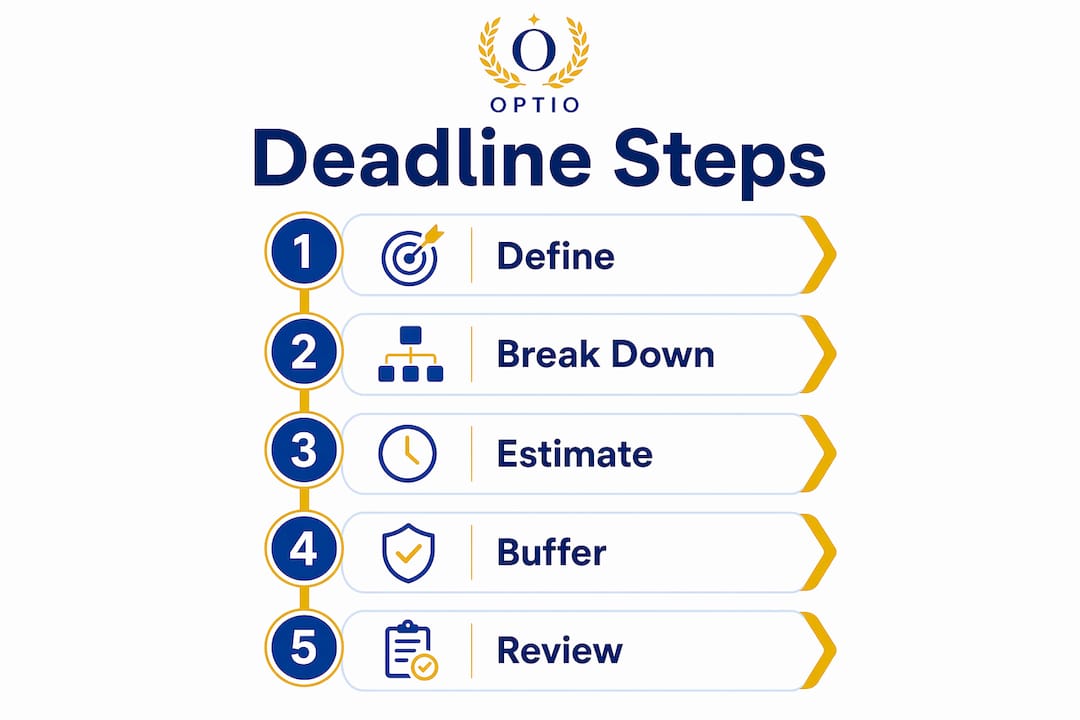
The psychological distance of a far-off deadline is one of the biggest obstacles in deadline planning. A deadline six months away registers as abstract and non-urgent, which is why procrastination wins so often on long projects.
| Approach | Single distant deadline | Mini-deadlines every 3 weeks |
|---|---|---|
| Urgency level | Low until the final weeks | Consistent throughout the project |
| Error detection | Late, often too late to fix | Early, while recovery is still possible |
| Motivation pattern | Panic-driven at the end | Steady progress with regular wins |
| Cognitive load | High, project feels overwhelming | Lower, each phase is manageable |
| Recommended for | Simple, short tasks only | Any project longer than 2 weeks |
Sprint cycles with mini-deadlines every three weeks are the standard recommendation from productivity experts for maintaining momentum on longer work. The Work Breakdown Structure (WBS), a project management framework used by teams at companies like Google and Deloitte, applies this same logic by decomposing any project into discrete deliverables, each with its own deadline.
For a student writing a research paper, this looks like: Week 1 deadline for topic approval and source list, Week 2 deadline for outline and thesis statement, Week 3 deadline for first draft of body sections. Each mini-deadline is tied to a concrete output, not just “make progress.” You can apply the same structure to work projects using project breakdown methods that map each phase to a specific date and deliverable.
What are the most common deadline-setting mistakes?
The single most damaging mistake in deadline setting is the Planning Fallacy. The Planning Fallacy causes habitual underestimation of how long tasks take, regardless of past experience. You have done it before: you set a two-hour deadline for something that took five hours, then repeated the same mistake the next week. The fix is not willpower. It is data, specifically the time audit practice described above.
The second major mistake is leaving assumptions unexamined. Vague expectations kill deadlines faster than any external disruption. Before you commit to a date, ask: What exactly is the output? Who needs to review or approve it? What resources do I need that I do not yet have? Clarifying these questions upfront prevents the “I didn’t know that was part of it” conversation that derails timelines.
Common deadline mistakes to watch for:
- Setting deadlines without defining the deliverable first
- Ignoring dependencies (waiting on someone else’s output before you can start)
- Failing to build in buffer time for review and revision
- Never reviewing whether your time estimates were accurate
- Treating a threatened deadline as a crisis rather than a data point
“Effective deadline management is more about systemic risk visibility and realistic scheduling than simply tracking dates.” — Project Management Formula
When a deadline is genuinely at risk, the right response is critical path analysis before adding resources or extending the timeline. Identify which tasks directly affect the final delivery date and which have slack time. Often, a threatened deadline can be recovered by fast-tracking two or three critical tasks rather than overhauling the entire schedule. This approach, drawn from formal project management, applies just as well to a student’s semester plan as to a corporate product launch.
Key takeaways
Effective deadline setting requires clear deliverables, calibrated time estimates, buffer time, and accountability systems working together.
| Point | Details |
|---|---|
| Define before you date | Specify the deliverable, quality standard, and dependencies before assigning any deadline. |
| Build in buffer time | Add 10 to 15% for routine tasks and 50% or more for complex work to protect against the unexpected. |
| Use mini-deadlines | Break any project longer than two weeks into sprint cycles with deliverables every three weeks. |
| Run weekly time audits | Compare estimated versus actual task time to eliminate the Planning Fallacy from your scheduling. |
| Make deadlines public | Announcing your commitments to others increases follow-through through commitment bias. |
The discipline behind the date
At Optiostation, we have watched thousands of students and young professionals struggle not because they lack ambition, but because they set deadlines based on hope rather than data. The first time we ran a weekly time audit internally, the results were uncomfortable. We were overestimating available focus time by nearly 40%, which meant every deadline we set was built on a fiction.
The shift that actually worked was treating time estimation as a skill to train, not a talent you either have or do not. Mini-deadlines changed the texture of long projects entirely. Instead of a looming wall at the end of a semester or a quarter, work became a series of small, winnable games. Each completed mini-deadline built the kind of momentum that makes the next one easier to hit.
Public accountability felt awkward at first. Telling a colleague or a study partner “I will have this draft to you by Thursday at noon” creates real pressure. That pressure is not comfortable, but it is productive. The discomfort of a public commitment is almost always smaller than the regret of a missed deadline. Pair that with assignment tracking strategies that keep your progress visible, and you have a system that works even when motivation is low.
The honest truth about deadline setting is that the first few attempts will be wrong. Your estimates will be off, your buffers will be too small, and something will go sideways. That is not failure. That is calibration data. Use it.
— Optiostation
How Optiostation helps you hit every deadline
Knowing the strategies is one thing. Having a system that holds them together is another.
Optiostation is built specifically for students and young professionals who need more than a basic to-do list. As your Optio, your second-in-command, it handles the structure so you can focus on the work. You can break projects into phases with individual deadlines, set reminders that fire before your internal buffer window closes, and sync across your devices so nothing slips through. Whether you are managing a semester of coursework or juggling multiple work projects, Optiostation gives you the task management tools to apply every strategy in this article without rebuilding your system from scratch each time. Your deadlines deserve a system that takes them as seriously as you do.
FAQ
What does it mean to set a deadline?
Setting a deadline means assigning a specific, non-negotiable completion date to a task or deliverable. A well-set deadline includes a defined output, a quality standard, and any dependencies that must be resolved before work can finish.
How do you set realistic deadlines for complex projects?
Break the project into phases with mini-deadlines every two to three weeks, add a 50% or greater buffer for complex tasks, and run weekly time audits to calibrate your estimates against actual performance.
What is the Planning Fallacy and why does it matter?
The Planning Fallacy is the tendency to underestimate how long tasks take, regardless of past experience. It matters because it is the root cause of most missed deadlines, and the only reliable fix is tracking actual task time and adjusting future estimates accordingly.
How can I stay accountable to my own deadlines?
Announce your deadlines to a classmate, colleague, or study group. Public commitment triggers commitment bias, a psychological mechanism that significantly increases follow-through because your reputation becomes tied to the outcome.
What should I do when a deadline is at risk?
Run a critical path analysis to identify which tasks directly affect the final delivery date before making any changes. Fast-tracking critical tasks or reducing scope is usually more effective than simply extending the deadline or adding more resources.
Recommended
- 7 Bad Time Management Examples Every Centurion Should Avoid – Optio Station: Best Project Management App for Prioritization
- 7 Steps to a Powerful Weekly Planning Checklist for Success – Optio Station: Best Project Management App for Prioritization
- How to Prioritize Assignments Effectively for Success – Optio Station: Best Project Management App for Prioritization
- 7 Key Goal Setting Techniques for Centurions – Optio Station: Best Project Management App for Prioritization
