

TL;DR:
- A project coordinator serves as the operational backbone of a project, managing scheduling, documentation, and communication to ensure timely progress. The role differs from a project manager by focusing on daily processes rather than outcome ownership, with advancement typically occurring within three to five years through experience and certifications. To excel, coordinators must proactively identify risks, master project tools, and demonstrate strategic thinking through clear communication and information management.
A project coordinator is the operational backbone of any project, responsible for organizing tasks, facilitating communication, and maintaining schedules so that projects reach their goals on time. This role sits directly beneath the project manager in the hierarchy and handles the day-to-day execution that keeps everything moving. Tools like Asana, ClickUp, and Microsoft Project are standard equipment for anyone in this position. If you are a college student or young professional mapping out a project management career path, understanding the project coordinator role is the clearest first step you can take.
What does a project coordinator do?
A project coordinator functions as the primary operational support for a project manager, managing documentation, organizing meetings, tracking tasks, and acting as the main communication link between team members and stakeholders. That description covers a lot of ground, and it is worth unpacking each piece. The coordinator does not own the project outcome. The coordinator owns the processes that make the outcome possible.
On any given day, a project coordinator might update a project schedule in Microsoft Project, send a status report to three different departments, log meeting minutes, and flag a delayed task to the project manager. None of those tasks are glamorous. All of them are critical. Project coordinators support project planning, scheduling, documentation, and communication, playing a central part in keeping projects aligned with their goals.
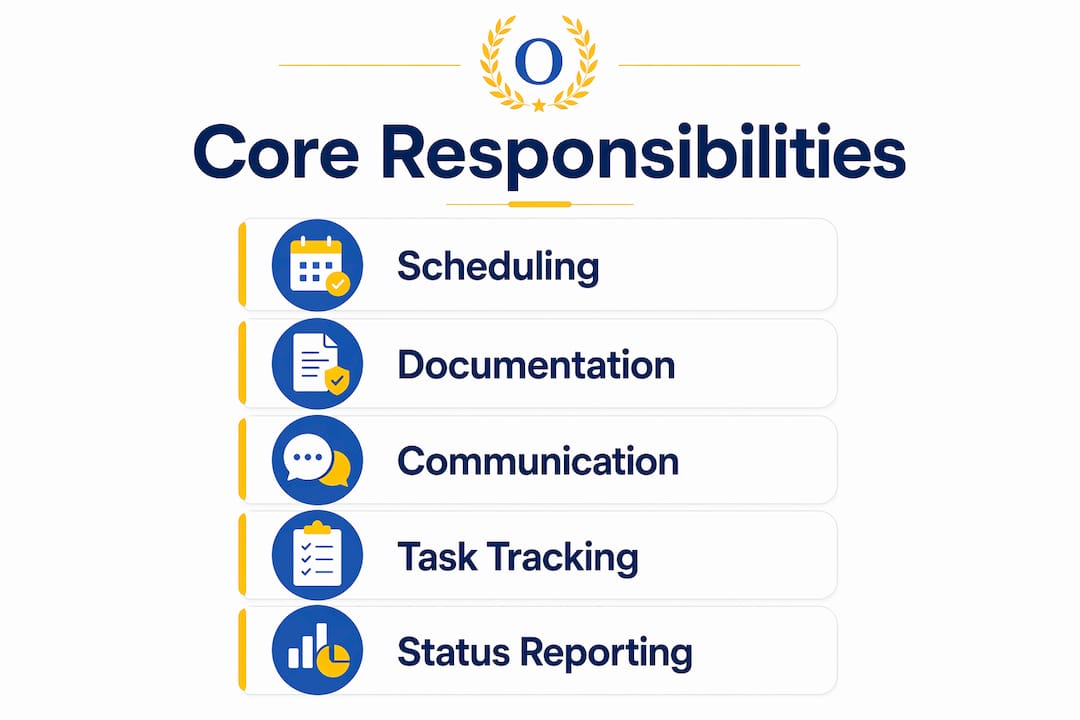
Core responsibilities at a glance
Here is what the project coordinator job description typically includes across industries:
- Scheduling and calendar management: Booking meetings, setting deadlines, and keeping the project timeline updated in real time.
- Documentation and record-keeping: Writing meeting minutes, maintaining budget logs, and filing project reports so nothing gets lost.
- Stakeholder communication: Sending updates, answering questions, and making sure every team member knows what is happening and when.
- Progress monitoring: Tracking milestones against the project plan and reporting variances before they become problems.
- Resource coordination: Helping allocate people, tools, and materials to the right tasks at the right time.
- Risk identification: Spotting early warning signs and escalating issues to the project manager before delays compound.
Pro Tip: Set up a weekly status template in Asana or ClickUp that auto-populates task completion percentages. Sending a consistent, visual update every Monday morning builds stakeholder trust faster than any single report.
What skills do you need as a project coordinator?
The skills that define a strong coordinator split into two categories: technical and interpersonal. Both matter equally, and neither compensates for a serious gap in the other.

On the technical side, essential skills include budget tracking, project documentation management, proficiency in PM software like Asana, ClickUp, and MS Project, time management, and proactive communication. Familiarity with tools like Jira, Trello, and Microsoft Project is expected in most job postings, and coordinators often use spreadsheets alongside communication platforms like Slack or Microsoft Teams to maintain alignment across distributed teams.
On the interpersonal side, the skills that separate good coordinators from great ones are harder to teach. Clear, proactive communication and early risk identification distinguish strong coordinators from average ones. You need to be the person who notices a task has been sitting at 60% completion for four days and asks why, before the project manager has to.
Here is a practical sequence for building your skill set as a student or early-career professional:
- Learn one PM tool deeply. Pick Asana or ClickUp and complete their free certification courses. Employers recognize these credentials, and the hands-on practice is worth more than any textbook chapter.
- Practice documentation on real projects. Volunteer to take meeting minutes for a student organization or internship team. Documentation is a skill that only improves through repetition.
- Pursue a foundational certification. The CAPM (Certified Associate in Project Management) from PMI and PRINCE2 are both recognized by hiring managers as signals of serious intent, even for entry-level candidates.
- Build cross-functional communication habits. Join projects that involve multiple teams or departments. The ability to translate priorities between a technical team and a marketing team is one of the most undervalued project coordinator skills.
- Study time management deliberately. Resources like student time management strategies offer frameworks that transfer directly to managing project schedules under pressure.
Pro Tip: Before applying for your first coordinator role, build a one-page portfolio of any project you have managed, even informally. Include the tools you used, the team size, and the outcome. Hiring managers respond to evidence, not claims.
How does a project coordinator differ from a project manager?
This is the question most students get wrong, and the confusion has real consequences for career planning. The key difference is accountability: project managers own project outcomes, client relations, and budget decisions, while coordinators keep the operational processes running daily.
Think of it this way. The project manager decides what the project needs to achieve and answers to the client when it does not. The coordinator decides how the daily work gets organized and answers to the project manager when something slips. Both roles are necessary. Neither is more important in absolute terms, but they require different authority levels and different mindsets.
| Dimension | Project coordinator | Project manager |
|---|---|---|
| Primary focus | Daily operations and process execution | Strategy, outcomes, and client accountability |
| Decision authority | Limited to scheduling and task logistics | Full authority over scope, budget, and team |
| Client interaction | Minimal, usually internal communication | Direct, regular client-facing responsibility |
| Typical experience | 0 to 3 years in project environments | 3 to 7 or more years, often with certifications |
| Career trajectory | Advances toward project manager role | Advances toward program or portfolio manager |
Understanding this distinction matters for your job search. A project coordinator job description that lists client-facing budget authority is actually describing a project manager role with a cheaper title. Know the difference before you accept an offer.
How to excel in the role and advance your career
Excelling as a coordinator is not about working harder. It is about working with more awareness than the people around you. Great coordinators read early warning signs such as stagnant task statuses or unconfirmed dependencies and act before delays materialize. That habit alone separates coordinators who get promoted from those who stay in the same role for years.
Career progression typically follows a path from coordinator to project manager, then into senior management roles, usually requiring three to five years of experience. That timeline is not fixed. Coordinators who demonstrate initiative, pursue certifications, and build strong internal networks often move faster.
Here are the practices that accelerate that progression:
- Use your PM software as a single source of truth. Every task, deadline, and dependency should live in one place. When the project manager needs a status update, you should be able to pull it in under a minute. Explore a task tracking guide to build that habit systematically.
- Communicate before you are asked. Send updates proactively. If a milestone is at risk, tell the project manager on Tuesday, not Friday.
- Understand the methodology you are working in. In Agile frameworks, coordinators handle fast-paced, communication-heavy tasks outside Scrum Master responsibilities. In traditional Waterfall projects, the role is more documentation-heavy and structured. Knowing which environment you are in changes how you prioritize your day.
- Network across project teams. The people you coordinate with today are the references and collaborators you will need tomorrow. Treat every interaction as a long-term professional relationship.
- Pursue continuous learning. The best project management software for students changes regularly. Staying current on tools and methodologies signals that you are growing, not just executing.
Pro Tip: Ask your project manager for a 15-minute monthly debrief where you review what went well and what did not. Most coordinators never ask for this feedback, which means they miss the fastest available path to improvement.
Key takeaways
The project coordinator role is the operational foundation of project success, requiring a combination of technical tool proficiency, proactive communication, and structured documentation habits.
| Point | Details |
|---|---|
| Core function | Coordinators manage scheduling, documentation, and communication to keep projects on track daily. |
| Essential skills | Proficiency in tools like Asana, Jira, and MS Project, combined with proactive communication, defines strong performance. |
| Role distinction | Coordinators execute operations; project managers own outcomes, budgets, and client relationships. |
| Career path | Most coordinators advance to project manager within three to five years through experience and certification. |
| Advancement habit | Reading early warning signs and acting before delays occur is the single most impactful coordinator behavior. |
What most people miss about the coordinator role
Here at Optiostation, we have worked with hundreds of students and young professionals who are entering project environments for the first time. The pattern we see most often is this: new coordinators treat the role as a glorified scheduling job and wonder why they are not advancing.
The coordinators who move fast understand something the others do not. The role is the operational heartbeat of the project, and its effectiveness directly correlates with project success or failure. That is not a motivational phrase. It is a structural reality. When a coordinator misses a dependency, the whole project feels it two weeks later.
What we tell every new coordinator is this: your job is not to manage tasks. Your job is to manage information flow. The tasks are the symptom. The information is the disease or the cure, depending on how you handle it. A coordinator who knows where every piece of information lives, who needs it, and when they need it is more valuable than one who simply checks boxes.
The other thing most coordinators overlook is the career signal embedded in every interaction. Every time you send a clear, well-structured update, you are demonstrating project manager behavior before you have the title. Every time you flag a risk early, you are proving you think at a strategic level. The promotion does not happen because you asked for it. It happens because the evidence was already there.
— Optiostation
How Optiostation helps project coordinators stay organized
Staying organized across tasks, deadlines, and team communication is the daily challenge every coordinator faces. Optiostation is built specifically for students and young professionals who need a structured system without the complexity of enterprise software.

As your Optio, your second-in-command, the app helps you track tasks, manage schedules, and keep your team aligned in one place. Whether you are coordinating a class project or your first professional assignment, having the right tool makes the difference between reactive and proactive coordination. Explore the best task management software options to find the setup that fits your workflow and start building the habits that project managers notice.
FAQ
What is a project coordinator role?
A project coordinator is an operational support professional who manages scheduling, documentation, and communication to keep a project on track. The role sits below the project manager and focuses on daily execution rather than strategic decision-making.
What are the key skills for a project coordinator?
The most critical project coordinator skills are proficiency in PM tools like Asana, Jira, or Microsoft Project, strong written communication, time management, and the ability to identify risks before they escalate into delays.
How do you become a project coordinator?
Most entry-level positions require a bachelor’s degree in business or a related field, along with familiarity with project management software. Certifications like the CAPM from PMI or PRINCE2 strengthen applications significantly for candidates without direct experience.
How is a project coordinator different from a project manager?
Project managers own the project outcome, client relationships, and budget authority. Project coordinators manage the operational processes, such as scheduling and documentation, that support the manager’s decisions.
What is the career path from project coordinator?
Career progression typically moves from coordinator to project manager, then into senior or program management roles. Most professionals make this transition within three to five years, accelerated by certifications and demonstrated initiative in the coordinator role.
Recommended
- Client Project Manager: Skills, Roles, and Best Practices – Optio Station: Best Project Management App for Prioritization
- Engineering project manager guide: frameworks and strategies – Optio Station: Best Project Management App for Prioritization
- Master project manager tasks to boost team success – Optio Station: Best Project Management App for Prioritization
- Command Log – Optio Station: Best Project Management App for Prioritization
