

TL;DR:
- Effective delegation requires thorough task auditing, clear documentation, and mindful assignment based on team members’ skills and confidence. Setting outcome-focused goals, establishing accountability checkpoints, and fostering open feedback loops sustain trust and prevent burnout. When leaders distribute ownership and support autonomous decision-making, team productivity and engagement significantly improve.
Most team leaders know they should delegate more. They just don’t know how to do it without things falling apart. The delegation process for teams fails not because people lack intentions, but because they skip the preparation, rush the handoff, and then hover anyway. The result: burned-out leaders, confused teammates, and work that bounces back like a boomerang. Done right, task delegation boosts team productivity while building the kind of trust that makes teams self-sufficient. This guide walks you through every step, from auditing your workload to sustaining genuine ownership.
Key Takeaways
| Point | Details |
|---|---|
| Audit before you assign | Map who owns what tasks today before redistributing any work to your team. |
| Document every handoff | Spend 20 to 30 minutes capturing inputs, tools, and decision rules for each delegated task. |
| Match tasks to readiness | Assign based on a team member’s skill level and confidence, not just availability. |
| Define outcomes, not steps | Tell people what “done” looks like rather than prescribing exactly how to get there. |
| Feedback closes the loop | Regular, specific feedback sustains ownership and prevents delegation from quietly collapsing. |
The delegation process for teams starts with a task audit
Before you hand anything off, you need to know what you’re working with. Most leaders skip this step entirely and jump straight to assigning tasks. That’s why things break down fast.
Start by listing every recurring task you and your team handle in a given week. Then ask two questions for each one: Who has the authority to make decisions about this? Who has the skills to execute it well? These two questions reveal misallocations immediately. You’ll likely find senior people doing work that could sit two levels below them, and junior team members stuck waiting for approvals they could handle themselves.
Once you’ve mapped the work, sort tasks into ownership tiers. The table below shows a practical way to think about this:
| Task type | Who should own it |
|---|---|
| Strategic decisions and external commitments | Team lead or senior manager |
| Complex projects requiring judgment | Mid-level team members with experience |
| Recurring processes with clear rules | Any team member with proper documentation |
| Administrative and logistical tasks | Entry-level or rotating ownership |
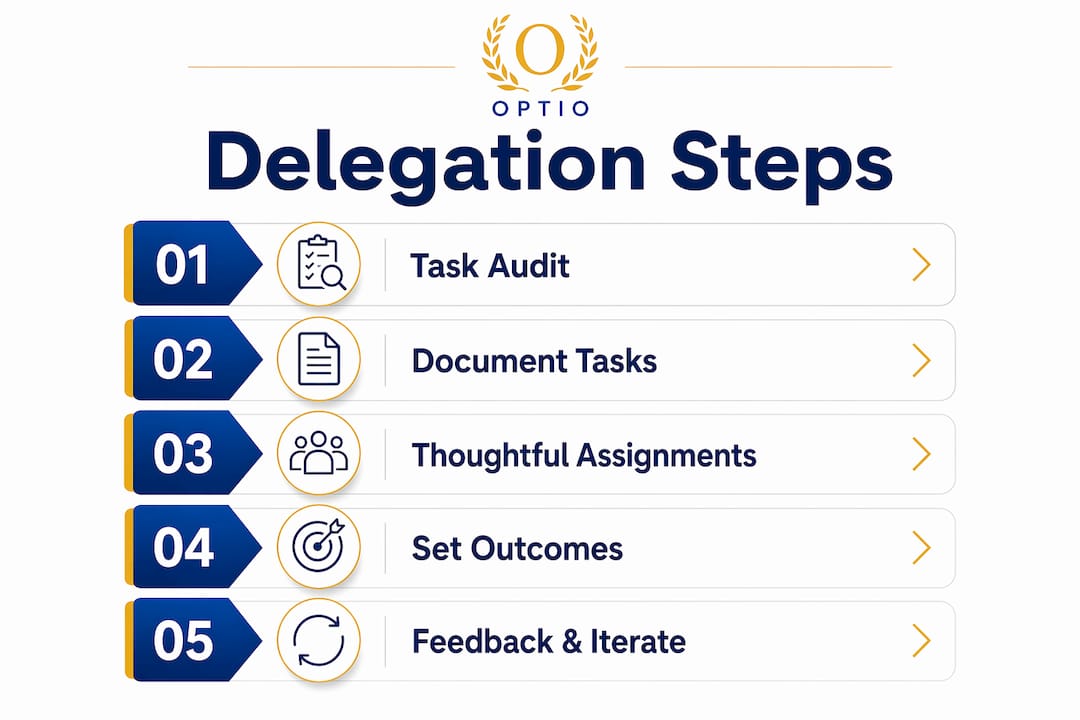
This kind of distributed ownership model produces scalable, consistent delegation rather than ad hoc assignment that depends on whoever is available that day. Getting the audit right sets up every step that follows.
Document tasks before you hand them off
Here’s where most leaders waste months of time. They delegate verbally, assume the other person understood, and then spend weeks re-explaining or correcting. The fix costs you less than half an hour per task.
For each task you plan to delegate, create a short handoff document covering four things:
- Inputs: What information, files, or access does the person need to start?
- Tools: Which platforms, apps, or systems are involved?
- Decision rules: What choices can they make independently, and what requires escalation?
- Output: What does a completed, correct result look like?
The decision rules piece is where most documentation fails. When you capture explicit decision rules, you prevent the constant back-and-forth that makes delegation feel like it’s not worth the effort. Instead of your team member asking “what should I do if X happens?”, they already know.
A 20 to 30 minute documentation session per task is all it takes. Keep it simple. You don’t need a 10-page manual. You need enough clarity that someone can execute without coming back to you for every small decision.
Pro Tip: Record a short screen walkthrough of yourself doing the task once, then write a brief summary below it. The video catches nuance that text misses, and the summary is what people will search for when they need a quick answer later.
Assign tasks thoughtfully, not just conveniently
Assigning work to whoever has bandwidth is not delegation. It’s task dumping, and it does real damage.

The core principle here is matching task complexity to the team member’s skill level and readiness. A task that stretches someone just beyond their comfort zone builds capability. A task that overwhelms someone without support builds resentment. Delegation without developmental support burdens employees who lack the skills or confidence to succeed, and research confirms that adequate preparation is what separates performance improvement from stress increase.
There’s also a psychological dimension most leaders ignore completely. When employees perceive that a task was handed to them because it serves the leader’s interests rather than their own growth, the outcome flips. Attributed motives matter: altruistic intent promotes positive outcomes, while self-interested perception increases emotional exhaustion and even counterproductive behavior. Be transparent about why you’re delegating a specific task to a specific person.
When assigning, cover these points explicitly:
- Why you chose them for this task
- What authority they have to make decisions
- What resources and support are available
- How success will be measured
- What the escalation path looks like if they hit a wall
“Delegation is not the transfer of a task. It is the transfer of ownership, responsibility, and the right to make decisions within defined boundaries.” This framing, drawn from empowering leadership research, separates teams that grow from teams that stagnate.
Meaningful work delegated with clear intent is also a retention and engagement tool. Complex tasks requiring judgment correlate with higher engagement when handled carefully. Don’t just delegate the boring stuff and keep the interesting projects for yourself.
Set outcomes and build accountability checkpoints
The most common delegation mistake at this stage is describing a task instead of defining a result. “Help me with the offsite” is not a delegation. “Book a venue for 12 people within two hours of the office by the end of the month, with a budget under $2,000” is a clear, outcome-oriented request that the person can actually execute without guessing what you want.
Once the outcome is defined, set up a lightweight accountability structure. This is where improving team collaboration happens in practice, not in theory.
| Approach | What it looks like |
|---|---|
| Micromanagement | Daily status updates, frequent check-ins, detailed step approval |
| Outcome-based accountability | Weekly 15-minute reviews focused on blockers and results |
Weekly structured check-ins consistently outperform daily status surveys. They maintain momentum without creating the psychological pressure that signals distrust. The goal is to be available, not omnipresent.
Use a project management tool for visibility so you can see progress asynchronously without requiring your team member to report in constantly. This reduces the anxiety leaders feel after delegating (“What’s happening with that thing?”) and removes the burden of constant updates from the team member’s plate.
Pro Tip: At each weekly check-in, ask “What’s blocking you?” before anything else. Most people won’t volunteer obstacles unless directly invited. That one question prevents small problems from becoming big derailments.
You can find more practical frameworks for this stage in Optiostation’s guide on managing team tasks and setting up accountability that doesn’t feel like surveillance.
Sustain delegation through feedback and iteration
Handing off a task and walking away is not complete delegation. It’s abandonment with paperwork. The final piece of an effective delegation process is a consistent feedback loop.
Effective feedback at this stage does three things:
- Acknowledges what went well specifically, not generically (“You handled the vendor pushback well” beats “Good job”)
- Addresses what needs adjustment without taking the task back
- Invites the team member’s own assessment before you offer yours
That last point matters more than most leaders realize. Psychological empowerment mediates how delegation transforms employee voice and proactive behavior. When people feel heard and trusted, they bring ideas forward instead of waiting to be told what to do next. That’s the compounding return on good delegation.
Watch for delegation burnout, too. It happens when someone accumulates too much delegated work without the authority or resources to match the responsibility. Regularly review what each team member owns and whether the load is sustainable. Reassigning or redistributing isn’t failure. It’s calibration.
The best practices for delegation include creating space for team members to push back on assignments, ask clarifying questions, and propose better approaches. That kind of open dialog signals that delegation is a two-way conversation, not a one-way directive.
My take on what actually makes delegation work
I’ve seen teams where delegation looked great on paper and collapsed in practice. The documentation was there, the check-ins were scheduled, the tasks were assigned. But nothing changed because the leader never actually let go.
The hardest part of assigning responsibilities in teams isn’t the process. It’s the mindset. Leaders hold onto complex, meaningful work because it feels like that’s where their value lives. But the research flips this completely. Delegating meaningful and complex tasks signals trust and builds engagement far more than offloading the tedious stuff.
What I’ve learned from working with teams across different contexts is that delegation scales when it becomes a shared expectation, not a favor the leader occasionally grants. When every team member knows how work gets handed off, what documentation looks like, and how decisions get made, the whole system runs without constant intervention. That’s what “distributed ownership” really means in practice.
The tools matter, but they’re secondary. A structured handoff in a notes app beats an undocumented “just figure it out” in the fanciest project management software on the market. Start with clarity. Let the tools serve the clarity, not replace it.
— Optiostation
Put your delegation process to work with Optiostation
Reading about delegation is step one. Executing it consistently across a real team is where most leaders need support. Optiostation’s task and team management tools are built specifically for students and young professionals who are leading teams for the first time or scaling their delegation habits.
Start with the structured delegation framework that walks you through every step from task audit to accountability checkpoint. If you want to go deeper on the software side, the best task management software guide covers the tools that make distributed ownership visible and trackable without turning into surveillance. Optiostation is built to be your second-in-command so you can actually lead, not just manage tasks.
FAQ
What is the delegation process for teams?
The delegation process for teams is a structured method for transferring task ownership from a leader to team members, covering task selection, documentation, assignment, outcome definition, and accountability. It works best when paired with clear decision rules and regular feedback.
How do you delegate tasks without micromanaging?
Define the outcome clearly, document the decision rules, and replace daily check-ins with weekly 15-minute reviews focused on blockers and results. Outcome-based accountability builds confidence without constant oversight.
Why does delegation fail in teams?
Delegation most often fails due to unclear outcomes, missing documentation, poor task-to-skill matching, or leaders who never fully let go of control. Delegation without adequate support also increases stress rather than improving performance.
What tasks should you delegate first?
Start with recurring tasks that have clear, documentable rules and don’t require strategic judgment. Once those run smoothly, delegate more complex work to team members who are ready to stretch their capabilities.
How does delegation improve team collaboration?
When team members own real work with genuine authority, they communicate more proactively and invest in outcomes beyond their individual tasks. Empowering leadership through delegation promotes voice behavior and collaborative problem-solving across the team.
Recommended
- How to Improve Teamwork for Success in College and Work – Optio Station: Best Project Management App for Prioritization
- Coordinating Remote Teams Workflow for Better Results – Optio Station: Best Project Management App for Prioritization
- Planning Group Assignments for Students and Professionals – Optio Station: Best Project Management App for Prioritization
- Task Delegation Steps for Effective Team Management – Optio Station: Best Project Management App for Prioritization
