

TL;DR:
- Most people create goals that lack clarity and measurable progress due to poor formatting.
- Using the SMART framework transforms vague intentions into specific, actionable, and trackable plans.
Most people set goals that sound good but go nowhere. You write down something like “get better grades” or “improve at my job,” and three months later, nothing has changed. The problem is not your motivation. The problem is the format. Using a proper smart goal format, technically known as the SMART framework, turns fuzzy intentions into specific, trackable plans. Developed from George Doran’s 1981 management paper, SMART stands for Specific, Measurable, Achievable, Relevant, and Time-bound. This guide breaks down exactly how to use it.
Table of Contents
- Key takeaways
- The smart goal format broken down by component
- How to write a SMART goal statement
- Common mistakes and how to fix them
- Putting SMART goals into daily practice
- My honest take on the SMART format
- Track your goals with the right tools
- FAQ
Key takeaways
| Point | Details |
|---|---|
| Vague goals fail by design | Without structure, goals lack the clarity and deadlines needed to drive real follow-through. |
| Each SMART letter matters equally | Missing any single element makes your goal harder to measure and act on. |
| One sentence, five elements | A well-written SMART goal combines all five criteria into a single, clear statement. |
| Review goals every quarter | Checking progress every three months lets you catch problems before they become failures. |
| Tools multiply your consistency | Pairing SMART goals with task tracking apps keeps accountability high between review sessions. |
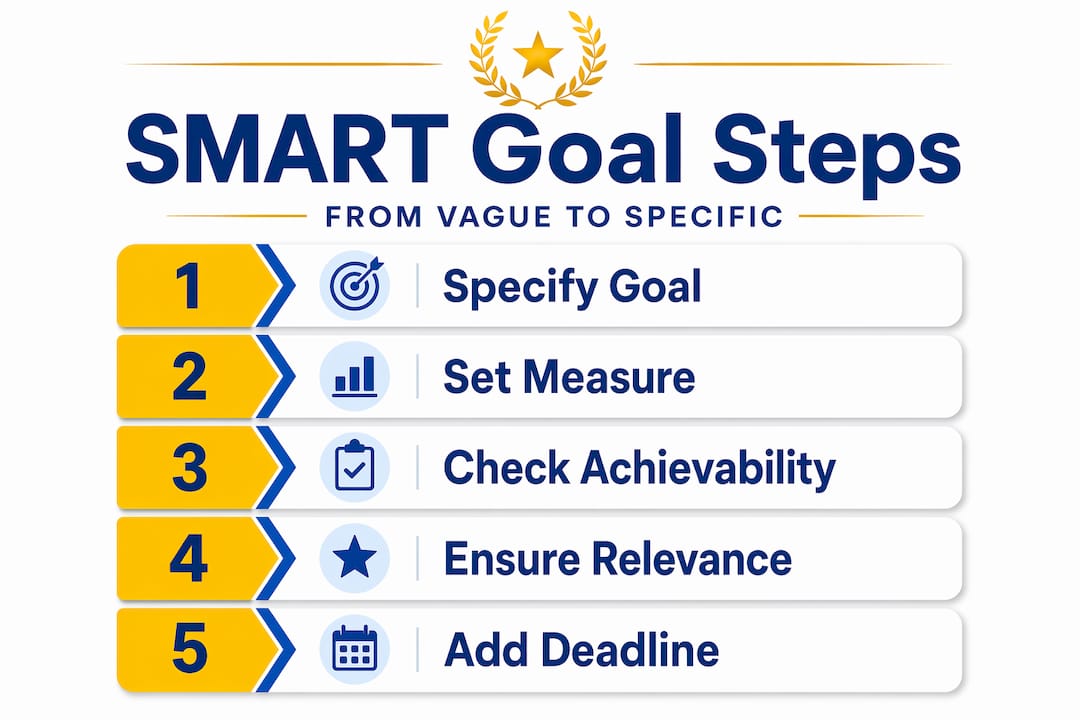
The smart goal format broken down by component
Understanding each letter is not about memorizing a checklist. It is about asking the right questions before you commit to a goal. Here is what each component actually means and why skipping any one of them is a mistake.
| SMART letter | What it means | Key question to ask |
|---|---|---|
| Specific | Clear, focused, detailed | Who is involved? What exactly do I want to accomplish? |
| Measurable | Trackable with numbers or evidence | How will I know when I have made progress? |
| Achievable | Realistic given your resources and time | Is this genuinely possible for me right now? |
| Relevant | Aligned with what actually matters to you | Does this goal move me toward a priority outcome? |
| Time-bound | Anchored to a concrete deadline | When will this be completed? |
Specific means you stop saying “do better in school” and start saying “raise my biology grade from a C to a B.” You are answering who, what, where, and why in one clear statement. The more detail you add upfront, the less room there is for drift.
Measurable is where most students and young professionals stumble. A goal is only measurable when you define a concrete number, percentage, or observable result. “Study more” is not measurable. “Complete two practice problem sets per week” is. Quantitative SMART metrics should include a defined data source and a baseline to measure from, so you know where you started.
Achievable does not mean easy. It means the goal should push you without being absurd. If you are currently pulling a 2.8 GPA, setting a goal to hit 4.0 by next month is not ambitious. It is a setup for failure. Aim for stretch targets that are grounded in your current reality.
Relevant is the filter most people ignore. Without relevance, goals can be specific and measurable but still fail to advance anything meaningful. Ask yourself whether this goal connects to something you genuinely care about, or whether you are just chasing something that sounds impressive.
Time-bound creates urgency. A goal without a deadline is just a wish. Set a specific date, whether that is the end of a semester, a performance review cycle, or a calendar quarter.

Pro Tip: Most people write the goal statement and stop there. Write the measurement source, your baseline, and your progress checkpoints in a separate line below the goal. That extra detail is what separates goals you track from goals you forget.
How to write a SMART goal statement
The goal is to combine all five elements into one clear, confident sentence. Not a paragraph. Not a bullet list. One sentence that passes every SMART test.
Here is a step-by-step process for getting there:
- Start with the outcome. What do you want to accomplish? Write it down without any filters first.
- Add the number. What metric will prove you got there? Insert a specific figure, percentage, or deliverable.
- Check the baseline. Where are you right now? This anchors your measurement and makes progress visible.
- Confirm it is achievable. Does this target make sense given your current schedule, skills, and resources?
- Link it to a priority. Why does this goal matter to your academic or professional direction?
- Set the deadline. Add a specific date or time period to the end of the statement.
Student example: raising your GPA
Here is what this looks like in practice. A vague version: “I want to get better grades.” The SMART version: “I will raise my GPA from 3.2 to 3.5 by the end of the spring semester by attending every lecture, completing all assignments on time, and scheduling two tutoring sessions per month.”
That single sentence answers all five SMART criteria. Specific (GPA from 3.2 to 3.5), measurable (a 0.3 point increase), achievable (a realistic improvement), relevant (directly impacts academic standing), and time-bound (end of spring semester).
Young professional example: budget reporting
For a young professional, the SMART format works just as well in a work context. Vague version: “Get better at managing the team budget.” SMART version: “I will distribute monthly budget reports comparing current expenses to the annual budget by the 5th of each month for the next six months, flagging any category that exceeds its allocation.”
The deliverable is concrete, the timeline is clear, and the relevance to professional growth is obvious.
Pro Tip: After writing your SMART goal sentence, create a short reference document that lists your measurement source, starting baseline, and three milestone checkpoints. Most people skip this step and end up with ambiguous progress data by month two.
Common mistakes and how to fix them
Even with a solid framework, people make predictable errors. Knowing what they are before you start saves you from a frustrating cycle of rewriting goals that still do not work.
Here are the most common pitfalls to watch for:
- Using vague language like “improve,” “increase,” or “better” without a number attached. These words feel meaningful but measure nothing.
- Setting targets that ignore your baseline. A goal with no starting point has no real trajectory. You cannot track progress without knowing where you began.
- Ignoring the relevance check. A goal that is specific and measurable but irrelevant to your actual priorities is busy work in disguise.
- Forgetting to schedule reviews. Writing a goal in January and checking it in December is not goal tracking. Quarterly reviews let you catch drift early and adjust before it compounds.
- Perfectionism before action. Spending three weeks crafting a perfect goal statement instead of starting with a good enough one.
Here is a quick comparison of poorly written versus well-written goals:
| Weak goal | SMART version |
|---|---|
| “Get better at public speaking” | “Deliver three five-minute presentations at team meetings by June 30th, requesting written feedback after each one.” |
| “Study harder for exams” | “Complete one full practice exam per week for four weeks before finals, targeting a score above 80% each time.” |
| “Spend less money” | “Reduce discretionary spending by $150 per month for three months by tracking all purchases in a budgeting app.” |
One more advanced idea worth knowing: distinguish between leading and lagging indicators in your goals. A lagging indicator is your GPA at the end of term. A leading indicator is study hours per week, practice problems completed, or tutoring sessions attended. Leading indicators are what you control daily. Measuring both gives you a much more honest picture of whether you are on track.
Using a fill-in-the-blank template with question prompts for each SMART letter is one of the fastest ways to eliminate vague language and make sure you have covered every element before committing to a goal.
Putting SMART goals into daily practice
Writing a strong goal statement is step one. The harder part is making it part of how you actually work and study every week.
A few approaches that genuinely change behavior:
- Break long-term goals into monthly checkpoints. If your goal spans a semester or a full quarter, define what “on track” looks like at the end of each month. This gives you an early warning signal if things slip.
- Build mini-goals around your big one. A weekly SMART-based sub-goal (like “complete two chapters of reading by Thursday”) keeps the bigger goal from feeling abstract. These small wins compound. Check out practical SMART goal tips for both academic and work settings.
- Use task management tools to track progress. Writing your goal in a notebook and never looking at it again is a common failure mode. Tracking apps let you attach deadlines, subtasks, and progress notes directly to each goal. For student-focused goal setting, a structured digital system beats a Post-it note every time.
- Find an accountability partner. Share your goal with someone whose judgment you respect. A weekly check-in, even a short message, creates social pressure that helps on the days motivation runs low.
- Schedule your review sessions in advance. Put your quarterly review on your calendar the day you write the goal. That appointment is non-negotiable.
Connecting your short-term goals (like weekly assignment completion) to your long-term outcomes like graduation GPA or a promotion improves both motivation and follow-through. The link between today’s effort and next year’s result has to be visible, or it stops feeling real.
My honest take on the SMART format
I have watched people treat SMART goals like a homework assignment. They fill out the template, check the box, and never look at the goal again. I have done it myself. The format did not fail them. The habit did.
What changed for me was treating the quarterly review as mandatory, not optional. The first time I actually sat down at the 90-day mark and compared where I said I would be versus where I actually was, it was uncomfortable. But it was useful. I caught two goals that had quietly become irrelevant and replaced them with targets that actually matched where my priorities had shifted.
The other thing I got wrong early on was confusing activity with progress. I wrote goals that tracked effort (hours studied, emails sent) without connecting those inputs to an actual outcome. That is the leading vs. lagging indicator problem in practice. Effort goals feel productive. Outcome goals are what actually move you forward.
My advice: write the goal, schedule the review, and start before it feels perfect. A step-by-step SMART guide is worth revisiting when your goals feel stale or disconnected from your real priorities. The format is simple. Sticking to it is the discipline.
— Optiostation
Track your goals with the right tools
Setting a strong SMART goal is only half the equation. You also need a system to track progress, manage deadlines, and hold yourself accountable week after week.

Optiostation is built for exactly this. Whether you are a student mapping out semester goals or a young professional managing multiple work projects, the app keeps your tasks, timelines, and team aligned in one place. Start with a curated list of time management apps to find the right tool for your setup. If you want to sharpen how you manage tasks at the ground level, the task management software guide from Optiostation walks through the best options available. Your goals deserve a system that keeps up with them.
FAQ
What is a SMART goal format?
The SMART goal format is a structured framework where every goal must be Specific, Measurable, Achievable, Relevant, and Time-bound. It originated from a 1981 management framework and is used across academic and professional settings to convert vague intentions into trackable plans.
How do I write a SMART goal in one sentence?
Combine all five elements in a single statement: name the specific outcome, include a measurable number, confirm it is realistic, connect it to a meaningful priority, and attach a deadline. For example: “I will raise my GPA from 3.2 to 3.5 by the end of the spring semester.”
What makes a goal measurable?
A goal is measurable when it includes a specific number, percentage, or observable deliverable, along with a defined data source and a starting baseline. SMART metrics that skip any of these elements become harder to evaluate objectively.
How often should I review my SMART goals?
Review your goals every quarter. Quarterly check-ins let you evaluate real progress, adjust timelines, and replace goals that have become irrelevant before too much time is lost.
What is the difference between a leading and lagging indicator in SMART goals?
A lagging indicator is the end result, like your final GPA or revenue number. A leading indicator is a behavior you control daily, like hours studied or reports submitted. Tracking both gives you a more accurate and motivating picture of progress.
Recommended
- Examples of SMART goals to boost academic success – Optio Station: Best Project Management App for Prioritization
- SMART goals: a step-by-step guide to real results – Optio Station: Best Project Management App for Prioritization
- SMART goals for work: practical tips to boost productivity – Optio Station: Best Project Management App for Prioritization
- Effective Goal Setting for Students: Achieve Your Dreams – Optio Station: Best Project Management App for Prioritization
