
{
“@type”: “Article”,
“image”: {
“url”: “https://csuxjmfbwmkxiegfpljm.supabase.co/storage/v1/object/public/blog-images/organization-4842/1779822574566_Teen-writing-goals-in-home-kitchen-setting.jpeg”,
“@type”: “ImageObject”,
“caption”: “Teen writing goals in home kitchen setting”
},
“author”: {
“url”: “https://optiostation.com”,
“name”: “Optiostation”,
“@type”: “Organization”
},
“@context”: “https://schema.org”,
“headline”: “What Is a Goal? a Clear Definition for Students”,
“publisher”: {
“url”: “https://optiostation.com”,
“name”: “Optiostation”,
“@type”: “Organization”
},
“inLanguage”: “en-US”,
“description”: “Discover what is a goal and how to set effective targets. Transform vague wishes into actionable plans for real success in your life!”,
“datePublished”: “2026-05-26T19:23:43.873Z”
}

TL;DR:
- Goals are specific targets that direct effort and decision-making toward a defined endpoint within a set timeframe. They motivate behavior by creating tension that fosters persistence, effort, and strategic action, especially when aligned with personal values. Effective goal setting involves clarity, the SMART framework, and ongoing adjustment to ensure lasting achievement and motivation.
Most people treat goals like wishes. They say things like “I want to get fit” or “I’d like to earn more money” and then wonder why nothing changes. The problem is not ambition. It is clarity. Knowing what is a goal in the truest sense separates people who drift through their plans from those who actually execute them. This article covers the real definition of a goal, the types worth knowing, the frameworks that make goals work, and the motivation science behind why some goals stick while others fade in a week.
Table of Contents
- Key takeaways
- What is a goal, really?
- Types of goals and why the differences matter
- Goal-setting frameworks: the SMART approach
- Motivation theories and the science behind goal pursuit
- Practical strategies for achieving your goals
- My take: what actually separates goal-setters from goal-achievers
- Turn your goals into a daily system
- FAQ
Key takeaways
| Point | Details |
|---|---|
| Goals are specific targets | A goal is not a wish. It is a defined endpoint that directs your effort and decision-making. |
| Types of goals shape your approach | Short-term, long-term, learning, and performance goals each serve a different purpose in your growth. |
| SMART goals reduce guesswork | The SMART framework turns vague intentions into measurable, time-bound plans you can actually track. |
| Motivation quality matters | Goals driven by your own values and interests produce more lasting results than goals set by outside pressure. |
| Feedback closes the loop | Tracking progress and adjusting your approach is what separates goal setting from goal achieving. |
What is a goal, really?
Most dictionary definitions keep it simple. Merriam-Webster defines a goal as an aim or endpoint that a person commits to reaching within a timeframe. That is a useful starting point, but it leaves out the part that actually matters: what a goal does to your behavior.
From a psychological standpoint, a goal is not just something you want. It is a mental reference point that your brain uses to measure the gap between where you are and where you want to be. That gap creates tension. Tension creates motivation. This is why vague goals feel uninspiring. “Be healthier” gives your brain nothing to measure, so no tension forms, and no real drive kicks in.
“Goals regulate human behavior by directing attention, mobilizing effort, increasing persistence, and motivating strategy development.” — Locke & Latham, as summarized in goal-setting theory
When you commit to a goal, it becomes a filter. Every decision you make gets evaluated against it. That is what separates a genuine goal from a casual preference. A goal you are committed to changes how you spend your Tuesday afternoon. A wish does not.
Two attributes define a well-formed goal: specificity and time-frame. Specificity tells you exactly what the target looks like. A time-frame creates urgency and forces prioritization. Together, they give your effort a direction and a deadline, which is why specific and difficult goals consistently outperform vague or easy ones in over 1,000 studies on human performance.
Types of goals and why the differences matter
Not all goals work the same way. Lumping them together is one reason people pick the wrong strategy for what they are actually trying to accomplish. Here is a breakdown worth knowing:
Short-term vs. long-term goals
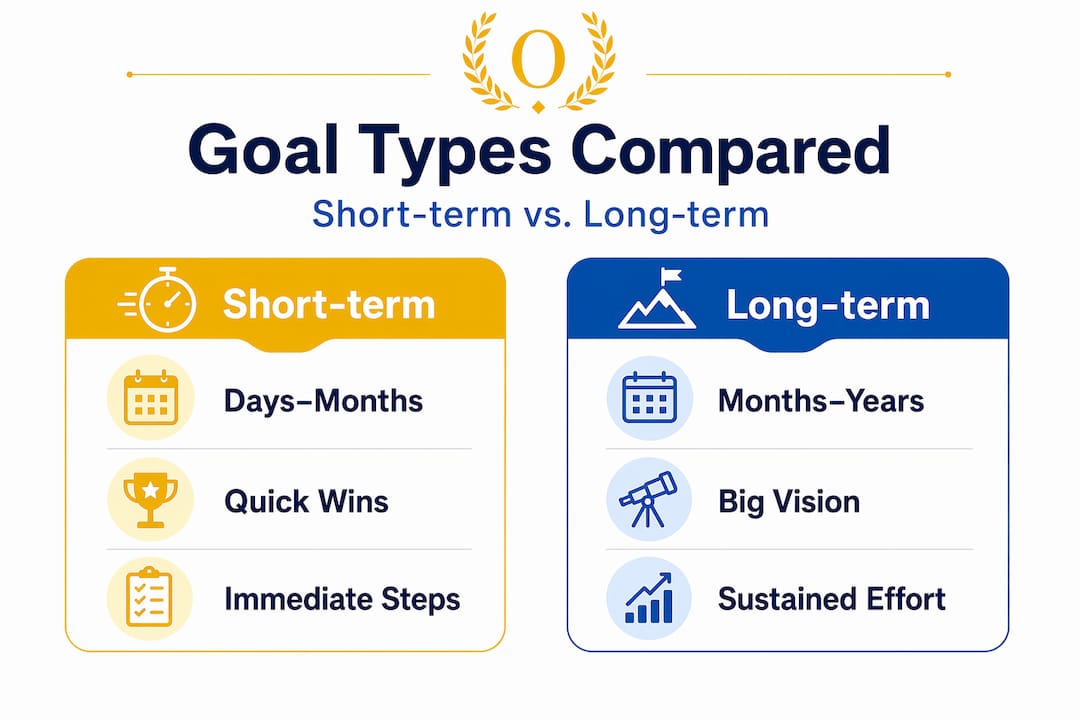
A short-term goal has a timeframe measured in days, weeks, or a few months. Finishing a chapter of a textbook by Friday. Submitting a job application this week. Long-term goals span months or years: completing a degree, earning a promotion, building a side business. Learning goals focus on skill acquisition, making them ideal for dynamic situations where you are figuring things out as you go. Performance goals focus on outcomes and are better suited to situations where you already know what good looks like.
Common examples across life areas
- Personal goals: Running a 5K by end of summer, reading 12 books this year, meditating five minutes each morning
- Academic goals: Raising your GPA by 0.3 points this semester, completing three internship applications before spring break
- Professional goals: Finishing a relevant certification within 90 days, leading one team project per quarter
Short-term vs. long-term at a glance
| Feature | Short-term goal | Long-term goal |
|---|---|---|
| Timeframe | Days to months | Months to years |
| Primary function | Builds momentum | Shapes direction |
| Risk if skipped | Slower progress | Loss of vision |
| Example | Pass next week’s exam | Graduate with honors |
The most effective goal plans use both types together. Long-term goals give you a destination. Short-term goals give you a path to walk every single day. As a Centurion managing your own growth, knowing which type of goal you are dealing with tells you which strategy to deploy.

Goal-setting frameworks: the SMART approach
Knowing the SMART goals definition is not just a corporate checkbox exercise. It is a practical system for turning a vague intention into something your brain can actually act on. SMART stands for:
- Specific — Define exactly what you want to accomplish. Not “get better at writing” but “write 500 words of original content every weekday.”
- Measurable — Attach a number or observable outcome. “Improve fitness” is not measurable. “Run 3 miles without stopping by March 1” is.
- Achievable — The goal should stretch you without breaking you. Unrealistic goals kill commitment fast.
- Relevant — The goal should connect to something you genuinely care about. A goal that does not align with your actual priorities will lose to distraction every time.
- Time-bound — Set a deadline. Deadlines create urgency and force you to prioritize effort rather than endlessly prepare.
Here is the contrast in practice. A vague goal sounds like this: “I want to do better at school this semester.” A SMART version looks like this: “I will raise my biology grade from a C+ to a B by the end of this semester by completing all assigned readings the day before each class and attending office hours twice per month.”
The second version gives you a decision rule. You know exactly when you are on track and when you are not. That is the entire point.
Pro Tip: When writing your SMART goal, test it with this question: “If I showed this to someone else, would they know exactly what success looks like?” If the answer is no, get more specific. You can find practical SMART goal examples for both academic and career contexts to get started faster.
For a structured walkthrough, the step-by-step SMART guide at Optiostation walks you through applying each element to real goals in your own life.
Motivation theories and the science behind goal pursuit
Understanding what goals are matters. Understanding why some goals move you to action while others sit on a list untouched matters even more. overview on reianyc
Locke and Latham’s goal-setting theory argues that goals aligned with personal values generate stronger commitment and more sustained effort. When you genuinely care about the outcome, you work harder, stay focused longer, and recover faster from setbacks. When the goal belongs to someone else’s agenda, you tolerate it until an easier path appears.
Self-determination theory adds another layer. According to research summarized by the APA, motivation quality depends on three psychological needs: autonomy (the sense that you chose this), competence (the belief that you can do it), and relatedness (the feeling that it connects to something meaningful). Goals that satisfy all three needs tend to produce lasting engagement and real well-being.
- Goals pursued because you want them produce higher satisfaction than goals set by external pressure.
- Feeling competent during the process keeps motivation alive when results are slow.
- Connecting a goal to something larger than the goal itself, a career path, a relationship, a personal value, makes it more resilient under stress.
The practical takeaway is straightforward. Before committing to a goal, ask whether you genuinely want it or whether you think you should want it. That distinction predicts more about your follow-through than any planning system ever will.
Practical strategies for achieving your goals
Setting goals without a clear structure is one of the most common reasons people never see results. Vague goals lack the decision rules needed to measure progress, which means you can always tell yourself you are “working on it” without actually moving forward.
Here is what actually works:
- Start with specificity. Write the goal down in one concrete sentence. If you cannot do that, you are not ready to pursue it yet.
- Set milestones, not just endpoints. Break a six-month goal into monthly checkpoints. Progress you can see keeps motivation alive.
- Align your goal with your values. A goal that feels meaningful to you wins every time over a goal you set because someone else expected it.
- Build feedback loops. Feedback tells you what is actually happening. Goals tell you what is desirable. You need both to self-correct in real time.
- Adjust your environment. Remove friction that pulls you away from the goal. Add cues that pull you toward it. Your space shapes your behavior more than willpower does.
Pro Tip: Do not wait until the goal feels perfect to start. A slightly imperfect goal you begin today beats a perfectly written goal you spend three weeks refining. Start, then adjust using the goal-setting tips that fit your specific situation.
The distinction between a wish and a plan is not intelligence or talent. Measurable goals with specific criteria are simply more effective at triggering real behavior change than open-ended desires.
My take: what actually separates goal-setters from goal-achievers
I’ve watched a lot of people write down ambitious goals and then do nothing with them for months. The pattern is almost always the same. The goal is either too vague to act on, or the motivation behind it belongs to someone else.
What I’ve learned is that the quality of a goal matters far more than the quantity. One specific, deeply personal goal that you check in on every week will move you further than a list of ten goals you barely remember setting. Specificity is not a productivity trick. It is respect for your own time and effort.
The other thing I’ve found to be true: goals need to evolve. Treating a goal as fixed, even when your circumstances or understanding has changed, is not commitment. It is stubbornness. The most effective goal-setters I know treat their goals as living documents. They revisit them, adjust them, and stay honest about whether the goal still serves where they are actually trying to go.
Intrinsic motivation is the real currency here. Goals that come from your own ambitions and support your sense of autonomy are the ones that survive the hard weeks when results are invisible and effort feels pointless. External pressure can start a goal. It almost never finishes one.
— Optiostation
Turn your goals into a daily system
You now understand what a goal is, why it works, and how to set one that actually drives behavior. The next challenge is execution. Knowing your goal is step one. Having a system that keeps it visible, trackable, and connected to your daily tasks is what closes the gap between intention and outcome.

Optiostation was built exactly for this. As your second-in-command, Optio helps Centurions like you translate personal and career goals into organized tasks, team coordination, and time-aware priorities. Whether you are a student tracking semester milestones or a young professional managing project deadlines, the right task management software makes every goal more executable. You can also explore Optiostation’s guide on managing tasks effectively for students and professionals who want their goals working for them every single day.
FAQ
What is a goal in simple terms?
A goal is a specific, desired outcome that a person commits to achieving within a defined timeframe. Unlike a wish, a goal directs real effort and shapes daily decisions.
What are the main types of goals?
The main types include short-term and long-term goals, as well as performance goals focused on outcomes and learning goals focused on skill development. Personal, academic, and professional categories are also widely used.
What does SMART stand for in goal setting?
SMART stands for Specific, Measurable, Achievable, Relevant, and Time-bound. The SMART framework is designed to turn vague intentions into clear, trackable plans.
Why are goals important for students and professionals?
Goals give direction by focusing attention on what matters most and providing a measurable target for effort and planning. Without them, effort tends to scatter across tasks without building toward anything meaningful.
How do I stay motivated to achieve my goals?
Set goals that align with your personal values and pursue them under conditions that support your sense of autonomy and competence. Research on self-directed motivation consistently shows that intrinsic goals produce more sustained engagement than goals driven by outside pressure.
Recommended
- Why set study goals? 250% higher performance awaits – Optio Station: Best Project Management App for Prioritization
- Complete Guide to Goal Setting for Students – Optio Station: Best Project Management App for Prioritization
- Define your goals: proven strategies for motivation and success – Optio Station: Best Project Management App for Prioritization
- Understanding Why Use Goal Trackers for Success – Optio Station: Best Project Management App for Prioritization
