

TL;DR:
- Most engineering projects fail due to poor understanding of frameworks, tools, and people skills that drive success. Effective project management relies on tailoring stages, enforcing stage-gates, and blending Agile with traditional processes for complex projects. Top project managers prioritize diagnosis, trust-building, and adapting tools, ensuring scope, schedule, and costs remain controlled throughout the lifecycle.
Most engineering projects fail before a single bolt is tightened. Only a minority of organizations consistently deliver capital projects on time and within budget, which means the odds are stacked against you the moment you step into a project manager role. The good news? That gap between success and failure is not random. It comes down to how well you understand the frameworks, tools, and people skills that separate a project that delivers from one that quietly unravels. This guide is your field manual for exactly that.
Table of Contents
- Understanding the engineering project lifecycle: Stages, tailoring, and gates
- Core tools: Scheduling, cost control, and risk analysis that drive results
- Managing scope, change, and the ‘triple constraint’
- Real-world risk management: From registers to psychological safety
- Hybrid and Agile for engineering projects: Blending adaptability with control
- What most new engineering project managers get wrong—and how to stand out
- Start your project management journey today
- Frequently asked questions
Key Takeaways
| Point | Details |
|---|---|
| Tailor PM frameworks | Adapting project management methods to your project’s reality increases your chance of success. |
| Master key metrics | Track SPI, CPI, and risk signals to spot trouble early and keep projects on track. |
| Control scope changes | Use robust protocols to prevent scope creep from derailing your project’s time and budget. |
| Blend governance styles | Combining Agile and stage-gate techniques can give both flexibility and rigorous oversight. |
| Prioritize risk conversations | Build psychological safety so your team surfaces risks early, not just in documentation. |
Understanding the engineering project lifecycle: Stages, tailoring, and gates
Every engineering project moves through a predictable sequence of decisions, activities, and approvals. Engineering project managers typically operate across the project lifecycle using structured approaches, tailoring governance and processes to match the project’s environment and objectives. Understanding these stages is not optional for aspiring PMs. It is the foundation everything else is built on.
The five core stages are:
- Initiation: Define the business need, identify key stakeholders, and secure project authorization. This is where scope boundaries are first sketched.
- Planning: Develop the schedule, cost baseline, risk register, and communication plan. The quality of this stage determines how every other stage unfolds.
- Execution: Mobilize the team, procure resources, and begin delivering project work according to the plan.
- Monitoring and controlling: Track performance metrics, manage changes, and keep the project aligned with its baseline.
- Closure: Formally accept deliverables, release resources, document lessons learned, and close contracts.
Now, here is where most new engineering project managers stumble. They treat these five stages as a rigid checklist rather than a flexible structure. “Tailoring” means adjusting your governance processes to fit the specific realities of your project, not applying a template you downloaded from the internet. A two-year infrastructure build needs heavy documentation and formal change boards. A three-month sensor integration project needs something leaner.
A critical tool for enforcing discipline across these stages is the stage-gate model. At each gate, a decision authority reviews project health and approves whether the team continues, pauses, or stops. Gates enforce funding discipline, regulatory compliance checks, and formal scope approvals. Without them, projects drift.
A practical way to choose your delivery approach is to map requirements stability and regulatory conditions to predictive, adaptive (Agile), or hybrid governance. Here is a quick reference table:
| Project scenario | Recommended approach |
|---|---|
| Fixed scope, regulatory compliance required | Predictive (Waterfall) |
| Evolving requirements, frequent client feedback | Adaptive (Agile) |
| Phased funding with iterative development inside stages | Hybrid |
| R&D or prototype work with unknown unknowns | Adaptive or Hybrid |
If you are just starting out, explore project portfolio templates and review a solid project management plan example to see how experienced PMs document these decisions.
Pro Tip: Engineering juniors should focus less on memorizing every PM process and more on learning when and how to tailor. Ask your senior PM why they chose a particular governance approach for a project. That conversation will teach you more than any textbook.
Core tools: Scheduling, cost control, and risk analysis that drive results
Knowing the lifecycle stages is one thing. Knowing how to monitor and steer a live project is where your technical edge matters. Engineering scheduling and performance management commonly rely on CPM-style critical path concepts and Earned Value Management (EVM) metrics such as SPI and CPI to quantify schedule and cost variance against baselines.

Critical Path Method (CPM) identifies the longest sequence of dependent tasks in your schedule. Any delay on a critical path task delays the entire project. Your job as a PM is to identify these tasks early, protect them with buffers, and monitor them obsessively. Non-critical tasks have “float,” meaning they can slip slightly without affecting the end date. Use that float strategically, but never ignore it entirely.
Earned Value Management (EVM) gives you a single language for project health:
- Calculate your Planned Value (PV): What should have been done by now?
- Calculate your Earned Value (EV): What work has actually been completed?
- Calculate your Actual Cost (AC): What did that completed work actually cost?
- Derive your Schedule Performance Index (SPI) = EV / PV. Values below 1.0 mean you are behind schedule.
- Derive your Cost Performance Index (CPI) = EV / AC. Values below 1.0 mean you are over budget.
EVM-style indices can be used as an operational health check by comparing achieved performance against planned baselines. A CPI of 0.85 in month three is a serious warning sign. Most project overruns appear in SPI and CPI data weeks before they hit the bottom line.
“Most project overruns show up in SPI/CPI before they hit the bottom line. If you wait for the finance team to tell you there is a problem, you have already lost two months.”
For projects with significant uncertainty, such as large infrastructure builds or first-of-kind systems, quantitative schedule and cost risk analysis such as Monte Carlo simulation estimates probabilistic completion dates and required contingency. Instead of one project end date, you get a probability distribution. A 70th percentile completion date is a far more honest commitment than an optimistic single-point estimate.
Here is a comparison of your core PM tools:
| Tool | What it does | Best used when |
|---|---|---|
| Critical Path Method | Maps task dependencies; finds longest chain | Scheduling any project with linked tasks |
| Earned Value Management | Tracks cost and schedule health numerically | Monitoring progress on fixed-baseline projects |
| Monte Carlo simulation | Generates probability ranges for schedule/cost | Projects with high uncertainty or risk exposure |
Pair these tools with the right software by checking out free project management software options, or review example project plans with EVM baked in to see how they look in practice.
Managing scope, change, and the ‘triple constraint’
With effective scheduling and risk tools in hand, your next challenge is proactively managing the project’s boundaries and knowing when a requested change will make or break your plan.
The triple constraint is the simplest mental model in project management: every project is bounded by time, cost, and scope. Change one, and the other two are affected. Add features without adjusting the budget, and you will either miss your deadline or cut quality. Compress the timeline without reducing scope, and costs spike. This is not a theory. It is physics for projects.
Engineering project managers frequently need an explicit scope-change protocol because scope creep destabilizes the time, scope, and cost constraints. Scope creep rarely arrives as a dramatic request. It shows up as small favors: “Can you just add one more sensor to the array?” or “Can we tweak the interface one more time?” Each request feels minor. Collectively, they sink projects.
A solid change control protocol includes:
- A formal change request form that documents what is being requested and why
- An impact assessment covering time, cost, and risk implications
- A designated change authority (person or committee) with approval power
- A baseline update process that revises the schedule and cost plan if the change is approved
- A communication plan that informs all affected stakeholders immediately after approval
When scope shifts are unavoidable, the right response is not panic. It is renegotiation. If a client adds major requirements mid-project, you have three choices: extend the deadline, increase the budget, or reduce other scope elements. Present all three options clearly, document the decision, and update your baselines. Review key project manager tasks to see how top PMs structure this kind of stakeholder communication.
Pro Tip: The best managers over-communicate every scope decision and document the impact before and after approval. If it is not written down, the change never officially happened, and that gap will cost you credibility later.
Real-world risk management: From registers to psychological safety
Setting boundaries is essential, but no engineering project is immune from uncertainty. Let’s look at how effective managers actually uncover and address risks before they become disasters.
Most early-career project managers inherit a risk register, add a few new rows, and check it monthly. That habit creates a false sense of security. Static risk registers capture the risks you already know about. The most catastrophic project failures almost always come from risks nobody put on the register, often because nobody felt safe raising them.
Risk management effectiveness hinges on creating psychological safety and surfacing threats early, not just maintaining a static risk register. Psychological safety means your team members feel they can flag problems, question assumptions, and challenge the schedule without fear of being labeled a troublemaker.
“It wasn’t on the register” is the reason so many projects fail. The risk existed. Nobody felt safe enough to say it out loud.
Here is how to build a risk culture that actually catches problems:
- Open risk reviews: Run brief weekly or biweekly meetings specifically for surfacing new risks, not just reviewing old ones. Ask direct questions: “What are you worried about that we have not talked about yet?”
- Normalize bad news: Publicly thank people who raise uncomfortable risks early. Make it clear that the messenger is never punished.
- Use anonymous channels: For large teams, a shared digital log where anyone can anonymously flag a concern removes social friction from risk reporting.
- Pre-mortem exercises: Before execution begins, ask the team to imagine the project has failed. What went wrong? This technique routinely surfaces risks that formal identification sessions miss.
- Follow up on surfaced risks: If someone raises a risk and nothing happens, they will never raise one again. Even a small acknowledgment builds trust.
To develop these advanced PM skills, you need to actively practice them on real projects, not just read about them. The technical side of risk analysis matters, but the cultural side is what determines whether your team gives you the full picture.
Hybrid and Agile for engineering projects: Blending adaptability with control
You have covered the foundational models. Now let’s address the most in-demand skill for today’s engineering project manager: blending the agility of modern methods with the controls required for project discipline.
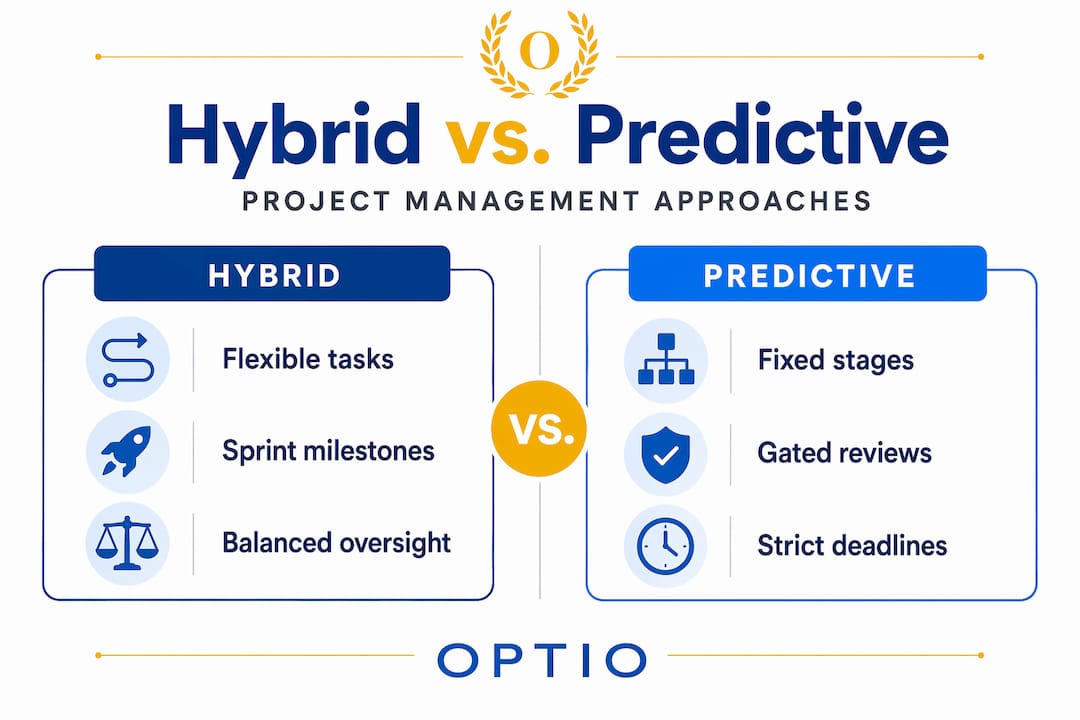
Pure Agile works beautifully for software products with evolving requirements and short feedback loops. Pure stage-gate works beautifully for highly regulated construction or safety-critical systems. Most real engineering projects live somewhere in between, which is exactly why blending Agile execution with stage-gate governance is now a common engineering-project delivery approach. It keeps funding and compliance discipline intact while allowing iterative development inside each stage.
Here is what each approach looks like in practice:
| Approach | Governance style | Best for | Main risk |
|---|---|---|---|
| Pure stage-gate | Sequential, milestone-driven | Regulated, fixed-scope builds | Slow to adapt to change |
| Pure Agile | Sprint-based, iterative | Software, R&D, evolving designs | Insufficient oversight |
| Hybrid | Gate approvals + internal sprints | Most complex engineering projects | Requires skilled tailoring |
In a hybrid model, you might run a three-month stage with a formal gate at the end (for budget and compliance sign-off), while running two-week sprints inside that stage to iterate on design deliverables. This gives you accountability at the executive level and speed at the team level.
Explore task list templates designed for hybrid teams to see how sprint tasks and stage milestones can coexist in a single plan.
Pro Tip: If you are a new PM experimenting with hybrid, start with a stage-gate backbone so you keep budget and compliance controls solid. Then introduce sprints inside one stage as a pilot. Expanding incrementally is far safer than redesigning your entire delivery model at once.
What most new engineering project managers get wrong—and how to stand out
Moving from theory to action, here is an honest look at what separates the aspiring PMs who make an impression from those who spin their wheels.
The most common mistake is treating PM frameworks as prescriptions rather than diagnostic tools. A Centurion who memorizes the PMBOK and applies every process to every project is not demonstrating competence. They are demonstrating rigidity. The highest-leverage early skill is diagnosis: reading the project’s context, identifying which constraints matter most, and building a governance model that fits.
The second mistake is neglecting the human side of risk and change management. You can have the cleanest risk register in the organization, but if your team does not trust you enough to tell you the truth, your register is fiction. The best engineering PMs we have observed build trust through consistency: they respond the same way to bad news every time, they follow up on every concern raised, and they protect the people who surface problems.
Here are the habits that set apart top new PMs:
- Tailor first, template second. Understand the project before choosing the process.
- Read SPI/CPI weekly. Do not wait for the monthly report to tell you what happened two weeks ago.
- Document every scope decision immediately. Memory is not a change control system.
- Build relationships with your risk skeptics. The person on your team who is always worried is often the most valuable early-warning signal you have.
- Ask “what are we not talking about?” in every risk review. That question alone will surface more real threats than any formal risk framework.
For the tools to support these habits from day one, check out engineering PM software picks built for students and young professionals navigating their first real projects.
Start your project management journey today
Frameworks, tools, and habits are only valuable when you put them into practice on real work. As your second-in-command, Optio is built to help Centurions like you execute with precision and clarity, without drowning in complexity.
Whether you are tracking sprint tasks, managing a stage-gate timeline, or keeping your team accountable on deliverables, Optio gives you the structure to move fast without losing control. Start with the best task management software comparison to find the right tool for your team, learn how to master effective task tracking across multiple workstreams, and explore real project tracker examples to see how top-performing project teams stay ahead of their baselines. Your first command decision is choosing the right tools. Make it count.
Frequently asked questions
What does an engineering project manager actually do?
They plan, organize, and oversee engineering projects from start to finish, tailoring methods to project requirements and constraints. Engineering project managers typically operate across the full lifecycle using structured PM approaches adapted to the project’s environment.
How do I choose between Agile, predictive, or hybrid methods for my project?
Pick predictive for stable requirements, Agile for changing scopes, and hybrid when you need executive oversight plus team-level adaptability. A practical way to choose is to map requirements stability and regulatory conditions to the appropriate governance model.
Which project management metrics matter most?
For engineering, SPI and CPI are your core health indicators. Engineering performance management relies on these EVM metrics to quantify schedule and cost variance against baselines in real time.
How do I avoid scope creep?
Always require formal documentation and approval before accepting any changes, and immediately communicate the impact on time and cost to all stakeholders. An explicit scope-change protocol is essential because unmanaged scope creep directly destabilizes the triple constraint.
What’s the biggest mistake new engineering project managers make?
They follow best practices too rigidly instead of adapting methods to the unique project context. A high-leverage early skill is tailoring: picking PM processes that fit the work’s uncertainty and constraints, then enforcing clear lifecycle gates for changes, funding, and compliance.
Recommended
- Master project manager tasks to boost team success – Optio Station: Best Project Management App for Prioritization
- Head of Project Management: Skills to Succeed in 2026 – Optio Station: Best Project Management App for Prioritization
- Project Manager Agile: Complete Guide for Students & Pros – Optio Station: Best Project Management App for Prioritization
- Essential Manager Skills List: Boost Your Team and Career – Optio Station: Best Project Management App for Prioritization
