

TL;DR:
- A skilled Scrum Master acts as a servant-leader who facilitates team effectiveness, not just managing meetings. They protect feedback loops, remove impediments, and foster self-organization, leading to faster delivery and higher satisfaction. Proper understanding and application of Scrum principles directly enhance team performance, especially for student and early-career groups.
Many project teams work hard and still fall short. The deadline slips, quality drops, and nobody is sure why. More often than not, the real culprit is a misunderstood role sitting right at the center of the team: the Scrum Master. Most students and early-career professionals either skip this role entirely, treat it like a glorified meeting host, or dump it on the most talkative person in the group. That’s a costly mistake. A Scrum Master is a servant-leader coach who helps the team understand and use Scrum effectively, and when that person knows what they’re doing, results improve fast.
Table of Contents
- What does a Scrum Master actually do?
- Why Scrum Masters are vital for student and early-career teams
- Common pitfalls: Mistakes new Scrum Masters make
- Making metrics work: Velocity and feedback loops explained
- Facilitation in action: Scrum events that drive results
- What most guides get wrong about Scrum Masters
- Level up your project management with the right tools
- Frequently asked questions
Key Takeaways
| Point | Details |
|---|---|
| Clear role duties | A Scrum Master coaches, facilitates, and shields teams so they stay focused and productive. |
| Impact on results | Effective Scrum Masters help teams finish faster, improve quality, and work better together. |
| Avoid common traps | Mistakes like turning events into status meetings or misusing Velocity can hurt team morale and outcomes. |
| Focus on feedback | Feedback loops and coaching—not rigid rituals—drive continual improvement and genuine productivity. |
What does a Scrum Master actually do?
Now that you’ve seen why the Scrum Master matters, let’s break down exactly what this role is and what it isn’t.
The Scrum Master is not a boss, not a secretary, and definitely not just someone who schedules stand-ups. The role has four core responsibilities that work together: facilitation, coaching, removing impediments, and protecting the team’s focus. Each one requires a specific mindset shift, especially if you’re coming from a traditional group project background.
Here’s what the Scrum Master’s day-to-day actually looks like compared to common misconceptions:
What Scrum Masters actually do:
- Guide the team through Sprint Planning, Daily Scrums, Sprint Reviews, and Retrospectives
- Ask questions that help the team self-organize rather than handing down decisions
- Identify and eliminate blockers, whether that’s a missing resource, unclear requirements, or interpersonal friction
- Shield the team from external interruptions during a sprint
- Coach the product owner on backlog refinement and clear communication
What Scrum Masters do NOT do:
- Assign tasks to individuals
- Serve as the single point of contact for stakeholders
- Measure individual performance
- Run meetings as status updates where each person reports to them
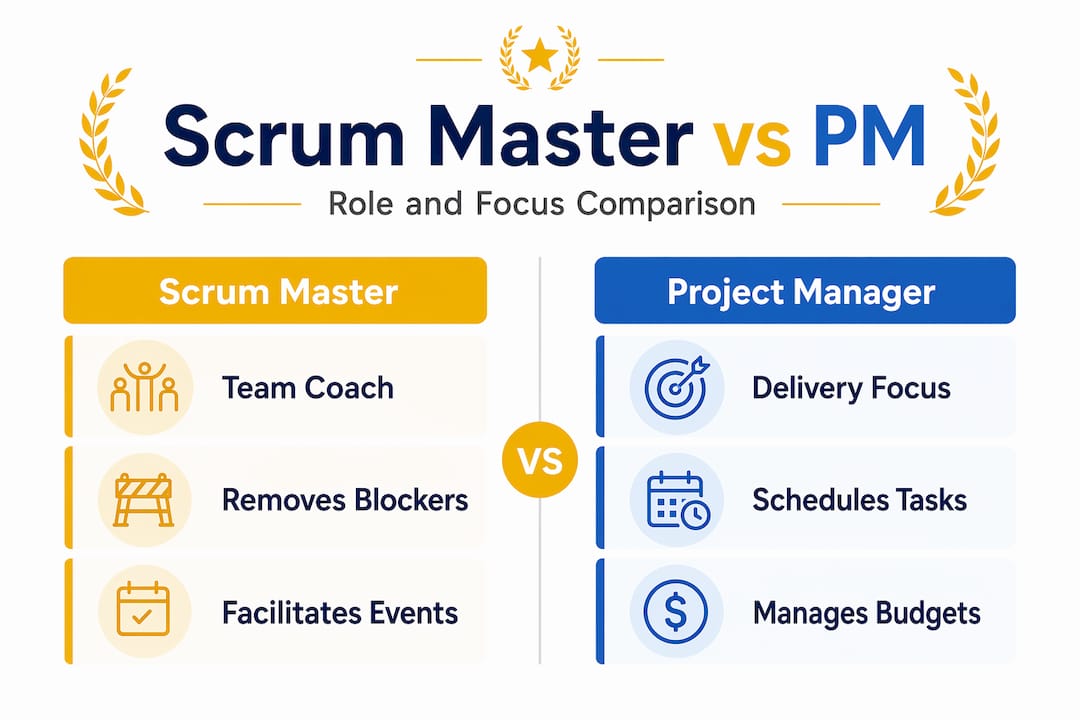
The difference between these two lists is massive. A Scrum Master role overlaps with project-management skills but is distinct from a traditional project manager’s lifecycle focus. Here’s a comparison to make that crystal clear:
| Responsibility | Scrum Master | Project Manager |
|---|---|---|
| Main focus | Team effectiveness and process | Deliverables, budget, timeline |
| Authority style | Servant-leader, no direct authority | Often has direct authority |
| Scope of work | Within the Scrum Team | Across the entire project |
| Decision-making | Empowers the team to decide | Makes decisions or escalates them |
| Success metric | Team improvement over time | Project delivered on spec |
| Manages people? | No | Often yes |
If you want to go deeper on adapting this role for fast-moving environments, the agile project manager guide at Optio Station covers the key differences in a practical way.
Pro Tip: Don’t assign the Scrum Master role to whoever has the best grades or talks the most. The best candidate is someone who listens well, asks smart questions, and genuinely cares about the team improving, not about being right.
Why Scrum Masters are vital for student and early-career teams
Understanding the key duties, let’s see why mastering this role can be a game-changer for your own teams.
The impact of a skilled Scrum Master shows up in numbers. Published research on Scrum’s outcomes consistently examines time to market, code quality, team productivity, and client satisfaction, and the results, while context-dependent, point in a clear direction: structured facilitation works.
Here’s what the evidence shows across multiple team settings:
| Outcome area | Improvement with effective Scrum practices |
|---|---|
| Time to deliver working output | Up to 37% faster in structured sprints |
| Team-reported satisfaction | Significantly higher vs. waterfall methods |
| Defect rates | Lower when retrospectives are used consistently |
| Stakeholder feedback integration | Faster and more frequent with short sprint cycles |
| Burnout risk | Lower when sprint scope is protected |
Now, it’s worth being honest: these results don’t happen automatically. The research is clear that context matters. A Scrum Master who runs bad ceremonies or who can’t protect the team’s focus can actually slow things down. The framework is only as good as the person facilitating it.
For student teams specifically, the wins are both immediate and resume-worthy. You improve your team collaboration within weeks, not semesters. You practice real prioritization techniques that apply directly to internships and entry-level roles. And you build the kind of professional instincts that most graduates only develop years into their careers.
The key benefits worth highlighting:
- Faster iteration: Short sprints force decisions and produce visible progress quickly
- Clearer accountability: Everyone knows what they’re working on and why
- Built-in quality checks: Reviews and retrospectives catch problems before they compound
- Real leadership experience: Rotating the Scrum Master role gives everyone a turn at leading without the pressure of formal authority
Common pitfalls: Mistakes new Scrum Masters make
Now that it’s clear why Scrum Masters matter, it’s crucial to understand what not to do so your efforts don’t backfire.
New Scrum Masters almost always make the same handful of mistakes. Knowing them ahead of time saves your team a lot of wasted effort and frustration.
-
Running the Daily Scrum like a status meeting. This is the most common error. The Daily Scrum is for the team to coordinate with each other, not for the Scrum Master to collect updates. The moment it becomes “report to the Scrum Master,” you’ve broken the self-organizing principle. Common Scrum Master failure modes include exactly this, along with letting work spill over repeatedly and pushing teams past a sustainable pace.
-
Letting scope creep into the sprint unchallenged. If your product owner or professor keeps adding work mid-sprint, the Scrum Master’s job is to protect the sprint goal. Constant spillover signals a planning problem, not a team effort problem.
-
Ignoring burnout signals. Students especially push hard near deadlines. A Scrum Master who sees team members working through the night and calls it “dedication” is making a mistake. Sustainable pace isn’t optional. It’s a Scrum principle.
-
Skipping retrospectives when time is tight. This is backwards logic. The retrospective is most valuable when things went wrong. Cutting it when you’re stressed is like skipping the debrief after a failed mission.
-
Trying to control instead of coach. Telling people what to do is faster in the short term and catastrophic long term. Teams that are directed rather than coached don’t improve. They just execute.
“When Scrum Masters run events like status meetings, let work spill into consecutive sprints, and push unsustainable pace, they erode trust and Scrum’s effectiveness faster than any external obstacle can.” — Mountain Goat Software
For better project time management and to understand what strong leadership in this role actually looks like, building on advanced project leadership skills will accelerate your growth faster than any certification alone.
Pro Tip: Practice shifting from “here’s what you should do” to “what’s stopping you from doing it?” That single question change moves you from manager mode into genuine Scrum Master mode.
Making metrics work: Velocity and feedback loops explained
To really set your team apart, you’ll want to use metrics wisely, and here’s what most guides overlook.

Velocity is the most talked-about Scrum metric and also the most misused. It measures how many story points a team completes in a sprint, and it’s genuinely useful for forecasting. The problem is when teams, professors, or managers start treating it like a performance score.
Velocity should be used carefully because metrics can mislead teams when they become goals rather than decision aids. The moment your team starts inflating story point estimates to hit a velocity target, the metric becomes meaningless and trust breaks down.
Good uses of Velocity and other metrics:
- Predicting how much work fits into future sprints
- Spotting patterns in team capacity over time
- Identifying when external blockers are reducing output
- Supporting honest sprint planning conversations
Bad uses of Velocity and other metrics:
- Comparing one team’s velocity to another’s
- Using it to evaluate individual contribution
- Treating a velocity increase as proof of improvement
- Setting velocity targets as goals for the team to hit
The real engine of Scrum improvement isn’t metrics at all. It’s empiricism: the practice of inspecting what’s actually happening and adapting based on what you find. Feedback loops, retrospectives, and sprint reviews are where real learning lives. Velocity just tells you how much you moved. Retrospectives tell you whether you moved in the right direction.
For a stronger look at collaboration tools that support these feedback loops in practice, Optio Station’s overview connects the tools to the workflow so nothing slips through.
Pro Tip: Track velocity for yourself to improve sprint planning accuracy, but never show it to stakeholders as a performance indicator. Keep it internal and use it as a planning compass, not a report card.
Facilitation in action: Scrum events that drive results
Armed with the knowledge of tools and pitfalls, let’s walk through how to facilitate Scrum ceremonies so your team thrives.
Three Scrum events make or break how a team operates: the Daily Scrum, the Sprint Planning, and the Sprint Retrospective. A Scrum Master is responsible for facilitating these events and coaching the team toward self-management. Here’s how to run each one so it actually adds value.
Daily Scrum (15 minutes, every day):
- Start on time, every time. Consistency builds the habit.
- Ask the three questions: What did I do yesterday? What will I do today? What’s blocking me?
- Keep it to 15 minutes. If a topic needs more discussion, schedule a separate conversation.
- Redirect any status reporting back to team-to-team communication.
Sprint Planning (timeboxed to 2 hours per week of sprint):
- Review the sprint goal before touching the backlog.
- Let the team pull work based on capacity, not a top-down assignment.
- Break stories into tasks small enough to be completed within a day.
- End the session with a shared, written sprint goal everyone agrees on.
Sprint Retrospective (1 to 1.5 hours at sprint end):
- Use a structured format: What went well? What didn’t? What do we change?
- Pick one or two actionable improvements, not a 10-item list nobody follows up on.
- Check back on last sprint’s retrospective commitments at the start.
- Create psychological safety. Blame has no place here.
For building the trust that makes these events work, team-building techniques specifically designed for project groups can make a measurable difference in how openly people engage.
Pro Tip: Ensure every Scrum event has a clear outcome before it starts. If you can’t answer “what decision or learning should come out of this meeting?”, you’re not ready to facilitate it yet.
What most guides get wrong about Scrum Masters
Here’s the hard truth most articles won’t say out loud: the majority of Scrum Master advice focuses almost entirely on rituals and ceremonies, as if running a good stand-up is the finish line. It isn’t. The rituals are a vehicle. The destination is a team that learns faster than its problems grow.
Most student teams that “do Scrum” pick up the vocabulary and the meeting schedule, then wonder why nothing feels different. The answer is almost always that they’re performing the ritual without understanding the intention. They run a Daily Scrum but skip the retrospective. They use a Kanban board but never look at what’s blocking the most cards. They track velocity but don’t ask whether they’re building the right thing.
The real Scrum Master superpower is protecting feedback loops, not managing ceremonies. Every sprint review, every retrospective, every quick “is this still the right priority?” conversation is a feedback loop. Keeping those loops intact from day one is the single biggest productivity win for new teams, far more than any tool or template.
Our experience watching student and early-career teams struggle reinforces this constantly. Be strict about feedback. Be adaptable about everything else. Don’t copy textbook Scrum if it doesn’t fit your team’s actual rhythm, but never skip the moments where the team inspects and adapts. That’s where growth happens, and collaboration best practices that support this mindset compound over time in ways that ceremonies alone never will.
Level up your project management with the right tools
Ready to actually apply these insights? Understanding the Scrum Master role is one thing. Having the right system to put it into practice is what separates teams that talk about agile from teams that actually execute it.
Optio Station is built for exactly this: students and young professionals who want real team and task management without the complexity of enterprise tools. Whether you’re coordinating a group capstone, running a club project, or organizing your first internship deliverables, the guides and frameworks at Optio Station give you a practical edge. Start with the best task management software guide to find the right fit for your team, and then build your workflow using the effective task management strategies that support real Scrum-style iteration. Your team deserves tools that actually serve the mission.
Frequently asked questions
What is the difference between a Scrum Master and a project manager?
A Scrum Master coaches teams in Scrum practices and removes blockers, while a project manager focuses on budgeting, scheduling, and overall coordination. The roles are distinct despite some skill overlap, especially in how authority and accountability are structured.
How does a Scrum Master help teams work better?
A Scrum Master removes obstacles, facilitates key Scrum events, and builds self-organizing habits that improve output over time. As a servant-leader coach, the role focuses on enabling the team rather than directing it.
Why shouldn’t teams use Velocity as a performance rating?
Velocity is a forecasting tool, not a scoreboard. When teams treat it as a goal, they inflate estimates or cut corners to hit numbers, which distorts results and erodes trust across the team.
Do Scrum Masters benefit non-technical teams and students?
Absolutely. The core principles of facilitation, feedback, and focus protection apply to any team with a shared goal and a deadline. Scrum’s impact has been studied across both technical and non-technical settings, with consistent improvements in collaboration and delivery.
Recommended
- How to Manage Team Tasks Effectively for Success – Optio Station: Best Project Management App for Prioritization
- 7 Practical Work Goal Examples for Students and Professionals – Optio Station: Best Project Management App for Prioritization
- How to Improve Teamwork for Success in College and Work – Optio Station: Best Project Management App for Prioritization
- Prioritization techniques in agile: student productivity – Optio Station: Best Project Management App for Prioritization
