

TL;DR:
- Making around 35,000 decisions daily, most are automatic, but some require deliberate frameworks to avoid decision fatigue. Utilizing tools like the decision matrix and 10-10-10 rule helps improve choice quality by aligning decisions with personal priorities and future outcomes. Building decision habits on small, everyday choices and understanding the value of deliberate thinking enhances overall confidence and life effectiveness.
You make roughly 35,000 decisions every single day. Most are automatic, like what to eat or which route to take, but enough of them are conscious and weighty to leave you mentally drained before noon. For college students juggling coursework, part-time jobs, social lives, and big-picture goals, and for young professionals navigating career moves and financial pressure, that cognitive load is no joke. The good news is that decision making is a skill, not a personality trait. With the right frameworks and tools, you can move from feeling paralyzed to feeling confident, one choice at a time.
Table of Contents
- Why decision making feels overwhelming
- Simple frameworks to strengthen your everyday choices
- Tools for overcoming mental blocks and emotional traps
- Deliberation vs. intuition: What science really shows
- Our take: How to actually use decision tools to change your life
- Take the next step: Tools that put decision making into action
- Frequently asked questions
Key Takeaways
| Point | Details |
|---|---|
| Decision fatigue is real | Understanding why we’re overwhelmed by choices is the first step to improvement. |
| Use proven frameworks | Simple tools like matrices and the 10-10-10 Rule help bring structure and clarity to personal decisions. |
| Challenge emotional habits | Addressing mental roadblocks makes your decisions more rational and satisfying. |
| Deliberate decisions win | Taking time to think through options usually creates better outcomes than relying on gut instincts. |
| Practice leads to skill | Building your decision making muscle on small choices prepares you for bigger life decisions. |
Why decision making feels overwhelming
The sheer volume of choices you face each day is only part of the problem. The real issue is that your brain burns through mental energy with every decision it makes, and by the time you hit an important one later in the day, you are running on fumes. This is called decision fatigue, and it is well documented in psychology research.
Here is what makes it especially rough for students and young professionals:
- You face an unusually high number of novel decisions, things you have never decided before, like choosing a major, accepting a job offer, or signing a lease
- Your prefrontal cortex, the part of the brain responsible for deliberate, rational thinking, is still developing into your mid-twenties
- You often lack the experience-based shortcuts that older adults use to streamline choices
- Peer influence, social media, and FOMO create emotional noise that clouds judgment
Psychologist Daniel Kahneman’s research explains this tension through two thinking systems. System 1 is fast, emotional, and automatic. System 2 is slow, deliberate, and analytical. Most people lean too heavily on System 1 for decisions that actually deserve System 2 attention. According to decision-making research, the quality of your process matters more than the outcome of any single choice, a point made forcefully by strategist Annie Duke.
“Resulting is the tendency to judge the quality of a decision based on the outcome rather than the process. A great process can lead to a bad outcome, and a poor process can lead to a good outcome. But over time, great process wins.” — Annie Duke
Building productivity systems for students around structured decision making is one of the most underrated moves you can make in your early years. It pays off in ways that raw intelligence or hard work alone cannot.
Simple frameworks to strengthen your everyday choices
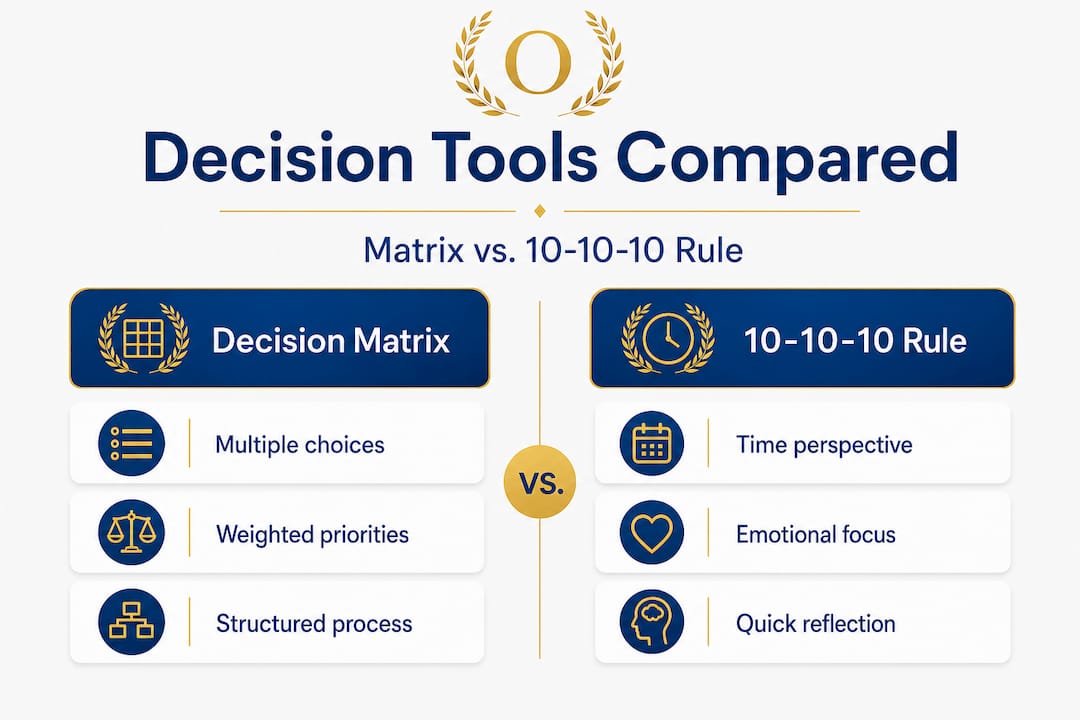
Once you understand why decisions are hard, the natural next step is building a repeatable process. Two of the most practical frameworks for personal life decisions are the Decision Matrix and the 10-10-10 Rule. Neither requires a business degree or a spreadsheet obsession. They just require a few minutes of honest thinking.
The decision matrix
A decision matrix works by forcing you to define what actually matters to you, then scoring your options against those criteria. Here is how to use it:
- Write down the decision you need to make clearly at the top of a page
- List all realistic options in a column on the left
- Identify three to five criteria that matter most to you, such as cost, enjoyment, long-term alignment, or time required
- Assign a weight to each criterion from 1 to 5 based on its importance
- Score each option from 1 to 5 for each criterion
- Multiply each score by the criterion weight, then add the totals for each option
- The option with the highest total is your most aligned choice
This works beautifully for decisions like choosing between two internship offers, picking a living situation, or even deciding which elective to take. It converts a fuzzy feeling into a structured comparison.
The 10-10-10 rule
Developed by author Suzy Welch, the 10-10-10 Rule asks you to evaluate any decision through three time lenses: How will you feel about this choice in 10 minutes? In 10 months? In 10 years? This simple exercise cuts through short-term anxiety and long-term overthinking at the same time.

Say you are debating whether to skip a networking event because you are tired. In 10 minutes, you will feel relieved. In 10 months, you might regret not building your professional circle. In 10 years, the connection you made at that event could be a mentor, a reference, or a business partner. That shift in perspective often makes the right call obvious.
When to use each framework:
| Framework | Best for | Time required | Complexity |
|---|---|---|---|
| Decision matrix | Multiple options with defined criteria | 15 to 30 minutes | Low to medium |
| 10-10-10 rule | Emotional or impulse-driven decisions | 5 to 10 minutes | Very low |
| Both combined | Major life choices with emotional stakes | 30 to 45 minutes | Medium |
Pro Tip: Practice both frameworks on low-stakes decisions first, like choosing a weekend activity or a new habit to try. The mechanics become second nature so that when a high-stakes moment hits, you are not learning a new tool under pressure.
Pairing these frameworks with solid prioritization techniques and SMART goals examples gives you a complete personal decision system that scales with your ambitions.
Tools for overcoming mental blocks and emotional traps
Frameworks give you structure, but emotional habits can sabotage even the most rational process. This is where cognitive behavioral therapy, known as CBT, becomes surprisingly practical. CBT is not just for therapy sessions. Its core tools are designed to help you identify distorted thinking and replace it with clearer, more accurate reasoning, exactly what you need when fear, anxiety, or overconfidence is steering your choices.
Common cognitive distortions that wreck decisions:
- Catastrophizing: Assuming the worst outcome is inevitable, so you avoid deciding at all
- All-or-nothing thinking: Seeing options as either perfect or worthless, with no middle ground
- Mind reading: Assuming you already know how others will react, so you decide based on imaginary responses
- Overgeneralization: Using one past failure to predict all future outcomes
CBT worksheets, like the Thought Record and Cognitive Restructuring tools, guide you through identifying these patterns and replacing them with more balanced thinking. A basic Thought Record, for example, asks you to write down a triggering situation, the automatic thought that followed, the emotion it created, and then a more realistic alternative thought. Doing this before a big decision takes under ten minutes and often reveals that your fear is based on distortion rather than reality.
Here is how distortions map to decisions in real student life:
| Distortion | Example scenario | CBT reframe |
|---|---|---|
| Catastrophizing | “If I fail this exam, my career is over” | “One exam affects my GPA, not my entire trajectory” |
| All-or-nothing | “This job isn’t perfect, so I should reject it” | “Good enough now can lead to great later” |
| Mind reading | “My professor will think I’m dumb if I ask” | “Professors expect and welcome questions” |
| Overgeneralization | “I always mess up interviews” | “I had one bad interview. I can improve with practice” |
Pro Tip: Before any major decision, spend five minutes writing your automatic thoughts on paper. Then ask: “Is this thought a fact or an assumption?” That one question alone can cut through a surprising amount of mental noise.
Combining emotional awareness with structural tools like a priority matrix for students helps you stay both grounded and organized. Using a command log to track your decisions and their outcomes also builds the kind of self-awareness that makes future choices faster and smarter. Aligning your decisions with your time management goals ensures that your choices support your broader life strategy.
Deliberation vs. intuition: What science really shows
There is a popular idea that the gut knows best. Countless motivational posts and TED talks tell you to trust your instincts. But what does the actual research say? The answer might surprise you.
A 2025 study published in Nature found that deliberate decision making is consistently rated as smarter and more trustworthy than intuitive decision making, even when the deliberating person is under time pressure. Participants in the study viewed people who took time to think through choices as more competent and reliable, regardless of whether the final outcome was good or bad.
This has real implications for how you operate:
- Slowing down is not a weakness. Taking thirty seconds before responding in a meeting or asking for a day before committing to something is a sign of maturity, not indecision
- Intuition is useful in high-expertise situations, like an experienced surgeon recognizing symptoms or a veteran teacher reading a classroom. But for situations where you lack deep experience, gut feelings are often just familiarity bias in disguise
- You can harness deliberation without getting paralyzed by setting a decision deadline. Give yourself a defined window, work through your framework, then commit
- Journaling decisions and reviewing them later is one of the fastest ways to calibrate your judgment over time
The trap most young people fall into is treating speed as confidence. Deciding fast can feel bold, but it often just means you acted before you had enough information. Pair deliberate thinking with the time management strategies that protect your mental bandwidth, and you give yourself the best possible conditions for making sound choices.
The practical takeaway is simple: build in the habit of pausing. Not endlessly, but intentionally. Your future self will thank you.
Our take: How to actually use decision tools to change your life
Here is the honest truth we want you to hear: no single framework solves everything. The people who benefit most from decision tools are not the ones who pick one method and stick to it religiously. They are the ones who treat their toolkit like a wardrobe, pulling out the right thing for the right situation.
A decision matrix is great for comparing graduate programs. It is overkill for figuring out which gym class to try. The 10-10-10 Rule is powerful for emotional dilemmas. It adds unnecessary complexity to simple logistical calls. CBT worksheets are invaluable when you are spinning out over a job rejection. They are not the move when you are just scheduling your week.
What we consistently see is that the biggest return comes from practicing these tools on small, daily decisions first. Most people only reach for a framework when they are already in crisis mode over a big choice. By then, the emotional noise is so loud that even a solid process struggles to cut through. If you build the habit on lunch choices and weekend plans, the muscle is already warm when it actually matters.
We also want to push back on the idea that rational tools and personal values are in conflict. The best decisions are not purely analytical. According to decision matrix research, the criteria you weight in your matrix should reflect what genuinely matters to you, not just what looks good on paper. A framework is only as good as the self-knowledge you feed into it.
That is why we believe the real work is not learning more frameworks. It is getting clear on your values, your priorities, and your non-negotiables. Then the frameworks simply organize what you already know about yourself. The right project management software for students can help you track commitments and outcomes so that pattern recognition develops faster. But the foundation is always personal clarity first, tools second.
Take the next step: Tools that put decision making into action
You now have a solid map of the mental terrain. The next move is putting these frameworks into a daily practice that actually sticks.
Optio is built for exactly this moment. As your second-in-command, it helps you organize tasks, manage your time, and track priorities so that your decision-making process has a home base to return to every day. From structured task lists to team coordination tools, Optio gives Centurions the operational backbone that turns good intentions into consistent action. Explore the best task management software options and learn how to manage tasks effectively so that your decisions translate directly into results, not just good thinking.
Frequently asked questions
What is the best decision making tool for personal use?
A decision matrix is a simple, effective tool for comparing choices based on your personal priorities, especially when you have multiple options and need a clear, unbiased comparison.
How does the 10-10-10 rule help with big decisions?
The 10-10-10 Rule helps you balance short-term emotions with long-term consequences by asking how you will feel about a choice in 10 minutes, 10 months, and 10 years.
Can emotional habits impact decision making?
Yes, unrecognized thought patterns like catastrophizing or all-or-nothing thinking can seriously distort your choices. CBT worksheets help you identify and reframe those patterns before they take over.
Is it better to trust my instincts or deliberate on choices?
Research shows that deliberate decision making is consistently rated as smarter and more trustworthy than intuition, particularly for people who lack deep experience in a given domain.
How many decisions do people really make each day?
Studies estimate that the average person makes around 35,000 decisions per day, with most happening automatically below the level of conscious awareness.
Recommended
- Design a personal development workflow for lasting gains – Optio Station: Best Project Management App for Prioritization
- SMART goals for work: practical tips to boost productivity – Optio Station: Best Project Management App for Prioritization
- Level Up Your Time Management Skills for School and Work – Optio Station: Best Project Management App for Prioritization
- Workplace productivity checklist: strategies for success – Optio Station: Best Project Management App for Prioritization
