

TL;DR:
- Choosing effective team activities relies on intentional design that fosters psychological safety and trust among members. The best activities, such as Minefield, Lego Challenge, and Cooperative Learning, promote clear communication, interdependence, and ongoing reflection for sustained team growth. Virtual and hybrid adaptations of these activities ensure teams build genuine connections and improve collaboration regardless of their physical environment.
Choosing a team building activity sounds simple until you realize how much rides on picking the right one. A poorly matched activity kills the energy in the room, wastes everyone’s time, and leaves your group no closer to working well together. The good news: teamwork activities boost productivity by 20 to 30%, raise engagement by 20%, and high-trust teams outperform low-trust ones by 50%. That kind of impact does not happen by accident. This guide gives you a practical, research-backed framework for choosing the best activities for your study group or work team, plus a complete list of proven options you can run today.
Table of Contents
- How to choose team building activities that work
- Top 7 team building activities for students and young professionals
- Comparison table: Which activity fits your group best?
- Adapt activities for virtual, hybrid, or in-person teams
- Perspective: Why team building that feels real always wins
- Make teamwork your advantage with expert tools
- Frequently asked questions
Key Takeaways
| Point | Details |
|---|---|
| Effective team building boosts results | Well-chosen activities can improve productivity, engagement, and trust among group members. |
| Choose activities based on group needs | Select team building games and models that match your context, group size, and objectives. |
| Mix fun with real outcomes | Combine enjoyable icebreakers with structured collaboration to get both short-term and lasting benefits. |
| Adapt for any setting | Most activities can be modified for in-person, virtual, or hybrid groups with minor tweaks. |
| Prioritize psychological safety | Focus on creating trust and clear communication for sustainable teamwork improvement. |
How to choose team building activities that work
With the importance of team results established, let’s look at what makes a team building activity truly effective.
Not every fun activity actually builds a team. You have probably sat through a forced icebreaker that left everyone more awkward than before. The difference between an activity that sticks and one that flops usually comes down to intentional design rather than entertainment value alone.
The best activities share a few core traits. They create psychological safety, which is the shared belief that it is okay to take risks, speak up, and be honest without fear of judgment. Google’s Project Aristotle research confirmed that psychological safety outperforms team composition as the single biggest driver of high performance. In other words, who is on your team matters less than how safe they feel working together.
Here is what to look for when evaluating any activity:
- Trust building: Does the activity require participants to rely on each other to succeed?
- Communication focus: Does it force clear, direct, or creative communication under some form of constraint?
- Psychological safety: Does it create a low-stakes environment where people can laugh at mistakes?
- Group size fit: Is it designed for pairs, small groups, or the whole cohort?
- Adaptability: Can you run it in person, virtually, or in a hybrid format?
- Time and setup: Does it fit your schedule and available resources?
Physical activities work well for in-person groups with shared space, while virtual teams benefit from digitally adaptable versions of the same formats. Fun matters, but it should serve a purpose. An activity that feels fun and builds a real skill, like communication or problem-solving, always outperforms one that is just entertaining.
Pro Tip: Before picking an activity, write down your one biggest team challenge. Is it that people do not speak up? Is it unclear roles? Match your activity to that specific gap for the best results.
Good team accountability strategies start with trust, and trust starts with the right shared experiences. If you want to harness teamwork for success, the activity you choose is your first deliberate investment in that direction.
Top 7 team building activities for students and young professionals
Now that you know what to look for in an activity, here are the top evidence-backed options you can use with your study group or work team.
-
Two Truths and a Lie
This classic icebreaker works because it is low-pressure and immediately personal. Each participant shares two truths and a lie about themselves, and the group tries to guess which statement is false. The goal is not to win. The goal is to spark curiosity, laughter, and unexpected connection. You discover that your quiet classmate once competed nationally in chess, or that your new teammate speaks four languages. These small revelations change how people see each other, which is the foundation of real trust. -
Human Bingo
Instead of numbers, your bingo card is filled with personal traits like “speaks more than one language,” “has lived in three or more states,” or “once pulled an all-nighter to finish a project.” Players mingle to find real matches among their group members, checking off squares as they go. Human Bingo is especially powerful for larger groups where people do not naturally interact. It forces everyone to move, talk, and discover shared experiences in a structured but playful way. -
Spaghetti Tower (Marshmallow Challenge)
This is one of the most research-referenced activities in team building for good reason. Teams build the tallest freestanding tower using only spaghetti, tape, string, and a marshmallow placed on top. The time constraint forces rapid prototyping, collaboration, and iteration. What makes this activity fascinating is that kindergartners typically outperform MBA students because they start building immediately instead of planning too long. It teaches your group a genuinely useful lesson: bias toward action and test your ideas early. -
Minefield
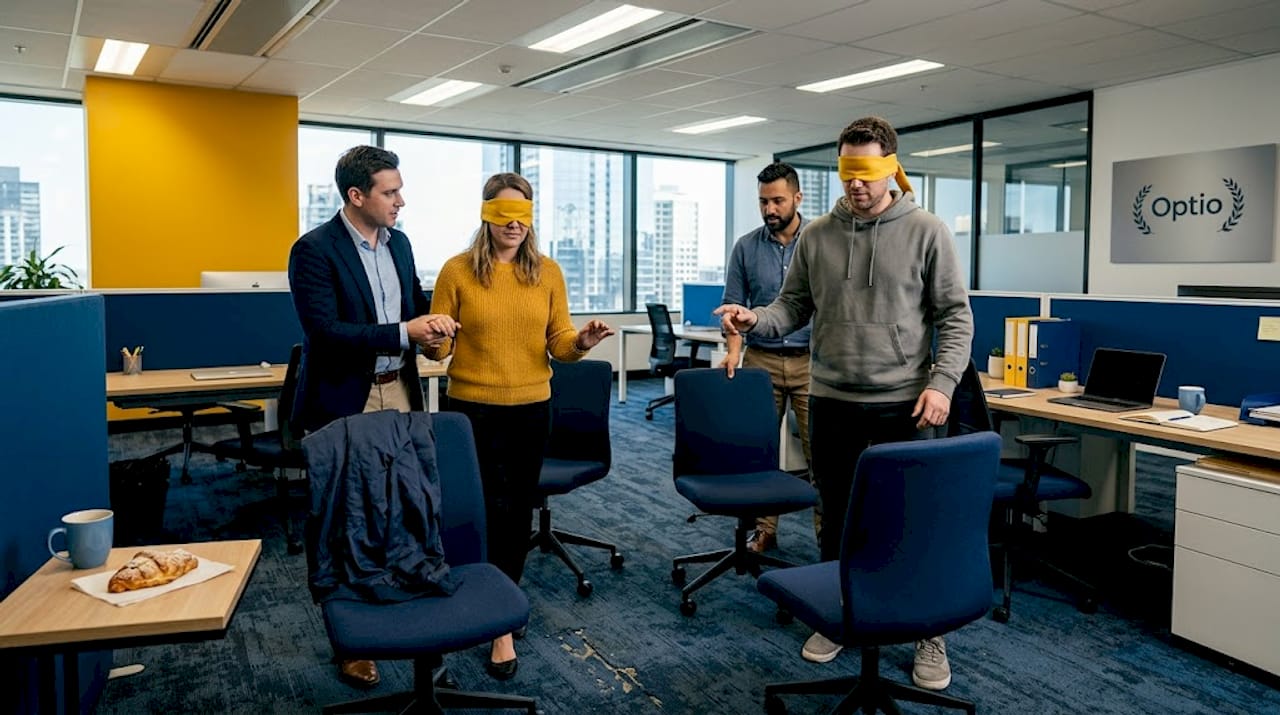
In this activity, one blindfolded team member navigates an obstacle course using only verbal instructions from their teammates guiding them through without touching. Minefield is raw trust in action. The person navigating has to let go of control entirely and rely on clear communication from their team. It exposes exactly how well your group gives and follows instructions, and the debrief conversation afterward is usually rich with insight about communication patterns. -
Lego Challenge
One team member sees a completed Lego model and must describe it to a builder who cannot see the model or the instructions. The builder constructs based purely on verbal description. This activity is brilliant because it reveals the gap between what you think you are communicating and what the other person actually hears. It is especially valuable for hybrid teams and study groups working on complex shared projects, because it trains precise, assumption-free communication. -
Campus Scavenger Hunt
Teams race to find campus landmarks or hidden facts within a set time. This activity combines physical movement, orientation for new students, and real-time team coordination. It works particularly well at the start of a semester or onboarding period. Teams have to divide responsibilities, make fast decisions together, and trust each other under mild time pressure. It also has the added bonus of making everyone more familiar with the campus environment. -
Cooperative Learning Groups
This is the most structured option and arguably the most powerful for sustained results. Unlike unstructured group discussions, cooperative learning assigns specific roles and uses clear structures like positive interdependence (every person’s contribution matters), individual accountability, and group processing (reflecting on how well the team worked together). Research on cooperative learning in college settings consistently shows it outperforms both competitive and individual learning formats for retention and group cohesion.
“The best team building activities are not the most elaborate ones. They are the ones that surface real dynamics, give people a shared experience to reference, and start an honest conversation about how your group works.” — Optio Station
Pro Tip: Run a brief debrief after any activity. Ask three questions: What went well? What was harder than expected? What will we do differently next time? The debrief is often where the real learning happens.
Comparison table: Which activity fits your group best?
With each activity’s details understood, use this table to quickly find which matches your situation.
| Activity | Group size | Time needed | Indoor/Outdoor | Trust focus | Communication focus | Setup effort |
|---|---|---|---|---|---|---|
| Two Truths and a Lie | 4 to 30+ | 10 to 20 min | Both | Medium | Medium | Very low |
| Human Bingo | 10 to 50+ | 15 to 30 min | Both | Low | High | Low |
| Spaghetti Tower | 3 to 6 per team | 30 to 45 min | Indoor | Medium | High | Medium |
| Minefield | 2 to 20 | 20 to 40 min | Both | Very high | Very high | Low |
| Lego Challenge | 2 to 4 per pair | 20 to 30 min | Indoor | High | Very high | Medium |
| Campus Scavenger Hunt | 4 to 10 per team | 45 to 90 min | Outdoor | Medium | High | High |
| Cooperative Learning | 3 to 6 per group | Ongoing | Indoor | High | High | Medium |
Notice that some of the highest-impact activities, like Minefield and Lego Challenge, require very little setup. The Cooperative Learning model is the outlier here. It is not a one-time game but a recurring structure that builds on itself over time, making it the most effective option for long-term study groups or project teams.
If you are building a productivity system for students that includes regular group sessions, combining a quick icebreaker with a cooperative learning structure gives you both the social connection and the operational rigor your group needs.
Adapt activities for virtual, hybrid, or in-person teams
Having found your ideal activities, make sure they fit your team’s unique environment with these adaptation tips.
Running activities across different formats is not just about logistics. It is about preserving the psychological impact of the activity regardless of where people are sitting. Campus-themed activities build community for students, while communication-focused formats like Lego Challenge are especially effective for improving hybrid team productivity.
Here is how to adapt the top activities for each environment:
- Virtual Human Bingo: Create a digital bingo card using Google Slides or Canva. Share your screen in the video call and use the chat or breakout rooms for players to find their matches. Keep groups small (8 to 12 people) so everyone gets talking time.
- Online Two Truths and a Lie: Works perfectly on Zoom or any video platform. Use a polling tool like Mentimeter to let everyone vote on which statement is the lie in real time, which adds energy to a normally quiet format.
- Digital Lego Challenge: Use virtual building tools or describe arrangements of colored blocks on a shared digital whiteboard (Miro or FigJam work well). The communication challenge translates perfectly to remote settings.
- Virtual Spaghetti Tower: Replace physical materials with a timed design challenge on a whiteboard tool. Teams sketch their tower structure and present it, then vote on which design would theoretically win. It shifts from building to strategic thinking, which still drives collaboration.
- Hybrid Minefield: In a physical space, run the standard blindfolded version. For remote participants, adapt it into a verbal puzzle where one player describes a complex image and the other has to recreate it without seeing it.
- Scavenger Hunt adaptations: For hybrid groups, use outdoor group games formats that mix in-person and digital checkpoints, such as photo challenges submitted via a group chat.
The key principle across all of these is that the mechanics can change, but the core purpose cannot. If you are doing Lego Challenge to improve communication, the virtual version must still force the same kind of precise, assumption-free language. Understanding your collaboration tools before the session starts saves significant time and prevents the activity from falling apart due to technical hiccups.
Perspective: Why team building that feels real always wins
There is an uncomfortable pattern in how most groups approach team building. They look for the most entertaining option, run it once, and expect results. When nothing changes, they assume team building does not work. The real problem is that they were optimizing for fun instead of function.
The evidence is clear: psychological safety and clear roles drive sustained productivity far more than any single fun activity. Fun is the vehicle, not the destination. The activity creates the conditions for an honest conversation. The conversation is what actually changes behavior.
Here is what we believe after watching hundreds of student and professional teams try to build better collaboration: the groups that improve are the ones that treat team building as a practice, not an event. They run a short activity, debrief honestly, and apply what they learned to the next real project. The groups that do not improve are the ones that treat a single workshop as a fix.
Authenticity matters more than production value. A simple Minefield exercise run with genuine attention and a ten-minute debrief will do more for your team than an expensive off-site that never surfaces real conversations. Your team knows when something feels genuine versus performative, and that perception directly affects whether they engage or just go through the motions.
The other thing most guides will not tell you: feedback loops are the missing ingredient. Build a simple habit of asking your team how collaboration is going, adjusting your approach based on what you hear, and trying new formats when the current one stops producing growth. That ongoing process of testing and refining is what academic productivity workflows and the best teams in the world have in common. They treat their own process as something to improve, not a fixed thing to accept.
Make teamwork your advantage with expert tools
If you have read this far, you are clearly serious about building a team that actually works well together. That intentionality is exactly the kind of leadership edge that separates average groups from exceptional ones.
Optio Station is the second-in-command for Centurions like you who want to turn collaboration from a challenge into a strength. Whether you are managing a study group or coordinating a young professional team, our resources on best task management software, collaboration best practices, and our complete team collaboration guide give you the systems to back up every team building session you run. The activities in this article build the trust. Optio gives you the structure to sustain it.
Frequently asked questions
What is the most effective team building activity for new groups?
Icebreaker activities like Two Truths and a Lie are most effective for new groups because they build personal connections quickly with zero setup and low social pressure.
How do team building activities improve productivity?
Team building raises trust, engagement, and psychological safety, and high-trust teams outperform low-trust teams by up to 50% while boosting overall productivity by 20 to 30%.
Which team building activities work best for hybrid or remote teams?
Communication-focused activities like Lego Challenge and virtual Human Bingo adapt especially well to hybrid or remote settings because their core mechanics translate easily to digital tools.
Are there structured models for team building beyond games?
Yes. Cooperative Learning structures that assign roles, build interdependence, and include group reflection are research-backed and consistently outperform unstructured group discussions for long-term team development.
How can introverts feel more comfortable in team activities?
Activities with defined roles and small group formats, like the Lego Challenge paired format, give introverts a clear job to do and reduce the open-ended social pressure that larger group formats can create.
Recommended
- How to Improve Teamwork for Success in College and Work – Optio Station: Best Project Management App for Prioritization
- 7 Inspiring Examples of Group Projects for Success – Optio Station: Best Project Management App for Prioritization
- Collaboration Best Practices 2026: Boost Productivity 30% – Optio Station: Best Project Management App for Prioritization
- 7 Best Collaboration Tools for Remote Teams Explained – Optio Station: Best Project Management App for Prioritization
- Team Building for Startups: Driving Growth Together
