

TL;DR:
- Structured checklists clarify roles and responsibilities, boosting team motivation and accountability.
- Converting goals into specific deliverables with deadlines reduces ambiguity and social loafing.
- Digital tools help maintain visibility, track progress, and reinforce accountability throughout the project.
Group projects have a way of starting strong and losing steam fast. Someone goes quiet, deadlines slip, and suddenly the whole team is scrambling. The problem rarely comes down to ability or even commitment. It comes down to structure. When expectations are vague and roles are fuzzy, motivation quietly collapses. A well-built team motivation checklist fixes that by giving every Centurion on your squad a clear map, shared accountability, and a repeatable system that keeps energy high from kickoff to final delivery.
Table of Contents
- Why every group needs a team motivation checklist
- Core elements of a high-impact team motivation checklist
- Checklist in action: practical steps and sample items
- Comparing motivation strategies: checklist vs ad-hoc approaches
- A smarter approach: why systems beat slogans for real motivation
- Move from ideas to action with the right tools
- Frequently asked questions
Key Takeaways
| Point | Details |
|---|---|
| Checklist creates clarity | A structured team motivation checklist provides clear roles, reduces ambiguity, and beats vague team-building exercises. |
| Break work into steps | Turning projects into concrete tasks with deadlines and owners keeps engagement high and progress visible. |
| Regular resets matter | Diagnose and realign after team changes for renewed motivation and better outcomes. |
| Systems outperform slogans | Lasting team motivation relies on explicit processes, not just good intentions or morale boosters. |
Why every group needs a team motivation checklist
Now that you’re aware of how easily teams can lose motivation, let’s see why a structured checklist makes all the difference.
Most teams don’t fail because people stop caring. They fail because nobody knows exactly who is responsible for what, or when. That ambiguity creates a slow leak of momentum. One member assumes another is handling a task. A deadline gets treated as a suggestion. Then comes the all-nighter, the resentment, and the mediocre final product that nobody feels proud of.
This pattern is so common in group work that researchers have studied it extensively. One of the biggest culprits is a phenomenon called social loafing, which happens when individuals reduce their personal effort because they expect others to carry the load. The moment roles are unclear, social loafing creeps in. A checklist directly attacks this problem by making every responsibility explicit and visible.
“To increase motivation, give teams a repeatable structure that reduces ambiguity and social loafing.”
— Center for Teaching and Learning Innovation
Here is what a motivation checklist actually addresses for your team:
- Role clarity: Every member knows their specific function, not just the general group goal
- Task visibility: Work is broken into concrete steps, not floating ideas
- Accountability anchors: Each item has an owner, so nothing gets lost in the group chat
- Progress tracking: The team can see what is done, what is in progress, and what is stalled
- Expectation alignment: Everyone agrees upfront on what “done” looks like for each task
Pairing this checklist approach with a solid workflow for team motivation turns intention into execution. The checklist is the skeleton. The workflow is how it moves.
Core elements of a high-impact team motivation checklist
With the benefits established, here’s a breakdown of what a results-driven checklist should include and why each item matters.
A checklist only works if it is built on the right foundations. Vague items like “work on the report” or “handle research” leave too much room for misinterpretation. The most effective checklists convert abstract assignments into specific, measurable deliverables.
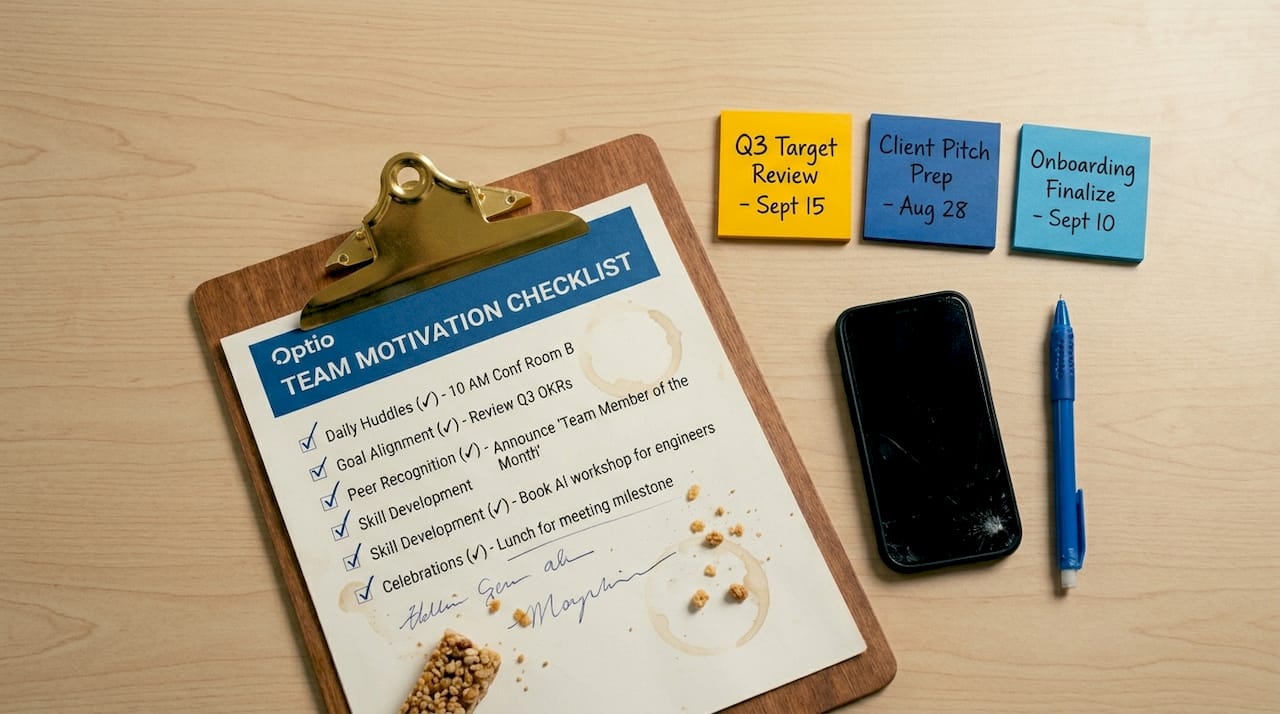
According to research on student and early-career group work, you can reduce motivation drag by converting work into concrete deliverables with owners, checkpoints, and micro-deadlines. That is a three-part formula worth memorizing: ownership, checkpoints, and micro-deadlines.
Here is a numbered breakdown of what every strong team motivation checklist must include:
- Define and rotate roles: Assign a team lead, a note-taker, a deadline tracker, and a reviewer at the start of each project phase. Rotating roles every few weeks keeps everyone engaged and prevents one person from burning out.
- Translate the goal into deliverables: Instead of writing “complete research,” write “compile 10 peer-reviewed sources by Thursday at 6 PM.” Specificity kills ambiguity.
- Assign a single owner per task: Group ownership sounds collaborative but breeds confusion. One name per task. That person coordinates input from others but owns the result.
- Set micro-deadlines for every phase: Break the project into weekly or biweekly checkpoints. Micro-deadlines create forward momentum and catch problems before they become emergencies.
- Schedule a brief weekly check-in: A 15-minute synchronous meeting (video or in-person) where each member shares one win, one blocker, and their next step. Short, structured, consistent.
- Revisit team expectations at each milestone: What worked last week might not work this week, especially if the scope changed or someone’s schedule shifted.
- Add a recognition step: At the end of each phase, acknowledge what went well. Motivation research consistently shows that recognition reinforces effort.
Pro Tip: Use a project management checklist template as your starting point instead of building from scratch. Customize it to your project, but let the structure do the heavy lifting.
For teams juggling multiple assignments across different courses or clients, a team task list template guide can help you adapt these elements across different project types without reinventing the wheel each time.
Checklist in action: practical steps and sample items
Knowing the elements is a good start, but seeing them applied in a real checklist will make them actionable for your group.
Let’s put the framework to work with a concrete example. Imagine your team of four is building a marketing proposal for a class competition. Here is what a properly structured checklist looks like in table form:
| Step | Owner | Deadline | Criteria for completion |
|---|---|---|---|
| Define target audience | Jordan | Day 3 | One-page written summary, reviewed by team |
| Competitive analysis | Sam | Day 6 | Three competitors analyzed with data points |
| Draft executive summary | Alex | Day 9 | 300-word draft, spell-checked, shared in folder |
| Design slide deck | Morgan | Day 12 | 12 slides, branded, reviewed by Jordan |
| Final team review | All | Day 14 | Everyone comments, changes locked by 8 PM |
| Submit final proposal | Jordan | Day 15 | Submitted via platform, confirmation screenshot saved |
This table does something most to-do lists don’t: it connects the who, the when, and the what success looks like in one place. When every member can see this, accountability becomes visual rather than assumed.
Beyond the table, here are practical checklist items your team can adapt immediately:
- Set up a shared folder or workspace on day one (not day five)
- Confirm that every member has access to all tools and files before work begins
- Write a one-sentence “definition of done” for every major task
- Flag dependencies early (task B can’t start until task A is finished)
- Build buffer time into the schedule, at least one day before the real deadline
On the topic of stalled or struggling teams, research from Harvard Business Review makes an important point: when a team hits a wall, the instinct is often to push harder. But the smarter move is to pause and diagnose before relaunching. A checklist reset, not a pep talk, is what gets teams back on track.
You can learn more about applying this in practice through the guide on how to manage team tasks and an assignment tracker setup that keeps everyone oriented even when things shift.
Comparing motivation strategies: checklist vs ad-hoc approaches
Now that you’ve seen sample action items, let’s compare how a checklist stacks up against more common, informal team approaches.
Many teams default to ad-hoc collaboration: group chats, casual agreements, and good intentions. It feels collaborative in the moment. But without structure, things fall through the cracks fast. The comparison below shows where the two approaches diverge most sharply.
| Dimension | Checklist-driven approach | Ad-hoc approach |
|---|---|---|
| Goal clarity | Explicit, written, agreed upon | Assumed or verbally stated |
| Role assignment | Named owners per task | Whoever gets to it first |
| Deadline adherence | Micro-deadlines with checkpoints | One final deadline, often missed |
| Accountability | Visible to all team members | Privately held, easily avoided |
| Social loafing risk | Low (named ownership) | High (group diffusion) |
| Team engagement over time | Sustained through structure | Drops after initial enthusiasm |
| Conflict response | Built-in review checkpoints | Reactive, often too late |
The pattern here is clear. Ad-hoc teams often start with more energy because spontaneity feels exciting. But that energy has no structure to channel it, so it fades. Checklist-driven teams might feel more “administrative” at the start, but they sustain performance because the system does the motivational heavy lifting.
As the Center for Teaching and Learning Innovation notes, motivation cannot be assumed from team-building alone. It is reinforced when goals, roles, and assessment criteria are explicit and periodically revisited as team norms form. In other words, a trust-fall exercise will not save a project with no task owners.
Understanding the role of motivation for peak productivity and looking at examples of group projects that used structured checklists can give your team a real-world benchmark to aim for.
A smarter approach: why systems beat slogans for real motivation
Here’s the uncomfortable truth about team motivation: enthusiasm is not a strategy. Every semester, thousands of student teams kick off group projects with genuine excitement, shared playlists, and a group chat full of fire emojis. Within two weeks, half of them are dealing with one person doing all the work and everyone else silently hoping for the best.
The same thing happens in early-career professional settings. A new project starts with a kickoff meeting full of energy and alignment. Then the calendar gets busy, someone’s scope creeps, and the team drifts back to individual work modes. No one made a conscious decision to disengage. It happened because there was no system keeping them connected to each other’s progress.
The teams that consistently outperform are not the ones with the most talented members or the most charismatic leader. They are the ones that build accountability into the process itself. When your checklist has named owners and visible deadlines, it is no longer on one person to remind everyone. The system does it.
There is also a less-discussed benefit of structured checklists: psychological safety. When roles and expectations are clear, team members feel confident contributing without fear of overstepping or being overlooked. That safety is where creativity and real collaboration actually happen.
From what we’ve seen across group project success insights, the teams that pause to “reset” their structure when things go sideways, rather than pushing through with broken dynamics, are the ones that recover fastest. The reset is not a sign of failure. It is a sign of a mature, functional team.
Slogans like “we’re all in this together” feel good to say. But a well-built checklist is the thing that actually makes it true.
Move from ideas to action with the right tools
Ready to put theory into practice? Here’s how to use the right apps and tools to launch your team motivation checklist today.
A checklist written on a sticky note or buried in a group chat message dies quickly. The real power of a motivation checklist shows up when it lives in a tool that every team member can access, update, and be reminded by in real time.
Optio is built exactly for this. As your second-in-command, Optio helps student and early-career Centurions turn checklists into living systems. You can assign tasks to specific team members, set micro-deadlines, track progress at a glance, and get reminders before anything slips through the cracks. Knowing how to manage team tasks effectively becomes a lot easier when your tool is designed around the way students and young professionals actually work. Explore the best task management software options to find your fit, or check out what strong collaboration tools for teams look like in practice. Optio brings all of it together in one place, so your team spends less time coordinating and more time executing.
Frequently asked questions
How do you keep a team motivated during a long project?
Break work into smaller deliverables with assigned owners and micro-deadlines. Research confirms you can reduce motivation drag by keeping tasks concrete, visible, and personally owned throughout the project.
What is the first step to reset a discouraged team?
Pause progress and run a quick diagnosis before pushing forward. Pausing to diagnose after a team loses momentum is more effective than forcing alignment through sheer effort.
How does defining roles help prevent social loafing?
Clear roles make each member’s contribution visible, which removes the cover of group anonymity. When responsibilities are defined and rotated, free-riding becomes much harder to pull off unnoticed.
How often should team motivation checklists be updated?
Update your checklist at every major milestone and any time roles, goals, or team composition change. A checklist that doesn’t evolve with the project quickly becomes irrelevant.
Are digital tools useful for implementing team motivation checklists?
Absolutely. Task management software makes checklists visible and trackable in real time, assigns clear ownership, and sends reminders so nothing gets missed between meetings.
Recommended
- How to Increase Motivation: Achieve Your Goals Effectively – Optio Station: Best Project Management App for Prioritization
- Unlock the true role of motivation for peak productivity – Optio Station: Best Project Management App for Prioritization
- How to Improve Teamwork for Success in College and Work – Optio Station: Best Project Management App for Prioritization
- Design a personal development workflow for lasting gains – Optio Station: Best Project Management App for Prioritization
- INUSUAL | 7 pasos clave en el checklist para líderes efectivos
