

TL;DR:
- Goal alignment reduces conflict, boosts motivation, and improves project quality.
- Building shared purpose, clear roles, and using frameworks like RACI and SMART helps align teams.
- Regular check-ins and reviews ensure progress, adapt objectives, and maintain team ownership.
You’ve been there: a group project kicks off with energy, everyone nods along in the first meeting, and then two weeks later half the team is working on completely different things. Despite good intentions, most student and early-career project teams fall short not because of laziness but because their objectives were never truly aligned from the start. Misaligned goals create friction, duplicated effort, and the kind of frustration that makes group work feel like a punishment. This guide gives you proven, step-by-step methods to get every teammate on the same page and actually achieve your shared goals.
Table of Contents
- Why aligned objectives matter in student and early-career teams
- Getting started: Building a foundation for alignment
- Setting objectives: OKRs, SMART goals, and cascading strategies
- Staying on track: Communication, check-ins, and troubleshooting
- Measuring success and adjusting team objectives
- What most teams get wrong about alignment (and how to do better)
- Unlock better results with the right tools and support
- Frequently asked questions
Key Takeaways
| Point | Details |
|---|---|
| Prioritize clear, shared goals | Teams with well-defined, collective objectives outperform those with vague or individual aims. |
| Involve everyone in alignment | Getting buy-in from all team members during goal-setting builds ownership and motivation. |
| Leverage OKR and SMART frameworks | Using proven methods like OKRs and SMART goals helps structure objectives that drive real progress. |
| Check in and adjust regularly | Frequent reviews ensure the team stays on track and adapts to new challenges. |
| Limit objectives for focus | Fewer, well-chosen goals prevent overwhelm and keep the team’s energy focused. |
Why aligned objectives matter in student and early-career teams
To solve the problem of team misalignment, first understand why it matters so much in the first place.
Misalignment is the root cause of most team failures, and it rarely looks obvious. It hides behind polite nods in meetings, vague task descriptions, and the assumption that everyone interprets “do a good job” the same way. When team members pursue different interpretations of the same goal, conflict becomes inevitable. Someone feels like they’re carrying the load while another person feels micromanaged. Neither is wrong. They’re just working from different maps.
The good news is that goal alignment for team success produces measurable benefits right away. Aligned teams report higher motivation because each person can see how their work connects to the bigger picture. Conflict drops because expectations are explicit, not assumed. And satisfaction goes up because progress feels real rather than chaotic.
Here’s what alignment actually delivers for students and young professionals:
- Reduced conflict from unclear responsibilities
- Stronger accountability because everyone owns a specific outcome
- Faster decision-making when priorities are already agreed upon
- Better grades or project reviews because the output is coherent
- More trust between teammates over time
One of the most common mistakes teams make is thinking that more goals equal more progress. Research on OKR frameworks in team settings consistently shows the opposite. As noted in alignment strategy research, too many goals dilute focus and the most effective teams limit themselves to three to five clear objectives at a time. Top-down mandates also tend to fail. When leadership hands down goals without team input, ownership evaporates. Bottom-up alignment, where the team helps shape the goals with guidance from above, consistently outperforms command-and-control approaches.
“Alignment isn’t about everyone agreeing on everything. It’s about everyone understanding what matters most and why.”
Improving teamwork starts with improving teamwork at the objective level, not the personality level. Fix the goals first, and the team dynamics often follow.
Getting started: Building a foundation for alignment
Recognizing the importance of alignment is only the beginning. Here’s how you prepare your team for success before a single task gets assigned.
The first step is stakeholder buy-in, which means every person on the team has a voice in shaping the objectives. This isn’t just a feel-good practice. Research on better academic collaborations shows that involving the team in goal-setting and decision-making through bottom-up alignment sessions builds genuine ownership, especially in student and early-career contexts. When people help write the goals, they actually care about hitting them.
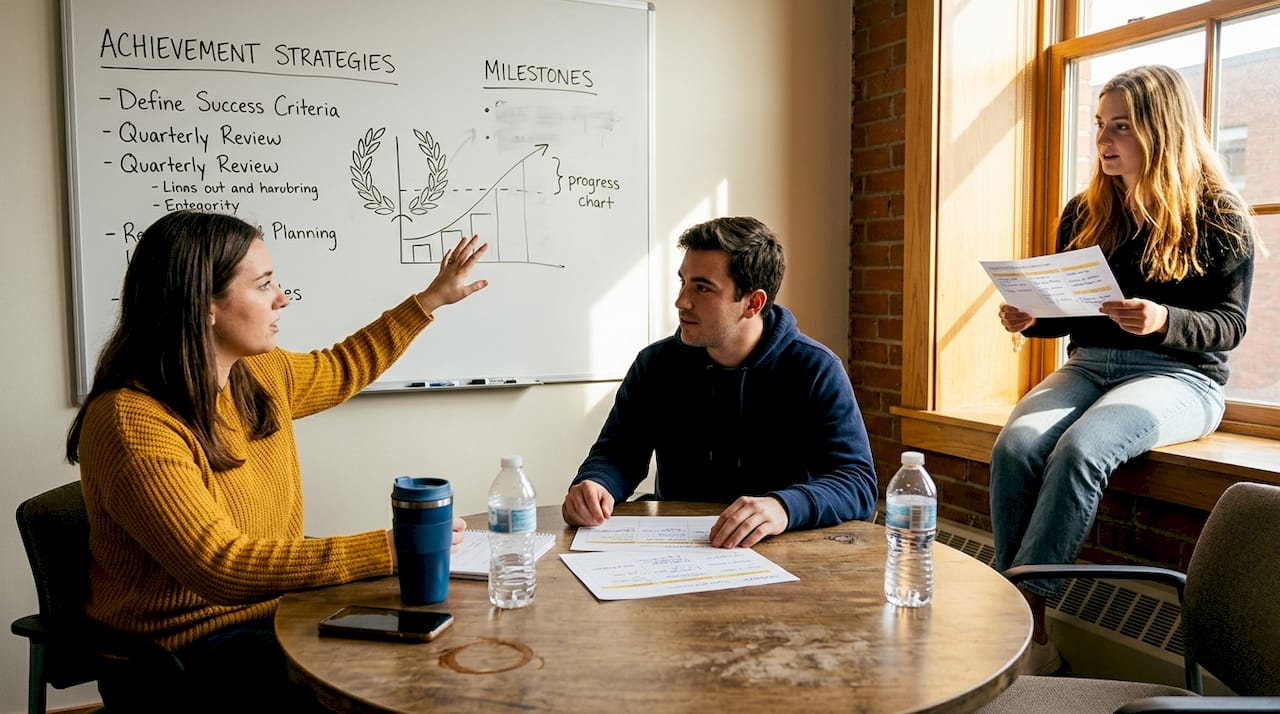
Next, clarify the team’s shared purpose. Ask: what does success look like at the end of this project? Write it down. Make it visible. A shared purpose statement doesn’t need to be fancy. “We want to deliver a market analysis that earns a distinction and impresses our professor” is a perfectly valid team purpose.
One of the most underused tools for student teams is the RACI matrix. RACI stands for Responsible, Accountable, Consulted, and Informed. It maps every task to a role so no one falls through the cracks and no one steps on each other’s toes.
| Role | Meaning | Example in a student project |
|---|---|---|
| Responsible | Does the work | Writes the research section |
| Accountable | Owns the outcome | Team lead who reviews final draft |
| Consulted | Provides input | Subject matter expert in the group |
| Informed | Kept in the loop | Teammates not directly involved |
Here are the tools and techniques that work best for building alignment early:
- Shared documents for goals and decisions (Google Docs, Notion)
- RACI matrices to clarify who does what
- SMART goal examples to make objectives concrete and measurable
- Kickoff meetings with a written agenda and documented outcomes
- A team charter that captures norms, communication preferences, and deadlines
Pro Tip: Over-communicate at the start. Send a follow-up message after every meeting summarizing what was decided and who owns what. It feels redundant at first, but it eliminates the “I thought you were doing that” conversations later.
A solid goal setting guide for students can help you formalize this foundation before your team gets too deep into the work.
Setting objectives: OKRs, SMART goals, and cascading strategies
With a strong foundation, you’re ready to craft objectives that actually align and get results.
Two frameworks dominate the conversation on team objectives: OKRs and SMART goals. Both are useful. Used together, they’re powerful.
OKR stands for Objectives and Key Results. An Objective is qualitative and ambitious, something that inspires. A Key Result is quantitative and measurable, something that proves you got there. According to the OKR implementation guide, the most effective teams set ambitious Objectives supported by three to five measurable Key Results, cascaded from the team level down to the individual level, with a 60 to 70 percent stretch target considered a success.
SMART goals are Specific, Measurable, Achievable, Relevant, and Time-bound. They work especially well for individual tasks and shorter timelines. The SMART goals in action approach pairs naturally with OKRs because SMART criteria help you write better Key Results.
Here’s how to cascade objectives from the team to the individual level:
- Define the team’s top Objective (e.g., “Deliver a client-ready marketing proposal by end of semester”)
- Write three to five Key Results that prove the Objective was met (e.g., “Complete competitor analysis by Week 4”)
- Break each Key Result into individual tasks assigned to specific people using RACI
- Apply SMART criteria to each individual task so expectations are crystal clear
- Review the cascade as a team to confirm every person’s work connects to the top Objective
Here’s a simple cascade example for a student consulting team:
| Level | Objective | Key result |
|---|---|---|
| Team | Win the case competition | Score in the top three of ten teams |
| Sub-team | Build a compelling financial model | Complete three-scenario model by Week 6 |
| Individual | Own the revenue projections | Deliver draft revenue model by Week 5 |
According to research on aligning objectives to strategy, cascading objectives hierarchically and linking individual goals explicitly to higher-level strategies creates a clear “line of sight” that keeps everyone motivated and on track. Explore entrepreneur goal setting strategies for additional frameworks that translate well into student project contexts.
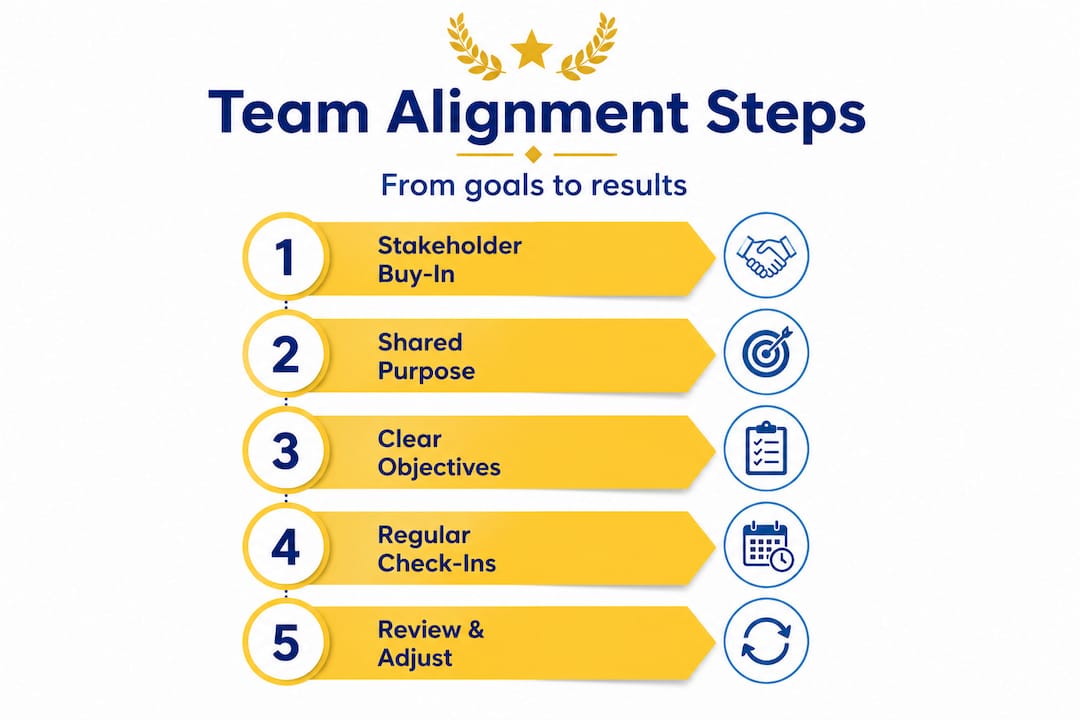
Pro Tip: Limit your team to three to five objectives maximum. More than that and you’re not prioritizing, you’re just listing. Clarity beats volume every time.
Use a student goal setting guide to help your team format and finalize your OKRs before the project begins.
Staying on track: Communication, check-ins, and troubleshooting
Even the best-laid plans can run into trouble. Here’s how to keep your team aligned as projects evolve.
Regular check-ins are the heartbeat of an aligned team. They don’t need to be long. A 15-minute weekly sync focused on three questions works well: What did we complete? What’s blocking us? Are we still on track toward our Objective? These short touchpoints catch drift early before it becomes a crisis.
Feedback loops matter just as much. Create a norm where teammates can flag confusion or disagreement without it feeling like an attack. The best teams treat misalignment as a systems problem, not a personal failure.
When goals become unclear mid-project, the instinct is often to wait for more information. Resist that. Research from HBR on unclear team paths shows that in situations where strategy or direction is uncertain, setting short-term goals and maintaining momentum is more effective than pausing. Small wins keep morale up and create the clarity that waiting never does.
Here are the most common alignment issues and their quick fixes:
- “I didn’t know that was my job” → Fix: Review the RACI matrix and reassign ownership explicitly
- “We’re behind but I don’t know why” → Fix: Break the remaining work into daily tasks with names attached
- “The goal changed but no one told me” → Fix: Add a 5-minute “goal check” to every meeting agenda
- “Two people are doing the same thing” → Fix: Audit task assignments weekly and eliminate duplication
- “We’re hitting our tasks but missing the point” → Fix: Revisit the top-level Objective and ask if current work still connects
“Short-term goals are not a sign of failure. They’re a navigation tool when the map is incomplete.”
Team accountability strategies work best when they’re built into the team’s routine rather than applied as a reaction to problems. Make check-ins a habit, not a fire drill.
Pro Tip: After any major team change, like a member leaving or a project scope shift, schedule an immediate alignment reset. Revisit your Objectives, reassign Key Results, and confirm everyone still understands their role. Skipping this step is where most teams lose momentum.
Use effective goal setting tips to help your team build these check-in habits from the start.
Measuring success and adjusting team objectives
Successful teams revisit and refine their objectives regularly. Here’s how to make it part of your workflow.
Measuring success isn’t just about checking whether you hit a number. It’s about understanding what the result means for the team’s growth and the project’s quality. Use both quantitative feedback (scores, completion rates, metrics) and qualitative feedback (peer reviews, professor comments, client impressions) to get a full picture.
Here’s a step-by-step review process that works for student and early-career teams:
- Schedule a formal review at each major milestone or monthly, whichever comes first
- Score each Key Result on a 0 to 1 scale (0 = not started, 0.7 = stretch goal hit, 1 = fully achieved)
- Discuss what drove the result, not just whether you hit it
- Identify what needs to change in process, communication, or task ownership
- Update or reset objectives if the project has shifted significantly
- Celebrate progress, even partial wins, to keep morale strong
According to the OKR implementation guide, a 60 to 70 percent achievement rate on stretch Key Results is actually the target. Hitting 100 percent consistently means your goals weren’t ambitious enough.
Signs your objectives have drifted from the team’s actual needs:
- Tasks are getting done but the project feels directionless
- Team members can’t explain how their work connects to the main goal
- Deadlines are being met but quality is slipping
- Conflict is increasing without a clear trigger
- The original Objective no longer reflects what the client or professor wants
Aligning your review process with individual growth makes it more meaningful. Ask each person: what did you learn? What would you do differently? This turns a project debrief into a career development moment.
Encourage honest, constructive conversations during reviews. Psychological safety, where people feel they can speak up without judgment, is what separates teams that improve from teams that just repeat the same mistakes. Track your team’s measuring team alignment progress over time to spot patterns and build on what works.
What most teams get wrong about alignment (and how to do better)
Here’s the uncomfortable truth about team alignment: most of the advice out there is designed for corporate hierarchies, not peer-driven student projects or early-career teams where everyone is roughly equal in authority.
Forced, top-down alignment almost always backfires in peer settings. When one person appoints themselves the goal-setter and hands down objectives without input, the rest of the team mentally checks out. They comply, but they don’t commit. The work gets done, but the ownership isn’t there. We’ve seen this pattern repeat constantly, and it’s not a personality problem. It’s a structural one.
Bottom-up input changes everything. When every team member contributes to shaping the objectives, even just by reviewing and approving them, the psychological ownership shifts. People defend goals they helped create. They push back on scope creep because the goal is theirs, not someone else’s assignment.
The other mistake is overcomplicating the system. Teams spend more time building elaborate tracking spreadsheets and color-coded charts than actually working toward the goal. A simple, repeatable rhythm beats a complex system every time. Clarity first. Feedback regularly. Review honestly. That three-step loop, done consistently, outperforms any fancy framework that gets abandoned after week two.
Psychological safety and clear roles are especially critical for early-career teams. Young professionals are still learning how to give and receive feedback professionally. Creating an environment where “I don’t understand the goal” is a safe thing to say prevents the silent confusion that derails projects. Pair that with explicit role clarity using tools like RACI, and you remove the two biggest sources of team friction at once.
The student goal setting lessons that stick are always the simple ones: know what you’re building, know your part in building it, and check in often enough to catch problems before they compound.
Unlock better results with the right tools and support
For teams ready to put these alignment strategies into practice, digital tools can make all the difference.
Optio is built exactly for this. As your second-in-command, Optio helps Centurions like you manage tasks, coordinate teams, and track time without the chaos of scattered messages and forgotten deadlines.
Explore the best task management software options available to students and young professionals, and see how the right platform can turn your OKR cascade into a living, trackable system. Whether you’re running a class project or coordinating a cross-functional team at your first job, Optio’s Roman-inspired command structure keeps everyone accountable and moving forward. Check out the full team collaboration guide to find the features that fit your team’s workflow and start aligning with confidence.
Frequently asked questions
What is the most effective method for aligning team objectives?
Adopting the OKR methodology is widely considered the most effective approach, as it pairs ambitious qualitative goals with three to five measurable Key Results that keep every team member focused and accountable.
How do you ensure individual goals support team objectives?
Cascade objectives from the team level down to the individual level and apply SMART criteria to each personal task, creating a direct line-of-sight link between individual contributions and the group’s overarching strategy.
What should a team do when the project goals are unclear?
Set short-term, actionable objectives to maintain momentum while seeking clarity on long-term direction, since short-term goals sustain progress better than waiting for a perfect plan.
How many objectives should a team set for best results?
Limit team objectives to three to five at a time, because too many goals dilute focus and reduce the clarity needed for effective execution.
How often should teams review and update their objectives?
Teams should review progress at each major milestone or at least monthly, adjusting Key Results as needed to stay aligned with the project’s evolving priorities.
Recommended
- How to Improve Teamwork for Success in College and Work – Optio Station: Best Project Management App for Prioritization
- How to Manage Team Tasks Effectively for Success – Optio Station: Best Project Management App for Prioritization
- 7 Goal Setting Strategies 2025 for Students and Professionals – Optio Station: Best Project Management App for Prioritization
- 7 Practical Work Goal Examples for Students and Professionals – Optio Station: Best Project Management App for Prioritization
- INUSUAL | Cómo crear equipos de alto desempeño para líderes innovadores
