

TL;DR:
- SMART goals provide a structured approach to achieving academic and professional objectives.
- Limiting to 3-5 SMART goals helps prevent burnout and maintain focus.
- Combining SMART with self-reflection and accountability enhances long-term success.
Most students and young professionals set goals the same way every semester or new job cycle: write down what they want, feel motivated for a week, then quietly abandon the plan. The problem is not a lack of ambition. It is a lack of structure. The SMART goals framework stands for Specific, Measurable, Achievable, Relevant, and Time-bound, giving your intentions a solid backbone instead of leaving them as hopeful wishes. This guide breaks down exactly how to use SMART goals to drive academic performance, land promotions, and build habits that actually stick, whether you are juggling finals week or your first 90 days at a new company.
Table of Contents
- What are SMART goals and why do they matter?
- How to set effective SMART goals: Step-by-step process
- Common pitfalls and how to avoid them
- Beyond execution: Comparing SMART to other goal frameworks
- What most guides miss about SMART goals
- Take your SMART goals from plan to real progress
- Frequently asked questions
Key Takeaways
| Point | Details |
|---|---|
| SMART goals add structure | Clear, Specific, Measurable objectives make goal setting more actionable and effective. |
| Balance and prioritize | Focus on 3-5 meaningful goals linked to your values for better performance and retention. |
| Avoid common pitfalls | Break goals into actionable steps, review progress routinely, and adjust as needed for success. |
| SMART fits execution | Use SMART goals for concrete achievements, but consider other frameworks for creativity and vision. |
| Motivation matters | Accountability, self-efficacy, and aligning goals to personal values drive lasting results. |
What are SMART goals and why do they matter?
Setting a goal like “do better in school” or “get promoted faster” feels productive in the moment. But without clear criteria, you have no way to measure progress, no finish line, and no real reason to stay consistent. That is where SMART goals change everything.
The SMART framework turns vague intentions into actionable plans by requiring every goal to meet five specific criteria:
- Specific: Your goal answers who, what, when, where, and why. Instead of “read more,” you say “read one chapter of my marketing textbook every weekday morning.”
- Measurable: You can track progress with numbers, percentages, or clearly observable outcomes. “Improve my GPA” becomes “raise my GPA from 2.9 to 3.3.”
- Achievable: The goal is realistic given your current resources and schedule. Ambitious is good. Impossible is discouraging.
- Relevant: The goal connects to something you actually care about, whether that is your major, your career path, or a personal value.
- Time-bound: There is a deadline. “By the end of this semester” or “within 90 days” gives you urgency without panic.
Here is a quick reference table to keep these criteria visible:
| SMART criteria | Key question | Example |
|---|---|---|
| Specific | What exactly will I do? | Study for my economics exam every Tuesday and Thursday |
| Measurable | How will I know I succeeded? | Score at least 85% on the midterm |
| Achievable | Is this realistic right now? | Yes, I have two hours free on those days |
| Relevant | Does this align with my goals? | Passing this course improves my GPA and pre-req standing |
| Time-bound | When will I complete this? | Before the midterm on March 14 |
The evidence for SMART goals is not just anecdotal. Empirical research shows that university students using SMART goal-setting achieved 73% goal attainment compared to 64% in control groups. In skills training studies, multiple SMART goals improved retention with a strong effect size (η²=0.33) and transfer (η²=0.42). One welfare-to-work program using SMART methods saw 80% goal achievement across participants.
“The difference between a dream and a goal is a deadline and a plan.” That is not motivational fluff. It is exactly what the SMART framework enforces.
You can explore SMART goal examples tailored for academic and professional contexts to see what strong SMART goals look like in practice before you start writing your own.
How to set effective SMART goals: Step-by-step process
Understanding the SMART framework is one thing. Actually sitting down and writing goals that meet every criterion is another. Here is a step-by-step method that works for both college coursework and early-career development.
-
Start with a broad goal. Write down what you want without filtering yourself. “I want better grades” or “I want a raise” is a perfectly fine starting point.
-
Apply the SMART filter one criterion at a time. Take your broad goal and ask: what specifically do I want to achieve? How will I measure it? Is it actually doable given my life right now? Why does it matter to me? When do I want to complete it?
-
Write the goal in one clear sentence. Avoid bullet points or vague language. A well-formed SMART goal should read like a commitment, not a wish.
-
Identify your action steps. Break the goal into weekly or daily tasks. A goal without smaller tasks is just a destination without a road.
-
Schedule check-ins. Block time once a week to review your progress. Adjust your action steps, not your goal, when things get hard.
-
Write it somewhere visible. A sticky note on your desk, a note on your phone’s home screen, or a pinned task in your project app. Out of sight really does mean out of mind.
For college students, SMART goals for academics work well for improving GPA, building better study habits, and preparing for internships. A strong example: “Boost my GPA from 2.8 to 3.2 by studying one hour daily and attending every office hours session this semester.” That goal is specific (one hour daily, office hours), measurable (GPA numbers), achievable (one hour is manageable), relevant (GPA affects your future), and time-bound (this semester).

For early-career professionals, SMART career goals work at the performance review level and beyond. A strong example: “Earn a promotion to Senior Manager by completing two industry certifications and leading at least three cross-functional projects within 12 months.” That goal gives you something concrete to report at every quarterly review.
Finding goal setting tips that fit your specific situation makes the process much smoother, especially when you are balancing multiple commitments at once. A solid goal setting guide can also help you build a system around your goals rather than treating each one as an isolated task.
Pro Tip: Limit yourself to three to five SMART goals at any given time. More than that and your attention is spread too thin. Pick the goals that align most closely with your current values and priorities, and give those your full effort before adding more.
Common pitfalls and how to avoid them
Even well-written SMART goals fail. Usually it is not because the goal was poorly structured. It is because of habits and mindsets that work against consistent progress. Knowing where people commonly go wrong puts you ahead of most.
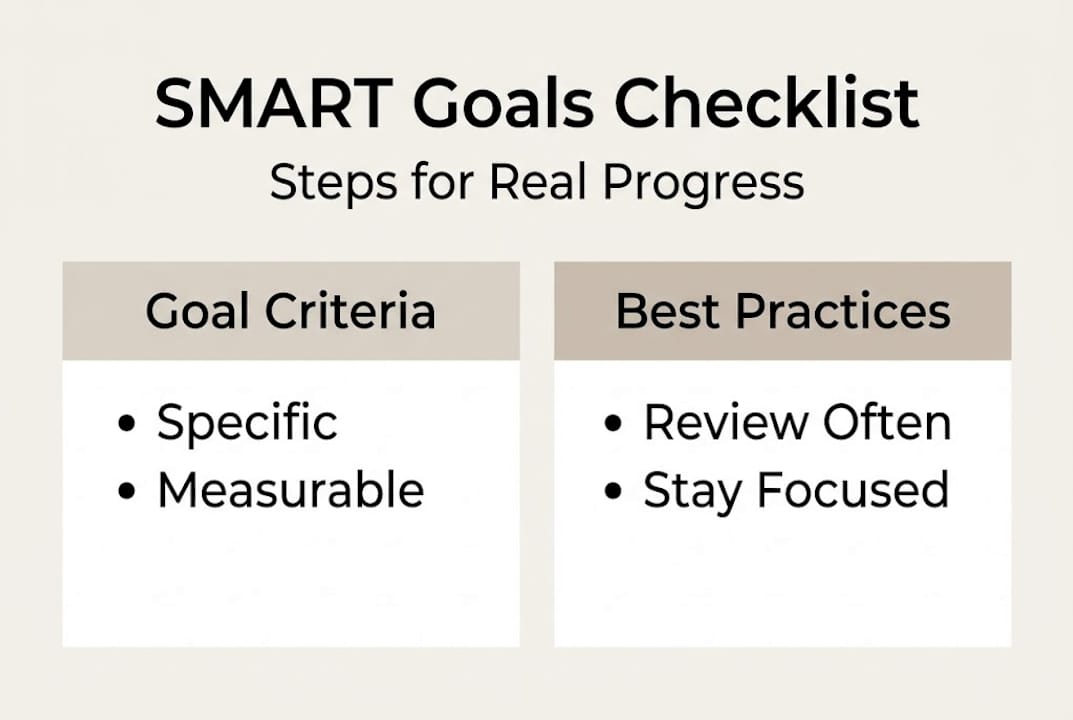
Here are the most common SMART goal mistakes students and early-career professionals make:
- Setting too many goals at once. Limiting yourself to 3 to 5 goals prevents the kind of burnout that comes from trying to improve everything simultaneously.
- Making goals too vague or too extreme. A goal that reads like a fantasy (“become the top student in the department this semester starting from a 2.5 GPA”) sets you up for discouragement, not growth.
- Writing a goal with no action plan. A SMART goal tells you what you want. Your action plan tells you how to get there. Skipping the action plan means you are hoping, not planning.
- Never reviewing your progress. Life changes. Schedules shift. A goal that made perfect sense in January may need adjustment by March. Ignoring this leads to abandonment.
- Going it alone. Research on motivation and accountability shows that weekly check-ins with an accountability partner and small imperfect progress beat perfectionism every time.
“Perfect is the enemy of done. Small, consistent progress beats an ambitious plan that never moves forward.”
One of the most underrated moves you can make is building a goal-oriented mindset around your SMART goals. This means treating setbacks as data, not failure. When you miss a week of studying, you ask why, adjust your plan, and continue. You do not restart from scratch or abandon the goal entirely.
There is also real value in working with multiple goal types at the same time. Process goals (I will study for one hour daily) support performance goals (I will score above 85% on my midterm) which connect to outcome goals (I will finish this semester with a 3.3 GPA). SMART works best at the process and performance level because those are the areas where structure creates the most traction. Exploring time management examples that use SMART criteria can help you see how this layering works in real life.
Pro Tip: Schedule a 15-minute weekly review every Sunday. Review what you accomplished, what got in the way, and what one adjustment will make the coming week more effective. Treat it like a meeting you cannot cancel.
Also check out goal-setting tips that address the mental side of staying on track, especially during high-pressure periods like finals or performance review season.
Beyond execution: Comparing SMART to other goal frameworks
SMART is powerful, but it is not the only tool in the toolbox. In fact, some researchers argue that SMART goals can actually limit creativity, stifle ambition, and miss the motivational spark that drives long-term achievement. For students and professionals who want to think bigger or work in more creative fields, understanding alternative frameworks is genuinely useful.
Here is a comparison of the most widely used goal frameworks:
| Framework | Best for | Strength | Weakness |
|---|---|---|---|
| SMART | Execution and concrete tasks | Clear, structured, measurable | Can feel rigid; may limit big thinking |
| OKR (Objectives and Key Results) | Team and organizational alignment | Ambitious objectives with trackable results | Can feel abstract without strong execution habits |
| HARD (Heartfelt, Animated, Required, Difficult) | Personal motivation and stretch goals | Pushes beyond comfort zones | Hard to measure; risk of burnout |
| BHAG (Big Hairy Audacious Goal) | Long-term vision and inspiration | Inspires bold thinking and identity-level change | No built-in structure for day-to-day action |
The key takeaway is that SMART and these other frameworks are not necessarily competitors. They can work together. You might use a BHAG to define your five-year vision (“become a product director at a tech company”) and then use SMART goals to drive your actions this semester (“complete a product management certification by June 30”).
Here is where each framework shines for your specific situation:
- Use SMART when you need clarity, consistency, and trackable outcomes. It is ideal for academic goals, performance reviews, and skill development.
- Use OKRs when you are working with a team or managing a project and need everyone moving toward the same outcome.
- Use HARD goals when you feel like SMART goals are not pushing you hard enough or lack emotional resonance.
- Use BHAG when you are doing long-term career planning and need a north star to orient your decisions.
For professionals who want to apply these frameworks at work, workplace SMART goals offer practical guidance on adapting the framework for job performance and team projects. Combining structured SMART goals with forward-thinking approaches gives you both the clarity of a plan and the inspiration to pursue something meaningful.
What most guides miss about SMART goals
Here is something most goal-setting articles will not tell you: the framework is the easy part. Writing a SMART goal takes maybe ten minutes. The hard part is what happens in weeks three and four, when the novelty has worn off, your schedule has gotten complicated, and the goal that felt urgent in January feels negotiable in February.
Research in psychology confirms what most students and professionals figure out the hard way: structured goal-setting like SMART works best when combined with psychological factors like self-efficacy (your belief that you can actually do it) and intrinsic motivation (doing it because it matters to you, not just because someone told you to).
That is the piece most guides skip. They hand you a template and wish you luck. But if your SMART goal does not connect to something you genuinely value, the structure will not save you. A student who writes “study economics for one hour daily” because they think they should, rather than because they want to pass and move into a field they care about, will stop after two weeks. Every time.
At Optio, we see this pattern constantly with the Centurions using our platform. The students and young professionals who make real progress are not necessarily the ones with the most detailed goals. They are the ones who know why the goal matters to them and who have a system for staying accountable when motivation dips. Pair the SMART framework with honest self-reflection and consistent check-ins, and you have something genuinely powerful. Build career goal achievement habits now, while the stakes are lower, and you will carry those skills into every stage of your professional life.
Take your SMART goals from plan to real progress
Writing a solid SMART goal is the first win. The second win is building the system that keeps you on track when life gets busy.

Optio is built for exactly that moment. As your second-in-command, Optio helps you organize tasks, manage your time, and track goal progress in one place, so nothing falls through the cracks. Whether you are a student managing coursework and internships or a young professional juggling projects and career development, Optio gives you the structure to follow through. Start with our task management guide to set up your system, use our task management tips to stay consistent, and apply time management SMART goals directly to your schedule. Your goals deserve more than a sticky note.
Frequently asked questions
What are SMART goals in simple terms?
SMART goals are clear, specific objectives that include a way to measure success, a realistic scope, a connection to your priorities, and a deadline, as defined by the SMART framework.
How many SMART goals should I set at once as a student or professional?
Limit yourself to 3 to 5 SMART goals at a time. Research shows that setting too many goals at once leads to burnout and significantly lower achievement rates.
Can SMART goals help with career advancement?
Absolutely. Early-career professionals who use SMART goals can map out promotions and skill development with clear steps, timelines, and measurable milestones that they can report at reviews.
What’s the main reason people fail to achieve SMART goals?
Most often, failure comes from setting too many vague goals, skipping the action plan, or never reviewing progress when life gets in the way.
Is SMART the best goal-setting method for creative or long-term projects?
SMART excels at structured execution, but frameworks like OKR or BHAG may be better for creativity and long-term vision. Many high-performers use a combination of both.
Recommended
- SMART goals for work: practical tips to boost productivity – Optio Station: Best Project Management App for Prioritization
- 7 Goal Setting Strategies 2025 for Students and Professionals – Optio Station: Best Project Management App for Prioritization
- 7 Key Goal Setting Techniques for Centurions – Optio Station: Best Project Management App for Prioritization
- Examples of SMART goals to boost academic success – Optio Station: Best Project Management App for Prioritization
